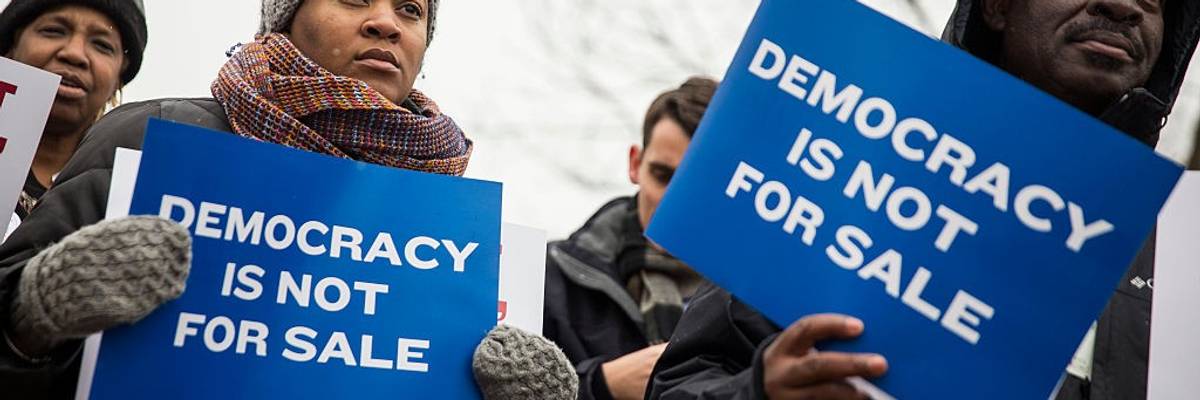
Attendees hold signs as they listen to speakers during a rally calling for an end to corporate money in politics and to mark the fifth anniversary of the Supreme Court's Citizens United decision, at Lafayette Square near the White House, January 21, 2015 in Washington, D.C.
The 2024 Election Was Smothered in Dark Money—How Do We Turn on the Lights?
A new Brennan Center study found that dark money groups spent almost $2 billion on the 2024 election, roughly double the total spent in 2020.
Every day brings a new story about the outsized role of private wealth in American politics. Elon Musk slashing and burning his way through federal agencies. Billionaire campaign donors like Howard Lutnick and Linda McMahon running cabinet departments. Other Trump patrons reportedly shaping policy on everything from crypto to the Middle East. Meanwhile, on the Democratic side, a small group of major donors is organizing to fund the party’s 2026 push to retake Congress.
And these are only the donors we know about.
The Supreme Court’s 2010 Citizens United decision ushered in the era of “dark money”—ballooning campaign spending by groups that do not disclose their funding sources. On Wednesday, the Brennan Center published a study by the journalist Anna Massoglia. She found that dark money groups spent almost $2 billion on the 2024 election, roughly double the total spent in 2020. And that’s the money Massoglia could identify—the real total is almost certainly higher, perhaps substantially so.
Voters are deeply unhappy about the role of money in politics, but years of inaction to address this issue have also left them understandably cynical.
The term “dark money” as we use it refers to election spending by groups that are not legally required to—and do not—disclose their donors. Most of this spending would have been illegal before Citizens United, which eviscerated many long-standing limits on campaign money and led to the creation of super PACs, political organizations that can raise and spend unlimited money on campaigns.
The justices got many things wrong in Citizens United. One of them was their assurance that all the new campaign spending they had just allowed would be transparent, allowing Americans to be fully informed about who was trying to influence their votes.
The justices seem not to have realized, however, that many of the new groups they were now permitting to spend unlimited amounts on campaigns were not subject to any disclosure rules. There have since been numerous efforts to fix this oversight and require all major campaign donors to be made public—most recently as part of the Freedom to Vote Act, which came within two votes of overcoming a Senate filibuster in 2022—but none of those bills have made it through Congress.
Meanwhile, dark money in federal elections has continued to rise—and become even harder to trace. In the years immediately after Citizens United, groups that didn’t reveal their donors tended to purchase their own campaign ads, which were at least reported to the Federal Election Commission if they ran in the weeks before the election and were therefore fairly easy to track. Even if the source of the money was opaque, we could see the spending itself.
Now, as our new analysis shows, reported campaign ads account for just a tiny fraction of dark money spending. Most of it now goes directly into the coffers of super PACs, and some of it pays for online ads and early-cycle TV and radio ads not subject to any legally required disclosure. We are able to track down some of that money due to voluntary disclosures and research using services that monitor TV advertising, but our overall tally of dark money spent in 2024 is an undercount, possibly by a large margin.
Both Republicans and Democrats benefited from significant dark money support in 2024, but the majority of traceable dark money backed Democrats. Most of those funds went toward enormous spending in the presidential race—$1 out of every $6 in dark money that we can track was funneled to Future Forward, the super PAC backing Joe Biden and then Kamala Harris. Trump’s dark money support that we know about was not as high, although it still amounted to hundreds of millions of dollars (including more than $35 million that paid for apparent “false flag” ads in swing states designed to look like they came from Harris).
Ultimately, neither party will have any incentive to curb reliance on secret spending absent a change in the law. To congressional Democrats’ credit, they included a fix in the Freedom to Vote Act. It was among the most popular provisions in the bill, enjoying broad public support among voters from both parties.
Voters are deeply unhappy about the role of money in politics, but years of inaction to address this issue have also left them understandably cynical. Regaining Americans’ trust must include concrete steps to make it easier for them to hold political leaders accountable. Providing the transparency that even Citizens United promised 15 years ago would be a good place to start.
We are at a crossroads
This country and this world are at a monumental crossroads. In a few short weeks, US voters will have an opportunity to beat back the forces of fascism and confront the billionaires who are rigging the economy, our media system, and our democracy, making it increasingly impossible for ordinary people to get by. We’re not just talking about the election. We’re talking about what must be done once these fascist elements are vanquished from power. We need a bolder set of solutions than what either major party has so far been willing to offer and a working-class movement ready to fight like hell for it. Trump didn't emerge from nowhere. The conditions that fueled MAGA authoritarianism were created by decades of radical neoliberal economic policies and a corrupt political system dominated by corporate interests. They slashed taxes on the super-rich, promising that the benefits would trickle down. They said giveaways to the corporate titans would make life more affordable for the rest of us. It was all bullshit. And when a bitter, betrayed populace searches for someone to blame, right-wing demagogues have little trouble finding scapegoats. People know when they're being lied to, but you won't hear any of this from the corporate media. Only independent journalism—powered and funded by people who believe in building a better world—can deliver truly trustworthy daily news. Our Fall Campaign is underway, and we need your help. To power our newsroom through the rest of the year, we need to raise $125,000 by midnight on October 31. So if you share our vision, please contribute whatever you can to sustain our work. |
Every day brings a new story about the outsized role of private wealth in American politics. Elon Musk slashing and burning his way through federal agencies. Billionaire campaign donors like Howard Lutnick and Linda McMahon running cabinet departments. Other Trump patrons reportedly shaping policy on everything from crypto to the Middle East. Meanwhile, on the Democratic side, a small group of major donors is organizing to fund the party’s 2026 push to retake Congress.
And these are only the donors we know about.
The Supreme Court’s 2010 Citizens United decision ushered in the era of “dark money”—ballooning campaign spending by groups that do not disclose their funding sources. On Wednesday, the Brennan Center published a study by the journalist Anna Massoglia. She found that dark money groups spent almost $2 billion on the 2024 election, roughly double the total spent in 2020. And that’s the money Massoglia could identify—the real total is almost certainly higher, perhaps substantially so.
Voters are deeply unhappy about the role of money in politics, but years of inaction to address this issue have also left them understandably cynical.
The term “dark money” as we use it refers to election spending by groups that are not legally required to—and do not—disclose their donors. Most of this spending would have been illegal before Citizens United, which eviscerated many long-standing limits on campaign money and led to the creation of super PACs, political organizations that can raise and spend unlimited money on campaigns.
The justices got many things wrong in Citizens United. One of them was their assurance that all the new campaign spending they had just allowed would be transparent, allowing Americans to be fully informed about who was trying to influence their votes.
The justices seem not to have realized, however, that many of the new groups they were now permitting to spend unlimited amounts on campaigns were not subject to any disclosure rules. There have since been numerous efforts to fix this oversight and require all major campaign donors to be made public—most recently as part of the Freedom to Vote Act, which came within two votes of overcoming a Senate filibuster in 2022—but none of those bills have made it through Congress.
Meanwhile, dark money in federal elections has continued to rise—and become even harder to trace. In the years immediately after Citizens United, groups that didn’t reveal their donors tended to purchase their own campaign ads, which were at least reported to the Federal Election Commission if they ran in the weeks before the election and were therefore fairly easy to track. Even if the source of the money was opaque, we could see the spending itself.
Now, as our new analysis shows, reported campaign ads account for just a tiny fraction of dark money spending. Most of it now goes directly into the coffers of super PACs, and some of it pays for online ads and early-cycle TV and radio ads not subject to any legally required disclosure. We are able to track down some of that money due to voluntary disclosures and research using services that monitor TV advertising, but our overall tally of dark money spent in 2024 is an undercount, possibly by a large margin.
Both Republicans and Democrats benefited from significant dark money support in 2024, but the majority of traceable dark money backed Democrats. Most of those funds went toward enormous spending in the presidential race—$1 out of every $6 in dark money that we can track was funneled to Future Forward, the super PAC backing Joe Biden and then Kamala Harris. Trump’s dark money support that we know about was not as high, although it still amounted to hundreds of millions of dollars (including more than $35 million that paid for apparent “false flag” ads in swing states designed to look like they came from Harris).
Ultimately, neither party will have any incentive to curb reliance on secret spending absent a change in the law. To congressional Democrats’ credit, they included a fix in the Freedom to Vote Act. It was among the most popular provisions in the bill, enjoying broad public support among voters from both parties.
Voters are deeply unhappy about the role of money in politics, but years of inaction to address this issue have also left them understandably cynical. Regaining Americans’ trust must include concrete steps to make it easier for them to hold political leaders accountable. Providing the transparency that even Citizens United promised 15 years ago would be a good place to start.
- Once Again, DNC Panel Blocks Vote on Dark Money Ban in Democratic Primaries ›
- Pro-Trump Dark Money Group Aims Lies at Arab and Jewish American Voters ›
- New Bill Would Prevent Billionaires From Donating to Dark Money Groups Tax-Free ›
- 'Turning Into the Super PAC Election': Outside Spending Tops $1 Billion for 2024 ›
- Analysis Shows 'Unprecedented Surge' of Dark Money Ahead of 2024 Elections ›
- In Tiny State of Maine, a Big Election Day Win Against Dark Money in Politics ›
- 72% of Americans Agree: There Is Too Much Money in US Politics | Common Dreams ›