5
#000000
#FFFFFF
To donate by check, phone, or other method, see our More Ways to Give page.
Daily news & progressive opinion—funded by the people, not the corporations—delivered straight to your inbox.
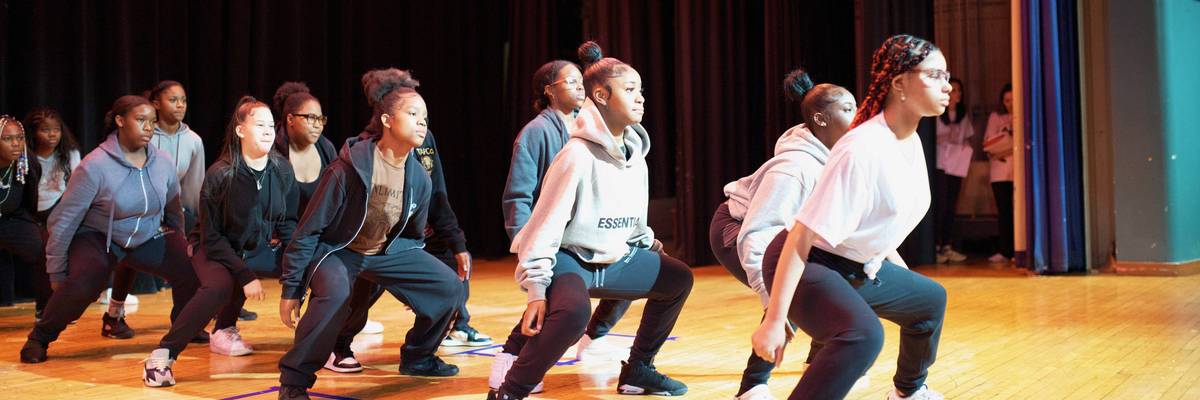
Students performing in an Accent Dance NYC school education program in New York City.
Some argue that acknowledging difference divides us; I have spent seven years seeing it do quite the opposite.
A group of female high school students from immigrant families at an East Harlem high school spent eight weeks learning about each other through dance. Each one brought something from her own family's history, her own culture, her own story of how she ended up in that school. What happened in those eight weeks, the connections they made, and the way they saw each other afterward, is the kind of thing that takes most people a lifetime to figure out.
One student had spent years quietly sidestepping the question of where her family was from. You wouldn't know it anyway, she would think, and change the subject. Her family was from Burkina Faso, in West Africa, and she had never shared that part of herself publicly before. Over the course of the program, she learned a West African dance. Then she stood in front of an auditorium full of her peers and performed it. Afterward, she said she had finally been able to show people where she was from and "the music that really makes us happy." When she first heard about the program, she was skeptical enough to consider skipping it altogether. By the time it was over, she said she would go back "a hundred times."
I have been thinking about these young women a lot lately.
Programs like ours should be replicated and expanded, here and nationally, because they work. The problem is they reach too few students.
We are in a moment when programs designed to help young people understand each other across lines of culture, race, and background are being systematically dismantled. Legislation in dozens of states has sought to ban diversity training and culturally responsive curricula from public schools. Federal rollbacks have targeted initiatives designed to diversify the teaching workforce. Some states are eliminating restorative justice practices, which experts warn will push suspension rates up for minority students.
The argument, if it is offered at all, is that acknowledging difference divides us. I have spent seven years seeing it do quite the opposite.
Proven ways to build cross-cultural understanding in schools exist, and we should expand them, not dismantle them. Those young women in East Harlem are one example of what that looks like. For the past seven years, I have been bringing professional teaching artists into elementary, middle, and high school classrooms across New York City, working with students over several weeks to create and perform dances rooted in their own cultural backgrounds. The program has reached more than 45,000 students and audience members across the five boroughs. When I started it, after 30 years practicing family law, I was not thinking about cross-cultural programming. I was thinking about bringing something I loved to kids who might not have had the same access to it that I had.
What I found, in school after school, surprised me. Asking young people to learn from each other, to dance to music they hadn't heard, to tell someone else's story through movement and expression, built the kind of understanding that no lecture or mandatory training has reliably produced.
One student, who had walked in convinced that people from different backgrounds were simply not meant to mix, said by the end that she realized her classmates' families had crossed the same borders and carried the same fears. "We're way more connected than I thought," she said.
Another learned a classmate's dance rooted in a story of arranged marriage and flight across a border. She talked to that classmate about her family, about what had happened and how it had shaped her. "Now she's one of my closest friends," she said.
A third described watching a friend perform and said that even though nothing was spoken, a student in the audience cried. "She just felt what we were trying to show."
According to the 2025 Arts in Schools Report, dance reaches fewer students in New York City public schools than any other art form. NYC has made real strides in arts education, and that deserves acknowledgment. But the "dance gap" is a signal worth taking seriously, and it points to something larger: The tools that build human connection are being underused at exactly the moment we need them most.
Programs like ours should be replicated and expanded, here and nationally, because they work. The problem is they reach too few students.
Another young woman in the East Harlem program said she wanted the audience to leave with a sense of unity. "We should all love each other, try to understand each other, learn more about each other," she said, "so that we can become a beautiful nation and beautiful humans."
I couldn't agree more.
This country and this world are at a monumental crossroads. US voters have an opportunity to beat back the forces of fascism and confront the billionaires who are rigging the economy, our media system, and our democracy, making it increasingly impossible for ordinary people to get by. We’re not just talking about the election. We’re talking about what must be done once these fascist elements are vanquished from power. We need a bolder set of solutions than what either major party has so far been willing to offer and a working-class movement ready to fight like hell for it. Trump didn't emerge from nowhere. The conditions that fueled MAGA authoritarianism were created by decades of radical neoliberal economic policies and a corrupt political system dominated by corporate interests. They slashed taxes on the super-rich, promising that the benefits would trickle down. They said giveaways to the corporate titans would make life more affordable for the rest of us. It was all bullshit. And when a bitter, betrayed populace searches for someone to blame, right-wing demagogues have little trouble finding scapegoats. People know when they're being lied to, but you won't hear any of this from the corporate media. Only independent journalism—powered and funded by people who believe in building a better world—can deliver truly trustworthy daily news. If you share our vision, please contribute whatever you can to sustain our work. |
A group of female high school students from immigrant families at an East Harlem high school spent eight weeks learning about each other through dance. Each one brought something from her own family's history, her own culture, her own story of how she ended up in that school. What happened in those eight weeks, the connections they made, and the way they saw each other afterward, is the kind of thing that takes most people a lifetime to figure out.
One student had spent years quietly sidestepping the question of where her family was from. You wouldn't know it anyway, she would think, and change the subject. Her family was from Burkina Faso, in West Africa, and she had never shared that part of herself publicly before. Over the course of the program, she learned a West African dance. Then she stood in front of an auditorium full of her peers and performed it. Afterward, she said she had finally been able to show people where she was from and "the music that really makes us happy." When she first heard about the program, she was skeptical enough to consider skipping it altogether. By the time it was over, she said she would go back "a hundred times."
I have been thinking about these young women a lot lately.
Programs like ours should be replicated and expanded, here and nationally, because they work. The problem is they reach too few students.
We are in a moment when programs designed to help young people understand each other across lines of culture, race, and background are being systematically dismantled. Legislation in dozens of states has sought to ban diversity training and culturally responsive curricula from public schools. Federal rollbacks have targeted initiatives designed to diversify the teaching workforce. Some states are eliminating restorative justice practices, which experts warn will push suspension rates up for minority students.
The argument, if it is offered at all, is that acknowledging difference divides us. I have spent seven years seeing it do quite the opposite.
Proven ways to build cross-cultural understanding in schools exist, and we should expand them, not dismantle them. Those young women in East Harlem are one example of what that looks like. For the past seven years, I have been bringing professional teaching artists into elementary, middle, and high school classrooms across New York City, working with students over several weeks to create and perform dances rooted in their own cultural backgrounds. The program has reached more than 45,000 students and audience members across the five boroughs. When I started it, after 30 years practicing family law, I was not thinking about cross-cultural programming. I was thinking about bringing something I loved to kids who might not have had the same access to it that I had.
What I found, in school after school, surprised me. Asking young people to learn from each other, to dance to music they hadn't heard, to tell someone else's story through movement and expression, built the kind of understanding that no lecture or mandatory training has reliably produced.
One student, who had walked in convinced that people from different backgrounds were simply not meant to mix, said by the end that she realized her classmates' families had crossed the same borders and carried the same fears. "We're way more connected than I thought," she said.
Another learned a classmate's dance rooted in a story of arranged marriage and flight across a border. She talked to that classmate about her family, about what had happened and how it had shaped her. "Now she's one of my closest friends," she said.
A third described watching a friend perform and said that even though nothing was spoken, a student in the audience cried. "She just felt what we were trying to show."
According to the 2025 Arts in Schools Report, dance reaches fewer students in New York City public schools than any other art form. NYC has made real strides in arts education, and that deserves acknowledgment. But the "dance gap" is a signal worth taking seriously, and it points to something larger: The tools that build human connection are being underused at exactly the moment we need them most.
Programs like ours should be replicated and expanded, here and nationally, because they work. The problem is they reach too few students.
Another young woman in the East Harlem program said she wanted the audience to leave with a sense of unity. "We should all love each other, try to understand each other, learn more about each other," she said, "so that we can become a beautiful nation and beautiful humans."
I couldn't agree more.