5
#000000
#FFFFFF
To donate by check, phone, or other method, see our More Ways to Give page.
Daily news & progressive opinion—funded by the people, not the corporations—delivered straight to your inbox.
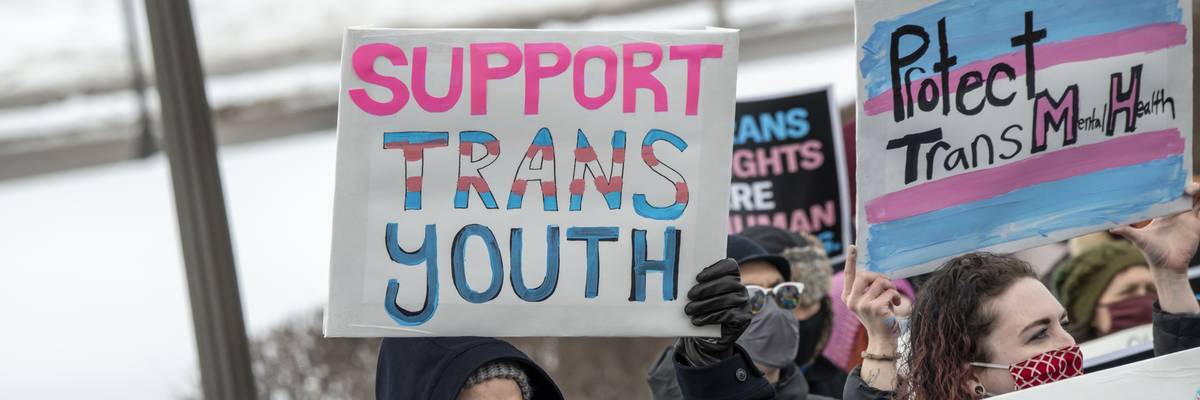
Because the attacks against transgender kids are increasing across the country, Minneasotans hold a rally at the capitol to support trans kids in Minnesota, Texas, and around the country in St. Paul, Minnesota on March 6, 2022.
When we allow our government to dismantle the fundamental rights of transgender people, we validate a legal precedent that threatens the liberties of every single citizen tomorrow.
In 1993, Minnesota became the first state in the country to protect people from discrimination based on sexual orientation and gender identity in its Human Rights Act, with explicit trans-inclusive language built into the law from the start. In 2014, the Minnesota State High School League clarified that student athletes can participate on teams that align with their gender identity. And just last year, the Minnesota Supreme Court unanimously ruled in Cooper v. USA Powerlifting that it’s illegal discrimination for sports organizations to ban trans women from participating.
Throughout these 30-plus years of trans inclusion, girls' and women's sports in Minnesota have thrived—the state ranks No. 1 in the nation on Action Network's Girls' Sports Opportunity Index, which measures participation, access, and gender parity across all 50 states. Minnesota is also home to the winningest coach in Women's National Basketball Association history.
As a cisgender woman, I believe it's past time for more women like me to stand in loud, public solidarity with trans people, rather than let this manufactured fight be waged in our name. The people most invested in “protecting” women's sports have rarely shown up for women's sports at all. And as the executive director of Gender Justice, a nonprofit advocacy organization based in the Upper Midwest, I’d love to know where all the urgency around fairness in women’s sports has been.
This is a familiar political playbook: Choose a wedge issue that polls well, use it to normalize the once-radical idea that civil rights law is negotiable, then expand from there.
I've spent years talking with women athletes across Minnesota. They talk about the sexual harassment. The state of their locker rooms. Subpar training facilities. Uneven access to fields and courts. Unequal pay and unequal media coverage. They talk about the coaches and administrators who still don't take their teams seriously. What they don’t talk about is the urgent need for the government to ban trans women from participating in sports.
So why does the noise persist? Republicans and their allies spent nearly $215 million on network television ads vilifying transgender people during the last presidential election cycle alone—more money than has ever been spent championing the women and girls they claim to want to protect.
Because sports was never the destination—they were the entry point. This is a familiar political playbook: Choose a wedge issue that polls well, use it to normalize the once-radical idea that civil rights law is negotiable, then expand from there. Across the country, courts are being asked whether Title IX protections extend to transgender students. The very law, passed in 1972, that guarantees equal access to education and athletics, protection from harassment, and freedom from discrimination based on sex, is being weaponized as a tool for exclusion. Executive orders now redefining "sex" across federal law and agencies don't stop at locker rooms either; they reach into schools, healthcare, and workplaces—into the fabric of American life. Title IX has never required schools to exclude trans students. It has long protected them.
What we are witnessing is not about fairness in athletics. It's political theater, and transgender youth are the ones paying the price—subjected to fear, harassment, and public scrutiny that lawmakers should be ashamed to have invited. What's happening now isn't a return to what the law always meant—it's a rewrite, carving an exception into a civil rights statute so that protections can be revoked for whichever group is politically convenient to sacrifice.
Attacks on trans rights, attacks on abortion rights, and persistent pay inequity are not separate fights; they are one fight against gender inequality, taking on different forms depending on the news cycle. Minnesota already answered the question of whether trans girls and women should have the right to play, with 30 years of evidence and a unanimous state supreme court ruling showcasing that trans inclusion works. The question still on the table is much more dangerous: Do we accept a government empowered to decide who gets rights, and who doesn't? When we allow our government to dismantle the fundamental rights of transgender people, we validate a legal precedent that threatens the liberties of every single citizen tomorrow.
If trans inclusion were the threat opponents claim, then three decades of it in Minnesota would have proven it. Instead, it's proven the opposite.
Dear Common Dreams reader, It’s been nearly 30 years since I co-founded Common Dreams with my late wife, Lina Newhouser. We had the radical notion that journalism should serve the public good, not corporate profits. It was clear to us from the outset what it would take to build such a project. No paid advertisements. No corporate sponsors. No millionaire publisher telling us what to think or do. Many people said we wouldn't last a year, but we proved those doubters wrong. Together with a tremendous team of journalists and dedicated staff, we built an independent media outlet free from the constraints of profits and corporate control. Our mission has always been simple: To inform. To inspire. To ignite change for the common good. Building Common Dreams was not easy. Our survival was never guaranteed. When you take on the most powerful forces—Wall Street greed, fossil fuel industry destruction, Big Tech lobbyists, and uber-rich oligarchs who have spent billions upon billions rigging the economy and democracy in their favor—the only bulwark you have is supporters who believe in your work. But here’s the urgent message from me today. It's never been this bad out there. And it's never been this hard to keep us going. At the very moment Common Dreams is most needed, the threats we face are intensifying. We need your support now more than ever. We don't accept corporate advertising and never will. We don't have a paywall because we don't think people should be blocked from critical news based on their ability to pay. Everything we do is funded by the donations of readers like you. When everyone does the little they can afford, we are strong. But if that support retreats or dries up, so do we. Will you donate now to make sure Common Dreams not only survives but thrives? —Craig Brown, Co-founder |
In 1993, Minnesota became the first state in the country to protect people from discrimination based on sexual orientation and gender identity in its Human Rights Act, with explicit trans-inclusive language built into the law from the start. In 2014, the Minnesota State High School League clarified that student athletes can participate on teams that align with their gender identity. And just last year, the Minnesota Supreme Court unanimously ruled in Cooper v. USA Powerlifting that it’s illegal discrimination for sports organizations to ban trans women from participating.
Throughout these 30-plus years of trans inclusion, girls' and women's sports in Minnesota have thrived—the state ranks No. 1 in the nation on Action Network's Girls' Sports Opportunity Index, which measures participation, access, and gender parity across all 50 states. Minnesota is also home to the winningest coach in Women's National Basketball Association history.
As a cisgender woman, I believe it's past time for more women like me to stand in loud, public solidarity with trans people, rather than let this manufactured fight be waged in our name. The people most invested in “protecting” women's sports have rarely shown up for women's sports at all. And as the executive director of Gender Justice, a nonprofit advocacy organization based in the Upper Midwest, I’d love to know where all the urgency around fairness in women’s sports has been.
This is a familiar political playbook: Choose a wedge issue that polls well, use it to normalize the once-radical idea that civil rights law is negotiable, then expand from there.
I've spent years talking with women athletes across Minnesota. They talk about the sexual harassment. The state of their locker rooms. Subpar training facilities. Uneven access to fields and courts. Unequal pay and unequal media coverage. They talk about the coaches and administrators who still don't take their teams seriously. What they don’t talk about is the urgent need for the government to ban trans women from participating in sports.
So why does the noise persist? Republicans and their allies spent nearly $215 million on network television ads vilifying transgender people during the last presidential election cycle alone—more money than has ever been spent championing the women and girls they claim to want to protect.
Because sports was never the destination—they were the entry point. This is a familiar political playbook: Choose a wedge issue that polls well, use it to normalize the once-radical idea that civil rights law is negotiable, then expand from there. Across the country, courts are being asked whether Title IX protections extend to transgender students. The very law, passed in 1972, that guarantees equal access to education and athletics, protection from harassment, and freedom from discrimination based on sex, is being weaponized as a tool for exclusion. Executive orders now redefining "sex" across federal law and agencies don't stop at locker rooms either; they reach into schools, healthcare, and workplaces—into the fabric of American life. Title IX has never required schools to exclude trans students. It has long protected them.
What we are witnessing is not about fairness in athletics. It's political theater, and transgender youth are the ones paying the price—subjected to fear, harassment, and public scrutiny that lawmakers should be ashamed to have invited. What's happening now isn't a return to what the law always meant—it's a rewrite, carving an exception into a civil rights statute so that protections can be revoked for whichever group is politically convenient to sacrifice.
Attacks on trans rights, attacks on abortion rights, and persistent pay inequity are not separate fights; they are one fight against gender inequality, taking on different forms depending on the news cycle. Minnesota already answered the question of whether trans girls and women should have the right to play, with 30 years of evidence and a unanimous state supreme court ruling showcasing that trans inclusion works. The question still on the table is much more dangerous: Do we accept a government empowered to decide who gets rights, and who doesn't? When we allow our government to dismantle the fundamental rights of transgender people, we validate a legal precedent that threatens the liberties of every single citizen tomorrow.
If trans inclusion were the threat opponents claim, then three decades of it in Minnesota would have proven it. Instead, it's proven the opposite.
In 1993, Minnesota became the first state in the country to protect people from discrimination based on sexual orientation and gender identity in its Human Rights Act, with explicit trans-inclusive language built into the law from the start. In 2014, the Minnesota State High School League clarified that student athletes can participate on teams that align with their gender identity. And just last year, the Minnesota Supreme Court unanimously ruled in Cooper v. USA Powerlifting that it’s illegal discrimination for sports organizations to ban trans women from participating.
Throughout these 30-plus years of trans inclusion, girls' and women's sports in Minnesota have thrived—the state ranks No. 1 in the nation on Action Network's Girls' Sports Opportunity Index, which measures participation, access, and gender parity across all 50 states. Minnesota is also home to the winningest coach in Women's National Basketball Association history.
As a cisgender woman, I believe it's past time for more women like me to stand in loud, public solidarity with trans people, rather than let this manufactured fight be waged in our name. The people most invested in “protecting” women's sports have rarely shown up for women's sports at all. And as the executive director of Gender Justice, a nonprofit advocacy organization based in the Upper Midwest, I’d love to know where all the urgency around fairness in women’s sports has been.
This is a familiar political playbook: Choose a wedge issue that polls well, use it to normalize the once-radical idea that civil rights law is negotiable, then expand from there.
I've spent years talking with women athletes across Minnesota. They talk about the sexual harassment. The state of their locker rooms. Subpar training facilities. Uneven access to fields and courts. Unequal pay and unequal media coverage. They talk about the coaches and administrators who still don't take their teams seriously. What they don’t talk about is the urgent need for the government to ban trans women from participating in sports.
So why does the noise persist? Republicans and their allies spent nearly $215 million on network television ads vilifying transgender people during the last presidential election cycle alone—more money than has ever been spent championing the women and girls they claim to want to protect.
Because sports was never the destination—they were the entry point. This is a familiar political playbook: Choose a wedge issue that polls well, use it to normalize the once-radical idea that civil rights law is negotiable, then expand from there. Across the country, courts are being asked whether Title IX protections extend to transgender students. The very law, passed in 1972, that guarantees equal access to education and athletics, protection from harassment, and freedom from discrimination based on sex, is being weaponized as a tool for exclusion. Executive orders now redefining "sex" across federal law and agencies don't stop at locker rooms either; they reach into schools, healthcare, and workplaces—into the fabric of American life. Title IX has never required schools to exclude trans students. It has long protected them.
What we are witnessing is not about fairness in athletics. It's political theater, and transgender youth are the ones paying the price—subjected to fear, harassment, and public scrutiny that lawmakers should be ashamed to have invited. What's happening now isn't a return to what the law always meant—it's a rewrite, carving an exception into a civil rights statute so that protections can be revoked for whichever group is politically convenient to sacrifice.
Attacks on trans rights, attacks on abortion rights, and persistent pay inequity are not separate fights; they are one fight against gender inequality, taking on different forms depending on the news cycle. Minnesota already answered the question of whether trans girls and women should have the right to play, with 30 years of evidence and a unanimous state supreme court ruling showcasing that trans inclusion works. The question still on the table is much more dangerous: Do we accept a government empowered to decide who gets rights, and who doesn't? When we allow our government to dismantle the fundamental rights of transgender people, we validate a legal precedent that threatens the liberties of every single citizen tomorrow.
If trans inclusion were the threat opponents claim, then three decades of it in Minnesota would have proven it. Instead, it's proven the opposite.