SUBSCRIBE TO OUR FREE NEWSLETTER
Daily news & progressive opinion—funded by the people, not the corporations—delivered straight to your inbox.
5
#000000
#FFFFFF
To donate by check, phone, or other method, see our More Ways to Give page.
Daily news & progressive opinion—funded by the people, not the corporations—delivered straight to your inbox.
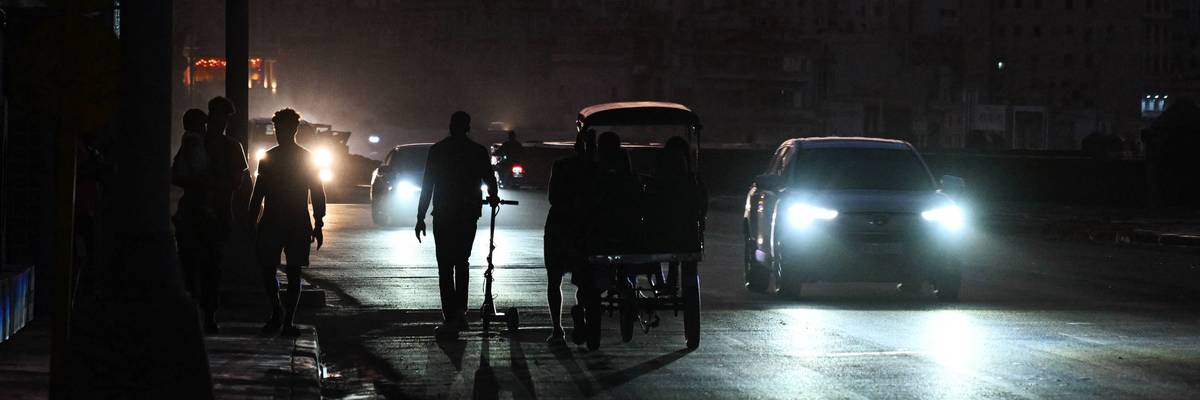
People transit on a street without power during a nationwide blackout in Havana on March 21, 2026.
Congress can stop a war it can see. It cannot stop one its members are forbidden to describe—and that is now the door the pressure campaign against Cuba has walked through.
Last December, writing here about unrest in Iran, I had to be careful. We must resist the temptation to treat capability as conspiracy, I wrote, while also resisting the delusion that absence of evidence means absence of action. That caution was owed to readers, because I could point to a history and a capability but not to an operation.
That caution is no longer necessary. In the first week of August, American newspapers reported that the Central Intelligence Agency has established a dedicated Cuba task force—case officers, analysts, cyber operators, specialists in covert influence—whose reported mandate is to create fissures among the Cuban political elite, in the hope of pressuring the replacement of officials deemed anti-American with leaders more agreeable to the president's demands. Cuba has been elevated to "Priority 1" in the intelligence community's collection framework, alongside China, Iran, and Russia. Satellites are being re-tasked. The Agency declined to comment.
We are told there are limits: no organized Cuban partners, no authority for lethal operations. We are also told, in the same breath, that the president may modify those authorities at any time.
What is remarkable here is not the operation. Lindsey A. O'Rourke's Covert Regime Change documents 64 covert American attempts to change foreign governments between 1947 and 1989, against six overt ones—a ratio of 10 to one. Only 25 succeeded even by the undemanding measure that an American-backed client took power. Her most damning finding is the one least quoted: States targeted for regime change—especially those that survived the attempt—were more likely to experience civil war or mass killing in the years that followed.
Covert action undertaken to alter the composition or constitutional order of a foreign government should be forbidden.
What is remarkable is that nothing in American law stands in the way—and that the reason has nothing to do with secrecy.
The War Powers Resolution is not, at bottom, a reporting statute. It is a termination statute. It gives the president 48 hours to report and 60 days to finish, after which he shall terminate the use of the forces concerned unless Congress affirmatively says otherwise. Congressional silence ends the operation. That default is the whole of its design.
Covert action runs under an entirely different law, 50 U.S.C. §3093. There must be a written presidential finding. The intelligence committees must be kept "fully and currently informed." These are real constraints, born of real scandals, and it would be wrong to say Congress is blind.
But §3093 contains no clock, no expiry, and no vote—ever. A finding, once signed and reported, may run indefinitely. Silence continues it. And where a war powers report enters a public record on which any member may act, a finding goes to two committees behind closed doors, sometimes to eight members alone. Those outside may not be told; those inside may not speak. The floor vote that the War Powers Resolution treats as the ordinary constitutional remedy becomes structurally impossible, because a legislature cannot vote on what its members are forbidden to describe.
Then there is the definitional gap, which is the loophole properly so called. The resolution regulates the introduction of "United States Armed Forces" into hostilities. Case officers are not Armed Forces. Identical objective, identical target, identical effect—but a different statute, depending on which badge the operator carries.
I have argued in these pages that economic warfare capable of collapsing a foreign economy should be subject to reporting and time limits comparable to those governing armed force. I still believe it. But I have to report that it would not close this gap. The War Powers Resolution regulates a category of actor. An economic amendment would regulate a category of instrument. Any scheme built on categories will leak, because the executive may always choose the category nobody regulates. Only a rule keyed to effects will hold.
In January I argued here that Washington's claims of Venezuelan "cooperation" were null and void, because consent extracted under coercion is not consent. Covert action takes that one step further, and it is worse.
Suppose the task force succeeds. Suppose that some month soon the Cuban leadership is reconstituted, or a concession is made, or an agreement signed on precisely the terms demanded. Who will be able to say who authored it?
Not Congress, which will have seen a finding but not its consequences. Not the United Nations, whose bedrock principle protects a state's freedom to choose its own political and economic system without external coercion. Not the Cuban people, in whose name it would be done. Not the American public, in whose name it was mounted. And not the negotiators themselves—the same agency whose director flew to Havana in May to meet Cuba's interior minister, its intelligence chief, and the intermediary through whom talks are said to run is the agency now tasked with fracturing the leadership those talks would bind.
A settlement whose authorship cannot be established is a settlement no one can rely on—including the party that obtained it. Covert influence aimed at the composition of a foreign government does not merely violate the norm against intervention. It destroys the evidence by which compliance with that norm could ever be judged.
The obvious answer is to regulate: an effects-based trigger reaching any sustained effort to alter a foreign government's composition, whichever agency conducts it; a finding that expires by law unless renewed by recorded committee vote; a path by which a committee can reach the full Congress in closed session.
I proposed exactly that, and then thought better of the framing. A statute that regulates a practice licenses it. Write a clock for operations aimed at foreign governments and you have conceded that such operations are lawfully available—and that concession reaches backward across O'Rourke's 64, converting a record of illegality into the quaint era before the paperwork. This is, not coincidentally, what intelligence services themselves have long wanted: Statutory footing transfers the risk from the officer to the statute. The vocabulary follows on its own. Subversion becomes stabilization. Regime change becomes democratic transition assistance. Fracturing an elite becomes engagement with reform-minded elements.
So the operative provision must be prohibition, not licensing. Covert action undertaken to alter the composition or constitutional order of a foreign government should be forbidden. The trigger, the clock, and the escalation path are then not the scheme but its enforcement—and the governing rule for the intelligence work that legitimately remains: collection, counterintelligence, counterterrorism, counterproliferation.
None of this is abstract in Cuba right now. On August 2 the national grid collapsed for the sixth time this year. On August 3 the restoration itself failed, and it collapsed again. The country's own energy minister said plainly that Cuba has no fuel and expects none in the volumes it needs, and that containers of solar panels, food, and medicines sit held at nearby ports—some destined for children whose medical condition depends on electricity. On August 6, United Nations experts said the humanitarian consequences are unfolding into a full-blown crisis, called the measures incompatible with Article 2 of the Charter, and urged the Security Council and General Assembly to take the matter up as one of international peace and security.
Into that, we have now introduced an effort to fracture a political elite. Whatever one thinks of the Cuban government—and one may think a great deal—an operation of that kind, in a country in that condition, is not an operation with a narrow band of outcomes. It sits adjacent to the conditions in which atrocity becomes possible.
Congress can stop a war it can see. Six months ago I asked in these pages whose job it is when Congress can no longer stop an unauthorized war. The answer keeps narrowing, and the doors keep multiplying. Two have been narrowed. A third stands open, and we have just been told, in the newspaper, that someone has walked through it.
Dear Common Dreams reader, It’s been nearly 30 years since I co-founded Common Dreams with my late wife, Lina Newhouser. We had the radical notion that journalism should serve the public good, not corporate profits. It was clear to us from the outset what it would take to build such a project. No paid advertisements. No corporate sponsors. No millionaire publisher telling us what to think or do. Many people said we wouldn't last a year, but we proved those doubters wrong. Together with a tremendous team of journalists and dedicated staff, we built an independent media outlet free from the constraints of profits and corporate control. Our mission has always been simple: To inform. To inspire. To ignite change for the common good. Building Common Dreams was not easy. Our survival was never guaranteed. When you take on the most powerful forces—Wall Street greed, fossil fuel industry destruction, Big Tech lobbyists, and uber-rich oligarchs who have spent billions upon billions rigging the economy and democracy in their favor—the only bulwark you have is supporters who believe in your work. But here’s the urgent message from me today. It's never been this bad out there. And it's never been this hard to keep us going. At the very moment Common Dreams is most needed, the threats we face are intensifying. We need your support now more than ever. We don't accept corporate advertising and never will. We don't have a paywall because we don't think people should be blocked from critical news based on their ability to pay. Everything we do is funded by the donations of readers like you. When everyone does the little they can afford, we are strong. But if that support retreats or dries up, so do we. Will you donate now to make sure Common Dreams not only survives but thrives? —Craig Brown, Co-founder |
Last December, writing here about unrest in Iran, I had to be careful. We must resist the temptation to treat capability as conspiracy, I wrote, while also resisting the delusion that absence of evidence means absence of action. That caution was owed to readers, because I could point to a history and a capability but not to an operation.
That caution is no longer necessary. In the first week of August, American newspapers reported that the Central Intelligence Agency has established a dedicated Cuba task force—case officers, analysts, cyber operators, specialists in covert influence—whose reported mandate is to create fissures among the Cuban political elite, in the hope of pressuring the replacement of officials deemed anti-American with leaders more agreeable to the president's demands. Cuba has been elevated to "Priority 1" in the intelligence community's collection framework, alongside China, Iran, and Russia. Satellites are being re-tasked. The Agency declined to comment.
We are told there are limits: no organized Cuban partners, no authority for lethal operations. We are also told, in the same breath, that the president may modify those authorities at any time.
What is remarkable here is not the operation. Lindsey A. O'Rourke's Covert Regime Change documents 64 covert American attempts to change foreign governments between 1947 and 1989, against six overt ones—a ratio of 10 to one. Only 25 succeeded even by the undemanding measure that an American-backed client took power. Her most damning finding is the one least quoted: States targeted for regime change—especially those that survived the attempt—were more likely to experience civil war or mass killing in the years that followed.
Covert action undertaken to alter the composition or constitutional order of a foreign government should be forbidden.
What is remarkable is that nothing in American law stands in the way—and that the reason has nothing to do with secrecy.
The War Powers Resolution is not, at bottom, a reporting statute. It is a termination statute. It gives the president 48 hours to report and 60 days to finish, after which he shall terminate the use of the forces concerned unless Congress affirmatively says otherwise. Congressional silence ends the operation. That default is the whole of its design.
Covert action runs under an entirely different law, 50 U.S.C. §3093. There must be a written presidential finding. The intelligence committees must be kept "fully and currently informed." These are real constraints, born of real scandals, and it would be wrong to say Congress is blind.
But §3093 contains no clock, no expiry, and no vote—ever. A finding, once signed and reported, may run indefinitely. Silence continues it. And where a war powers report enters a public record on which any member may act, a finding goes to two committees behind closed doors, sometimes to eight members alone. Those outside may not be told; those inside may not speak. The floor vote that the War Powers Resolution treats as the ordinary constitutional remedy becomes structurally impossible, because a legislature cannot vote on what its members are forbidden to describe.
Then there is the definitional gap, which is the loophole properly so called. The resolution regulates the introduction of "United States Armed Forces" into hostilities. Case officers are not Armed Forces. Identical objective, identical target, identical effect—but a different statute, depending on which badge the operator carries.
I have argued in these pages that economic warfare capable of collapsing a foreign economy should be subject to reporting and time limits comparable to those governing armed force. I still believe it. But I have to report that it would not close this gap. The War Powers Resolution regulates a category of actor. An economic amendment would regulate a category of instrument. Any scheme built on categories will leak, because the executive may always choose the category nobody regulates. Only a rule keyed to effects will hold.
In January I argued here that Washington's claims of Venezuelan "cooperation" were null and void, because consent extracted under coercion is not consent. Covert action takes that one step further, and it is worse.
Suppose the task force succeeds. Suppose that some month soon the Cuban leadership is reconstituted, or a concession is made, or an agreement signed on precisely the terms demanded. Who will be able to say who authored it?
Not Congress, which will have seen a finding but not its consequences. Not the United Nations, whose bedrock principle protects a state's freedom to choose its own political and economic system without external coercion. Not the Cuban people, in whose name it would be done. Not the American public, in whose name it was mounted. And not the negotiators themselves—the same agency whose director flew to Havana in May to meet Cuba's interior minister, its intelligence chief, and the intermediary through whom talks are said to run is the agency now tasked with fracturing the leadership those talks would bind.
A settlement whose authorship cannot be established is a settlement no one can rely on—including the party that obtained it. Covert influence aimed at the composition of a foreign government does not merely violate the norm against intervention. It destroys the evidence by which compliance with that norm could ever be judged.
The obvious answer is to regulate: an effects-based trigger reaching any sustained effort to alter a foreign government's composition, whichever agency conducts it; a finding that expires by law unless renewed by recorded committee vote; a path by which a committee can reach the full Congress in closed session.
I proposed exactly that, and then thought better of the framing. A statute that regulates a practice licenses it. Write a clock for operations aimed at foreign governments and you have conceded that such operations are lawfully available—and that concession reaches backward across O'Rourke's 64, converting a record of illegality into the quaint era before the paperwork. This is, not coincidentally, what intelligence services themselves have long wanted: Statutory footing transfers the risk from the officer to the statute. The vocabulary follows on its own. Subversion becomes stabilization. Regime change becomes democratic transition assistance. Fracturing an elite becomes engagement with reform-minded elements.
So the operative provision must be prohibition, not licensing. Covert action undertaken to alter the composition or constitutional order of a foreign government should be forbidden. The trigger, the clock, and the escalation path are then not the scheme but its enforcement—and the governing rule for the intelligence work that legitimately remains: collection, counterintelligence, counterterrorism, counterproliferation.
None of this is abstract in Cuba right now. On August 2 the national grid collapsed for the sixth time this year. On August 3 the restoration itself failed, and it collapsed again. The country's own energy minister said plainly that Cuba has no fuel and expects none in the volumes it needs, and that containers of solar panels, food, and medicines sit held at nearby ports—some destined for children whose medical condition depends on electricity. On August 6, United Nations experts said the humanitarian consequences are unfolding into a full-blown crisis, called the measures incompatible with Article 2 of the Charter, and urged the Security Council and General Assembly to take the matter up as one of international peace and security.
Into that, we have now introduced an effort to fracture a political elite. Whatever one thinks of the Cuban government—and one may think a great deal—an operation of that kind, in a country in that condition, is not an operation with a narrow band of outcomes. It sits adjacent to the conditions in which atrocity becomes possible.
Congress can stop a war it can see. Six months ago I asked in these pages whose job it is when Congress can no longer stop an unauthorized war. The answer keeps narrowing, and the doors keep multiplying. Two have been narrowed. A third stands open, and we have just been told, in the newspaper, that someone has walked through it.
Last December, writing here about unrest in Iran, I had to be careful. We must resist the temptation to treat capability as conspiracy, I wrote, while also resisting the delusion that absence of evidence means absence of action. That caution was owed to readers, because I could point to a history and a capability but not to an operation.
That caution is no longer necessary. In the first week of August, American newspapers reported that the Central Intelligence Agency has established a dedicated Cuba task force—case officers, analysts, cyber operators, specialists in covert influence—whose reported mandate is to create fissures among the Cuban political elite, in the hope of pressuring the replacement of officials deemed anti-American with leaders more agreeable to the president's demands. Cuba has been elevated to "Priority 1" in the intelligence community's collection framework, alongside China, Iran, and Russia. Satellites are being re-tasked. The Agency declined to comment.
We are told there are limits: no organized Cuban partners, no authority for lethal operations. We are also told, in the same breath, that the president may modify those authorities at any time.
What is remarkable here is not the operation. Lindsey A. O'Rourke's Covert Regime Change documents 64 covert American attempts to change foreign governments between 1947 and 1989, against six overt ones—a ratio of 10 to one. Only 25 succeeded even by the undemanding measure that an American-backed client took power. Her most damning finding is the one least quoted: States targeted for regime change—especially those that survived the attempt—were more likely to experience civil war or mass killing in the years that followed.
Covert action undertaken to alter the composition or constitutional order of a foreign government should be forbidden.
What is remarkable is that nothing in American law stands in the way—and that the reason has nothing to do with secrecy.
The War Powers Resolution is not, at bottom, a reporting statute. It is a termination statute. It gives the president 48 hours to report and 60 days to finish, after which he shall terminate the use of the forces concerned unless Congress affirmatively says otherwise. Congressional silence ends the operation. That default is the whole of its design.
Covert action runs under an entirely different law, 50 U.S.C. §3093. There must be a written presidential finding. The intelligence committees must be kept "fully and currently informed." These are real constraints, born of real scandals, and it would be wrong to say Congress is blind.
But §3093 contains no clock, no expiry, and no vote—ever. A finding, once signed and reported, may run indefinitely. Silence continues it. And where a war powers report enters a public record on which any member may act, a finding goes to two committees behind closed doors, sometimes to eight members alone. Those outside may not be told; those inside may not speak. The floor vote that the War Powers Resolution treats as the ordinary constitutional remedy becomes structurally impossible, because a legislature cannot vote on what its members are forbidden to describe.
Then there is the definitional gap, which is the loophole properly so called. The resolution regulates the introduction of "United States Armed Forces" into hostilities. Case officers are not Armed Forces. Identical objective, identical target, identical effect—but a different statute, depending on which badge the operator carries.
I have argued in these pages that economic warfare capable of collapsing a foreign economy should be subject to reporting and time limits comparable to those governing armed force. I still believe it. But I have to report that it would not close this gap. The War Powers Resolution regulates a category of actor. An economic amendment would regulate a category of instrument. Any scheme built on categories will leak, because the executive may always choose the category nobody regulates. Only a rule keyed to effects will hold.
In January I argued here that Washington's claims of Venezuelan "cooperation" were null and void, because consent extracted under coercion is not consent. Covert action takes that one step further, and it is worse.
Suppose the task force succeeds. Suppose that some month soon the Cuban leadership is reconstituted, or a concession is made, or an agreement signed on precisely the terms demanded. Who will be able to say who authored it?
Not Congress, which will have seen a finding but not its consequences. Not the United Nations, whose bedrock principle protects a state's freedom to choose its own political and economic system without external coercion. Not the Cuban people, in whose name it would be done. Not the American public, in whose name it was mounted. And not the negotiators themselves—the same agency whose director flew to Havana in May to meet Cuba's interior minister, its intelligence chief, and the intermediary through whom talks are said to run is the agency now tasked with fracturing the leadership those talks would bind.
A settlement whose authorship cannot be established is a settlement no one can rely on—including the party that obtained it. Covert influence aimed at the composition of a foreign government does not merely violate the norm against intervention. It destroys the evidence by which compliance with that norm could ever be judged.
The obvious answer is to regulate: an effects-based trigger reaching any sustained effort to alter a foreign government's composition, whichever agency conducts it; a finding that expires by law unless renewed by recorded committee vote; a path by which a committee can reach the full Congress in closed session.
I proposed exactly that, and then thought better of the framing. A statute that regulates a practice licenses it. Write a clock for operations aimed at foreign governments and you have conceded that such operations are lawfully available—and that concession reaches backward across O'Rourke's 64, converting a record of illegality into the quaint era before the paperwork. This is, not coincidentally, what intelligence services themselves have long wanted: Statutory footing transfers the risk from the officer to the statute. The vocabulary follows on its own. Subversion becomes stabilization. Regime change becomes democratic transition assistance. Fracturing an elite becomes engagement with reform-minded elements.
So the operative provision must be prohibition, not licensing. Covert action undertaken to alter the composition or constitutional order of a foreign government should be forbidden. The trigger, the clock, and the escalation path are then not the scheme but its enforcement—and the governing rule for the intelligence work that legitimately remains: collection, counterintelligence, counterterrorism, counterproliferation.
None of this is abstract in Cuba right now. On August 2 the national grid collapsed for the sixth time this year. On August 3 the restoration itself failed, and it collapsed again. The country's own energy minister said plainly that Cuba has no fuel and expects none in the volumes it needs, and that containers of solar panels, food, and medicines sit held at nearby ports—some destined for children whose medical condition depends on electricity. On August 6, United Nations experts said the humanitarian consequences are unfolding into a full-blown crisis, called the measures incompatible with Article 2 of the Charter, and urged the Security Council and General Assembly to take the matter up as one of international peace and security.
Into that, we have now introduced an effort to fracture a political elite. Whatever one thinks of the Cuban government—and one may think a great deal—an operation of that kind, in a country in that condition, is not an operation with a narrow band of outcomes. It sits adjacent to the conditions in which atrocity becomes possible.
Congress can stop a war it can see. Six months ago I asked in these pages whose job it is when Congress can no longer stop an unauthorized war. The answer keeps narrowing, and the doors keep multiplying. Two have been narrowed. A third stands open, and we have just been told, in the newspaper, that someone has walked through it.