SUBSCRIBE TO OUR FREE NEWSLETTER
Daily news & progressive opinion—funded by the people, not the corporations—delivered straight to your inbox.
5
#000000
#FFFFFF
To donate by check, phone, or other method, see our More Ways to Give page.
Daily news & progressive opinion—funded by the people, not the corporations—delivered straight to your inbox.
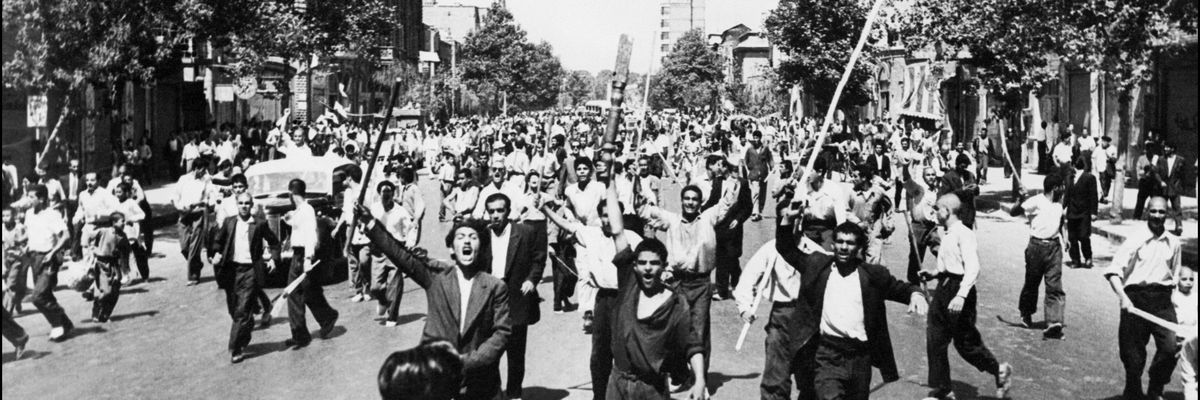
Rioters armed with staves shout slogans during riots in Tehran, Iran in August 1953.
In a world where information warfare blurs fact and narrative, we must resist the temptation to treat capability as conspiracy. But we must also resist the delusion that the absence of evidence today means an absence of action.
Speculation about covert operations tends to rise with geopolitical heat, and few places are as historically charged as Iran when it comes to foreign interference. The memory of the 1953 CIA-backed coup remains vivid in Tehran’s political consciousness, shaping both internal paranoia and external discourse. In today’s climate of US-Iran hostility—marked by sanctions, nuclear disputes, and regional proxy conflicts—whispers of destabilization efforts inevitably resurface. But plausibility should not be mistaken for proof.
Yet there are ghosts worth heeding…
In 1953, the CIA executed Operation TPAJAX—a covert operation that overthrew Iran’s democratically elected Prime Minister Mohammad Mossadegh, reinstating the autocratic Shah. This operation was denied, downplayed, and hidden for decades. It wasn’t until 2017—64 years later—that the US government officially declassified key documents from the Foreign Relations of the United States (FRUS) series detailing the planning and implementation of the coup. The materials that confirmed America’s role in the 1953 coup were not fully acknowledged through official channels until generations had passed, long after their geopolitical consequences had reshaped the Middle East.
Given that historical precedent, it’s not unreasonable to wonder: If something like that were happening today, would we know?
If the CIA is involved in orchestrating unrest in Iran today, we may not know until 2089.
Currently, Iran is again roiled by protests. Slogans like “Death to the Dictator” echo in the streets. Western headlines frame this as grassroots unrest, and it may well be. But for a country with a long and painful history of foreign interference cloaked in democracy rhetoric, the line between internal dissent and external orchestration is never clean.
From a strategic standpoint, the United States clearly possesses the capacity to conduct covert influence operations. Legal mechanisms for such actions exist under US law, with covert operations authorized by the president and subject to congressional oversight. The intelligence community, with decades of institutional experience, is equipped with modern tools ranging from cyber operations to narrative influence and financial pressure. These capabilities are real. But capacity alone tells us nothing about intent.
Public policy statements from the US government consistently emphasize deterrence and nonproliferation, not regime change. While tensions are undeniable, open endorsement of covert destabilization would carry significant political and legal costs. Congress, the media, and public opinion create substantial friction for any administration considering escalation by clandestine means. Adversarial relationships can foster suspicion, but they do not constitute motive.
Environmental conditions further complicate the picture. Iran, despite internal pressures and unrest, retains a strong security apparatus and hardened counter-intelligence services. Regional dynamics—involving militias, proxies, and overlapping crises—do not create the same permissive environment that existed in the early Cold War. On the contrary, they elevate the risks of blowback and exposure. Modern operations would need to be diffuse, multi domain, and plausibly deniable—relying on soft pressure through economic levers, information warfare, and alliances rather than the heavy-handed political interventions of the past.
And yet, these more nuanced forms of influence are precisely what make attribution difficult. In a world of cyber shadows, targeted sanctions, and disinformation, it’s easy to see ghosts. But serious allegations require serious evidence. Credible investigative reporting, declassified documents, congressional disputes, or allied intelligence consensus are necessary to move the needle from theoretical possibility to actionable suspicion—let alone attribution.
That’s where Dan Kovalik’s The Plot to Attack Iran enters the conversation. Kovalik draws clear lines from historical US interventions—including the CIA's own admission of past regime change—to present-day provocations and misinformation. He details a long history of fabricated threats, from nonexistent Iraqi WMDs to exaggerated fears about Iran’s nuclear program. He argues that current rhetoric and actions—sanctions, assassinations, drone incursions, proxy pressures—form a consistent pattern of provocation meant to destabilize Iran under the guise of security policy.
Kovalik also reminds us that accusations of terrorism, often leveled at Iran, are selectively applied. While Iran is listed as a state sponsor of terrorism, US allies like Saudi Arabia—implicated in exporting Wahhabi extremism—are exempt from such labels. Groups like Hezbollah, which Iran supports, are framed by the US as terroristic, while Kovalik argues they act in regional resistance to Israeli occupation. This asymmetry of language is not just semantic—it builds the ideological scaffolding for war.
Legal oversight, international norms, and the specter of asymmetric retaliation all serve as meaningful deterrents. A misstep in this space could trigger regional escalation, damage US credibility, or backfire diplomatically. These are not trivial constraints. They are built-in brakes against rash or covert adventurism. And yet, none of them prevented the 1953 coup. Nor did they stop covert operations in Iraq, Libya, or Syria. History shows us that legal deterrents and political norms often collapse under the weight of perceived strategic necessity.
Bottom line: While it is analytically sound to say the United States could conduct covert operations against Iran under the right conditions, there is no defensible basis to assert that such actions are underway without evidence. Plausibility is not a claim—it is a lens for understanding risk, not a substitute for proof.
But perhaps the more sobering truth is this: If the CIA is involved in orchestrating unrest in Iran today, we may not know until 2089. Sixty-four years is a long time to wait for the truth. In that gap, entire wars can be fought, nations broken, and histories rewritten. The ghosts of TPAJAX aren’t just historical—they’re prophetic. And Iran, perhaps more than any other nation, knows that ghosts have long memories.
In a world where information warfare blurs fact and narrative, we must resist the temptation to treat capability as conspiracy. But we must also resist the delusion that the absence of evidence today means an absence of action. The stakes—diplomatic, strategic, and human—are far too high for anything less than disciplined analysis and historical awareness.
The past may not repeat, but it whispers—and in Iran, it is whispering loudly.
Dear Common Dreams reader, It’s been nearly 30 years since I co-founded Common Dreams with my late wife, Lina Newhouser. We had the radical notion that journalism should serve the public good, not corporate profits. It was clear to us from the outset what it would take to build such a project. No paid advertisements. No corporate sponsors. No millionaire publisher telling us what to think or do. Many people said we wouldn't last a year, but we proved those doubters wrong. Together with a tremendous team of journalists and dedicated staff, we built an independent media outlet free from the constraints of profits and corporate control. Our mission has always been simple: To inform. To inspire. To ignite change for the common good. Building Common Dreams was not easy. Our survival was never guaranteed. When you take on the most powerful forces—Wall Street greed, fossil fuel industry destruction, Big Tech lobbyists, and uber-rich oligarchs who have spent billions upon billions rigging the economy and democracy in their favor—the only bulwark you have is supporters who believe in your work. But here’s the urgent message from me today. It's never been this bad out there. And it's never been this hard to keep us going. At the very moment Common Dreams is most needed, the threats we face are intensifying. We need your support now more than ever. We don't accept corporate advertising and never will. We don't have a paywall because we don't think people should be blocked from critical news based on their ability to pay. Everything we do is funded by the donations of readers like you. When everyone does the little they can afford, we are strong. But if that support retreats or dries up, so do we. Will you donate now to make sure Common Dreams not only survives but thrives? —Craig Brown, Co-founder |
Speculation about covert operations tends to rise with geopolitical heat, and few places are as historically charged as Iran when it comes to foreign interference. The memory of the 1953 CIA-backed coup remains vivid in Tehran’s political consciousness, shaping both internal paranoia and external discourse. In today’s climate of US-Iran hostility—marked by sanctions, nuclear disputes, and regional proxy conflicts—whispers of destabilization efforts inevitably resurface. But plausibility should not be mistaken for proof.
Yet there are ghosts worth heeding…
In 1953, the CIA executed Operation TPAJAX—a covert operation that overthrew Iran’s democratically elected Prime Minister Mohammad Mossadegh, reinstating the autocratic Shah. This operation was denied, downplayed, and hidden for decades. It wasn’t until 2017—64 years later—that the US government officially declassified key documents from the Foreign Relations of the United States (FRUS) series detailing the planning and implementation of the coup. The materials that confirmed America’s role in the 1953 coup were not fully acknowledged through official channels until generations had passed, long after their geopolitical consequences had reshaped the Middle East.
Given that historical precedent, it’s not unreasonable to wonder: If something like that were happening today, would we know?
If the CIA is involved in orchestrating unrest in Iran today, we may not know until 2089.
Currently, Iran is again roiled by protests. Slogans like “Death to the Dictator” echo in the streets. Western headlines frame this as grassroots unrest, and it may well be. But for a country with a long and painful history of foreign interference cloaked in democracy rhetoric, the line between internal dissent and external orchestration is never clean.
From a strategic standpoint, the United States clearly possesses the capacity to conduct covert influence operations. Legal mechanisms for such actions exist under US law, with covert operations authorized by the president and subject to congressional oversight. The intelligence community, with decades of institutional experience, is equipped with modern tools ranging from cyber operations to narrative influence and financial pressure. These capabilities are real. But capacity alone tells us nothing about intent.
Public policy statements from the US government consistently emphasize deterrence and nonproliferation, not regime change. While tensions are undeniable, open endorsement of covert destabilization would carry significant political and legal costs. Congress, the media, and public opinion create substantial friction for any administration considering escalation by clandestine means. Adversarial relationships can foster suspicion, but they do not constitute motive.
Environmental conditions further complicate the picture. Iran, despite internal pressures and unrest, retains a strong security apparatus and hardened counter-intelligence services. Regional dynamics—involving militias, proxies, and overlapping crises—do not create the same permissive environment that existed in the early Cold War. On the contrary, they elevate the risks of blowback and exposure. Modern operations would need to be diffuse, multi domain, and plausibly deniable—relying on soft pressure through economic levers, information warfare, and alliances rather than the heavy-handed political interventions of the past.
And yet, these more nuanced forms of influence are precisely what make attribution difficult. In a world of cyber shadows, targeted sanctions, and disinformation, it’s easy to see ghosts. But serious allegations require serious evidence. Credible investigative reporting, declassified documents, congressional disputes, or allied intelligence consensus are necessary to move the needle from theoretical possibility to actionable suspicion—let alone attribution.
That’s where Dan Kovalik’s The Plot to Attack Iran enters the conversation. Kovalik draws clear lines from historical US interventions—including the CIA's own admission of past regime change—to present-day provocations and misinformation. He details a long history of fabricated threats, from nonexistent Iraqi WMDs to exaggerated fears about Iran’s nuclear program. He argues that current rhetoric and actions—sanctions, assassinations, drone incursions, proxy pressures—form a consistent pattern of provocation meant to destabilize Iran under the guise of security policy.
Kovalik also reminds us that accusations of terrorism, often leveled at Iran, are selectively applied. While Iran is listed as a state sponsor of terrorism, US allies like Saudi Arabia—implicated in exporting Wahhabi extremism—are exempt from such labels. Groups like Hezbollah, which Iran supports, are framed by the US as terroristic, while Kovalik argues they act in regional resistance to Israeli occupation. This asymmetry of language is not just semantic—it builds the ideological scaffolding for war.
Legal oversight, international norms, and the specter of asymmetric retaliation all serve as meaningful deterrents. A misstep in this space could trigger regional escalation, damage US credibility, or backfire diplomatically. These are not trivial constraints. They are built-in brakes against rash or covert adventurism. And yet, none of them prevented the 1953 coup. Nor did they stop covert operations in Iraq, Libya, or Syria. History shows us that legal deterrents and political norms often collapse under the weight of perceived strategic necessity.
Bottom line: While it is analytically sound to say the United States could conduct covert operations against Iran under the right conditions, there is no defensible basis to assert that such actions are underway without evidence. Plausibility is not a claim—it is a lens for understanding risk, not a substitute for proof.
But perhaps the more sobering truth is this: If the CIA is involved in orchestrating unrest in Iran today, we may not know until 2089. Sixty-four years is a long time to wait for the truth. In that gap, entire wars can be fought, nations broken, and histories rewritten. The ghosts of TPAJAX aren’t just historical—they’re prophetic. And Iran, perhaps more than any other nation, knows that ghosts have long memories.
In a world where information warfare blurs fact and narrative, we must resist the temptation to treat capability as conspiracy. But we must also resist the delusion that the absence of evidence today means an absence of action. The stakes—diplomatic, strategic, and human—are far too high for anything less than disciplined analysis and historical awareness.
The past may not repeat, but it whispers—and in Iran, it is whispering loudly.
Speculation about covert operations tends to rise with geopolitical heat, and few places are as historically charged as Iran when it comes to foreign interference. The memory of the 1953 CIA-backed coup remains vivid in Tehran’s political consciousness, shaping both internal paranoia and external discourse. In today’s climate of US-Iran hostility—marked by sanctions, nuclear disputes, and regional proxy conflicts—whispers of destabilization efforts inevitably resurface. But plausibility should not be mistaken for proof.
Yet there are ghosts worth heeding…
In 1953, the CIA executed Operation TPAJAX—a covert operation that overthrew Iran’s democratically elected Prime Minister Mohammad Mossadegh, reinstating the autocratic Shah. This operation was denied, downplayed, and hidden for decades. It wasn’t until 2017—64 years later—that the US government officially declassified key documents from the Foreign Relations of the United States (FRUS) series detailing the planning and implementation of the coup. The materials that confirmed America’s role in the 1953 coup were not fully acknowledged through official channels until generations had passed, long after their geopolitical consequences had reshaped the Middle East.
Given that historical precedent, it’s not unreasonable to wonder: If something like that were happening today, would we know?
If the CIA is involved in orchestrating unrest in Iran today, we may not know until 2089.
Currently, Iran is again roiled by protests. Slogans like “Death to the Dictator” echo in the streets. Western headlines frame this as grassroots unrest, and it may well be. But for a country with a long and painful history of foreign interference cloaked in democracy rhetoric, the line between internal dissent and external orchestration is never clean.
From a strategic standpoint, the United States clearly possesses the capacity to conduct covert influence operations. Legal mechanisms for such actions exist under US law, with covert operations authorized by the president and subject to congressional oversight. The intelligence community, with decades of institutional experience, is equipped with modern tools ranging from cyber operations to narrative influence and financial pressure. These capabilities are real. But capacity alone tells us nothing about intent.
Public policy statements from the US government consistently emphasize deterrence and nonproliferation, not regime change. While tensions are undeniable, open endorsement of covert destabilization would carry significant political and legal costs. Congress, the media, and public opinion create substantial friction for any administration considering escalation by clandestine means. Adversarial relationships can foster suspicion, but they do not constitute motive.
Environmental conditions further complicate the picture. Iran, despite internal pressures and unrest, retains a strong security apparatus and hardened counter-intelligence services. Regional dynamics—involving militias, proxies, and overlapping crises—do not create the same permissive environment that existed in the early Cold War. On the contrary, they elevate the risks of blowback and exposure. Modern operations would need to be diffuse, multi domain, and plausibly deniable—relying on soft pressure through economic levers, information warfare, and alliances rather than the heavy-handed political interventions of the past.
And yet, these more nuanced forms of influence are precisely what make attribution difficult. In a world of cyber shadows, targeted sanctions, and disinformation, it’s easy to see ghosts. But serious allegations require serious evidence. Credible investigative reporting, declassified documents, congressional disputes, or allied intelligence consensus are necessary to move the needle from theoretical possibility to actionable suspicion—let alone attribution.
That’s where Dan Kovalik’s The Plot to Attack Iran enters the conversation. Kovalik draws clear lines from historical US interventions—including the CIA's own admission of past regime change—to present-day provocations and misinformation. He details a long history of fabricated threats, from nonexistent Iraqi WMDs to exaggerated fears about Iran’s nuclear program. He argues that current rhetoric and actions—sanctions, assassinations, drone incursions, proxy pressures—form a consistent pattern of provocation meant to destabilize Iran under the guise of security policy.
Kovalik also reminds us that accusations of terrorism, often leveled at Iran, are selectively applied. While Iran is listed as a state sponsor of terrorism, US allies like Saudi Arabia—implicated in exporting Wahhabi extremism—are exempt from such labels. Groups like Hezbollah, which Iran supports, are framed by the US as terroristic, while Kovalik argues they act in regional resistance to Israeli occupation. This asymmetry of language is not just semantic—it builds the ideological scaffolding for war.
Legal oversight, international norms, and the specter of asymmetric retaliation all serve as meaningful deterrents. A misstep in this space could trigger regional escalation, damage US credibility, or backfire diplomatically. These are not trivial constraints. They are built-in brakes against rash or covert adventurism. And yet, none of them prevented the 1953 coup. Nor did they stop covert operations in Iraq, Libya, or Syria. History shows us that legal deterrents and political norms often collapse under the weight of perceived strategic necessity.
Bottom line: While it is analytically sound to say the United States could conduct covert operations against Iran under the right conditions, there is no defensible basis to assert that such actions are underway without evidence. Plausibility is not a claim—it is a lens for understanding risk, not a substitute for proof.
But perhaps the more sobering truth is this: If the CIA is involved in orchestrating unrest in Iran today, we may not know until 2089. Sixty-four years is a long time to wait for the truth. In that gap, entire wars can be fought, nations broken, and histories rewritten. The ghosts of TPAJAX aren’t just historical—they’re prophetic. And Iran, perhaps more than any other nation, knows that ghosts have long memories.
In a world where information warfare blurs fact and narrative, we must resist the temptation to treat capability as conspiracy. But we must also resist the delusion that the absence of evidence today means an absence of action. The stakes—diplomatic, strategic, and human—are far too high for anything less than disciplined analysis and historical awareness.
The past may not repeat, but it whispers—and in Iran, it is whispering loudly.