SUBSCRIBE TO OUR FREE NEWSLETTER
Daily news & progressive opinion—funded by the people, not the corporations—delivered straight to your inbox.
5
#000000
#FFFFFF
To donate by check, phone, or other method, see our More Ways to Give page.
Daily news & progressive opinion—funded by the people, not the corporations—delivered straight to your inbox.
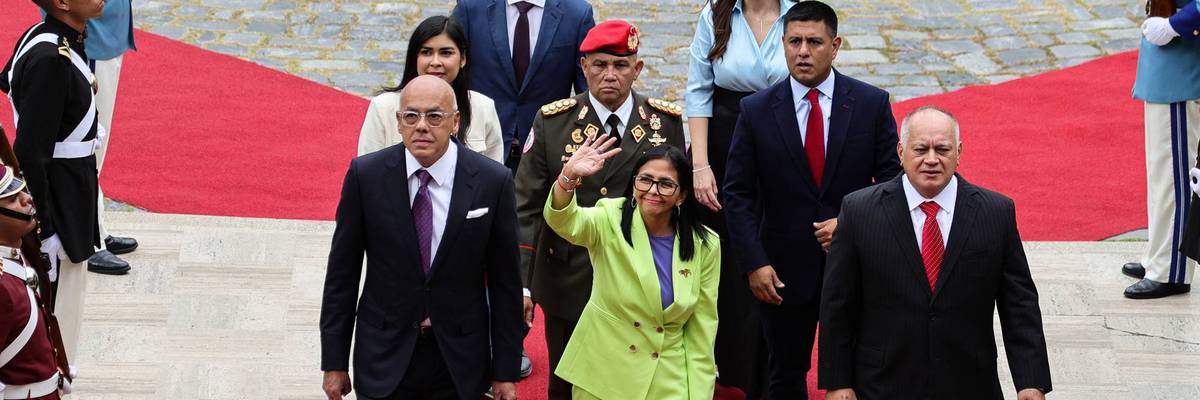
National Assembly president Jorge Rodríguez, Venezuela's interim president Delcy Rodríguez, and Minister of Interior Diosdado Cabello (R) arrive to the delivery of the first year's government report at Palacio Federal Legislativo on January 15, 2026 in Caracas, Venezuela.
Consent given under the barrel of a gun—or under the crushing weight of engineered economic catastrophe—cannot be recognized as valid.
In the aftermath of the kidnapping of Venezuelan President Nicolás Maduro by US forces in early 2026, the Trump administration has repeatedly proclaimed the full “cooperation” of Venezuela’s interim leadership, prominently naming Acting President Delcy Rodríguez as a key partner. Under the clear framework of international law, however, these assertions are legally meaningless—null and void from their inception. Cooperation, to carry legal or diplomatic weight, must be freely given. What has been presented instead resembles consent extracted under duress.
A growing body of evidence indicates that the purported “partnership” with Rodríguez and the interim government was not the product of diplomacy or mutual interest, but of military intervention, direct threats, and sustained economic coercion. Reports circulating widely describe a leaked audio recording in which Venezuelan officials were issued a fifteen-minute ultimatum by US forces following Maduro’s ouster: comply or face lethal consequences. While the recording has not been independently authenticated, neither its gravity nor its substance has been officially denied or investigated. The allegation remains unrefuted and gains plausibility from its consistency with publicly observable executive conduct.
At the same time, US officials publicly took credit for controlling Venezuela’s transitional arrangements. State assets, including oil revenues, were placed under American authority. Sanctions were explicitly framed by senior Treasury officials as instruments of “economic statecraft,” designed to impose maximum financial pressure to influence political outcomes. In substance and by their foreseeable consequences, this strategy operates as a form of hybrid coercion—seeking regime change through economic collapse rather than direct military engagement. This is not diplomacy; it is coercion through threat and deprivation, as a matter of law and practice.
International law leaves little room for ambiguity. The Vienna Convention on the Law of Treaties provides that any agreement secured through the coercion of state representatives is legally void, and that arrangements born of the threat or use of force are nullities as a matter of law. These provisions reflect foundational principles: the legitimacy of state action rests on the free will of its representatives. Consent given under the barrel of a gun—or under the crushing weight of engineered economic catastrophe—cannot be recognized as valid. By this standard, claims of Venezuelan “cooperation” do not demonstrate diplomatic success; they amount to admissions of coercion.
That Rodríguez now serves as interim president under these conditions does not confer legitimacy on her actions as a freely acting representative. If her authority emerged under duress, shaped by ultimatums and bounded by ongoing threats of renewed military action or economic devastation, then any subsequent “cooperation” attributed to her must be treated with profound skepticism. Acting where refusal is not a viable option is not partnership; it is submission enforced by power.
The broader danger lies in normalizing coercion disguised as consent. If executives can compel foreign leadership changes through military or economic force and then cite “cooperation” from installed interlocutors as proof of legitimacy, international law is rendered meaningless. Domestic safeguards erode as well: war-powers constraints are sidelined, congressional oversight is bypassed, and a precedent is set for repetition elsewhere, wherever the next “strategic interest” is declared. This is not solely a Venezuelan concern; it is a warning for global governance and democratic accountability.
Every claim by the Trump administration regarding Venezuelan “cooperation” after the forceful removal of President Maduro must therefore be regarded as legally and morally suspect. International law does not grant impunity to victors, validate arrangements imposed under threat of annihilation, or recognize coerced submission as consent. Until coercion is replaced by a genuinely free and verifiable process grounded in real diplomacy, all current assertions of cooperation with Hon. Delcy Rodríguez and the interim Venezuelan government are, by definition and by law, null and void.
Dear Common Dreams reader, It’s been nearly 30 years since I co-founded Common Dreams with my late wife, Lina Newhouser. We had the radical notion that journalism should serve the public good, not corporate profits. It was clear to us from the outset what it would take to build such a project. No paid advertisements. No corporate sponsors. No millionaire publisher telling us what to think or do. Many people said we wouldn't last a year, but we proved those doubters wrong. Together with a tremendous team of journalists and dedicated staff, we built an independent media outlet free from the constraints of profits and corporate control. Our mission has always been simple: To inform. To inspire. To ignite change for the common good. Building Common Dreams was not easy. Our survival was never guaranteed. When you take on the most powerful forces—Wall Street greed, fossil fuel industry destruction, Big Tech lobbyists, and uber-rich oligarchs who have spent billions upon billions rigging the economy and democracy in their favor—the only bulwark you have is supporters who believe in your work. But here’s the urgent message from me today. It's never been this bad out there. And it's never been this hard to keep us going. At the very moment Common Dreams is most needed, the threats we face are intensifying. We need your support now more than ever. We don't accept corporate advertising and never will. We don't have a paywall because we don't think people should be blocked from critical news based on their ability to pay. Everything we do is funded by the donations of readers like you. When everyone does the little they can afford, we are strong. But if that support retreats or dries up, so do we. Will you donate now to make sure Common Dreams not only survives but thrives? —Craig Brown, Co-founder |
In the aftermath of the kidnapping of Venezuelan President Nicolás Maduro by US forces in early 2026, the Trump administration has repeatedly proclaimed the full “cooperation” of Venezuela’s interim leadership, prominently naming Acting President Delcy Rodríguez as a key partner. Under the clear framework of international law, however, these assertions are legally meaningless—null and void from their inception. Cooperation, to carry legal or diplomatic weight, must be freely given. What has been presented instead resembles consent extracted under duress.
A growing body of evidence indicates that the purported “partnership” with Rodríguez and the interim government was not the product of diplomacy or mutual interest, but of military intervention, direct threats, and sustained economic coercion. Reports circulating widely describe a leaked audio recording in which Venezuelan officials were issued a fifteen-minute ultimatum by US forces following Maduro’s ouster: comply or face lethal consequences. While the recording has not been independently authenticated, neither its gravity nor its substance has been officially denied or investigated. The allegation remains unrefuted and gains plausibility from its consistency with publicly observable executive conduct.
At the same time, US officials publicly took credit for controlling Venezuela’s transitional arrangements. State assets, including oil revenues, were placed under American authority. Sanctions were explicitly framed by senior Treasury officials as instruments of “economic statecraft,” designed to impose maximum financial pressure to influence political outcomes. In substance and by their foreseeable consequences, this strategy operates as a form of hybrid coercion—seeking regime change through economic collapse rather than direct military engagement. This is not diplomacy; it is coercion through threat and deprivation, as a matter of law and practice.
International law leaves little room for ambiguity. The Vienna Convention on the Law of Treaties provides that any agreement secured through the coercion of state representatives is legally void, and that arrangements born of the threat or use of force are nullities as a matter of law. These provisions reflect foundational principles: the legitimacy of state action rests on the free will of its representatives. Consent given under the barrel of a gun—or under the crushing weight of engineered economic catastrophe—cannot be recognized as valid. By this standard, claims of Venezuelan “cooperation” do not demonstrate diplomatic success; they amount to admissions of coercion.
That Rodríguez now serves as interim president under these conditions does not confer legitimacy on her actions as a freely acting representative. If her authority emerged under duress, shaped by ultimatums and bounded by ongoing threats of renewed military action or economic devastation, then any subsequent “cooperation” attributed to her must be treated with profound skepticism. Acting where refusal is not a viable option is not partnership; it is submission enforced by power.
The broader danger lies in normalizing coercion disguised as consent. If executives can compel foreign leadership changes through military or economic force and then cite “cooperation” from installed interlocutors as proof of legitimacy, international law is rendered meaningless. Domestic safeguards erode as well: war-powers constraints are sidelined, congressional oversight is bypassed, and a precedent is set for repetition elsewhere, wherever the next “strategic interest” is declared. This is not solely a Venezuelan concern; it is a warning for global governance and democratic accountability.
Every claim by the Trump administration regarding Venezuelan “cooperation” after the forceful removal of President Maduro must therefore be regarded as legally and morally suspect. International law does not grant impunity to victors, validate arrangements imposed under threat of annihilation, or recognize coerced submission as consent. Until coercion is replaced by a genuinely free and verifiable process grounded in real diplomacy, all current assertions of cooperation with Hon. Delcy Rodríguez and the interim Venezuelan government are, by definition and by law, null and void.
In the aftermath of the kidnapping of Venezuelan President Nicolás Maduro by US forces in early 2026, the Trump administration has repeatedly proclaimed the full “cooperation” of Venezuela’s interim leadership, prominently naming Acting President Delcy Rodríguez as a key partner. Under the clear framework of international law, however, these assertions are legally meaningless—null and void from their inception. Cooperation, to carry legal or diplomatic weight, must be freely given. What has been presented instead resembles consent extracted under duress.
A growing body of evidence indicates that the purported “partnership” with Rodríguez and the interim government was not the product of diplomacy or mutual interest, but of military intervention, direct threats, and sustained economic coercion. Reports circulating widely describe a leaked audio recording in which Venezuelan officials were issued a fifteen-minute ultimatum by US forces following Maduro’s ouster: comply or face lethal consequences. While the recording has not been independently authenticated, neither its gravity nor its substance has been officially denied or investigated. The allegation remains unrefuted and gains plausibility from its consistency with publicly observable executive conduct.
At the same time, US officials publicly took credit for controlling Venezuela’s transitional arrangements. State assets, including oil revenues, were placed under American authority. Sanctions were explicitly framed by senior Treasury officials as instruments of “economic statecraft,” designed to impose maximum financial pressure to influence political outcomes. In substance and by their foreseeable consequences, this strategy operates as a form of hybrid coercion—seeking regime change through economic collapse rather than direct military engagement. This is not diplomacy; it is coercion through threat and deprivation, as a matter of law and practice.
International law leaves little room for ambiguity. The Vienna Convention on the Law of Treaties provides that any agreement secured through the coercion of state representatives is legally void, and that arrangements born of the threat or use of force are nullities as a matter of law. These provisions reflect foundational principles: the legitimacy of state action rests on the free will of its representatives. Consent given under the barrel of a gun—or under the crushing weight of engineered economic catastrophe—cannot be recognized as valid. By this standard, claims of Venezuelan “cooperation” do not demonstrate diplomatic success; they amount to admissions of coercion.
That Rodríguez now serves as interim president under these conditions does not confer legitimacy on her actions as a freely acting representative. If her authority emerged under duress, shaped by ultimatums and bounded by ongoing threats of renewed military action or economic devastation, then any subsequent “cooperation” attributed to her must be treated with profound skepticism. Acting where refusal is not a viable option is not partnership; it is submission enforced by power.
The broader danger lies in normalizing coercion disguised as consent. If executives can compel foreign leadership changes through military or economic force and then cite “cooperation” from installed interlocutors as proof of legitimacy, international law is rendered meaningless. Domestic safeguards erode as well: war-powers constraints are sidelined, congressional oversight is bypassed, and a precedent is set for repetition elsewhere, wherever the next “strategic interest” is declared. This is not solely a Venezuelan concern; it is a warning for global governance and democratic accountability.
Every claim by the Trump administration regarding Venezuelan “cooperation” after the forceful removal of President Maduro must therefore be regarded as legally and morally suspect. International law does not grant impunity to victors, validate arrangements imposed under threat of annihilation, or recognize coerced submission as consent. Until coercion is replaced by a genuinely free and verifiable process grounded in real diplomacy, all current assertions of cooperation with Hon. Delcy Rodríguez and the interim Venezuelan government are, by definition and by law, null and void.