SUBSCRIBE TO OUR FREE NEWSLETTER
Daily news & progressive opinion—funded by the people, not the corporations—delivered straight to your inbox.
5
#000000
#FFFFFF
To donate by check, phone, or other method, see our More Ways to Give page.
Daily news & progressive opinion—funded by the people, not the corporations—delivered straight to your inbox.
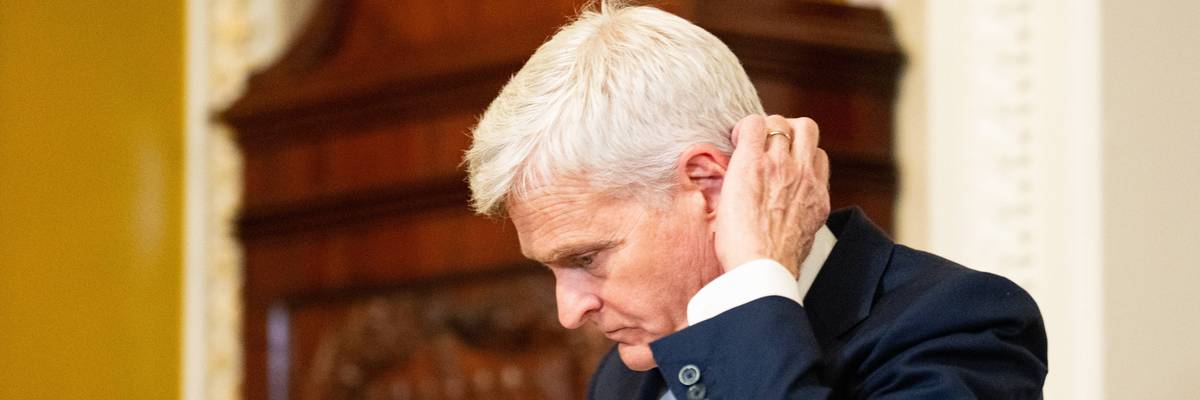
Sen. Bill Cassidy (R-La.) walks through the Ohio Clock Corridor before President Donald Trump arrives for the Senate Republicans' lunch meeting in the US Capitol on Wednesday, June 24, 2026.
For half a century, federal courts have waved away the war-powers question as a “political question” the elected branches would settle among themselves. Late June proved they cannot. That is precisely why the Supreme Court must finally take the case.
For one day in late June, it looked as though the Constitution had won. For the first time in the 53-year life of the War Powers Resolution, both chambers of Congress voted to order a president to remove US forces from a war he had never asked them to authorize. The House carried the measure on June 3. The Senate followed on June 23. After more than half a century of the legislature flinching from its own authority, here at last was a majority in both houses saying, on the record, that the war in Iran was not theirs and would not be waged in their name.
It lasted about 24 hours.
The resolution that passed was a concurrent resolution—a vehicle that, by design, never reaches the president’s desk and carries no force of law. The measure with teeth, the one that would have required his signature, reached the Senate floor the very next day, June 24. By then the president had summoned Senate Republicans to a closed-door lunch, turned it into a confrontation over the war, and sent at least one wavering senator to a same-day White House briefing. When the binding resolution was called, it failed. Two senators who had voted to constrain the war on Tuesday declined to do so on Wednesday. A war-powers majority had been assembled and dismantled inside a single news cycle—not by argument on the merits, but by a luncheon and a briefing.
Set aside, for a moment, the conduct of any one senator. The deeper fact is structural, and it should trouble anyone who believes the decision to go to war belongs to the people through their representatives. If Congress can pass a war-powers resolution and then refuse to enforce it within a day, the question is no longer whether Congress will check this president. The question is whether it can—and what is supposed to happen when it cannot.
A Congress that can be moved from a war-powers majority to a war-powers minority overnight is not a Congress that is merely choosing not to act. It is a Congress that has shown it cannot make its own action stick.
The administration has not been coy about its view. The war in Iran began in late February without a congressional vote. The Resolution’s 60-day clock expired on May 1, and the president answered with a letter declaring the hostilities “terminated” even as a naval blockade remained in force. His secretary of state told a White House briefing that the War Powers Act is “unconstitutional, 100%,” adding that the administration honors it only as a courtesy, to preserve good relations with Congress. The vice president had earlier dismissed the statute as “a fake and unconstitutional law.” Strip away the “show,” and one proposition remains: that a duly enacted federal law binds the executive only when, and only so far as, the executive cares to be bound. That is not a war-powers position. It is a position about whether laws are laws.
Nor did the threats subside. Even after a memorandum of understanding was signed in mid-June to extend the ceasefire and reopen the Strait of Hormuz, the president warned that he would “bomb the hell out of” Iran if it failed to comply—a threat of force in open tension with the very agreement he had just concluded. Days earlier, discussing Iran’s nuclear stockpile, he reached for “the ultimate alternative, hopefully never to be used again,” the unmistakable register of nuclear menace from the leader of the only nation ever to have used such weapons against a civilian population. As I have argued previously in these pages, language like this is not loose talk. It is the rhetorical scaffolding of a war the public was never asked to approve.
Here is where the courts enter—or rather, where they have declined to. For 50 years, whenever members of Congress have asked federal judges to enforce the war-powers framework, the judiciary has turned them away, most often by invoking the “political question” doctrine: the notion that disputes between the political branches over war are committed to those branches to resolve, not to courts. That doctrine has always rested on an empirical assumption—that the political process can correct itself, that Congress has tools enough to defend its own prerogatives if only it chooses to use them.
June 23 and 24 are the clearest refutation of that assumption in a generation. The political branches did not resolve this. They demonstrated, in real time and on camera, that the institutional machinery the doctrine relies upon no longer holds under pressure. A Congress that can be moved from a war-powers majority to a war-powers minority overnight is not a Congress that is merely choosing not to act. It is a Congress that has shown it cannot make its own action stick. When the premise of a doctrine collapses, the doctrine built upon it should not survive untouched.
So whose job is it now? The answer the Constitution supplies, once the political branches have failed, points to the one branch that has spent half a century looking away: the judiciary. The Supreme Court has never squarely decided whether a president may wage sustained, unauthorized hostilities past the 60-day deadline in defiance of an explicit statute. It has had reasons, prudential and real, to avoid the question. Those reasons weaken by the week. When an administration pronounces a federal statute void from the podium, complies only as “good relations,” and a Congress that votes to end the war cannot keep the vote alive for a day, the case for judicial abstention has run out. The framework Justice Robert Jackson set down in Youngstown—that a president acts at the “lowest ebb” of his power when he moves against the expressed will of Congress—was written for precisely this situation. It is waiting to be applied.
None of this is simple. Standing is a genuine hurdle; the path to the court runs most plausibly through members of Congress, or a chamber, suing in their institutional capacity rather than through any single citizen. The political-question doctrine will be raised again. But “political question” was always a choice the courts made, not a command the Constitution issued—and the conditions that once made the choice defensible no longer hold. A controversy is ripe for decision when it is concrete and when withholding review inflicts real harm. A war waged in the country’s name without its consent; a statute openly nullified; a legislature unable to enforce its own majority: If that is not ripe, nothing is. And Iran, for all its starkness, is not the only theater in which force has lately preceded authorization rather than followed it.
The Framers placed the war power in Article I—the first article, the people’s article—for a reason that does not age. They had watched kings march nations into war on their own word, and they meant to make that impossible here. The power “to declare War” was given to Congress alone. The War Powers Act did not invent that allocation; it merely tried to make it work in an age of undeclared wars. If Congress can no longer make it work, and the courts will not look, then the war power has quietly migrated to wherever the president happens to be standing when he decides to use it. That is the exact outcome the Constitution was written to prevent.
The stalemate is not an accident of partisanship; it has hardened into a feature of the system, and this president has learned to exploit it with unusual skill. Breaking stalemates between the political branches is what a court of last resort exists to do. It is time for the Supreme Court to take up the question it has avoided for 50 years—and to say, before the next war begins without a vote, who in this country actually holds the power to start one.
Dear Common Dreams reader, It’s been nearly 30 years since I co-founded Common Dreams with my late wife, Lina Newhouser. We had the radical notion that journalism should serve the public good, not corporate profits. It was clear to us from the outset what it would take to build such a project. No paid advertisements. No corporate sponsors. No millionaire publisher telling us what to think or do. Many people said we wouldn't last a year, but we proved those doubters wrong. Together with a tremendous team of journalists and dedicated staff, we built an independent media outlet free from the constraints of profits and corporate control. Our mission has always been simple: To inform. To inspire. To ignite change for the common good. Building Common Dreams was not easy. Our survival was never guaranteed. When you take on the most powerful forces—Wall Street greed, fossil fuel industry destruction, Big Tech lobbyists, and uber-rich oligarchs who have spent billions upon billions rigging the economy and democracy in their favor—the only bulwark you have is supporters who believe in your work. But here’s the urgent message from me today. It's never been this bad out there. And it's never been this hard to keep us going. At the very moment Common Dreams is most needed, the threats we face are intensifying. We need your support now more than ever. We don't accept corporate advertising and never will. We don't have a paywall because we don't think people should be blocked from critical news based on their ability to pay. Everything we do is funded by the donations of readers like you. When everyone does the little they can afford, we are strong. But if that support retreats or dries up, so do we. Will you donate now to make sure Common Dreams not only survives but thrives? —Craig Brown, Co-founder |
For one day in late June, it looked as though the Constitution had won. For the first time in the 53-year life of the War Powers Resolution, both chambers of Congress voted to order a president to remove US forces from a war he had never asked them to authorize. The House carried the measure on June 3. The Senate followed on June 23. After more than half a century of the legislature flinching from its own authority, here at last was a majority in both houses saying, on the record, that the war in Iran was not theirs and would not be waged in their name.
It lasted about 24 hours.
The resolution that passed was a concurrent resolution—a vehicle that, by design, never reaches the president’s desk and carries no force of law. The measure with teeth, the one that would have required his signature, reached the Senate floor the very next day, June 24. By then the president had summoned Senate Republicans to a closed-door lunch, turned it into a confrontation over the war, and sent at least one wavering senator to a same-day White House briefing. When the binding resolution was called, it failed. Two senators who had voted to constrain the war on Tuesday declined to do so on Wednesday. A war-powers majority had been assembled and dismantled inside a single news cycle—not by argument on the merits, but by a luncheon and a briefing.
Set aside, for a moment, the conduct of any one senator. The deeper fact is structural, and it should trouble anyone who believes the decision to go to war belongs to the people through their representatives. If Congress can pass a war-powers resolution and then refuse to enforce it within a day, the question is no longer whether Congress will check this president. The question is whether it can—and what is supposed to happen when it cannot.
A Congress that can be moved from a war-powers majority to a war-powers minority overnight is not a Congress that is merely choosing not to act. It is a Congress that has shown it cannot make its own action stick.
The administration has not been coy about its view. The war in Iran began in late February without a congressional vote. The Resolution’s 60-day clock expired on May 1, and the president answered with a letter declaring the hostilities “terminated” even as a naval blockade remained in force. His secretary of state told a White House briefing that the War Powers Act is “unconstitutional, 100%,” adding that the administration honors it only as a courtesy, to preserve good relations with Congress. The vice president had earlier dismissed the statute as “a fake and unconstitutional law.” Strip away the “show,” and one proposition remains: that a duly enacted federal law binds the executive only when, and only so far as, the executive cares to be bound. That is not a war-powers position. It is a position about whether laws are laws.
Nor did the threats subside. Even after a memorandum of understanding was signed in mid-June to extend the ceasefire and reopen the Strait of Hormuz, the president warned that he would “bomb the hell out of” Iran if it failed to comply—a threat of force in open tension with the very agreement he had just concluded. Days earlier, discussing Iran’s nuclear stockpile, he reached for “the ultimate alternative, hopefully never to be used again,” the unmistakable register of nuclear menace from the leader of the only nation ever to have used such weapons against a civilian population. As I have argued previously in these pages, language like this is not loose talk. It is the rhetorical scaffolding of a war the public was never asked to approve.
Here is where the courts enter—or rather, where they have declined to. For 50 years, whenever members of Congress have asked federal judges to enforce the war-powers framework, the judiciary has turned them away, most often by invoking the “political question” doctrine: the notion that disputes between the political branches over war are committed to those branches to resolve, not to courts. That doctrine has always rested on an empirical assumption—that the political process can correct itself, that Congress has tools enough to defend its own prerogatives if only it chooses to use them.
June 23 and 24 are the clearest refutation of that assumption in a generation. The political branches did not resolve this. They demonstrated, in real time and on camera, that the institutional machinery the doctrine relies upon no longer holds under pressure. A Congress that can be moved from a war-powers majority to a war-powers minority overnight is not a Congress that is merely choosing not to act. It is a Congress that has shown it cannot make its own action stick. When the premise of a doctrine collapses, the doctrine built upon it should not survive untouched.
So whose job is it now? The answer the Constitution supplies, once the political branches have failed, points to the one branch that has spent half a century looking away: the judiciary. The Supreme Court has never squarely decided whether a president may wage sustained, unauthorized hostilities past the 60-day deadline in defiance of an explicit statute. It has had reasons, prudential and real, to avoid the question. Those reasons weaken by the week. When an administration pronounces a federal statute void from the podium, complies only as “good relations,” and a Congress that votes to end the war cannot keep the vote alive for a day, the case for judicial abstention has run out. The framework Justice Robert Jackson set down in Youngstown—that a president acts at the “lowest ebb” of his power when he moves against the expressed will of Congress—was written for precisely this situation. It is waiting to be applied.
None of this is simple. Standing is a genuine hurdle; the path to the court runs most plausibly through members of Congress, or a chamber, suing in their institutional capacity rather than through any single citizen. The political-question doctrine will be raised again. But “political question” was always a choice the courts made, not a command the Constitution issued—and the conditions that once made the choice defensible no longer hold. A controversy is ripe for decision when it is concrete and when withholding review inflicts real harm. A war waged in the country’s name without its consent; a statute openly nullified; a legislature unable to enforce its own majority: If that is not ripe, nothing is. And Iran, for all its starkness, is not the only theater in which force has lately preceded authorization rather than followed it.
The Framers placed the war power in Article I—the first article, the people’s article—for a reason that does not age. They had watched kings march nations into war on their own word, and they meant to make that impossible here. The power “to declare War” was given to Congress alone. The War Powers Act did not invent that allocation; it merely tried to make it work in an age of undeclared wars. If Congress can no longer make it work, and the courts will not look, then the war power has quietly migrated to wherever the president happens to be standing when he decides to use it. That is the exact outcome the Constitution was written to prevent.
The stalemate is not an accident of partisanship; it has hardened into a feature of the system, and this president has learned to exploit it with unusual skill. Breaking stalemates between the political branches is what a court of last resort exists to do. It is time for the Supreme Court to take up the question it has avoided for 50 years—and to say, before the next war begins without a vote, who in this country actually holds the power to start one.
For one day in late June, it looked as though the Constitution had won. For the first time in the 53-year life of the War Powers Resolution, both chambers of Congress voted to order a president to remove US forces from a war he had never asked them to authorize. The House carried the measure on June 3. The Senate followed on June 23. After more than half a century of the legislature flinching from its own authority, here at last was a majority in both houses saying, on the record, that the war in Iran was not theirs and would not be waged in their name.
It lasted about 24 hours.
The resolution that passed was a concurrent resolution—a vehicle that, by design, never reaches the president’s desk and carries no force of law. The measure with teeth, the one that would have required his signature, reached the Senate floor the very next day, June 24. By then the president had summoned Senate Republicans to a closed-door lunch, turned it into a confrontation over the war, and sent at least one wavering senator to a same-day White House briefing. When the binding resolution was called, it failed. Two senators who had voted to constrain the war on Tuesday declined to do so on Wednesday. A war-powers majority had been assembled and dismantled inside a single news cycle—not by argument on the merits, but by a luncheon and a briefing.
Set aside, for a moment, the conduct of any one senator. The deeper fact is structural, and it should trouble anyone who believes the decision to go to war belongs to the people through their representatives. If Congress can pass a war-powers resolution and then refuse to enforce it within a day, the question is no longer whether Congress will check this president. The question is whether it can—and what is supposed to happen when it cannot.
A Congress that can be moved from a war-powers majority to a war-powers minority overnight is not a Congress that is merely choosing not to act. It is a Congress that has shown it cannot make its own action stick.
The administration has not been coy about its view. The war in Iran began in late February without a congressional vote. The Resolution’s 60-day clock expired on May 1, and the president answered with a letter declaring the hostilities “terminated” even as a naval blockade remained in force. His secretary of state told a White House briefing that the War Powers Act is “unconstitutional, 100%,” adding that the administration honors it only as a courtesy, to preserve good relations with Congress. The vice president had earlier dismissed the statute as “a fake and unconstitutional law.” Strip away the “show,” and one proposition remains: that a duly enacted federal law binds the executive only when, and only so far as, the executive cares to be bound. That is not a war-powers position. It is a position about whether laws are laws.
Nor did the threats subside. Even after a memorandum of understanding was signed in mid-June to extend the ceasefire and reopen the Strait of Hormuz, the president warned that he would “bomb the hell out of” Iran if it failed to comply—a threat of force in open tension with the very agreement he had just concluded. Days earlier, discussing Iran’s nuclear stockpile, he reached for “the ultimate alternative, hopefully never to be used again,” the unmistakable register of nuclear menace from the leader of the only nation ever to have used such weapons against a civilian population. As I have argued previously in these pages, language like this is not loose talk. It is the rhetorical scaffolding of a war the public was never asked to approve.
Here is where the courts enter—or rather, where they have declined to. For 50 years, whenever members of Congress have asked federal judges to enforce the war-powers framework, the judiciary has turned them away, most often by invoking the “political question” doctrine: the notion that disputes between the political branches over war are committed to those branches to resolve, not to courts. That doctrine has always rested on an empirical assumption—that the political process can correct itself, that Congress has tools enough to defend its own prerogatives if only it chooses to use them.
June 23 and 24 are the clearest refutation of that assumption in a generation. The political branches did not resolve this. They demonstrated, in real time and on camera, that the institutional machinery the doctrine relies upon no longer holds under pressure. A Congress that can be moved from a war-powers majority to a war-powers minority overnight is not a Congress that is merely choosing not to act. It is a Congress that has shown it cannot make its own action stick. When the premise of a doctrine collapses, the doctrine built upon it should not survive untouched.
So whose job is it now? The answer the Constitution supplies, once the political branches have failed, points to the one branch that has spent half a century looking away: the judiciary. The Supreme Court has never squarely decided whether a president may wage sustained, unauthorized hostilities past the 60-day deadline in defiance of an explicit statute. It has had reasons, prudential and real, to avoid the question. Those reasons weaken by the week. When an administration pronounces a federal statute void from the podium, complies only as “good relations,” and a Congress that votes to end the war cannot keep the vote alive for a day, the case for judicial abstention has run out. The framework Justice Robert Jackson set down in Youngstown—that a president acts at the “lowest ebb” of his power when he moves against the expressed will of Congress—was written for precisely this situation. It is waiting to be applied.
None of this is simple. Standing is a genuine hurdle; the path to the court runs most plausibly through members of Congress, or a chamber, suing in their institutional capacity rather than through any single citizen. The political-question doctrine will be raised again. But “political question” was always a choice the courts made, not a command the Constitution issued—and the conditions that once made the choice defensible no longer hold. A controversy is ripe for decision when it is concrete and when withholding review inflicts real harm. A war waged in the country’s name without its consent; a statute openly nullified; a legislature unable to enforce its own majority: If that is not ripe, nothing is. And Iran, for all its starkness, is not the only theater in which force has lately preceded authorization rather than followed it.
The Framers placed the war power in Article I—the first article, the people’s article—for a reason that does not age. They had watched kings march nations into war on their own word, and they meant to make that impossible here. The power “to declare War” was given to Congress alone. The War Powers Act did not invent that allocation; it merely tried to make it work in an age of undeclared wars. If Congress can no longer make it work, and the courts will not look, then the war power has quietly migrated to wherever the president happens to be standing when he decides to use it. That is the exact outcome the Constitution was written to prevent.
The stalemate is not an accident of partisanship; it has hardened into a feature of the system, and this president has learned to exploit it with unusual skill. Breaking stalemates between the political branches is what a court of last resort exists to do. It is time for the Supreme Court to take up the question it has avoided for 50 years—and to say, before the next war begins without a vote, who in this country actually holds the power to start one.