5
#000000
#FFFFFF
To donate by check, phone, or other method, see our More Ways to Give page.
Daily news & progressive opinion—funded by the people, not the corporations—delivered straight to your inbox.
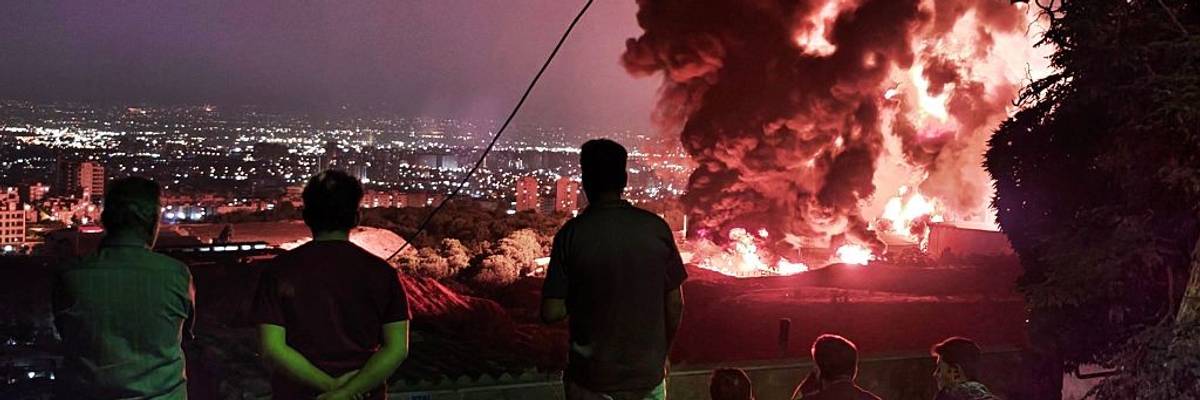
People observe fire and smoke from an Israeli attack on the Shahran oil depot on June 15, 2025 in Tehran, Iran.
What if every war came with a bill for the carbon it releases into the atmosphere?
When a bomb destroys a home, we see the rubble. When a factory burns, we see the smoke. When forests are set on fire, we see the devastation. But one consequence of war is almost impossible to see: the greenhouse gases released into the atmosphere.
And that carbon does not stay where the bombs fall. Once released, greenhouse gases enter the atmosphere and contribute to global warming far beyond the borders of the country at war. A war may begin in one place, but part of its climate cost is carried by the entire planet.
The smoke may clear. The carbon does not simply stay behind.
The Carbon War Tax is not simply about creating another tax. It is about changing the way we understand the price of war.
Yet when we talk about the cost of war, that climate cost is rarely part of the bill.
That gap in accountability led Saravana Kumar Nagarajan and his colleague Sean Xavier to develop the idea of a Carbon War Tax, documented in their 2021 master's thesis at Klaipėda University and the University of Bergen. The question behind it was simple: if industries are increasingly expected to measure and account for their carbon emissions, why should warfare be treated differently?
The Carbon War Tax proposes a new principle: Measure the greenhouse-gas emissions caused by war, assign responsibility, and attach a financial obligation to those emissions.
Military fuel use, weapons production and transportation, fires, destroyed factories and power plants, damaged infrastructure, and burning forests can all create emissions. Scientific models, satellite imagery, and other data could help estimate them. The goal would not be perfect accounting overnight. It would be to make an invisible cost visible.
And then make someone responsible for it.
The money generated through such a system could support carbon capture and storage, environmental restoration, ecosystem recovery, pollution cleanup, and climate-resilient rebuilding in communities affected by war.
That creates a striking possibility: The environmental cost of destruction could help pay for restoration.
The Carbon War Tax is not a proposal to put a price on human suffering. No amount of money can compensate a family for a life lost or a community destroyed. It addresses one specific consequence of war—the carbon and environmental damage that reaches far beyond the battlefield.
Today, we count the cost of weapons. We count military spending. We count destroyed buildings and economic losses. We count refugees and reconstruction.
The Carbon War Tax asks us to add another question: How much carbon did this war release—and who is responsible for paying for it?
That question could also change the economics of war.
No tax will magically end conflict. Wars are driven by power, territory, security, ideology, and politics. But economic consequences influence decisions. If military escalation carried a measurable climate liability, governments would have one more cost to consider before choosing destruction over negotiation.
And there is a deeper question of justice.
Why should a community devastated by war inherit the environmental damage? Why should people who had no role in starting a conflict bear the climate consequences of the emissions it creates? And why should future generations inherit an atmospheric debt they never chose?
The Carbon War Tax is not presented as a finished international policy. It is a starting framework that needs to be tested, challenged, and developed.
Climate-policy researchers could determine how wartime emissions should be measured. Scientists could improve methods for calculating emissions from military operations and conflict-related destruction. Economists could study how a financial mechanism could work without creating unintended consequences. International-law experts could examine questions of responsibility and enforcement. Policymakers, diplomats, and peace organizations could explore how such a system might fit within existing international climate and legal frameworks.
In other words, the idea needs a global research effort to turn a powerful concept into a credible mechanism that could one day be implemented.
That work has not yet been done. And that is precisely why the conversation should begin.
The idea began as an academic question in 2021. It now deserves to move beyond the pages of a thesis and into the hands of the researchers, policymakers, and institutions capable of testing its possibilities.
Because if the world can develop systems to make industries accountable for their carbon, perhaps it can eventually develop a system to make war accountable for its carbon.
Imagine a future in which governments considering military escalation must confront not only the human and financial costs of war, but also the environmental debt it could create.
Imagine that debt helping restore forests, ecosystems, and communities damaged by conflict.
Imagine peace having not only a moral argument, but another economic one.
The Carbon War Tax is not simply about creating another tax.
It is about changing the way we understand the price of war.
War destroys lives. War destroys communities. And war can leave behind a carbon debt carried by the entire planet.
Perhaps it is time that debt became visible.
Perhaps it is time that the world studied how to make it accountable.
And perhaps, if developed into a workable international mechanism, the Carbon War Tax could give peace one more powerful reason to prevail.
Dear Common Dreams reader, It’s been nearly 30 years since I co-founded Common Dreams with my late wife, Lina Newhouser. We had the radical notion that journalism should serve the public good, not corporate profits. It was clear to us from the outset what it would take to build such a project. No paid advertisements. No corporate sponsors. No millionaire publisher telling us what to think or do. Many people said we wouldn't last a year, but we proved those doubters wrong. Together with a tremendous team of journalists and dedicated staff, we built an independent media outlet free from the constraints of profits and corporate control. Our mission has always been simple: To inform. To inspire. To ignite change for the common good. Building Common Dreams was not easy. Our survival was never guaranteed. When you take on the most powerful forces—Wall Street greed, fossil fuel industry destruction, Big Tech lobbyists, and uber-rich oligarchs who have spent billions upon billions rigging the economy and democracy in their favor—the only bulwark you have is supporters who believe in your work. But here’s the urgent message from me today. It's never been this bad out there. And it's never been this hard to keep us going. At the very moment Common Dreams is most needed, the threats we face are intensifying. We need your support now more than ever. We don't accept corporate advertising and never will. We don't have a paywall because we don't think people should be blocked from critical news based on their ability to pay. Everything we do is funded by the donations of readers like you. When everyone does the little they can afford, we are strong. But if that support retreats or dries up, so do we. Will you donate now to make sure Common Dreams not only survives but thrives? —Craig Brown, Co-founder |
When a bomb destroys a home, we see the rubble. When a factory burns, we see the smoke. When forests are set on fire, we see the devastation. But one consequence of war is almost impossible to see: the greenhouse gases released into the atmosphere.
And that carbon does not stay where the bombs fall. Once released, greenhouse gases enter the atmosphere and contribute to global warming far beyond the borders of the country at war. A war may begin in one place, but part of its climate cost is carried by the entire planet.
The smoke may clear. The carbon does not simply stay behind.
The Carbon War Tax is not simply about creating another tax. It is about changing the way we understand the price of war.
Yet when we talk about the cost of war, that climate cost is rarely part of the bill.
That gap in accountability led Saravana Kumar Nagarajan and his colleague Sean Xavier to develop the idea of a Carbon War Tax, documented in their 2021 master's thesis at Klaipėda University and the University of Bergen. The question behind it was simple: if industries are increasingly expected to measure and account for their carbon emissions, why should warfare be treated differently?
The Carbon War Tax proposes a new principle: Measure the greenhouse-gas emissions caused by war, assign responsibility, and attach a financial obligation to those emissions.
Military fuel use, weapons production and transportation, fires, destroyed factories and power plants, damaged infrastructure, and burning forests can all create emissions. Scientific models, satellite imagery, and other data could help estimate them. The goal would not be perfect accounting overnight. It would be to make an invisible cost visible.
And then make someone responsible for it.
The money generated through such a system could support carbon capture and storage, environmental restoration, ecosystem recovery, pollution cleanup, and climate-resilient rebuilding in communities affected by war.
That creates a striking possibility: The environmental cost of destruction could help pay for restoration.
The Carbon War Tax is not a proposal to put a price on human suffering. No amount of money can compensate a family for a life lost or a community destroyed. It addresses one specific consequence of war—the carbon and environmental damage that reaches far beyond the battlefield.
Today, we count the cost of weapons. We count military spending. We count destroyed buildings and economic losses. We count refugees and reconstruction.
The Carbon War Tax asks us to add another question: How much carbon did this war release—and who is responsible for paying for it?
That question could also change the economics of war.
No tax will magically end conflict. Wars are driven by power, territory, security, ideology, and politics. But economic consequences influence decisions. If military escalation carried a measurable climate liability, governments would have one more cost to consider before choosing destruction over negotiation.
And there is a deeper question of justice.
Why should a community devastated by war inherit the environmental damage? Why should people who had no role in starting a conflict bear the climate consequences of the emissions it creates? And why should future generations inherit an atmospheric debt they never chose?
The Carbon War Tax is not presented as a finished international policy. It is a starting framework that needs to be tested, challenged, and developed.
Climate-policy researchers could determine how wartime emissions should be measured. Scientists could improve methods for calculating emissions from military operations and conflict-related destruction. Economists could study how a financial mechanism could work without creating unintended consequences. International-law experts could examine questions of responsibility and enforcement. Policymakers, diplomats, and peace organizations could explore how such a system might fit within existing international climate and legal frameworks.
In other words, the idea needs a global research effort to turn a powerful concept into a credible mechanism that could one day be implemented.
That work has not yet been done. And that is precisely why the conversation should begin.
The idea began as an academic question in 2021. It now deserves to move beyond the pages of a thesis and into the hands of the researchers, policymakers, and institutions capable of testing its possibilities.
Because if the world can develop systems to make industries accountable for their carbon, perhaps it can eventually develop a system to make war accountable for its carbon.
Imagine a future in which governments considering military escalation must confront not only the human and financial costs of war, but also the environmental debt it could create.
Imagine that debt helping restore forests, ecosystems, and communities damaged by conflict.
Imagine peace having not only a moral argument, but another economic one.
The Carbon War Tax is not simply about creating another tax.
It is about changing the way we understand the price of war.
War destroys lives. War destroys communities. And war can leave behind a carbon debt carried by the entire planet.
Perhaps it is time that debt became visible.
Perhaps it is time that the world studied how to make it accountable.
And perhaps, if developed into a workable international mechanism, the Carbon War Tax could give peace one more powerful reason to prevail.
When a bomb destroys a home, we see the rubble. When a factory burns, we see the smoke. When forests are set on fire, we see the devastation. But one consequence of war is almost impossible to see: the greenhouse gases released into the atmosphere.
And that carbon does not stay where the bombs fall. Once released, greenhouse gases enter the atmosphere and contribute to global warming far beyond the borders of the country at war. A war may begin in one place, but part of its climate cost is carried by the entire planet.
The smoke may clear. The carbon does not simply stay behind.
The Carbon War Tax is not simply about creating another tax. It is about changing the way we understand the price of war.
Yet when we talk about the cost of war, that climate cost is rarely part of the bill.
That gap in accountability led Saravana Kumar Nagarajan and his colleague Sean Xavier to develop the idea of a Carbon War Tax, documented in their 2021 master's thesis at Klaipėda University and the University of Bergen. The question behind it was simple: if industries are increasingly expected to measure and account for their carbon emissions, why should warfare be treated differently?
The Carbon War Tax proposes a new principle: Measure the greenhouse-gas emissions caused by war, assign responsibility, and attach a financial obligation to those emissions.
Military fuel use, weapons production and transportation, fires, destroyed factories and power plants, damaged infrastructure, and burning forests can all create emissions. Scientific models, satellite imagery, and other data could help estimate them. The goal would not be perfect accounting overnight. It would be to make an invisible cost visible.
And then make someone responsible for it.
The money generated through such a system could support carbon capture and storage, environmental restoration, ecosystem recovery, pollution cleanup, and climate-resilient rebuilding in communities affected by war.
That creates a striking possibility: The environmental cost of destruction could help pay for restoration.
The Carbon War Tax is not a proposal to put a price on human suffering. No amount of money can compensate a family for a life lost or a community destroyed. It addresses one specific consequence of war—the carbon and environmental damage that reaches far beyond the battlefield.
Today, we count the cost of weapons. We count military spending. We count destroyed buildings and economic losses. We count refugees and reconstruction.
The Carbon War Tax asks us to add another question: How much carbon did this war release—and who is responsible for paying for it?
That question could also change the economics of war.
No tax will magically end conflict. Wars are driven by power, territory, security, ideology, and politics. But economic consequences influence decisions. If military escalation carried a measurable climate liability, governments would have one more cost to consider before choosing destruction over negotiation.
And there is a deeper question of justice.
Why should a community devastated by war inherit the environmental damage? Why should people who had no role in starting a conflict bear the climate consequences of the emissions it creates? And why should future generations inherit an atmospheric debt they never chose?
The Carbon War Tax is not presented as a finished international policy. It is a starting framework that needs to be tested, challenged, and developed.
Climate-policy researchers could determine how wartime emissions should be measured. Scientists could improve methods for calculating emissions from military operations and conflict-related destruction. Economists could study how a financial mechanism could work without creating unintended consequences. International-law experts could examine questions of responsibility and enforcement. Policymakers, diplomats, and peace organizations could explore how such a system might fit within existing international climate and legal frameworks.
In other words, the idea needs a global research effort to turn a powerful concept into a credible mechanism that could one day be implemented.
That work has not yet been done. And that is precisely why the conversation should begin.
The idea began as an academic question in 2021. It now deserves to move beyond the pages of a thesis and into the hands of the researchers, policymakers, and institutions capable of testing its possibilities.
Because if the world can develop systems to make industries accountable for their carbon, perhaps it can eventually develop a system to make war accountable for its carbon.
Imagine a future in which governments considering military escalation must confront not only the human and financial costs of war, but also the environmental debt it could create.
Imagine that debt helping restore forests, ecosystems, and communities damaged by conflict.
Imagine peace having not only a moral argument, but another economic one.
The Carbon War Tax is not simply about creating another tax.
It is about changing the way we understand the price of war.
War destroys lives. War destroys communities. And war can leave behind a carbon debt carried by the entire planet.
Perhaps it is time that debt became visible.
Perhaps it is time that the world studied how to make it accountable.
And perhaps, if developed into a workable international mechanism, the Carbon War Tax could give peace one more powerful reason to prevail.