SUBSCRIBE TO OUR FREE NEWSLETTER
Daily news & progressive opinion—funded by the people, not the corporations—delivered straight to your inbox.
5
#000000
#FFFFFF
To donate by check, phone, or other method, see our More Ways to Give page.
Daily news & progressive opinion—funded by the people, not the corporations—delivered straight to your inbox.
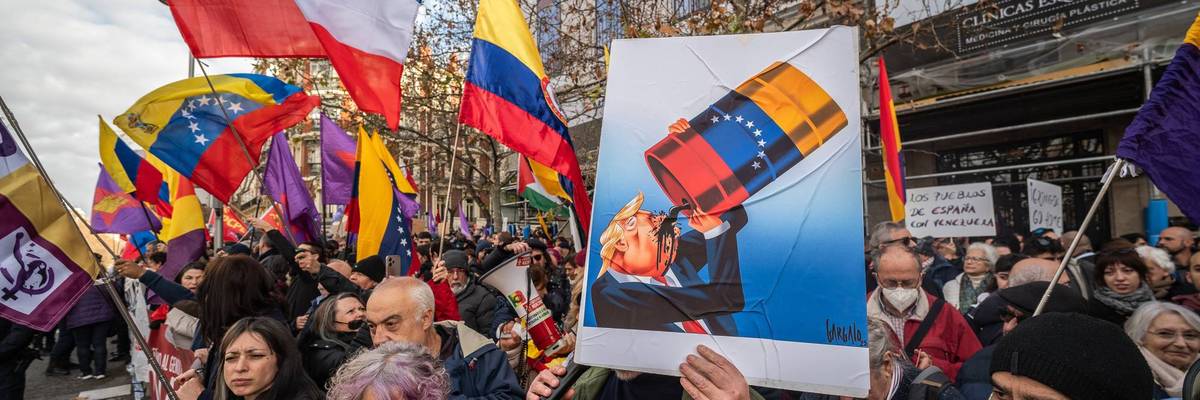
A man holds a placard during a protest showing US President Donald Trump drinking from a barrel of oil in Madrid, Spain on January 4, 2026.
For a long time, the word “capitalism” was taboo. Now that multimillionaires and billionaires have taken over the US government, it’s on everyone’s lips. Yet there are only a few systematic analyses of “capitalism and war.”
Karl Marx and Friedrich Engels taught us that capitalism is a system primarily characterized by private control over the means of production. In other words: Factories and banks are privately owned. Business decisions are guided by whether they generate surplus value that can be appropriated as profit by the owners. Workers become a commodity, one that must, however, market itself and generate exchange value.
In this context, the state’s primary role is to safeguard these relations of production and balance the interests of the various factions of capital. In doing so, the construction of neoliberal ideologies sought to minimize state benefits for the poorer strata of society, destroy the protective mechanisms of poorer societies, and simultaneously transfer state resources to capitalist oligarchies. Those who demanded the elimination of subsidies were, in fact, the very ones who benefited from them. Elon Musk is a current example of this, having actively helped reduce government spending while simultaneously securing subsidies for SpaceX.
Capital has always been and remains constantly on the lookout for new avenues of exploitation. This requires, on the one hand, the necessity of permanent economic growth within society and, on the other hand, the constant development of new global markets. This not only comes at the expense of people but also devastates and destroys the ecology of this planet. The compulsion and the inherent dynamics of capitalism to constantly grow and achieve ever-higher profits lead to the depletion of the planet and, step by step—but also through tipping points—destroy the conditions of existence on Earth.
Marx and Engels already foresightedly analyzed in the mid-19th century how the process of globalization unfolds under capitalism—here is their famous and still relevant quote from the Communist Manifesto:
The need for ever-expanding markets for its products drives the bourgeoisie across the entire globe. Everywhere it must take root, everywhere it must expand, everywhere it must establish connections. Through the exploitation of the world market, the bourgeoisie has made production and consumption cosmopolitan.
Capitalism means the embedding of economic greed in the deep structures of a society. This manifests itself in an extreme wealth gap, with very rich multimillionaires and billionaires and an increasingly larger class of impoverished people. The Marxist theory of impoverishment applies not only to the wealth gap between the rich nations of the Global North and the nations of the Global South affected by global exploitation, but is now also evident in the wealthier nations.
US President Donald Trump, Peter Thiel, Elon Musk, Vice President JD Vance, and others are examples of the capitalist right wing, which is attempting, through radical means, to undermine the welfare state and install an extremely ruthless form of capitalism.
Capitalism expanded worldwide as part of its historic triumphal march. It not only spread from Europe into all geographical regions of the world, but it also penetrated hegemonicly into the inner spaces of human coexistence—as Elmar Altvater notes:
The micro- and nanostructures of life are assigned value and thereby manipulated in such a way that their transformation into commodities and their exploitation in monetary form result. Private retreats are not safe from the constraints of money and capital. Forms of social co-existence are increasingly structured in contractual terms and thereby subjected to the logic of monetary market equivalence. Capitalist valorization is an all-encompassing yet, within the confines of the planet, limited and limiting principle, whose rules must be obeyed as if they were God’s commandments.
In an ever-evolving and diversifying capitalism, zones are emerging worldwide where financial oligarchies live behind guarded walls, largely evade taxes, and refuse to fulfill the social obligations of a community. The system described by Canadian-born historian Quinn Slobodian as “crack-up capitalism” is characterized by him as follows:
Within the national containers, one finds unusual legal spaces, anomalous territories, and peculiar jurisdictions. There are city-states, tax havens, enclaves, free ports, technology parks, duty-free zones, and innovation centers. The world of nation-states is littered with zones—and we are only beginning to understand their influence on contemporary politics.
The privatization of public funds, destructive investment in weapons and the military, the lack of purchasing power among impoverished segments of the population, geopolitical rivalries, as well as the finite nature of the Earth’s resources and the struggles over them lead to economic crises that are managed in various ways. Eco-imperial tensions are—according to political scientists Ulrich Brand and Markus Wissen:
Tensions between states and state alliances resulting from capitalism’s access to an ‘outside’ that is becoming increasingly available and uncontested in the ecological crisis. These eco-imperial tensions are becoming a structural feature of international politics; they are therefore not merely temporary but permanently present.
The extreme political right, in particular, exploits the crisis-prone nature of capitalism to promise authoritarian solutions to crises and, ultimately, to further exacerbate the wealth gap if it gains the power to do so. Human rights are disregarded; international law is violated. The struggle for resources such as oil, gas, and rare earths, and the billions in profits associated with them, shapes international politics and leads to wars and mass displacement.
Currently, the largest fossil fuel dealers—the US, Russia, and Iran—are fighting over global resources in the interests of their economies and financial capital. They are also fighting against an emerging capitalist faction and against cooperative initiatives that aim to solve the global energy problem with the help of renewable energy.
This critique applies not only to conditions in the Global North but also to the capitalist development path in the countries of the Global South—according to political scientist and activist Alexander Behr:
A brutal class struggle is also underway in many other countries of the Global South. The national bourgeoisie serves the interests of transnational corporations. In the short term, it can rely on a growing middle class that wants to secure its imperial lifestyle. But the hegemonic development path—whether state-interventionist as in China or neoliberal as in Brazil—is deeply destructive and will further intensify resource conflicts in the future. It thus ultimately jeopardizes the security of supply for all people.
It should be noted here that a struggle over solar energy does not lead to wars. The sun’s energy is limitlessly usable for us humans. The struggle over fossil fuels and rare earths is a struggle over limited resources that will become increasingly scarce in the future. The peace- and ecology-oriented journalist and author Franz Alt therefore writes in his article “Sun and Wind Do Not Need the Strait of Hormuz”:
One of the most crucial questions for the future is: War over oil or peace through the sun? The Iraq War, the Afghanistan War, the war over Venezuela, and now the Iran War: All these wars were or are wars over fossil fuels. Sun and wind, however, are gifts from heaven. They are energies of peace.
Of course, we must not forget that even “green” raw materials needed to produce electric car batteries (e.g., lithium or cobalt) are already hotly contested—regardless of whether the electric cars are powered by solar energy.
Authoritarian capitalist systems have no qualms about invading other states to secure and expand their own economic growth as well as the returns and privileges for their ruling classes. In states where the scope for public action is still governed by democratic constitutions, however, an internal societal debate takes place. The question here is whether international law and human rights must be respected or whether asserting interests through military means is appropriate. Societies with a democratic self-image, however, are currently tending toward militarization and increasingly authoritarian structures in the face of individual states perceived as threats. Russia’s war of aggression in Ukraine, for example, is a trigger here.
In this context, the arms industry appears to be prevailing over capitalist circles more interested in peace regarding the use of public, state funds, due to geopolitical trends. This means that an industry and its shareholders are currently gaining the upper hand, whose products are used for destruction, rather than for constructive investments. Conversely, attempts are being made to divert public funds away from ecologically oriented industries and social support for underprivileged segments of society in order to finance weapons and military personnel.
Wars are—besides geopolitical power ambitions—primarily resource wars in the interest of capital owners who profit from them and speculative war profiteers.
To this end, for example in Germany, a horrendous level of national debt disguised as a “special fund” is being accepted. This means that funds necessary for repairing what has been destroyed and for rebuilding alternative societies are also being withdrawn from future generations. This constitutes a massive privatization of public funds.
Naomi Klein discusses disaster capitalism and its profit-maximizing shock strategy. Natural disasters, military conflicts, or massive economic crises are deliberately exploited under capitalism to engineer economic redistribution and increase returns. Democratic structures and development would be brutally suppressed if the exploitation of disasters were to be hindered.
In particular, the combination of capitalism and an authoritarian-repressive social structure is a highly dangerous systemic alliance.
In this context, the further development of the means of production in a digital direction driven by artificial intelligence serves both to increase profits and to monitor and manipulate the population, as well as to enhance the efficiency of weapon systems used in wars—according to the Greek economist and politician Yannis Varouvakis (2025):
The implications are staggering: ubiquitous surveillance, automated targeting on the battlefields, macroeconomic instability (as cloud rents destroy aggregate demand), the end of democracy itself as an ideal (hailed by Peter Thiel), and the death of universities, replaced by personalized AI extensions.
US President Donald Trump, Peter Thiel, Elon Musk, Vice President JD Vance, and others are examples of the capitalist right wing, which is attempting, through radical means, to undermine the welfare state and install an extremely ruthless form of capitalism. In doing so, they seek to revise and abolish the centuries-long struggle of exploited and alienated people—both in their daily lives and in their work—against the inhuman power of unbridled capitalism.
Wars are—besides geopolitical power ambitions—primarily resource wars in the interest of capital owners who profit from them and speculative war profiteers. The more repressive a state’s social structure is, the easier it is for its ruling “elite” or capitalist oligarchies to legitimize wars and enforce them within society.
The death of people—including civilians—the destruction of painstakingly built infrastructure, as well as ecocide—the destruction of nature as a weapon of war—do not play a role in limiting the actions of these systems.
Critical peace research seeks to analytically elucidate this connection and raise awareness of it. At the same time, its task should also be to develop step-by-step perspectives on how to strengthen democracy within society in a broader sense and how international understanding and cooperation can be achieved.
In this context, the topic of "capitalism" must not be overlooked. All systems—including capitalism—must be scrutinized to determine the extent to which their structures exhibit excesses of power that go beyond the state’s legitimate monopoly on the use of force. Domination without constitutional and democratic oversight leads to domestic repression and the destruction of interstate peace and international peace orders. States such as Russia, the US, or Turkey are current capitalist examples of this—even if they are authoritarian in different ways.
Peace, on the other hand, requires a social system whose economic practices are both solidarity based and ecological, and which takes the rule of law, international and human rights, and democracy seriously. This system can begin within capitalism, but will only be able to fully develop in a different social formation that can no longer be described as a capitalist society.
Dear Common Dreams reader, It’s been nearly 30 years since I co-founded Common Dreams with my late wife, Lina Newhouser. We had the radical notion that journalism should serve the public good, not corporate profits. It was clear to us from the outset what it would take to build such a project. No paid advertisements. No corporate sponsors. No millionaire publisher telling us what to think or do. Many people said we wouldn't last a year, but we proved those doubters wrong. Together with a tremendous team of journalists and dedicated staff, we built an independent media outlet free from the constraints of profits and corporate control. Our mission has always been simple: To inform. To inspire. To ignite change for the common good. Building Common Dreams was not easy. Our survival was never guaranteed. When you take on the most powerful forces—Wall Street greed, fossil fuel industry destruction, Big Tech lobbyists, and uber-rich oligarchs who have spent billions upon billions rigging the economy and democracy in their favor—the only bulwark you have is supporters who believe in your work. But here’s the urgent message from me today. It's never been this bad out there. And it's never been this hard to keep us going. At the very moment Common Dreams is most needed, the threats we face are intensifying. We need your support now more than ever. We don't accept corporate advertising and never will. We don't have a paywall because we don't think people should be blocked from critical news based on their ability to pay. Everything we do is funded by the donations of readers like you. When everyone does the little they can afford, we are strong. But if that support retreats or dries up, so do we. Will you donate now to make sure Common Dreams not only survives but thrives? —Craig Brown, Co-founder |
Karl Marx and Friedrich Engels taught us that capitalism is a system primarily characterized by private control over the means of production. In other words: Factories and banks are privately owned. Business decisions are guided by whether they generate surplus value that can be appropriated as profit by the owners. Workers become a commodity, one that must, however, market itself and generate exchange value.
In this context, the state’s primary role is to safeguard these relations of production and balance the interests of the various factions of capital. In doing so, the construction of neoliberal ideologies sought to minimize state benefits for the poorer strata of society, destroy the protective mechanisms of poorer societies, and simultaneously transfer state resources to capitalist oligarchies. Those who demanded the elimination of subsidies were, in fact, the very ones who benefited from them. Elon Musk is a current example of this, having actively helped reduce government spending while simultaneously securing subsidies for SpaceX.
Capital has always been and remains constantly on the lookout for new avenues of exploitation. This requires, on the one hand, the necessity of permanent economic growth within society and, on the other hand, the constant development of new global markets. This not only comes at the expense of people but also devastates and destroys the ecology of this planet. The compulsion and the inherent dynamics of capitalism to constantly grow and achieve ever-higher profits lead to the depletion of the planet and, step by step—but also through tipping points—destroy the conditions of existence on Earth.
Marx and Engels already foresightedly analyzed in the mid-19th century how the process of globalization unfolds under capitalism—here is their famous and still relevant quote from the Communist Manifesto:
The need for ever-expanding markets for its products drives the bourgeoisie across the entire globe. Everywhere it must take root, everywhere it must expand, everywhere it must establish connections. Through the exploitation of the world market, the bourgeoisie has made production and consumption cosmopolitan.
Capitalism means the embedding of economic greed in the deep structures of a society. This manifests itself in an extreme wealth gap, with very rich multimillionaires and billionaires and an increasingly larger class of impoverished people. The Marxist theory of impoverishment applies not only to the wealth gap between the rich nations of the Global North and the nations of the Global South affected by global exploitation, but is now also evident in the wealthier nations.
US President Donald Trump, Peter Thiel, Elon Musk, Vice President JD Vance, and others are examples of the capitalist right wing, which is attempting, through radical means, to undermine the welfare state and install an extremely ruthless form of capitalism.
Capitalism expanded worldwide as part of its historic triumphal march. It not only spread from Europe into all geographical regions of the world, but it also penetrated hegemonicly into the inner spaces of human coexistence—as Elmar Altvater notes:
The micro- and nanostructures of life are assigned value and thereby manipulated in such a way that their transformation into commodities and their exploitation in monetary form result. Private retreats are not safe from the constraints of money and capital. Forms of social co-existence are increasingly structured in contractual terms and thereby subjected to the logic of monetary market equivalence. Capitalist valorization is an all-encompassing yet, within the confines of the planet, limited and limiting principle, whose rules must be obeyed as if they were God’s commandments.
In an ever-evolving and diversifying capitalism, zones are emerging worldwide where financial oligarchies live behind guarded walls, largely evade taxes, and refuse to fulfill the social obligations of a community. The system described by Canadian-born historian Quinn Slobodian as “crack-up capitalism” is characterized by him as follows:
Within the national containers, one finds unusual legal spaces, anomalous territories, and peculiar jurisdictions. There are city-states, tax havens, enclaves, free ports, technology parks, duty-free zones, and innovation centers. The world of nation-states is littered with zones—and we are only beginning to understand their influence on contemporary politics.
The privatization of public funds, destructive investment in weapons and the military, the lack of purchasing power among impoverished segments of the population, geopolitical rivalries, as well as the finite nature of the Earth’s resources and the struggles over them lead to economic crises that are managed in various ways. Eco-imperial tensions are—according to political scientists Ulrich Brand and Markus Wissen:
Tensions between states and state alliances resulting from capitalism’s access to an ‘outside’ that is becoming increasingly available and uncontested in the ecological crisis. These eco-imperial tensions are becoming a structural feature of international politics; they are therefore not merely temporary but permanently present.
The extreme political right, in particular, exploits the crisis-prone nature of capitalism to promise authoritarian solutions to crises and, ultimately, to further exacerbate the wealth gap if it gains the power to do so. Human rights are disregarded; international law is violated. The struggle for resources such as oil, gas, and rare earths, and the billions in profits associated with them, shapes international politics and leads to wars and mass displacement.
Currently, the largest fossil fuel dealers—the US, Russia, and Iran—are fighting over global resources in the interests of their economies and financial capital. They are also fighting against an emerging capitalist faction and against cooperative initiatives that aim to solve the global energy problem with the help of renewable energy.
This critique applies not only to conditions in the Global North but also to the capitalist development path in the countries of the Global South—according to political scientist and activist Alexander Behr:
A brutal class struggle is also underway in many other countries of the Global South. The national bourgeoisie serves the interests of transnational corporations. In the short term, it can rely on a growing middle class that wants to secure its imperial lifestyle. But the hegemonic development path—whether state-interventionist as in China or neoliberal as in Brazil—is deeply destructive and will further intensify resource conflicts in the future. It thus ultimately jeopardizes the security of supply for all people.
It should be noted here that a struggle over solar energy does not lead to wars. The sun’s energy is limitlessly usable for us humans. The struggle over fossil fuels and rare earths is a struggle over limited resources that will become increasingly scarce in the future. The peace- and ecology-oriented journalist and author Franz Alt therefore writes in his article “Sun and Wind Do Not Need the Strait of Hormuz”:
One of the most crucial questions for the future is: War over oil or peace through the sun? The Iraq War, the Afghanistan War, the war over Venezuela, and now the Iran War: All these wars were or are wars over fossil fuels. Sun and wind, however, are gifts from heaven. They are energies of peace.
Of course, we must not forget that even “green” raw materials needed to produce electric car batteries (e.g., lithium or cobalt) are already hotly contested—regardless of whether the electric cars are powered by solar energy.
Authoritarian capitalist systems have no qualms about invading other states to secure and expand their own economic growth as well as the returns and privileges for their ruling classes. In states where the scope for public action is still governed by democratic constitutions, however, an internal societal debate takes place. The question here is whether international law and human rights must be respected or whether asserting interests through military means is appropriate. Societies with a democratic self-image, however, are currently tending toward militarization and increasingly authoritarian structures in the face of individual states perceived as threats. Russia’s war of aggression in Ukraine, for example, is a trigger here.
In this context, the arms industry appears to be prevailing over capitalist circles more interested in peace regarding the use of public, state funds, due to geopolitical trends. This means that an industry and its shareholders are currently gaining the upper hand, whose products are used for destruction, rather than for constructive investments. Conversely, attempts are being made to divert public funds away from ecologically oriented industries and social support for underprivileged segments of society in order to finance weapons and military personnel.
Wars are—besides geopolitical power ambitions—primarily resource wars in the interest of capital owners who profit from them and speculative war profiteers.
To this end, for example in Germany, a horrendous level of national debt disguised as a “special fund” is being accepted. This means that funds necessary for repairing what has been destroyed and for rebuilding alternative societies are also being withdrawn from future generations. This constitutes a massive privatization of public funds.
Naomi Klein discusses disaster capitalism and its profit-maximizing shock strategy. Natural disasters, military conflicts, or massive economic crises are deliberately exploited under capitalism to engineer economic redistribution and increase returns. Democratic structures and development would be brutally suppressed if the exploitation of disasters were to be hindered.
In particular, the combination of capitalism and an authoritarian-repressive social structure is a highly dangerous systemic alliance.
In this context, the further development of the means of production in a digital direction driven by artificial intelligence serves both to increase profits and to monitor and manipulate the population, as well as to enhance the efficiency of weapon systems used in wars—according to the Greek economist and politician Yannis Varouvakis (2025):
The implications are staggering: ubiquitous surveillance, automated targeting on the battlefields, macroeconomic instability (as cloud rents destroy aggregate demand), the end of democracy itself as an ideal (hailed by Peter Thiel), and the death of universities, replaced by personalized AI extensions.
US President Donald Trump, Peter Thiel, Elon Musk, Vice President JD Vance, and others are examples of the capitalist right wing, which is attempting, through radical means, to undermine the welfare state and install an extremely ruthless form of capitalism. In doing so, they seek to revise and abolish the centuries-long struggle of exploited and alienated people—both in their daily lives and in their work—against the inhuman power of unbridled capitalism.
Wars are—besides geopolitical power ambitions—primarily resource wars in the interest of capital owners who profit from them and speculative war profiteers. The more repressive a state’s social structure is, the easier it is for its ruling “elite” or capitalist oligarchies to legitimize wars and enforce them within society.
The death of people—including civilians—the destruction of painstakingly built infrastructure, as well as ecocide—the destruction of nature as a weapon of war—do not play a role in limiting the actions of these systems.
Critical peace research seeks to analytically elucidate this connection and raise awareness of it. At the same time, its task should also be to develop step-by-step perspectives on how to strengthen democracy within society in a broader sense and how international understanding and cooperation can be achieved.
In this context, the topic of "capitalism" must not be overlooked. All systems—including capitalism—must be scrutinized to determine the extent to which their structures exhibit excesses of power that go beyond the state’s legitimate monopoly on the use of force. Domination without constitutional and democratic oversight leads to domestic repression and the destruction of interstate peace and international peace orders. States such as Russia, the US, or Turkey are current capitalist examples of this—even if they are authoritarian in different ways.
Peace, on the other hand, requires a social system whose economic practices are both solidarity based and ecological, and which takes the rule of law, international and human rights, and democracy seriously. This system can begin within capitalism, but will only be able to fully develop in a different social formation that can no longer be described as a capitalist society.
Karl Marx and Friedrich Engels taught us that capitalism is a system primarily characterized by private control over the means of production. In other words: Factories and banks are privately owned. Business decisions are guided by whether they generate surplus value that can be appropriated as profit by the owners. Workers become a commodity, one that must, however, market itself and generate exchange value.
In this context, the state’s primary role is to safeguard these relations of production and balance the interests of the various factions of capital. In doing so, the construction of neoliberal ideologies sought to minimize state benefits for the poorer strata of society, destroy the protective mechanisms of poorer societies, and simultaneously transfer state resources to capitalist oligarchies. Those who demanded the elimination of subsidies were, in fact, the very ones who benefited from them. Elon Musk is a current example of this, having actively helped reduce government spending while simultaneously securing subsidies for SpaceX.
Capital has always been and remains constantly on the lookout for new avenues of exploitation. This requires, on the one hand, the necessity of permanent economic growth within society and, on the other hand, the constant development of new global markets. This not only comes at the expense of people but also devastates and destroys the ecology of this planet. The compulsion and the inherent dynamics of capitalism to constantly grow and achieve ever-higher profits lead to the depletion of the planet and, step by step—but also through tipping points—destroy the conditions of existence on Earth.
Marx and Engels already foresightedly analyzed in the mid-19th century how the process of globalization unfolds under capitalism—here is their famous and still relevant quote from the Communist Manifesto:
The need for ever-expanding markets for its products drives the bourgeoisie across the entire globe. Everywhere it must take root, everywhere it must expand, everywhere it must establish connections. Through the exploitation of the world market, the bourgeoisie has made production and consumption cosmopolitan.
Capitalism means the embedding of economic greed in the deep structures of a society. This manifests itself in an extreme wealth gap, with very rich multimillionaires and billionaires and an increasingly larger class of impoverished people. The Marxist theory of impoverishment applies not only to the wealth gap between the rich nations of the Global North and the nations of the Global South affected by global exploitation, but is now also evident in the wealthier nations.
US President Donald Trump, Peter Thiel, Elon Musk, Vice President JD Vance, and others are examples of the capitalist right wing, which is attempting, through radical means, to undermine the welfare state and install an extremely ruthless form of capitalism.
Capitalism expanded worldwide as part of its historic triumphal march. It not only spread from Europe into all geographical regions of the world, but it also penetrated hegemonicly into the inner spaces of human coexistence—as Elmar Altvater notes:
The micro- and nanostructures of life are assigned value and thereby manipulated in such a way that their transformation into commodities and their exploitation in monetary form result. Private retreats are not safe from the constraints of money and capital. Forms of social co-existence are increasingly structured in contractual terms and thereby subjected to the logic of monetary market equivalence. Capitalist valorization is an all-encompassing yet, within the confines of the planet, limited and limiting principle, whose rules must be obeyed as if they were God’s commandments.
In an ever-evolving and diversifying capitalism, zones are emerging worldwide where financial oligarchies live behind guarded walls, largely evade taxes, and refuse to fulfill the social obligations of a community. The system described by Canadian-born historian Quinn Slobodian as “crack-up capitalism” is characterized by him as follows:
Within the national containers, one finds unusual legal spaces, anomalous territories, and peculiar jurisdictions. There are city-states, tax havens, enclaves, free ports, technology parks, duty-free zones, and innovation centers. The world of nation-states is littered with zones—and we are only beginning to understand their influence on contemporary politics.
The privatization of public funds, destructive investment in weapons and the military, the lack of purchasing power among impoverished segments of the population, geopolitical rivalries, as well as the finite nature of the Earth’s resources and the struggles over them lead to economic crises that are managed in various ways. Eco-imperial tensions are—according to political scientists Ulrich Brand and Markus Wissen:
Tensions between states and state alliances resulting from capitalism’s access to an ‘outside’ that is becoming increasingly available and uncontested in the ecological crisis. These eco-imperial tensions are becoming a structural feature of international politics; they are therefore not merely temporary but permanently present.
The extreme political right, in particular, exploits the crisis-prone nature of capitalism to promise authoritarian solutions to crises and, ultimately, to further exacerbate the wealth gap if it gains the power to do so. Human rights are disregarded; international law is violated. The struggle for resources such as oil, gas, and rare earths, and the billions in profits associated with them, shapes international politics and leads to wars and mass displacement.
Currently, the largest fossil fuel dealers—the US, Russia, and Iran—are fighting over global resources in the interests of their economies and financial capital. They are also fighting against an emerging capitalist faction and against cooperative initiatives that aim to solve the global energy problem with the help of renewable energy.
This critique applies not only to conditions in the Global North but also to the capitalist development path in the countries of the Global South—according to political scientist and activist Alexander Behr:
A brutal class struggle is also underway in many other countries of the Global South. The national bourgeoisie serves the interests of transnational corporations. In the short term, it can rely on a growing middle class that wants to secure its imperial lifestyle. But the hegemonic development path—whether state-interventionist as in China or neoliberal as in Brazil—is deeply destructive and will further intensify resource conflicts in the future. It thus ultimately jeopardizes the security of supply for all people.
It should be noted here that a struggle over solar energy does not lead to wars. The sun’s energy is limitlessly usable for us humans. The struggle over fossil fuels and rare earths is a struggle over limited resources that will become increasingly scarce in the future. The peace- and ecology-oriented journalist and author Franz Alt therefore writes in his article “Sun and Wind Do Not Need the Strait of Hormuz”:
One of the most crucial questions for the future is: War over oil or peace through the sun? The Iraq War, the Afghanistan War, the war over Venezuela, and now the Iran War: All these wars were or are wars over fossil fuels. Sun and wind, however, are gifts from heaven. They are energies of peace.
Of course, we must not forget that even “green” raw materials needed to produce electric car batteries (e.g., lithium or cobalt) are already hotly contested—regardless of whether the electric cars are powered by solar energy.
Authoritarian capitalist systems have no qualms about invading other states to secure and expand their own economic growth as well as the returns and privileges for their ruling classes. In states where the scope for public action is still governed by democratic constitutions, however, an internal societal debate takes place. The question here is whether international law and human rights must be respected or whether asserting interests through military means is appropriate. Societies with a democratic self-image, however, are currently tending toward militarization and increasingly authoritarian structures in the face of individual states perceived as threats. Russia’s war of aggression in Ukraine, for example, is a trigger here.
In this context, the arms industry appears to be prevailing over capitalist circles more interested in peace regarding the use of public, state funds, due to geopolitical trends. This means that an industry and its shareholders are currently gaining the upper hand, whose products are used for destruction, rather than for constructive investments. Conversely, attempts are being made to divert public funds away from ecologically oriented industries and social support for underprivileged segments of society in order to finance weapons and military personnel.
Wars are—besides geopolitical power ambitions—primarily resource wars in the interest of capital owners who profit from them and speculative war profiteers.
To this end, for example in Germany, a horrendous level of national debt disguised as a “special fund” is being accepted. This means that funds necessary for repairing what has been destroyed and for rebuilding alternative societies are also being withdrawn from future generations. This constitutes a massive privatization of public funds.
Naomi Klein discusses disaster capitalism and its profit-maximizing shock strategy. Natural disasters, military conflicts, or massive economic crises are deliberately exploited under capitalism to engineer economic redistribution and increase returns. Democratic structures and development would be brutally suppressed if the exploitation of disasters were to be hindered.
In particular, the combination of capitalism and an authoritarian-repressive social structure is a highly dangerous systemic alliance.
In this context, the further development of the means of production in a digital direction driven by artificial intelligence serves both to increase profits and to monitor and manipulate the population, as well as to enhance the efficiency of weapon systems used in wars—according to the Greek economist and politician Yannis Varouvakis (2025):
The implications are staggering: ubiquitous surveillance, automated targeting on the battlefields, macroeconomic instability (as cloud rents destroy aggregate demand), the end of democracy itself as an ideal (hailed by Peter Thiel), and the death of universities, replaced by personalized AI extensions.
US President Donald Trump, Peter Thiel, Elon Musk, Vice President JD Vance, and others are examples of the capitalist right wing, which is attempting, through radical means, to undermine the welfare state and install an extremely ruthless form of capitalism. In doing so, they seek to revise and abolish the centuries-long struggle of exploited and alienated people—both in their daily lives and in their work—against the inhuman power of unbridled capitalism.
Wars are—besides geopolitical power ambitions—primarily resource wars in the interest of capital owners who profit from them and speculative war profiteers. The more repressive a state’s social structure is, the easier it is for its ruling “elite” or capitalist oligarchies to legitimize wars and enforce them within society.
The death of people—including civilians—the destruction of painstakingly built infrastructure, as well as ecocide—the destruction of nature as a weapon of war—do not play a role in limiting the actions of these systems.
Critical peace research seeks to analytically elucidate this connection and raise awareness of it. At the same time, its task should also be to develop step-by-step perspectives on how to strengthen democracy within society in a broader sense and how international understanding and cooperation can be achieved.
In this context, the topic of "capitalism" must not be overlooked. All systems—including capitalism—must be scrutinized to determine the extent to which their structures exhibit excesses of power that go beyond the state’s legitimate monopoly on the use of force. Domination without constitutional and democratic oversight leads to domestic repression and the destruction of interstate peace and international peace orders. States such as Russia, the US, or Turkey are current capitalist examples of this—even if they are authoritarian in different ways.
Peace, on the other hand, requires a social system whose economic practices are both solidarity based and ecological, and which takes the rule of law, international and human rights, and democracy seriously. This system can begin within capitalism, but will only be able to fully develop in a different social formation that can no longer be described as a capitalist society.