
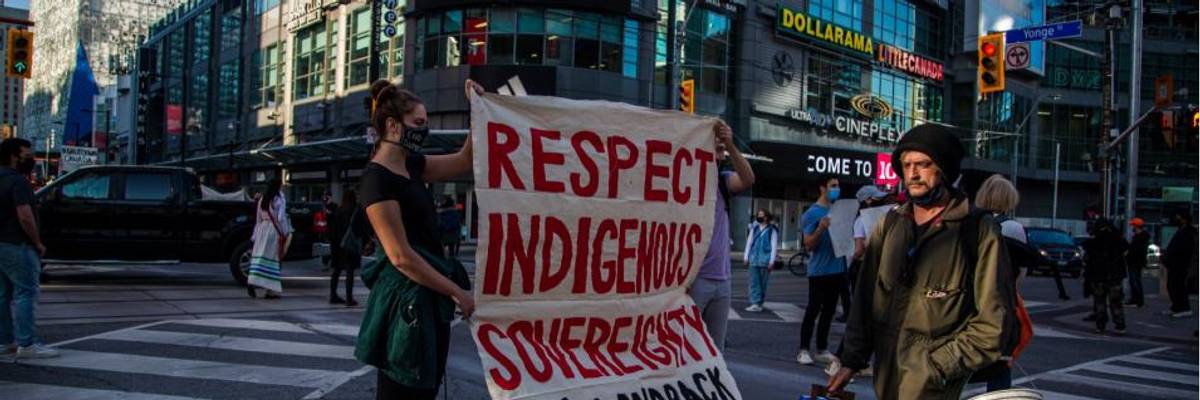
First Nations activists and allies blocked the intersection of Yonge and Dundas Street in Toronto for almost three hours Friday October 23, 2020. The group called on the Canadian government to uphold treaty rights, respect indigenous sovereignty across the nation, and protect indigenous land defenders asserting their rights in various conflicts. (Photo: Nick Lachance/NurPhoto via Getty Images)
Thanksgiving Is Time for Reparations
"Though lives cannot be brought back, the only compensation for land is land."
It's Thanksgiving morning everywhere in America. Thanksgiving needs to mean something to Native people, preferably in the form of justice and reparations. Not a "thanks for taking" sort of commemoration. Maybe it's even time for a reconciliation with Mother Earth.
Here are some ideas. Consider the first thanksgiving with the Wampanoags, Pequots and the Pilgrims. After dining, there were beheadings of Native leaders and their heads were displayed on spikes for decades in Puritan towns. Fast forward to 2018 when the Trump administration issued a decision to remove the Wampanoag Cape Cod reservation from trust status, harkening back to the termination era.
But there is a chance to make good this Thanksgiving.
Beyond eating Native foods, like wild rice, traditional corn and our chocolate, perhaps we can talk about reparations and justice. This is about land -- it's already happening. Across the country, from sea to shining sea, land is being restored to Native people, and it's about time.
This past October, the Maine-based Elliotsville Foundation donated 735 acres of land to the Penobscot Nation, including the headwaters of the Pleasant River, a tributary to the Penobscot River, which is sacred to the tribe.
With the work of the Elliotsville Foundation, the Quimby family, which owns the foundation, along with nearly 50 other land trusts have joined together to form the First Light. This will help restore lands to Indigenous Peoples of the region.
A year ago, on Oct. 21, Tuluwat, known as Indian Island, was returned to the Wiyot Tribe of northern California, which is a good step toward reparations. In 1860, the Tuluwat or Indian Island massacre occurred, in which about 60 to 100 Wiyot peoples were killed.
Though lives cannot be brought back, the only compensation for land is land. "Land acknowledgements" and Indigenous Peoples' Day declarations are a start in the process.
Mount Rushmore, for example, is situated in the Black Hills, which used to belong to the Lakota people. As we watch the statues of white supremacists downed this year, it is also time for this national monument to shut down and be given back to Indigenous people.
The movement for the return of the Black Hills to its people is based on the foundational understanding that it was never for sale. The Black Hills were unilaterally taken after the treaty of 1868 from the Lakota. The Indian Claims Commission (ICC) found that the United States should pay $105 million for the land in 1981. That was then.
To date, the tribes have never taken the settlement, instead, arguing that the land should be returned. After all, if you steal something, you should return it. The ICC settlement money remains, and in July, Native organizers from the NDN Collective, launched a protest when President Trump came to the Black Hills. Much of the Black Hills -- the sacred Paha Sapa -- is in fact held by state and federal government agencies.
National Parks -- Glacier, Mesa Verde, Yosemite, Yellowstone, the Black Hills, to name a few -- are literally a stolen treasure chest from Native people.
It's a fact that the national parks and wildlife refuges hold more land than Native people, which is ironic and tragic. In the long arc of history, we find that enlightenment is still possible. And on this Thanksgiving, I am reminded that the brutality of history only finds redress in reparations and justice.
We are at a crossroads
This country and this world are at a monumental crossroads. In a few short weeks, US voters will have an opportunity to beat back the forces of fascism and confront the billionaires who are rigging the economy, our media system, and our democracy, making it increasingly impossible for ordinary people to get by. We’re not just talking about the election. We’re talking about what must be done once these fascist elements are vanquished from power. We need a bolder set of solutions than what either major party has so far been willing to offer and a working-class movement ready to fight like hell for it. Trump didn't emerge from nowhere. The conditions that fueled MAGA authoritarianism were created by decades of radical neoliberal economic policies and a corrupt political system dominated by corporate interests. They slashed taxes on the super-rich, promising that the benefits would trickle down. They said giveaways to the corporate titans would make life more affordable for the rest of us. It was all bullshit. And when a bitter, betrayed populace searches for someone to blame, right-wing demagogues have little trouble finding scapegoats. People know when they're being lied to, but you won't hear any of this from the corporate media. Only independent journalism—powered and funded by people who believe in building a better world—can deliver truly trustworthy daily news. Our Fall Campaign is underway, and we need your help. To power our newsroom through the rest of the year, we need to raise $125,000 by midnight on October 31. So if you share our vision, please contribute whatever you can to sustain our work. |
Winona LaDuke is Anishinaabe, a writer, an economist and a hemp farmer. LaDuke is a leader in cultural-based sustainable development strategies, renewable energy, sustainable food systems and Indigenous rights. She is the owner of Winona's Hemp, which can be found online at winonashemp.com.
It's Thanksgiving morning everywhere in America. Thanksgiving needs to mean something to Native people, preferably in the form of justice and reparations. Not a "thanks for taking" sort of commemoration. Maybe it's even time for a reconciliation with Mother Earth.
Here are some ideas. Consider the first thanksgiving with the Wampanoags, Pequots and the Pilgrims. After dining, there were beheadings of Native leaders and their heads were displayed on spikes for decades in Puritan towns. Fast forward to 2018 when the Trump administration issued a decision to remove the Wampanoag Cape Cod reservation from trust status, harkening back to the termination era.
But there is a chance to make good this Thanksgiving.
Beyond eating Native foods, like wild rice, traditional corn and our chocolate, perhaps we can talk about reparations and justice. This is about land -- it's already happening. Across the country, from sea to shining sea, land is being restored to Native people, and it's about time.
This past October, the Maine-based Elliotsville Foundation donated 735 acres of land to the Penobscot Nation, including the headwaters of the Pleasant River, a tributary to the Penobscot River, which is sacred to the tribe.
With the work of the Elliotsville Foundation, the Quimby family, which owns the foundation, along with nearly 50 other land trusts have joined together to form the First Light. This will help restore lands to Indigenous Peoples of the region.
A year ago, on Oct. 21, Tuluwat, known as Indian Island, was returned to the Wiyot Tribe of northern California, which is a good step toward reparations. In 1860, the Tuluwat or Indian Island massacre occurred, in which about 60 to 100 Wiyot peoples were killed.
Though lives cannot be brought back, the only compensation for land is land. "Land acknowledgements" and Indigenous Peoples' Day declarations are a start in the process.
Mount Rushmore, for example, is situated in the Black Hills, which used to belong to the Lakota people. As we watch the statues of white supremacists downed this year, it is also time for this national monument to shut down and be given back to Indigenous people.
The movement for the return of the Black Hills to its people is based on the foundational understanding that it was never for sale. The Black Hills were unilaterally taken after the treaty of 1868 from the Lakota. The Indian Claims Commission (ICC) found that the United States should pay $105 million for the land in 1981. That was then.
To date, the tribes have never taken the settlement, instead, arguing that the land should be returned. After all, if you steal something, you should return it. The ICC settlement money remains, and in July, Native organizers from the NDN Collective, launched a protest when President Trump came to the Black Hills. Much of the Black Hills -- the sacred Paha Sapa -- is in fact held by state and federal government agencies.
National Parks -- Glacier, Mesa Verde, Yosemite, Yellowstone, the Black Hills, to name a few -- are literally a stolen treasure chest from Native people.
It's a fact that the national parks and wildlife refuges hold more land than Native people, which is ironic and tragic. In the long arc of history, we find that enlightenment is still possible. And on this Thanksgiving, I am reminded that the brutality of history only finds redress in reparations and justice.