SUBSCRIBE TO OUR FREE NEWSLETTER
Daily news & progressive opinion—funded by the people, not the corporations—delivered straight to your inbox.
5
#000000
#FFFFFF
To donate by check, phone, or other method, see our More Ways to Give page.
Daily news & progressive opinion—funded by the people, not the corporations—delivered straight to your inbox.
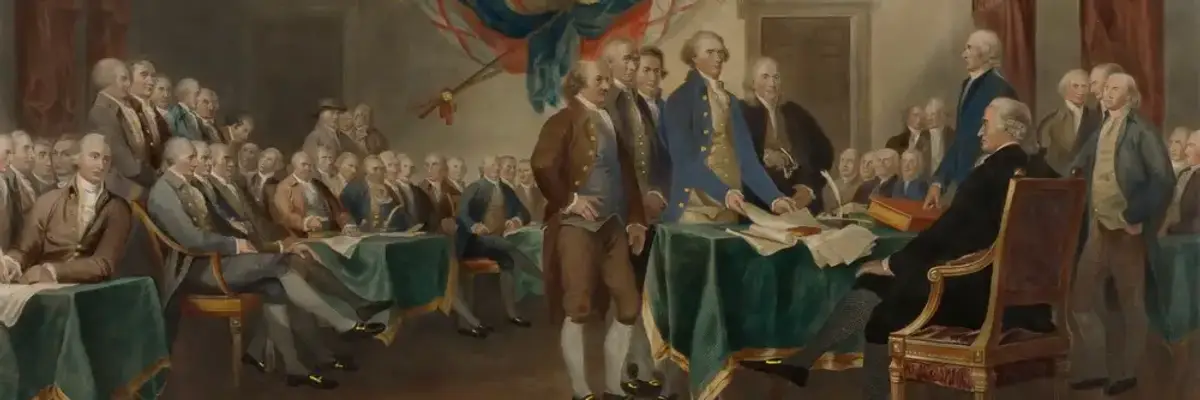
Signing of the Declaration of Independence, July 4, 1776.
The lesson of 250 years: Democracy is hard won and may be easily lost unless we are vigilant in protecting it.
This Fourth of July marks the 250th birthday of a new kind of nation state — based not on ancestral ties to a land or on the territorial reach of monarchs, but on shared principles about the rights of citizens and the purpose of the state.
The Founding Fathers set forth those principles in the Declaration of Independence: “All men are created equal” and have “unalienable Rights [to] Life, Liberty, and the pursuit of Happiness.” To “secure these rights,” Jefferson wrote, the government must “derive just powers from the consent of the governed.”
America has come a long way over two and a half centuries, but today we face a grave challenge from within — and especially from our own leaders.
Of course, those founding ideas have always been more aspiration than reality. In a sense the Declaration of Independence was an invitation to struggle over the inequalities that marred the new nation: slavery and white supremacy, the subjugation of Native peoples, the legal subordination of women, the limitation of voting rights to the well-off.
In the course of 250 years, those struggles have achieved tremendous progress.
A bloody Civil War won what Lincoln called “a new birth of freedom.” Slavery was abolished and the Constitution amended to strengthen the government’s ability to safeguard the rights of African Americans and other people.
Women were eventually enfranchised and achieved formal legal equality. The lawless subordination and genocides of Native Americans were eventually recognized as the evils they are. The Civil Rights Movement repealed American apartheid and restored rights that had been stripped away.
But equality and democracy are openly contested today in a manner not seen in a century. Those who oppose the Founding Fathers’ fundamental values are using our government to attack equality and democracy. The good news is that tens of millions of Americans are fighting back.
America is and always has been a nation of diverse peoples — a multi-ethnic, multi-racial mix — and that is what the Framers and their successors had in mind.
Indeed, the Declaration of Independence complained that the King obstructed the “Naturalization of Foreigners” and failed to “encourage migration hither.” Enslavers brought millions of Africans to our shores, and America became their land as well. National expansion westward incorporated French, Spanish, and Mexican peoples into America, too.
But today the Trump regime seeks to erase the diversity essential to our national character. White supremacy and white nationalism are threads running through nearly every policy — from ending civil rights enforcement to discriminating against African-American military leaders, terminating refugee programs for nonwhites, slandering Haitians, and calling Hispanic migrants “the worst of the worst.”
Free elections, majority rule, and democracy itself are Trump’s targets — from his efforts to overturn the 2020 election to his unrelenting assault on voting rights and representation today.
Today, gerrymanders demanded by Trump are likely to eliminate one third of African-American members of Congress. The Supreme Court has erased the protections of the Voting Rights Act. Evidence-free voter suppression laws are making it more difficult for eligible voters to cast their ballots, while Trump seeks to outlaw voting by mail and his backers threaten to deploy ICE to intimidate midterm voters.
On this 250th anniversary of our first struggle for American freedom and democracy, Americans are fighting back against this war on what makes America America — in the voting booth, in the courts, in the streets, and in our hearts.
The lesson of 250 years: Democracy is hard won and may be easily lost unless we are vigilant in protecting it. The vision of our Founding Fathers depends on you, me, and all of us to safeguard it.
Dear Common Dreams reader, It’s been nearly 30 years since I co-founded Common Dreams with my late wife, Lina Newhouser. We had the radical notion that journalism should serve the public good, not corporate profits. It was clear to us from the outset what it would take to build such a project. No paid advertisements. No corporate sponsors. No millionaire publisher telling us what to think or do. Many people said we wouldn't last a year, but we proved those doubters wrong. Together with a tremendous team of journalists and dedicated staff, we built an independent media outlet free from the constraints of profits and corporate control. Our mission has always been simple: To inform. To inspire. To ignite change for the common good. Building Common Dreams was not easy. Our survival was never guaranteed. When you take on the most powerful forces—Wall Street greed, fossil fuel industry destruction, Big Tech lobbyists, and uber-rich oligarchs who have spent billions upon billions rigging the economy and democracy in their favor—the only bulwark you have is supporters who believe in your work. But here’s the urgent message from me today. It's never been this bad out there. And it's never been this hard to keep us going. At the very moment Common Dreams is most needed, the threats we face are intensifying. We need your support now more than ever. We don't accept corporate advertising and never will. We don't have a paywall because we don't think people should be blocked from critical news based on their ability to pay. Everything we do is funded by the donations of readers like you. When everyone does the little they can afford, we are strong. But if that support retreats or dries up, so do we. Will you donate now to make sure Common Dreams not only survives but thrives? —Craig Brown, Co-founder |
This Fourth of July marks the 250th birthday of a new kind of nation state — based not on ancestral ties to a land or on the territorial reach of monarchs, but on shared principles about the rights of citizens and the purpose of the state.
The Founding Fathers set forth those principles in the Declaration of Independence: “All men are created equal” and have “unalienable Rights [to] Life, Liberty, and the pursuit of Happiness.” To “secure these rights,” Jefferson wrote, the government must “derive just powers from the consent of the governed.”
America has come a long way over two and a half centuries, but today we face a grave challenge from within — and especially from our own leaders.
Of course, those founding ideas have always been more aspiration than reality. In a sense the Declaration of Independence was an invitation to struggle over the inequalities that marred the new nation: slavery and white supremacy, the subjugation of Native peoples, the legal subordination of women, the limitation of voting rights to the well-off.
In the course of 250 years, those struggles have achieved tremendous progress.
A bloody Civil War won what Lincoln called “a new birth of freedom.” Slavery was abolished and the Constitution amended to strengthen the government’s ability to safeguard the rights of African Americans and other people.
Women were eventually enfranchised and achieved formal legal equality. The lawless subordination and genocides of Native Americans were eventually recognized as the evils they are. The Civil Rights Movement repealed American apartheid and restored rights that had been stripped away.
But equality and democracy are openly contested today in a manner not seen in a century. Those who oppose the Founding Fathers’ fundamental values are using our government to attack equality and democracy. The good news is that tens of millions of Americans are fighting back.
America is and always has been a nation of diverse peoples — a multi-ethnic, multi-racial mix — and that is what the Framers and their successors had in mind.
Indeed, the Declaration of Independence complained that the King obstructed the “Naturalization of Foreigners” and failed to “encourage migration hither.” Enslavers brought millions of Africans to our shores, and America became their land as well. National expansion westward incorporated French, Spanish, and Mexican peoples into America, too.
But today the Trump regime seeks to erase the diversity essential to our national character. White supremacy and white nationalism are threads running through nearly every policy — from ending civil rights enforcement to discriminating against African-American military leaders, terminating refugee programs for nonwhites, slandering Haitians, and calling Hispanic migrants “the worst of the worst.”
Free elections, majority rule, and democracy itself are Trump’s targets — from his efforts to overturn the 2020 election to his unrelenting assault on voting rights and representation today.
Today, gerrymanders demanded by Trump are likely to eliminate one third of African-American members of Congress. The Supreme Court has erased the protections of the Voting Rights Act. Evidence-free voter suppression laws are making it more difficult for eligible voters to cast their ballots, while Trump seeks to outlaw voting by mail and his backers threaten to deploy ICE to intimidate midterm voters.
On this 250th anniversary of our first struggle for American freedom and democracy, Americans are fighting back against this war on what makes America America — in the voting booth, in the courts, in the streets, and in our hearts.
The lesson of 250 years: Democracy is hard won and may be easily lost unless we are vigilant in protecting it. The vision of our Founding Fathers depends on you, me, and all of us to safeguard it.
This Fourth of July marks the 250th birthday of a new kind of nation state — based not on ancestral ties to a land or on the territorial reach of monarchs, but on shared principles about the rights of citizens and the purpose of the state.
The Founding Fathers set forth those principles in the Declaration of Independence: “All men are created equal” and have “unalienable Rights [to] Life, Liberty, and the pursuit of Happiness.” To “secure these rights,” Jefferson wrote, the government must “derive just powers from the consent of the governed.”
America has come a long way over two and a half centuries, but today we face a grave challenge from within — and especially from our own leaders.
Of course, those founding ideas have always been more aspiration than reality. In a sense the Declaration of Independence was an invitation to struggle over the inequalities that marred the new nation: slavery and white supremacy, the subjugation of Native peoples, the legal subordination of women, the limitation of voting rights to the well-off.
In the course of 250 years, those struggles have achieved tremendous progress.
A bloody Civil War won what Lincoln called “a new birth of freedom.” Slavery was abolished and the Constitution amended to strengthen the government’s ability to safeguard the rights of African Americans and other people.
Women were eventually enfranchised and achieved formal legal equality. The lawless subordination and genocides of Native Americans were eventually recognized as the evils they are. The Civil Rights Movement repealed American apartheid and restored rights that had been stripped away.
But equality and democracy are openly contested today in a manner not seen in a century. Those who oppose the Founding Fathers’ fundamental values are using our government to attack equality and democracy. The good news is that tens of millions of Americans are fighting back.
America is and always has been a nation of diverse peoples — a multi-ethnic, multi-racial mix — and that is what the Framers and their successors had in mind.
Indeed, the Declaration of Independence complained that the King obstructed the “Naturalization of Foreigners” and failed to “encourage migration hither.” Enslavers brought millions of Africans to our shores, and America became their land as well. National expansion westward incorporated French, Spanish, and Mexican peoples into America, too.
But today the Trump regime seeks to erase the diversity essential to our national character. White supremacy and white nationalism are threads running through nearly every policy — from ending civil rights enforcement to discriminating against African-American military leaders, terminating refugee programs for nonwhites, slandering Haitians, and calling Hispanic migrants “the worst of the worst.”
Free elections, majority rule, and democracy itself are Trump’s targets — from his efforts to overturn the 2020 election to his unrelenting assault on voting rights and representation today.
Today, gerrymanders demanded by Trump are likely to eliminate one third of African-American members of Congress. The Supreme Court has erased the protections of the Voting Rights Act. Evidence-free voter suppression laws are making it more difficult for eligible voters to cast their ballots, while Trump seeks to outlaw voting by mail and his backers threaten to deploy ICE to intimidate midterm voters.
On this 250th anniversary of our first struggle for American freedom and democracy, Americans are fighting back against this war on what makes America America — in the voting booth, in the courts, in the streets, and in our hearts.
The lesson of 250 years: Democracy is hard won and may be easily lost unless we are vigilant in protecting it. The vision of our Founding Fathers depends on you, me, and all of us to safeguard it.