SUBSCRIBE TO OUR FREE NEWSLETTER
Daily news & progressive opinion—funded by the people, not the corporations—delivered straight to your inbox.
5
#000000
#FFFFFF
To donate by check, phone, or other method, see our More Ways to Give page.
Daily news & progressive opinion—funded by the people, not the corporations—delivered straight to your inbox.
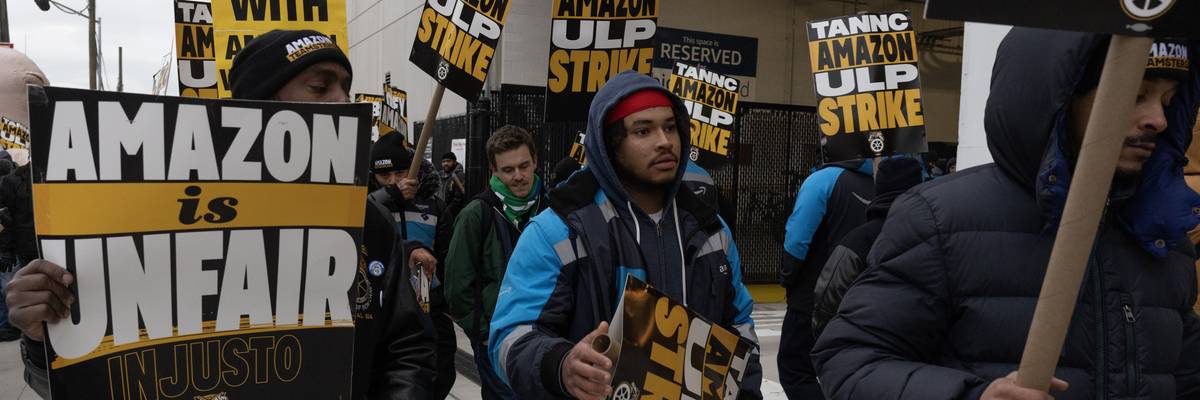
Amazon workers organized by the Teamsters Union go on strike and walk a picket line in front of the DBK4 Amazon facility on December 20, 2024 in the Maspeth neighborhood in the Queens borough of New York City.
During “peak” season, the time between Amazon Prime Day in October and the holidays, Amazon forces its associates across the country to work overtime.
At the beginning of 2024, Amazon reported $10.6 billion in profits during the fourth quarter of the previous year, an unexpected level of success which Andrew Jassy, the company’s CEO, attributed to the company’s 14% growth from last year in holiday season sales. Holiday shopping has long been crucial to Amazon’s business model, so much so that Amazon announced in October its intention to hire 250,000 more workers nationwide for the holiday season. But at JFK-8—the Staten Island fulfillment center where workers became the first employees in Amazon’s history to win union recognition in 2022, and have yet to reach a contract agreement with the company—workers have only seen their workloads increase, and are struggling amid greater productivity demands from management.
“During this time of the year, health and safety goes out the window,” says Tristan Martinez, a six-year Amazon employee and organizer for the Amazon Labor Union (ALU). “It’s all about pushing the numbers so they [management] can get their bonuses.”
During “peak” season, the time between Amazon Prime Day (a two day Prime Member exclusive event, during which Amazon promises “epic deals on top brands”) in October and the holidays, Amazon forces its associates across the country to work overtime. This increased demand for labor starts around Prime Day and ramps up as the holiday season approaches. Workers I spoke to at JFK-8 reported shifts up to 12 hours long, with one 30-minute and two 15-minute breaks, five days a week.
Amazon warehouse workers were nearly twice as likely to be injured as workers at other warehouses in the industry.
For most of their shifts, Amazon warehouse workers are on their feet, picking items from inventory and preparing them to get picked out, packing them, and loading them on Amazon’s blue trucks. Several workers I spoke to make long commutes from neighborhoods such as Canarsie, Harlem, and Crown Heights, which usually take upwards of two hours. If they’re lucky with the timing of bus and subway transfers, they would get home at around 9 p.m. that night, only to embark on their commute eight short hours later for the start of another 12-hour shift at 7 a.m.
“We’re not machines. Everyone has their own circumstances,” Jasmine Youma, who has worked as a picker and packer at Amazon for over a year, told me as she rushed into a crowded bus.
She wasn’t the only Amazon worker I spoke to who felt the need to remind me she was human. “They think we’re robots,” said Shayna, a packer of five years who asked that her last name not be used. “If you’re not hitting the numbers, they’ll come out and talk to you.”
Workers across the board feel dehumanized. “Productivity manager to associate relationships are very robotic,” says Jaquan Taylor, who has worked at Amazon for six years. “In order to work as a manager here, you have to lose all sense of humanity.” According to some Amazon associates, the increased productivity demands result in less workplace safety. “They talk about safety, but when it’s time to apply safety, they only look at the numbers,” says Terry, a processing assistant of four years who asked that her last name not be used.
This month, the United States Senate Committee on Health, Education, Labor, and Pensions, led by Sen. Bernie Sanders (I-Vt.), released a report on workplace safety at Amazon Warehouses. The committee found that Amazon warehouse workers were nearly twice as likely to be injured as workers at other warehouses in the industry.
The Senate’s report corroborates the sentiments expressed by Jasmine, Shayna, Jaquan, Terry, and Tristan, finding that “workers are forced to choose between following safety procedures and risking discipline and potential termination for not moving fast enough.” The report also states that Amazon is aware of the dangers to worker safety associated with their productivity demands, but manipulates data to make the problem look less severe.
As a result, Amazon workers all over the world have been organizing for better working conditions. JFK-8 made history two years ago by becoming the first unionized Amazon Warehouse in the United States. Amazon unsuccessfully attempted to overturn the National Labor Relation Board (NLRB) election result in 2022, and has since has since refused to recognize the Amazon Labor Union (ALU) and begin contract negotiations, in defiance of the NLRB's orders. In 2024, the company joined SpaceX and Trader Joe’s in filing a federal lawsuit against the NLRB, alleging that the agency’s structure is unconstitutional.
If the courts rule in Amazon’s favor, labor activists fear that it could undo a century of progress on workers’ rights in the United States. Legal actions have not deterred Amazon workers from organizing, with new unions forming in Atlanta, City of Industry, and San Bernardino with the help of the International Brotherhood of Teamsters. On December 21, 2024, Amazon Teamsters at JFK-8 began their strike, joining eight other Amazon warehouses in California, New York, and Illinois.
At JFK-8, the NLRB found that Amazon retaliates against employees who support the union. The union contends that several organizers have been terminated for their union activity, among them Christian Smalls, Sultana Hossain, and Pasquale Cioffi. Martinez, who has been involved in organizing at JFK-8 since 2020, describes his experience as “coming every day with a target on your back. That’s what it’s like working here whether you’re an organizer or not.”
Though most of the workers I spoke to were not actively involved in organizing, their general sentiments toward the union were positive. Workers expressed excitement at the prospect of longer breaks, shorter hours, better pay, and more reliable transportation.
Amazon workers’ labor is visible everywhere this city, from the trucks stopped on neighborhood streets, to the packages that appear on every other doorstep. The workers themselves are hardly ever seen, spending most of their time in a part of the city that rarely crosses the minds of tourists and locals alike. In the midst of the holiday season, customers appreciate the convenience of Amazon’s quick deliveries and endless catalogue of goods.
Rather than rushing around the city, waiting in lines, and lugging bags onto crowded trains, New Yorkers can do their holiday shopping in just a few clicks. Yet, the holiday stress does not cease to exist. It’s only transferred somewhere else, to someone else, several trains, buses, and ferries away. Far enough to be forgotten, but not so far that it affects the convenience of two-day delivery. The convenience and savings come at a high, yet largely invisible, price. As Martinez puts it, “people bleed to make sure your packages are delivered on time.”
Dear Common Dreams reader, It’s been nearly 30 years since I co-founded Common Dreams with my late wife, Lina Newhouser. We had the radical notion that journalism should serve the public good, not corporate profits. It was clear to us from the outset what it would take to build such a project. No paid advertisements. No corporate sponsors. No millionaire publisher telling us what to think or do. Many people said we wouldn't last a year, but we proved those doubters wrong. Together with a tremendous team of journalists and dedicated staff, we built an independent media outlet free from the constraints of profits and corporate control. Our mission has always been simple: To inform. To inspire. To ignite change for the common good. Building Common Dreams was not easy. Our survival was never guaranteed. When you take on the most powerful forces—Wall Street greed, fossil fuel industry destruction, Big Tech lobbyists, and uber-rich oligarchs who have spent billions upon billions rigging the economy and democracy in their favor—the only bulwark you have is supporters who believe in your work. But here’s the urgent message from me today. It's never been this bad out there. And it's never been this hard to keep us going. At the very moment Common Dreams is most needed, the threats we face are intensifying. We need your support now more than ever. We don't accept corporate advertising and never will. We don't have a paywall because we don't think people should be blocked from critical news based on their ability to pay. Everything we do is funded by the donations of readers like you. When everyone does the little they can afford, we are strong. But if that support retreats or dries up, so do we. Will you donate now to make sure Common Dreams not only survives but thrives? —Craig Brown, Co-founder |
At the beginning of 2024, Amazon reported $10.6 billion in profits during the fourth quarter of the previous year, an unexpected level of success which Andrew Jassy, the company’s CEO, attributed to the company’s 14% growth from last year in holiday season sales. Holiday shopping has long been crucial to Amazon’s business model, so much so that Amazon announced in October its intention to hire 250,000 more workers nationwide for the holiday season. But at JFK-8—the Staten Island fulfillment center where workers became the first employees in Amazon’s history to win union recognition in 2022, and have yet to reach a contract agreement with the company—workers have only seen their workloads increase, and are struggling amid greater productivity demands from management.
“During this time of the year, health and safety goes out the window,” says Tristan Martinez, a six-year Amazon employee and organizer for the Amazon Labor Union (ALU). “It’s all about pushing the numbers so they [management] can get their bonuses.”
During “peak” season, the time between Amazon Prime Day (a two day Prime Member exclusive event, during which Amazon promises “epic deals on top brands”) in October and the holidays, Amazon forces its associates across the country to work overtime. This increased demand for labor starts around Prime Day and ramps up as the holiday season approaches. Workers I spoke to at JFK-8 reported shifts up to 12 hours long, with one 30-minute and two 15-minute breaks, five days a week.
Amazon warehouse workers were nearly twice as likely to be injured as workers at other warehouses in the industry.
For most of their shifts, Amazon warehouse workers are on their feet, picking items from inventory and preparing them to get picked out, packing them, and loading them on Amazon’s blue trucks. Several workers I spoke to make long commutes from neighborhoods such as Canarsie, Harlem, and Crown Heights, which usually take upwards of two hours. If they’re lucky with the timing of bus and subway transfers, they would get home at around 9 p.m. that night, only to embark on their commute eight short hours later for the start of another 12-hour shift at 7 a.m.
“We’re not machines. Everyone has their own circumstances,” Jasmine Youma, who has worked as a picker and packer at Amazon for over a year, told me as she rushed into a crowded bus.
She wasn’t the only Amazon worker I spoke to who felt the need to remind me she was human. “They think we’re robots,” said Shayna, a packer of five years who asked that her last name not be used. “If you’re not hitting the numbers, they’ll come out and talk to you.”
Workers across the board feel dehumanized. “Productivity manager to associate relationships are very robotic,” says Jaquan Taylor, who has worked at Amazon for six years. “In order to work as a manager here, you have to lose all sense of humanity.” According to some Amazon associates, the increased productivity demands result in less workplace safety. “They talk about safety, but when it’s time to apply safety, they only look at the numbers,” says Terry, a processing assistant of four years who asked that her last name not be used.
This month, the United States Senate Committee on Health, Education, Labor, and Pensions, led by Sen. Bernie Sanders (I-Vt.), released a report on workplace safety at Amazon Warehouses. The committee found that Amazon warehouse workers were nearly twice as likely to be injured as workers at other warehouses in the industry.
The Senate’s report corroborates the sentiments expressed by Jasmine, Shayna, Jaquan, Terry, and Tristan, finding that “workers are forced to choose between following safety procedures and risking discipline and potential termination for not moving fast enough.” The report also states that Amazon is aware of the dangers to worker safety associated with their productivity demands, but manipulates data to make the problem look less severe.
As a result, Amazon workers all over the world have been organizing for better working conditions. JFK-8 made history two years ago by becoming the first unionized Amazon Warehouse in the United States. Amazon unsuccessfully attempted to overturn the National Labor Relation Board (NLRB) election result in 2022, and has since has since refused to recognize the Amazon Labor Union (ALU) and begin contract negotiations, in defiance of the NLRB's orders. In 2024, the company joined SpaceX and Trader Joe’s in filing a federal lawsuit against the NLRB, alleging that the agency’s structure is unconstitutional.
If the courts rule in Amazon’s favor, labor activists fear that it could undo a century of progress on workers’ rights in the United States. Legal actions have not deterred Amazon workers from organizing, with new unions forming in Atlanta, City of Industry, and San Bernardino with the help of the International Brotherhood of Teamsters. On December 21, 2024, Amazon Teamsters at JFK-8 began their strike, joining eight other Amazon warehouses in California, New York, and Illinois.
At JFK-8, the NLRB found that Amazon retaliates against employees who support the union. The union contends that several organizers have been terminated for their union activity, among them Christian Smalls, Sultana Hossain, and Pasquale Cioffi. Martinez, who has been involved in organizing at JFK-8 since 2020, describes his experience as “coming every day with a target on your back. That’s what it’s like working here whether you’re an organizer or not.”
Though most of the workers I spoke to were not actively involved in organizing, their general sentiments toward the union were positive. Workers expressed excitement at the prospect of longer breaks, shorter hours, better pay, and more reliable transportation.
Amazon workers’ labor is visible everywhere this city, from the trucks stopped on neighborhood streets, to the packages that appear on every other doorstep. The workers themselves are hardly ever seen, spending most of their time in a part of the city that rarely crosses the minds of tourists and locals alike. In the midst of the holiday season, customers appreciate the convenience of Amazon’s quick deliveries and endless catalogue of goods.
Rather than rushing around the city, waiting in lines, and lugging bags onto crowded trains, New Yorkers can do their holiday shopping in just a few clicks. Yet, the holiday stress does not cease to exist. It’s only transferred somewhere else, to someone else, several trains, buses, and ferries away. Far enough to be forgotten, but not so far that it affects the convenience of two-day delivery. The convenience and savings come at a high, yet largely invisible, price. As Martinez puts it, “people bleed to make sure your packages are delivered on time.”
At the beginning of 2024, Amazon reported $10.6 billion in profits during the fourth quarter of the previous year, an unexpected level of success which Andrew Jassy, the company’s CEO, attributed to the company’s 14% growth from last year in holiday season sales. Holiday shopping has long been crucial to Amazon’s business model, so much so that Amazon announced in October its intention to hire 250,000 more workers nationwide for the holiday season. But at JFK-8—the Staten Island fulfillment center where workers became the first employees in Amazon’s history to win union recognition in 2022, and have yet to reach a contract agreement with the company—workers have only seen their workloads increase, and are struggling amid greater productivity demands from management.
“During this time of the year, health and safety goes out the window,” says Tristan Martinez, a six-year Amazon employee and organizer for the Amazon Labor Union (ALU). “It’s all about pushing the numbers so they [management] can get their bonuses.”
During “peak” season, the time between Amazon Prime Day (a two day Prime Member exclusive event, during which Amazon promises “epic deals on top brands”) in October and the holidays, Amazon forces its associates across the country to work overtime. This increased demand for labor starts around Prime Day and ramps up as the holiday season approaches. Workers I spoke to at JFK-8 reported shifts up to 12 hours long, with one 30-minute and two 15-minute breaks, five days a week.
Amazon warehouse workers were nearly twice as likely to be injured as workers at other warehouses in the industry.
For most of their shifts, Amazon warehouse workers are on their feet, picking items from inventory and preparing them to get picked out, packing them, and loading them on Amazon’s blue trucks. Several workers I spoke to make long commutes from neighborhoods such as Canarsie, Harlem, and Crown Heights, which usually take upwards of two hours. If they’re lucky with the timing of bus and subway transfers, they would get home at around 9 p.m. that night, only to embark on their commute eight short hours later for the start of another 12-hour shift at 7 a.m.
“We’re not machines. Everyone has their own circumstances,” Jasmine Youma, who has worked as a picker and packer at Amazon for over a year, told me as she rushed into a crowded bus.
She wasn’t the only Amazon worker I spoke to who felt the need to remind me she was human. “They think we’re robots,” said Shayna, a packer of five years who asked that her last name not be used. “If you’re not hitting the numbers, they’ll come out and talk to you.”
Workers across the board feel dehumanized. “Productivity manager to associate relationships are very robotic,” says Jaquan Taylor, who has worked at Amazon for six years. “In order to work as a manager here, you have to lose all sense of humanity.” According to some Amazon associates, the increased productivity demands result in less workplace safety. “They talk about safety, but when it’s time to apply safety, they only look at the numbers,” says Terry, a processing assistant of four years who asked that her last name not be used.
This month, the United States Senate Committee on Health, Education, Labor, and Pensions, led by Sen. Bernie Sanders (I-Vt.), released a report on workplace safety at Amazon Warehouses. The committee found that Amazon warehouse workers were nearly twice as likely to be injured as workers at other warehouses in the industry.
The Senate’s report corroborates the sentiments expressed by Jasmine, Shayna, Jaquan, Terry, and Tristan, finding that “workers are forced to choose between following safety procedures and risking discipline and potential termination for not moving fast enough.” The report also states that Amazon is aware of the dangers to worker safety associated with their productivity demands, but manipulates data to make the problem look less severe.
As a result, Amazon workers all over the world have been organizing for better working conditions. JFK-8 made history two years ago by becoming the first unionized Amazon Warehouse in the United States. Amazon unsuccessfully attempted to overturn the National Labor Relation Board (NLRB) election result in 2022, and has since has since refused to recognize the Amazon Labor Union (ALU) and begin contract negotiations, in defiance of the NLRB's orders. In 2024, the company joined SpaceX and Trader Joe’s in filing a federal lawsuit against the NLRB, alleging that the agency’s structure is unconstitutional.
If the courts rule in Amazon’s favor, labor activists fear that it could undo a century of progress on workers’ rights in the United States. Legal actions have not deterred Amazon workers from organizing, with new unions forming in Atlanta, City of Industry, and San Bernardino with the help of the International Brotherhood of Teamsters. On December 21, 2024, Amazon Teamsters at JFK-8 began their strike, joining eight other Amazon warehouses in California, New York, and Illinois.
At JFK-8, the NLRB found that Amazon retaliates against employees who support the union. The union contends that several organizers have been terminated for their union activity, among them Christian Smalls, Sultana Hossain, and Pasquale Cioffi. Martinez, who has been involved in organizing at JFK-8 since 2020, describes his experience as “coming every day with a target on your back. That’s what it’s like working here whether you’re an organizer or not.”
Though most of the workers I spoke to were not actively involved in organizing, their general sentiments toward the union were positive. Workers expressed excitement at the prospect of longer breaks, shorter hours, better pay, and more reliable transportation.
Amazon workers’ labor is visible everywhere this city, from the trucks stopped on neighborhood streets, to the packages that appear on every other doorstep. The workers themselves are hardly ever seen, spending most of their time in a part of the city that rarely crosses the minds of tourists and locals alike. In the midst of the holiday season, customers appreciate the convenience of Amazon’s quick deliveries and endless catalogue of goods.
Rather than rushing around the city, waiting in lines, and lugging bags onto crowded trains, New Yorkers can do their holiday shopping in just a few clicks. Yet, the holiday stress does not cease to exist. It’s only transferred somewhere else, to someone else, several trains, buses, and ferries away. Far enough to be forgotten, but not so far that it affects the convenience of two-day delivery. The convenience and savings come at a high, yet largely invisible, price. As Martinez puts it, “people bleed to make sure your packages are delivered on time.”