

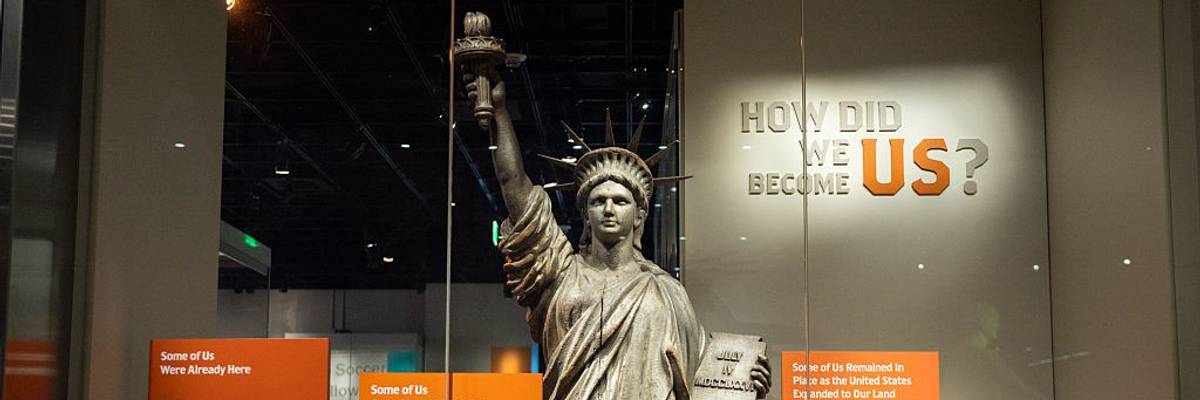
Revolutionary and social justice movements that formed the United States are explored inside the Smithsonian National Museum of American History in Washington, DC, as seen on March 31, 2025.
(Photo by Maansi Srivastava/ For The Washington Post via Getty Images)
Who's Afraid of Diverse Histories?
Instead of warning Americans away, we should safeguard exhibits, lesson plans, and art that tell diverse histories. They help us understand our country better.
Aug 30, 2026
In a recent, high-profile dispute, the president castigated the Smithsonian’s National Museum of American History for failing to “present American history as a shared national inheritance to be taught and celebrated.” His showdown with its director, Anthea Hartig, followed a contentious House subcommittee hearing at which Republicans openly chastised her for similar reasons. The White House has now directed that the National Park Service install signage outside the building warning visitors of alleged inaccuracies within.
Many of the museum’s current exhibits commemorate the country’s diverse histories in honor of the American semiquincentennial. The president is wrong that these displays pander and divide. Rather, they educate Americans on often overlooked events in our own country.
Take my wheelhouse, Asian American and Pacific Islander (AAPI) history. It gets the Smithsonian treatment in an exhibit canvassing Filipino American history from the 1910s to the 1970s. In fact, Asian Americans have been here since before the Declaration of Independence—from the crew of a Spanish expedition in 1587 to a mid-1700s settlement in the swamplands near New Orleans. I bet your school textbooks never taught that.
A robust American education requires that we preserve more of these stories: in museums, in the classroom, and in broader popular culture. To our credit, we are beginning to do so. Five years ago, Illinois passed the first state-level mandate to teach AAPI history in classrooms. Since then, local pilot programs and legislation in 23 states have expanded AAPI history in K-12 social-studies curricula. These efforts have accompanied moves in many school districts to teach diverse content, including Black, women’s, and LGBTQ+ histories.
Whatever one’s political leanings, having more information about our shared past allows us to draw more educated conclusions about our present.
Still, 55% of Americans cannot name a single event or policy related to Asian Americans. That means more than lacking familiarity with a racial group. Without knowing the past, and how diverse communities influenced it, we cannot fully understand many of today’s legal institutions and enforcement activities.
For example, immigration enforcement at our Southern border first became a priority during the era of Chinese Exclusion. To skirt detention at Angel Island, new arrivals from China increasingly entered the country via Mexico. Around 1904, mounted federal agents began patrolling the border in response. Over time, their duties expanded from immigration to general law enforcement. In conjunction with the Texas Rangers, they engaged in confrontations, sometimes fatal, with Tejanos and others accused of smuggling illicit goods.
The border, it hardly requires pointing out, haunts national politics still, with mass detention, visas, and the status of sanctuary cities dominating the news cycle. The construction of a physical border wall, meanwhile, threatens to disrupt our relations with Native American tribes and jeopardize our national parks.
Other links between past and present abound. For example, many contemporary labor movements share DNA with those that AAPI workers led. The American History Museum’s exhibit on Filipino Americans explores the decades-long organizing work of Larry Itliong, which culminated in his leadership of the 1965 Delano grape strike alongside Cesar Chavez. The latter is a household name, and the former should be.
Similarly, the movie Sinners brought attention to the role of Chinese American grocers in the Mississippi Delta during Jim Crow. They played complex roles in their local communities, testing and fortifying racial hierarchies in turn. They sold goods to Black patrons on credit, breaking the dominance of extractive plantation commissaries. But they also brought legal challenges that reinforced the premise of “separate but equal,” such as a suit in which they argued for their children’s admission into white schools while accepting the need for separate Black schools. How Chinese American families lived in and navigated the political climate of the postbellum South sheds light on little-known facets of the region’s economy and institutions.
I learned about all these events as an adult, reading texts on my own (such as Erika Lee’s The Making of Asian America). And far from diminishing my patriotism, as the president apparently fears, each of these stories has strengthened my belief in the resilience of all Americans—and in the idea that America itself is a collective project.
Instead of warning Americans away, we should safeguard exhibits, lesson plans, and art that tell diverse histories. They help us understand our country better. Whatever one’s political leanings, having more information about our shared past allows us to draw more educated conclusions about our present. Democracies rely on informed citizens. And the way to build an informed citizenry is to treat diverse histories as a vital part of our national inheritance.
An Urgent Message From Our Co-Founder
Dear Common Dreams reader, It’s been nearly 30 years since I co-founded Common Dreams with my late wife, Lina Newhouser. We had the radical notion that journalism should serve the public good, not corporate profits. It was clear to us from the outset what it would take to build such a project. No paid advertisements. No corporate sponsors. No millionaire publisher telling us what to think or do. Many people said we wouldn't last a year, but we proved those doubters wrong. Together with a tremendous team of journalists and dedicated staff, we built an independent media outlet free from the constraints of profits and corporate control. Our mission has always been simple: To inform. To inspire. To ignite change for the common good. Building Common Dreams was not easy. Our survival was never guaranteed. When you take on the most powerful forces—Wall Street greed, fossil fuel industry destruction, Big Tech lobbyists, and uber-rich oligarchs who have spent billions upon billions rigging the economy and democracy in their favor—the only bulwark you have is supporters who believe in your work. But here’s the urgent message from me today. It's never been this bad out there. And it's never been this hard to keep us going. At the very moment Common Dreams is most needed, the threats we face are intensifying. We need your support now more than ever. We don't accept corporate advertising and never will. We don't have a paywall because we don't think people should be blocked from critical news based on their ability to pay. Everything we do is funded by the donations of readers like you. When everyone does the little they can afford, we are strong. But if that support retreats or dries up, so do we. Will you donate now to make sure Common Dreams not only survives but thrives? —Craig Brown, Co-founder |
Our work is licensed under Creative Commons (CC BY-NC-ND 3.0). Feel free to republish and share widely.
Katherine Fang is an attorney and co-author of A Portrait of Asian Americans in the Law 2.0, the most comprehensive study of Asian American representation in the legal field. She is a Public Voices fellow of the OpEd Project in partnership with the Paul & Daisy Soros Foundation. This op-ed reflects personal views only.
In a recent, high-profile dispute, the president castigated the Smithsonian’s National Museum of American History for failing to “present American history as a shared national inheritance to be taught and celebrated.” His showdown with its director, Anthea Hartig, followed a contentious House subcommittee hearing at which Republicans openly chastised her for similar reasons. The White House has now directed that the National Park Service install signage outside the building warning visitors of alleged inaccuracies within.
Many of the museum’s current exhibits commemorate the country’s diverse histories in honor of the American semiquincentennial. The president is wrong that these displays pander and divide. Rather, they educate Americans on often overlooked events in our own country.
Take my wheelhouse, Asian American and Pacific Islander (AAPI) history. It gets the Smithsonian treatment in an exhibit canvassing Filipino American history from the 1910s to the 1970s. In fact, Asian Americans have been here since before the Declaration of Independence—from the crew of a Spanish expedition in 1587 to a mid-1700s settlement in the swamplands near New Orleans. I bet your school textbooks never taught that.
A robust American education requires that we preserve more of these stories: in museums, in the classroom, and in broader popular culture. To our credit, we are beginning to do so. Five years ago, Illinois passed the first state-level mandate to teach AAPI history in classrooms. Since then, local pilot programs and legislation in 23 states have expanded AAPI history in K-12 social-studies curricula. These efforts have accompanied moves in many school districts to teach diverse content, including Black, women’s, and LGBTQ+ histories.
Whatever one’s political leanings, having more information about our shared past allows us to draw more educated conclusions about our present.
Still, 55% of Americans cannot name a single event or policy related to Asian Americans. That means more than lacking familiarity with a racial group. Without knowing the past, and how diverse communities influenced it, we cannot fully understand many of today’s legal institutions and enforcement activities.
For example, immigration enforcement at our Southern border first became a priority during the era of Chinese Exclusion. To skirt detention at Angel Island, new arrivals from China increasingly entered the country via Mexico. Around 1904, mounted federal agents began patrolling the border in response. Over time, their duties expanded from immigration to general law enforcement. In conjunction with the Texas Rangers, they engaged in confrontations, sometimes fatal, with Tejanos and others accused of smuggling illicit goods.
The border, it hardly requires pointing out, haunts national politics still, with mass detention, visas, and the status of sanctuary cities dominating the news cycle. The construction of a physical border wall, meanwhile, threatens to disrupt our relations with Native American tribes and jeopardize our national parks.
Other links between past and present abound. For example, many contemporary labor movements share DNA with those that AAPI workers led. The American History Museum’s exhibit on Filipino Americans explores the decades-long organizing work of Larry Itliong, which culminated in his leadership of the 1965 Delano grape strike alongside Cesar Chavez. The latter is a household name, and the former should be.
Similarly, the movie Sinners brought attention to the role of Chinese American grocers in the Mississippi Delta during Jim Crow. They played complex roles in their local communities, testing and fortifying racial hierarchies in turn. They sold goods to Black patrons on credit, breaking the dominance of extractive plantation commissaries. But they also brought legal challenges that reinforced the premise of “separate but equal,” such as a suit in which they argued for their children’s admission into white schools while accepting the need for separate Black schools. How Chinese American families lived in and navigated the political climate of the postbellum South sheds light on little-known facets of the region’s economy and institutions.
I learned about all these events as an adult, reading texts on my own (such as Erika Lee’s The Making of Asian America). And far from diminishing my patriotism, as the president apparently fears, each of these stories has strengthened my belief in the resilience of all Americans—and in the idea that America itself is a collective project.
Instead of warning Americans away, we should safeguard exhibits, lesson plans, and art that tell diverse histories. They help us understand our country better. Whatever one’s political leanings, having more information about our shared past allows us to draw more educated conclusions about our present. Democracies rely on informed citizens. And the way to build an informed citizenry is to treat diverse histories as a vital part of our national inheritance.
Katherine Fang is an attorney and co-author of A Portrait of Asian Americans in the Law 2.0, the most comprehensive study of Asian American representation in the legal field. She is a Public Voices fellow of the OpEd Project in partnership with the Paul & Daisy Soros Foundation. This op-ed reflects personal views only.
In a recent, high-profile dispute, the president castigated the Smithsonian’s National Museum of American History for failing to “present American history as a shared national inheritance to be taught and celebrated.” His showdown with its director, Anthea Hartig, followed a contentious House subcommittee hearing at which Republicans openly chastised her for similar reasons. The White House has now directed that the National Park Service install signage outside the building warning visitors of alleged inaccuracies within.
Many of the museum’s current exhibits commemorate the country’s diverse histories in honor of the American semiquincentennial. The president is wrong that these displays pander and divide. Rather, they educate Americans on often overlooked events in our own country.
Take my wheelhouse, Asian American and Pacific Islander (AAPI) history. It gets the Smithsonian treatment in an exhibit canvassing Filipino American history from the 1910s to the 1970s. In fact, Asian Americans have been here since before the Declaration of Independence—from the crew of a Spanish expedition in 1587 to a mid-1700s settlement in the swamplands near New Orleans. I bet your school textbooks never taught that.
A robust American education requires that we preserve more of these stories: in museums, in the classroom, and in broader popular culture. To our credit, we are beginning to do so. Five years ago, Illinois passed the first state-level mandate to teach AAPI history in classrooms. Since then, local pilot programs and legislation in 23 states have expanded AAPI history in K-12 social-studies curricula. These efforts have accompanied moves in many school districts to teach diverse content, including Black, women’s, and LGBTQ+ histories.
Whatever one’s political leanings, having more information about our shared past allows us to draw more educated conclusions about our present.
Still, 55% of Americans cannot name a single event or policy related to Asian Americans. That means more than lacking familiarity with a racial group. Without knowing the past, and how diverse communities influenced it, we cannot fully understand many of today’s legal institutions and enforcement activities.
For example, immigration enforcement at our Southern border first became a priority during the era of Chinese Exclusion. To skirt detention at Angel Island, new arrivals from China increasingly entered the country via Mexico. Around 1904, mounted federal agents began patrolling the border in response. Over time, their duties expanded from immigration to general law enforcement. In conjunction with the Texas Rangers, they engaged in confrontations, sometimes fatal, with Tejanos and others accused of smuggling illicit goods.
The border, it hardly requires pointing out, haunts national politics still, with mass detention, visas, and the status of sanctuary cities dominating the news cycle. The construction of a physical border wall, meanwhile, threatens to disrupt our relations with Native American tribes and jeopardize our national parks.
Other links between past and present abound. For example, many contemporary labor movements share DNA with those that AAPI workers led. The American History Museum’s exhibit on Filipino Americans explores the decades-long organizing work of Larry Itliong, which culminated in his leadership of the 1965 Delano grape strike alongside Cesar Chavez. The latter is a household name, and the former should be.
Similarly, the movie Sinners brought attention to the role of Chinese American grocers in the Mississippi Delta during Jim Crow. They played complex roles in their local communities, testing and fortifying racial hierarchies in turn. They sold goods to Black patrons on credit, breaking the dominance of extractive plantation commissaries. But they also brought legal challenges that reinforced the premise of “separate but equal,” such as a suit in which they argued for their children’s admission into white schools while accepting the need for separate Black schools. How Chinese American families lived in and navigated the political climate of the postbellum South sheds light on little-known facets of the region’s economy and institutions.
I learned about all these events as an adult, reading texts on my own (such as Erika Lee’s The Making of Asian America). And far from diminishing my patriotism, as the president apparently fears, each of these stories has strengthened my belief in the resilience of all Americans—and in the idea that America itself is a collective project.
Instead of warning Americans away, we should safeguard exhibits, lesson plans, and art that tell diverse histories. They help us understand our country better. Whatever one’s political leanings, having more information about our shared past allows us to draw more educated conclusions about our present. Democracies rely on informed citizens. And the way to build an informed citizenry is to treat diverse histories as a vital part of our national inheritance.
We've had enough. The 1% own and operate the corporate media. They are doing everything they can to defend the status quo, squash dissent and protect the wealthy and the powerful. The Common Dreams media model is different. We cover the news that matters to the 99%. Our mission? To inform. To inspire. To ignite change for the common good. How? Nonprofit. Independent. Reader-supported. Free to read. Free to republish. Free to share. With no advertising. No paywalls. No selling of your data. Thousands of small donations fund our newsroom and allow us to continue publishing. Can you chip in? We can't do it without you. Thank you.
To inform. To inspire. To ignite change for the common good.
News & Opinion
Trending
Common Dreams, Inc. Founded 1997. Registered 501(c3) Non-Profit
Privacy Policy