SUBSCRIBE TO OUR FREE NEWSLETTER
Daily news & progressive opinion—funded by the people, not the corporations—delivered straight to your inbox.
5
#000000
#FFFFFF
To donate by check, phone, or other method, see our More Ways to Give page.
Daily news & progressive opinion—funded by the people, not the corporations—delivered straight to your inbox.
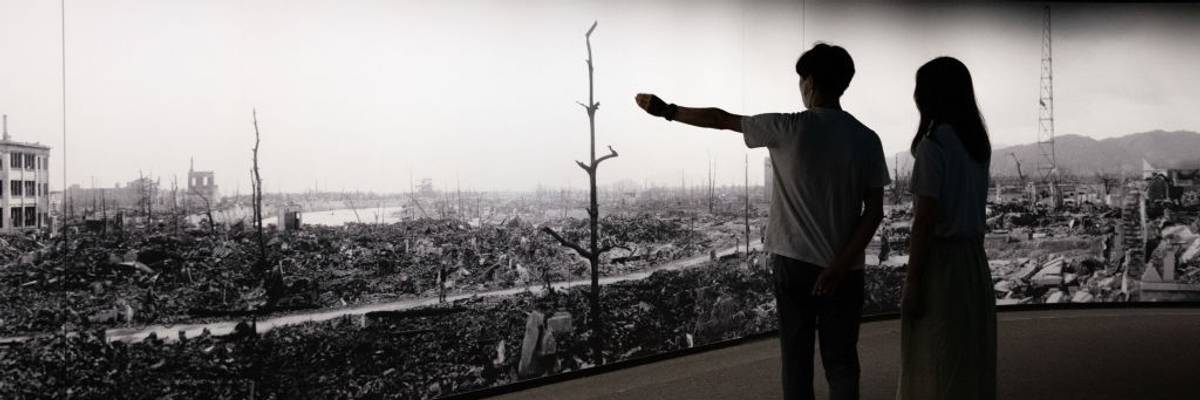
Visitors to Hiroshima Peace Memorial Museum view a large-scale panoramic photograph of the aftermath of the atomic bomb attack on Hiroshima, on August 5, 2020 in Hiroshima, Japan.
When we awaken from this trance and understand that these weapons do not make us safer, but rather are our greatest existential threat, we will be able to work together to lead an international effort to abolish them in a time-bound and verifiable manner.
On August 6, 1945 at 8:15 am local time, our world changed forever when the US dropped the first atomic bomb used in war over the Japanese city of Hiroshima. The immediate death toll was approximately 70,000 with ~140,000 to have died by year's end. Three days later, the US would drop a plutonium bomb over the city of Nagasaki. The immediate death toll there was ~40,000 with ~70,000 to have died by year's end with a combined total of ~210,000. Three weeks earlier, following the atomic bombing of New Mexico with the Trinity test, the nuclear age was thrust upon mankind. The nuclear legacies from victims and survivors of the atomic bombings, Hibakusha, and their history lingers to this day. The legacy extends from the mining for the nuclear materials and its impact on local communities to the processing, testing, use, storage, and waste management, as well as the impacts and risks of nuclear power to this day.
Amnesic of past history and events, the United States initiated a new arms race beginning in 2010 with then-President Barack Obama‘s “grand bargain“ to garner favor with the Republican Congress to ratify the New START Treaty. Following our lead, all of the remaining nine nuclear nations are working to modernize their stockpiles as well.
With the advent of artificial intelligence programs already utilized by President Donald Trump’s Department of War and the race to bring this technology to war, we move ever closer to the brink of nuclear war, either by intent, miscalculation, mistake, or cyber attack using disruptive technologies. This fact was recognized by the Bulletin of Atomic Scientists, moving their Doomsday Clock forward this past January to 85 seconds to midnight.
In order to survive, we must awaken from the myth of deterrence, realizing it for what it is, the greatest driver of the arms race. The unexamined assumptions that these weapons must exist is blatantly false. We know how to build these weapons, and we know how to disassemble them. From a height of roughly 64,000 weapons in 1986 we have reduced global stockpiles to approximately 12,187 currently. We also know that even a “limited nuclear war“ in a remote region of the world, for example, between India and Pakistan, using less than one half of 1% of global stockpiles, will result in a global nuclear famine. This could potentially result in up to 2 billion deaths on the planet due to the catastrophic climate change that would follow.
The Hibakusha have a mantra of “never again.” We owe a debt to the Hibakusha, their memory, and future generations to demand the complete abolition of these weapons.
When we awaken from this trance and understand that these weapons do not make us safer, but rather are our greatest existential threat, we will be able to work together to lead an international effort to abolish them in a time-bound and verifiable manner.
What is required in this race to save ourselves is the political courage and will to do so. Thankfully, there is hope both internationally and nationally. The Treaty on the Prohibition of Nuclear Weapons has been ratified by 75 nations and signed by 25 additional nations representing a majority of the global population. Here at home the Back From the Brink grassroots movement currently has endorsing congressional resolutions. There are 70 members of Congress, who have endorsed House Resolution 317 and Senate Resolution 323.
The Hibakusha have a mantra of “never again.” We owe a debt to the Hibakusha, their memory, and future generations to demand the complete abolition of these weapons. We must demand our elected officials endorse this campaign or move out of the way for those who will.
Dear Common Dreams reader, It’s been nearly 30 years since I co-founded Common Dreams with my late wife, Lina Newhouser. We had the radical notion that journalism should serve the public good, not corporate profits. It was clear to us from the outset what it would take to build such a project. No paid advertisements. No corporate sponsors. No millionaire publisher telling us what to think or do. Many people said we wouldn't last a year, but we proved those doubters wrong. Together with a tremendous team of journalists and dedicated staff, we built an independent media outlet free from the constraints of profits and corporate control. Our mission has always been simple: To inform. To inspire. To ignite change for the common good. Building Common Dreams was not easy. Our survival was never guaranteed. When you take on the most powerful forces—Wall Street greed, fossil fuel industry destruction, Big Tech lobbyists, and uber-rich oligarchs who have spent billions upon billions rigging the economy and democracy in their favor—the only bulwark you have is supporters who believe in your work. But here’s the urgent message from me today. It's never been this bad out there. And it's never been this hard to keep us going. At the very moment Common Dreams is most needed, the threats we face are intensifying. We need your support now more than ever. We don't accept corporate advertising and never will. We don't have a paywall because we don't think people should be blocked from critical news based on their ability to pay. Everything we do is funded by the donations of readers like you. When everyone does the little they can afford, we are strong. But if that support retreats or dries up, so do we. Will you donate now to make sure Common Dreams not only survives but thrives? —Craig Brown, Co-founder |
On August 6, 1945 at 8:15 am local time, our world changed forever when the US dropped the first atomic bomb used in war over the Japanese city of Hiroshima. The immediate death toll was approximately 70,000 with ~140,000 to have died by year's end. Three days later, the US would drop a plutonium bomb over the city of Nagasaki. The immediate death toll there was ~40,000 with ~70,000 to have died by year's end with a combined total of ~210,000. Three weeks earlier, following the atomic bombing of New Mexico with the Trinity test, the nuclear age was thrust upon mankind. The nuclear legacies from victims and survivors of the atomic bombings, Hibakusha, and their history lingers to this day. The legacy extends from the mining for the nuclear materials and its impact on local communities to the processing, testing, use, storage, and waste management, as well as the impacts and risks of nuclear power to this day.
Amnesic of past history and events, the United States initiated a new arms race beginning in 2010 with then-President Barack Obama‘s “grand bargain“ to garner favor with the Republican Congress to ratify the New START Treaty. Following our lead, all of the remaining nine nuclear nations are working to modernize their stockpiles as well.
With the advent of artificial intelligence programs already utilized by President Donald Trump’s Department of War and the race to bring this technology to war, we move ever closer to the brink of nuclear war, either by intent, miscalculation, mistake, or cyber attack using disruptive technologies. This fact was recognized by the Bulletin of Atomic Scientists, moving their Doomsday Clock forward this past January to 85 seconds to midnight.
In order to survive, we must awaken from the myth of deterrence, realizing it for what it is, the greatest driver of the arms race. The unexamined assumptions that these weapons must exist is blatantly false. We know how to build these weapons, and we know how to disassemble them. From a height of roughly 64,000 weapons in 1986 we have reduced global stockpiles to approximately 12,187 currently. We also know that even a “limited nuclear war“ in a remote region of the world, for example, between India and Pakistan, using less than one half of 1% of global stockpiles, will result in a global nuclear famine. This could potentially result in up to 2 billion deaths on the planet due to the catastrophic climate change that would follow.
The Hibakusha have a mantra of “never again.” We owe a debt to the Hibakusha, their memory, and future generations to demand the complete abolition of these weapons.
When we awaken from this trance and understand that these weapons do not make us safer, but rather are our greatest existential threat, we will be able to work together to lead an international effort to abolish them in a time-bound and verifiable manner.
What is required in this race to save ourselves is the political courage and will to do so. Thankfully, there is hope both internationally and nationally. The Treaty on the Prohibition of Nuclear Weapons has been ratified by 75 nations and signed by 25 additional nations representing a majority of the global population. Here at home the Back From the Brink grassroots movement currently has endorsing congressional resolutions. There are 70 members of Congress, who have endorsed House Resolution 317 and Senate Resolution 323.
The Hibakusha have a mantra of “never again.” We owe a debt to the Hibakusha, their memory, and future generations to demand the complete abolition of these weapons. We must demand our elected officials endorse this campaign or move out of the way for those who will.
On August 6, 1945 at 8:15 am local time, our world changed forever when the US dropped the first atomic bomb used in war over the Japanese city of Hiroshima. The immediate death toll was approximately 70,000 with ~140,000 to have died by year's end. Three days later, the US would drop a plutonium bomb over the city of Nagasaki. The immediate death toll there was ~40,000 with ~70,000 to have died by year's end with a combined total of ~210,000. Three weeks earlier, following the atomic bombing of New Mexico with the Trinity test, the nuclear age was thrust upon mankind. The nuclear legacies from victims and survivors of the atomic bombings, Hibakusha, and their history lingers to this day. The legacy extends from the mining for the nuclear materials and its impact on local communities to the processing, testing, use, storage, and waste management, as well as the impacts and risks of nuclear power to this day.
Amnesic of past history and events, the United States initiated a new arms race beginning in 2010 with then-President Barack Obama‘s “grand bargain“ to garner favor with the Republican Congress to ratify the New START Treaty. Following our lead, all of the remaining nine nuclear nations are working to modernize their stockpiles as well.
With the advent of artificial intelligence programs already utilized by President Donald Trump’s Department of War and the race to bring this technology to war, we move ever closer to the brink of nuclear war, either by intent, miscalculation, mistake, or cyber attack using disruptive technologies. This fact was recognized by the Bulletin of Atomic Scientists, moving their Doomsday Clock forward this past January to 85 seconds to midnight.
In order to survive, we must awaken from the myth of deterrence, realizing it for what it is, the greatest driver of the arms race. The unexamined assumptions that these weapons must exist is blatantly false. We know how to build these weapons, and we know how to disassemble them. From a height of roughly 64,000 weapons in 1986 we have reduced global stockpiles to approximately 12,187 currently. We also know that even a “limited nuclear war“ in a remote region of the world, for example, between India and Pakistan, using less than one half of 1% of global stockpiles, will result in a global nuclear famine. This could potentially result in up to 2 billion deaths on the planet due to the catastrophic climate change that would follow.
The Hibakusha have a mantra of “never again.” We owe a debt to the Hibakusha, their memory, and future generations to demand the complete abolition of these weapons.
When we awaken from this trance and understand that these weapons do not make us safer, but rather are our greatest existential threat, we will be able to work together to lead an international effort to abolish them in a time-bound and verifiable manner.
What is required in this race to save ourselves is the political courage and will to do so. Thankfully, there is hope both internationally and nationally. The Treaty on the Prohibition of Nuclear Weapons has been ratified by 75 nations and signed by 25 additional nations representing a majority of the global population. Here at home the Back From the Brink grassroots movement currently has endorsing congressional resolutions. There are 70 members of Congress, who have endorsed House Resolution 317 and Senate Resolution 323.
The Hibakusha have a mantra of “never again.” We owe a debt to the Hibakusha, their memory, and future generations to demand the complete abolition of these weapons. We must demand our elected officials endorse this campaign or move out of the way for those who will.