SUBSCRIBE TO OUR FREE NEWSLETTER
Daily news & progressive opinion—funded by the people, not the corporations—delivered straight to your inbox.
5
#000000
#FFFFFF
To donate by check, phone, or other method, see our More Ways to Give page.
Daily news & progressive opinion—funded by the people, not the corporations—delivered straight to your inbox.
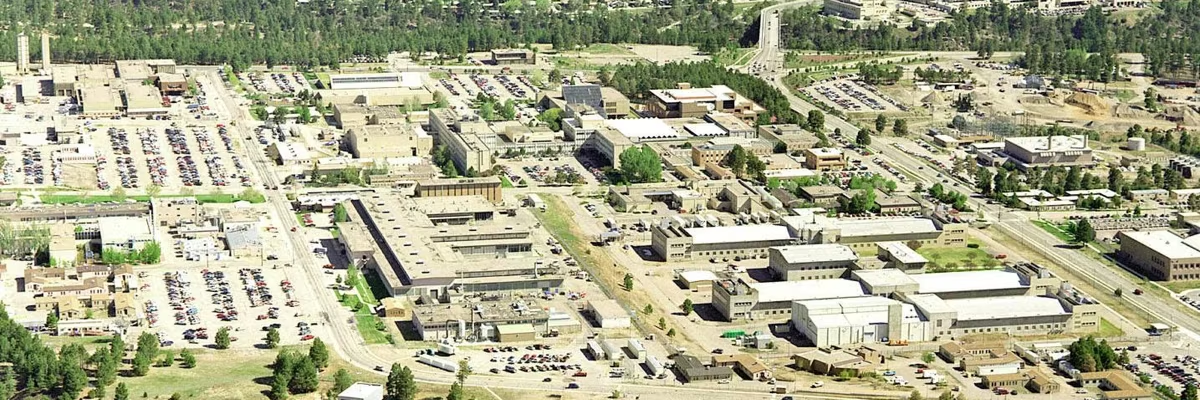
An aerial view of Los Alamos National Laboratory is shown.
The rush to increase production at 80 pits per year by 2030 unnecessarily increases the risk to workers and sidelines necessary environmental cleanup at the sites that already have ongoing release of radioactive waste into the air, water, and soil from legacy activities.
Plutonium pits are the radioactive core “trigger” of every US nuclear weapon. On detonation, the plutonium sets off a nuclear chain reaction initiating a nuclear explosion. The Department of Energy’s National Nuclear Security Administration, or NNSA, plutonium pit production Programmatic Environmental Impact Statement, or PEIS, public comment period ends this Friday, July 16. Our input regarding this major component of today’s nuclear arms race is critical.
Paradoxically, on that same day, 81 years prior in 1945, the nuclear arms race began when the United States bombed New Mexico with the Trinity test. The PEIS released in April this year provides an incomplete and non-comprehensive environmental review of this accelerated race to develop new plutonium pits by 2030. The justification put forth stems from a Cold War mentality of Congress from 2014 requiring the United States to develop the capacity to produce 80 plutonium pits per year by 2030, subsequently bolstered by the 2018 Trump administration's Nuclear Posture Review requiring the US to produce 80 pits per year by 2030; 30 at the Los Alamos National Laboratory (LANL) and 50 at the Savannah River Site.
As background, the majority of current plutonium pits completed production at the contaminated Rocky Flats plant outside of Boulder, Colorado by 1989. Therefore most plutonium pits are roughly 30-40 years old. Currently there are over 15,000 plutonium pits in reserve at the Pantex Plant near Amarillo, Texas, and over 5,000 which are suitable for use in strategic reserve. These large grapefruit size pits have at their core the incredibly hazardous radionuclide plutonium 239, which has a half life of 24,000 years.
Concerns over the aging of the current stockpile have been the impetus for building new pits. That concern was largely put to rest with the congressionally mandated 2006 JASON study, which confirmed that plutonium pits would last at least 100 years, and a subsequent 2012 Lawrence Livermore National Lab study found “...no unexpected aging issues are appearing in plutonium pits artificially aged to 150 years of age…” and they “...performed as designed.” This scientific evidence deemed as inconvenient was ignored. A subsequent new JASON Study was completed in 2025, and the NNSA has refused to release the results despite congressional demands and watchdog agency lawsuits, presumably due to the inconvenient results threatening their multibillion dollar windfall.
Historically the only thing that can be guaranteed in this proposed increased plutonium pit production plan is that it will be significantly delayed and far over budget.
As noted, this current race to rapidly expand pit production will occur at the existing, and already contaminated, sites at Savannah River in South Carolina, and the Los Alamos National Lab in New Mexico. It’s as though these communities are expendable.
The current draft PEIS only gives lip service to addressing the environmental impacts, failing to adequately take into account the dangers posed by the production of these pits to surrounding communities. According to the Union of Concerned Scientists, while the PEIS “clearly highlights an increased risk of radiation in the environment and across communities near facilities and workers it dismisses them as negligible continuing the most harmful and risky option of continued multi-site operations…. with only passing acknowledgement of the increased impacts at other sites, including nationwide transportation and impending waste management bottlenecks.”
According to a peer reviewed study published last week in the journal Science and Global Security, the Department of Energy has underestimated the potential deadly consequences if plutonium were to escape the Los Alamos National Laboratory. In the most serious case, if more than one kilogram of plutonium was to escape, the town of Los Alamos could become unlivable, and radioactive particles could spread across state lines. As many as 3,200 people could eventually get cancer with an estimated 1,000 deaths. Under certain circumstances, particles could travel as far north as Central Colorado and as far south as Southern New Mexico.
The draft PEIS fails to address the “no action“ option of not producing plutonium pits, thus dismissing it outright, presuming that production moving forward is a foregone conclusion. The rush to increase production at 80 pits per year by 2030 unnecessarily increases the risk to workers and sidelines necessary environmental cleanup at the sites that already have ongoing release of radioactive waste into the air, water, and soil from legacy activities on site. In addition, most reviews have concluded that this deadline is not realistic.
In addition, the proposed production will add fuel to the current ongoing arms race and proliferation disregarding the purported mission of the NNSA to “promote international nuclear safety and non-proliferation, and reduce global danger from weapons of mass destruction.” This will further erode confidence in the sincerity of the United States and its legal obligation under Article VI of the 1970 Treaty on the Non-Proliferation of Nuclear Weapons, NPT, to work in good faith with other nations to abolish nuclear weapons.
Historically the only thing that can be guaranteed in this proposed increased plutonium pit production plan is that it will be significantly delayed and far over budget.
Imagine the international capital that could be gained by placing the entire plan on hold. Our national security would not be compromised. And there would be massive financial savings to be realized.
We must demand a more complete and transparent PEIS that addresses the entire environmental, economic, and health impacts to the communities directly at risk, as well as our entire nation and world. Absent that, we are not dealing with science, but rather opinion, conjecture, and fearmongering. Use your voice today by submitting your comments via email to PitPEIS@nnsa.doe.gov, being sure to reference Doc: DOE/EIS-0573.
Dear Common Dreams reader, It’s been nearly 30 years since I co-founded Common Dreams with my late wife, Lina Newhouser. We had the radical notion that journalism should serve the public good, not corporate profits. It was clear to us from the outset what it would take to build such a project. No paid advertisements. No corporate sponsors. No millionaire publisher telling us what to think or do. Many people said we wouldn't last a year, but we proved those doubters wrong. Together with a tremendous team of journalists and dedicated staff, we built an independent media outlet free from the constraints of profits and corporate control. Our mission has always been simple: To inform. To inspire. To ignite change for the common good. Building Common Dreams was not easy. Our survival was never guaranteed. When you take on the most powerful forces—Wall Street greed, fossil fuel industry destruction, Big Tech lobbyists, and uber-rich oligarchs who have spent billions upon billions rigging the economy and democracy in their favor—the only bulwark you have is supporters who believe in your work. But here’s the urgent message from me today. It's never been this bad out there. And it's never been this hard to keep us going. At the very moment Common Dreams is most needed, the threats we face are intensifying. We need your support now more than ever. We don't accept corporate advertising and never will. We don't have a paywall because we don't think people should be blocked from critical news based on their ability to pay. Everything we do is funded by the donations of readers like you. When everyone does the little they can afford, we are strong. But if that support retreats or dries up, so do we. Will you donate now to make sure Common Dreams not only survives but thrives? —Craig Brown, Co-founder |
Plutonium pits are the radioactive core “trigger” of every US nuclear weapon. On detonation, the plutonium sets off a nuclear chain reaction initiating a nuclear explosion. The Department of Energy’s National Nuclear Security Administration, or NNSA, plutonium pit production Programmatic Environmental Impact Statement, or PEIS, public comment period ends this Friday, July 16. Our input regarding this major component of today’s nuclear arms race is critical.
Paradoxically, on that same day, 81 years prior in 1945, the nuclear arms race began when the United States bombed New Mexico with the Trinity test. The PEIS released in April this year provides an incomplete and non-comprehensive environmental review of this accelerated race to develop new plutonium pits by 2030. The justification put forth stems from a Cold War mentality of Congress from 2014 requiring the United States to develop the capacity to produce 80 plutonium pits per year by 2030, subsequently bolstered by the 2018 Trump administration's Nuclear Posture Review requiring the US to produce 80 pits per year by 2030; 30 at the Los Alamos National Laboratory (LANL) and 50 at the Savannah River Site.
As background, the majority of current plutonium pits completed production at the contaminated Rocky Flats plant outside of Boulder, Colorado by 1989. Therefore most plutonium pits are roughly 30-40 years old. Currently there are over 15,000 plutonium pits in reserve at the Pantex Plant near Amarillo, Texas, and over 5,000 which are suitable for use in strategic reserve. These large grapefruit size pits have at their core the incredibly hazardous radionuclide plutonium 239, which has a half life of 24,000 years.
Concerns over the aging of the current stockpile have been the impetus for building new pits. That concern was largely put to rest with the congressionally mandated 2006 JASON study, which confirmed that plutonium pits would last at least 100 years, and a subsequent 2012 Lawrence Livermore National Lab study found “...no unexpected aging issues are appearing in plutonium pits artificially aged to 150 years of age…” and they “...performed as designed.” This scientific evidence deemed as inconvenient was ignored. A subsequent new JASON Study was completed in 2025, and the NNSA has refused to release the results despite congressional demands and watchdog agency lawsuits, presumably due to the inconvenient results threatening their multibillion dollar windfall.
Historically the only thing that can be guaranteed in this proposed increased plutonium pit production plan is that it will be significantly delayed and far over budget.
As noted, this current race to rapidly expand pit production will occur at the existing, and already contaminated, sites at Savannah River in South Carolina, and the Los Alamos National Lab in New Mexico. It’s as though these communities are expendable.
The current draft PEIS only gives lip service to addressing the environmental impacts, failing to adequately take into account the dangers posed by the production of these pits to surrounding communities. According to the Union of Concerned Scientists, while the PEIS “clearly highlights an increased risk of radiation in the environment and across communities near facilities and workers it dismisses them as negligible continuing the most harmful and risky option of continued multi-site operations…. with only passing acknowledgement of the increased impacts at other sites, including nationwide transportation and impending waste management bottlenecks.”
According to a peer reviewed study published last week in the journal Science and Global Security, the Department of Energy has underestimated the potential deadly consequences if plutonium were to escape the Los Alamos National Laboratory. In the most serious case, if more than one kilogram of plutonium was to escape, the town of Los Alamos could become unlivable, and radioactive particles could spread across state lines. As many as 3,200 people could eventually get cancer with an estimated 1,000 deaths. Under certain circumstances, particles could travel as far north as Central Colorado and as far south as Southern New Mexico.
The draft PEIS fails to address the “no action“ option of not producing plutonium pits, thus dismissing it outright, presuming that production moving forward is a foregone conclusion. The rush to increase production at 80 pits per year by 2030 unnecessarily increases the risk to workers and sidelines necessary environmental cleanup at the sites that already have ongoing release of radioactive waste into the air, water, and soil from legacy activities on site. In addition, most reviews have concluded that this deadline is not realistic.
In addition, the proposed production will add fuel to the current ongoing arms race and proliferation disregarding the purported mission of the NNSA to “promote international nuclear safety and non-proliferation, and reduce global danger from weapons of mass destruction.” This will further erode confidence in the sincerity of the United States and its legal obligation under Article VI of the 1970 Treaty on the Non-Proliferation of Nuclear Weapons, NPT, to work in good faith with other nations to abolish nuclear weapons.
Historically the only thing that can be guaranteed in this proposed increased plutonium pit production plan is that it will be significantly delayed and far over budget.
Imagine the international capital that could be gained by placing the entire plan on hold. Our national security would not be compromised. And there would be massive financial savings to be realized.
We must demand a more complete and transparent PEIS that addresses the entire environmental, economic, and health impacts to the communities directly at risk, as well as our entire nation and world. Absent that, we are not dealing with science, but rather opinion, conjecture, and fearmongering. Use your voice today by submitting your comments via email to PitPEIS@nnsa.doe.gov, being sure to reference Doc: DOE/EIS-0573.
Plutonium pits are the radioactive core “trigger” of every US nuclear weapon. On detonation, the plutonium sets off a nuclear chain reaction initiating a nuclear explosion. The Department of Energy’s National Nuclear Security Administration, or NNSA, plutonium pit production Programmatic Environmental Impact Statement, or PEIS, public comment period ends this Friday, July 16. Our input regarding this major component of today’s nuclear arms race is critical.
Paradoxically, on that same day, 81 years prior in 1945, the nuclear arms race began when the United States bombed New Mexico with the Trinity test. The PEIS released in April this year provides an incomplete and non-comprehensive environmental review of this accelerated race to develop new plutonium pits by 2030. The justification put forth stems from a Cold War mentality of Congress from 2014 requiring the United States to develop the capacity to produce 80 plutonium pits per year by 2030, subsequently bolstered by the 2018 Trump administration's Nuclear Posture Review requiring the US to produce 80 pits per year by 2030; 30 at the Los Alamos National Laboratory (LANL) and 50 at the Savannah River Site.
As background, the majority of current plutonium pits completed production at the contaminated Rocky Flats plant outside of Boulder, Colorado by 1989. Therefore most plutonium pits are roughly 30-40 years old. Currently there are over 15,000 plutonium pits in reserve at the Pantex Plant near Amarillo, Texas, and over 5,000 which are suitable for use in strategic reserve. These large grapefruit size pits have at their core the incredibly hazardous radionuclide plutonium 239, which has a half life of 24,000 years.
Concerns over the aging of the current stockpile have been the impetus for building new pits. That concern was largely put to rest with the congressionally mandated 2006 JASON study, which confirmed that plutonium pits would last at least 100 years, and a subsequent 2012 Lawrence Livermore National Lab study found “...no unexpected aging issues are appearing in plutonium pits artificially aged to 150 years of age…” and they “...performed as designed.” This scientific evidence deemed as inconvenient was ignored. A subsequent new JASON Study was completed in 2025, and the NNSA has refused to release the results despite congressional demands and watchdog agency lawsuits, presumably due to the inconvenient results threatening their multibillion dollar windfall.
Historically the only thing that can be guaranteed in this proposed increased plutonium pit production plan is that it will be significantly delayed and far over budget.
As noted, this current race to rapidly expand pit production will occur at the existing, and already contaminated, sites at Savannah River in South Carolina, and the Los Alamos National Lab in New Mexico. It’s as though these communities are expendable.
The current draft PEIS only gives lip service to addressing the environmental impacts, failing to adequately take into account the dangers posed by the production of these pits to surrounding communities. According to the Union of Concerned Scientists, while the PEIS “clearly highlights an increased risk of radiation in the environment and across communities near facilities and workers it dismisses them as negligible continuing the most harmful and risky option of continued multi-site operations…. with only passing acknowledgement of the increased impacts at other sites, including nationwide transportation and impending waste management bottlenecks.”
According to a peer reviewed study published last week in the journal Science and Global Security, the Department of Energy has underestimated the potential deadly consequences if plutonium were to escape the Los Alamos National Laboratory. In the most serious case, if more than one kilogram of plutonium was to escape, the town of Los Alamos could become unlivable, and radioactive particles could spread across state lines. As many as 3,200 people could eventually get cancer with an estimated 1,000 deaths. Under certain circumstances, particles could travel as far north as Central Colorado and as far south as Southern New Mexico.
The draft PEIS fails to address the “no action“ option of not producing plutonium pits, thus dismissing it outright, presuming that production moving forward is a foregone conclusion. The rush to increase production at 80 pits per year by 2030 unnecessarily increases the risk to workers and sidelines necessary environmental cleanup at the sites that already have ongoing release of radioactive waste into the air, water, and soil from legacy activities on site. In addition, most reviews have concluded that this deadline is not realistic.
In addition, the proposed production will add fuel to the current ongoing arms race and proliferation disregarding the purported mission of the NNSA to “promote international nuclear safety and non-proliferation, and reduce global danger from weapons of mass destruction.” This will further erode confidence in the sincerity of the United States and its legal obligation under Article VI of the 1970 Treaty on the Non-Proliferation of Nuclear Weapons, NPT, to work in good faith with other nations to abolish nuclear weapons.
Historically the only thing that can be guaranteed in this proposed increased plutonium pit production plan is that it will be significantly delayed and far over budget.
Imagine the international capital that could be gained by placing the entire plan on hold. Our national security would not be compromised. And there would be massive financial savings to be realized.
We must demand a more complete and transparent PEIS that addresses the entire environmental, economic, and health impacts to the communities directly at risk, as well as our entire nation and world. Absent that, we are not dealing with science, but rather opinion, conjecture, and fearmongering. Use your voice today by submitting your comments via email to PitPEIS@nnsa.doe.gov, being sure to reference Doc: DOE/EIS-0573.