SUBSCRIBE TO OUR FREE NEWSLETTER
Daily news & progressive opinion—funded by the people, not the corporations—delivered straight to your inbox.
5
#000000
#FFFFFF
To donate by check, phone, or other method, see our More Ways to Give page.
When Ben Bagdikian, an esteemed journalist and early FAIR contributor, published his groundbreaking book The Media Monopoly in 1983, he painted a troubling picture of US media consolidation, reporting that 50 corporations controlled the media business. With each reprint, that number dwindled (FAIR.org, 6/1/87). When FAIR replicated his analysis in 2011 (Extra!, 10/11), it stood at 20.
Now, over 40 years after the initial release of The Monopoly Media, the media landscape has transformed drastically. Even Bagdikian’s later editions, written at the dawn of the internet, could not fully anticipate how profoundly digital technology would reconfigure the media oligarchy.
“News” is increasingly synonymous with online news. Over half the US public (56%) say that they “often” get news through their digital devices—compared to less than 1 in 3 (32%) who often get news from TV, 1 in 9 from radio, and only 1 in 14 from print publications like newspapers or magazines (Pew, 9/25/25).
Which raises the question: Who owns the leading online news sites—and, by extension, largely shapes the ideas and information that reach millions of Americans?
The pervasive presence of billionaires and the entrance of private equity firms in FAIR’s Top 7 suggest even further shifts away from democratic, truth-telling media.
Each month, Press Gazette, a London-based magazine for the journalism industry, ranks the top 50 news websites in the US in order of monthly visits, based on data from the marketing firm Similarweb. FAIR tallied Press Gazette’s results over a 12-month span, from December 2024 to November 2025, to get a figure for total US visits to major news sites over that period: 45.6 billion.
More than half of those visits, nearly 25.5 billion, went to news sites controlled by just seven families or corporate entities.
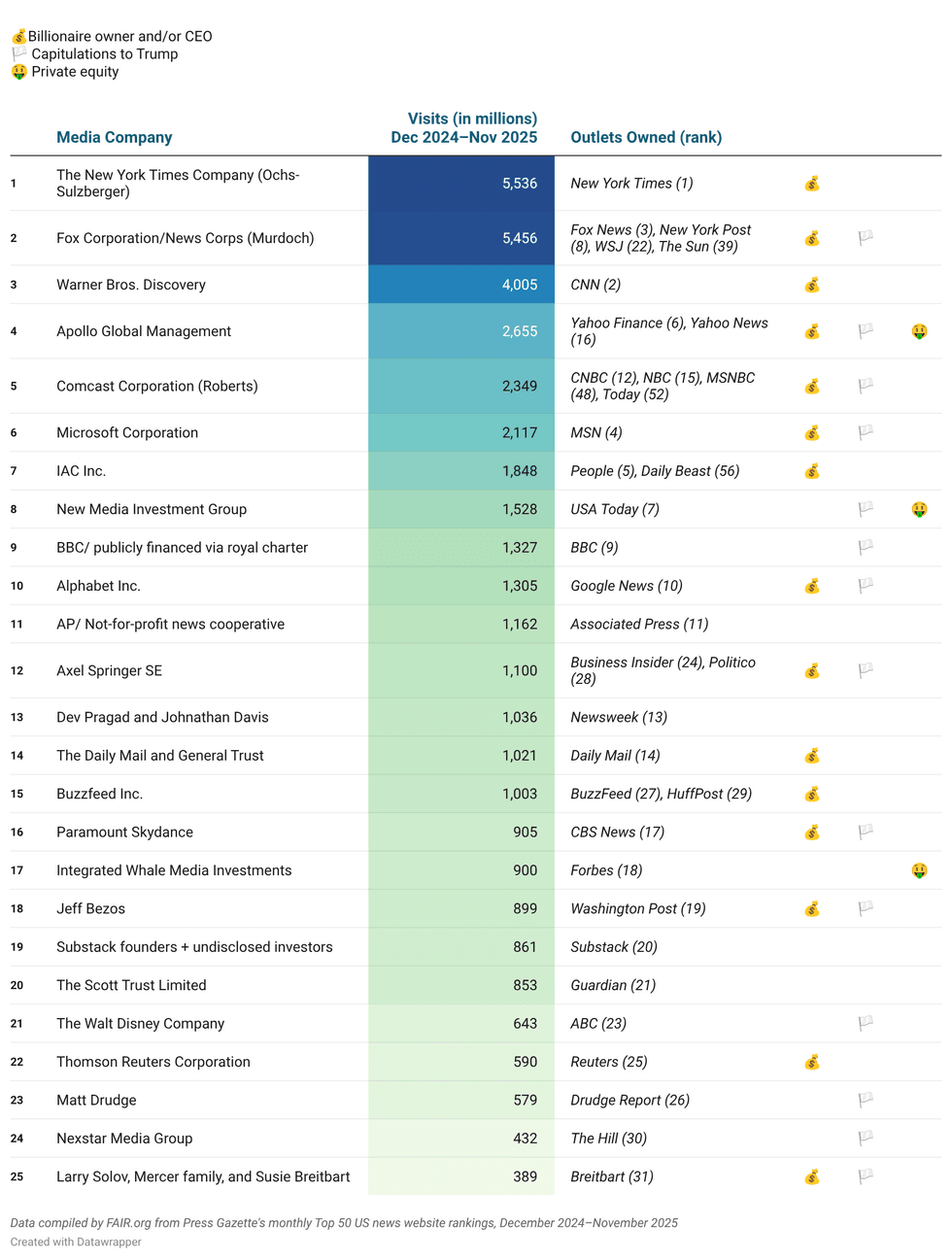
The owner that commands the largest share of news site viewership–a staggering 5.5 billion over one year—is the Ochs-Sulzberger family, the media dynasty that acquired the New York Times in 1896. Control of the Times has since passed through four generations, cemented by a family trust; over a century later, scion A.G. Sulzberger currently sits as the chair and publisher. As its reach greatly expanded in the digital age, the paper continues its tradition of allegiance to the establishment and opposition to what it sees as excessively progressive policies.
The No. 2 spot (just under 5.5 billion views) is occupied by the Murdoch family. Billionaire right-winger Rupert Murdoch built an expansive global media empire encompassing Fox News, the Wall Street Journal, the New York Post, and British tabloid the Sun, all of which made the US Top 50 list, as well as many other media outlets in the US, Britain, and Australia.
The empire is now under two corporate umbrellas, News Corp (the papers) and Fox Corporation (TV); both are led by Rupert’s billionaire son, Lachlan Murdoch, who inherited the role following a messy succession battle. He was apparently chosen for his dedication to maintaining the right-wing political advocacy that has long characterized the Murdoch media portfolio.
Rupert Murdoch, who has always cultivated political connections, has a relationship with President Donald Trump going back decades, with Murdoch even acting as an informal adviser during Trump’s first administration. That chumminess has not been enough to protect Murdoch from Trump’s assault on the news media: Trump is currently suing the Wall Street Journal for $10 billion for publishing an incriminating birthday letter to Jeffrey Epstein that features his signature. Still, Murdoch and Trump were recently reported to be dining together at the White House.
Warner Bros. Discovery (WBD), a US media and entertainment conglomerate, comes in third in terms of news audience reach (4 billion), solely on the basis of its ownership of CNN. (The media group also owns extensive non-news holdings, including the Warner Bros. movie studio and HBO.)
WBD accepted a buyout bid from Netflix for an estimated $83 billion, but the deal does not include CNN or any of Warner Bros. cable networks, which would be consolidated into the separate corporation Discovery Global next year.
The Netflix-Warner Bros. deal appears to have survived numerous hostile takeover bids by Paramount Skydance that sought to include CNN. But there are more obstacles ahead: Aside from antitrust concerns raised by Democrats over the streaming giant taking over a major Hollywood studio, Trump’s connections to Larry and David Ellison of Paramount—and the fact that ownership of CNN is still very much up for grabs—means that the battle over this set of influential media properties is far from over.
Warner Bros. already has a track record of capitulating to the demands of the Trump administration, but a loud and proud Trump ally at the helm of CNN would be a major escalation.
Trump has pledged personal involvement in the federal government’s review of the merger, warning that “it could be a problem.” He has insisted that CNN be sold in any Warner Bros. deal, signaling his intent to install pro-Trump ownership and steer the network’s political angle.
Gaining control of CNN would bring Paramount to the No. 3 spot, and would grant David Ellison—son of billionaire technocrat Larry Ellison, both vocal Trump supporters who have pledged to use their power to further advance Trump’s own—a new level of control over the US media landscape. Warner Bros. already has a track record of capitulating to the demands of the Trump administration, but a loud and proud Trump ally at the helm of CNN would be a major escalation.
Consider the rapid changes implemented at CBS following Skydance’s August 2025 acquisition of Paramount, which hugely expanded the Ellisons’ media empire. As documented by FAIR (7/24/25, 10/9/25, 11/6/25), this merger has resulted in blatant “ideological restructuring,” with the appointment of “anti-woke” ideologue Bari Weiss to CBS editor-in-chief, the cancellation of the famously Trump-critical "Late Show With Stephen Colbert," and a wave of politically motivated layoffs.
At No. 4 is private equity firm Apollo Global Management, which since 2021 has owned the Yahoo group. Yahoo News and Yahoo Finance together generated 2.7 billion views during the analyzed period. These sites primarily aggregate content from other news outlets, with occasional original articles, and rely heavily on algorithm-based personalization. Apollo‘s current CEO, billionaire Marc Rowan, has recently donated millions to Republicans.
Rowan was also heavily involved in developing Trump’s “Compact for Academic Excellence in Higher Education,” a proposal, as the New York Times (10/3/25) reported, that would provide financial incentives and preferential treatment to schools that sign and, in turn, agree to limit international students, protect conservative speech, generally require standardized testing for admissions, and to adopt policies recognizing “that academic freedom is not absolute,” among other conditions.
Ranked No. 5 with 2.35 billion visits during the analyzed period, Comcast is a media and technology company with extensive holdings—of which NBC News, CNBC, MSNBC, and Today all made appearances in the Top 50. Comcast’s billionaire CEO, Brian Roberts, is the controlling shareholder.
FAIR (6/11/16, 4/23/18) has long criticized the corporate skew of Comcast-owned media. More recently, however, this bias has devolved into patent deference to the Trump administration. Trump has repeatedly criticized Comcast and its news subsidiaries for bias against him. In February 2025, his FCC targeted Comcast for its “promotion of DEI.” Comcast quickly “confirmed it had received [FCC chair Brendan] Carr’s letter,” noting that it will be “cooperating with the FCC to answer their questions.” (The Hill, 2/12/25).
Changes to accommodate Trump’s demands were swift and severe. As covered by FAIR (3/6/25), MSNBC overhauled its staff soon afterward:
The news channel has nixed or demoted their most progressive anchors, all of whom are people of color. These are the hosts who have drawn the most ire from Donald Trump’s online warriors, according to Dave Zirin of The Nation (2/28/25).
Comcast further demonstrated its subservience to Trump with a recent donation to the new White House ballroom.
In January 2026, Comcast completed its spin-off of many of its news and cable holdings, including CNBC and MSNBC (rebranded as MS Now), to Versant Media—a company that Roberts retains control over.
Coming in at No. 6, Microsoft, the technology conglomerate that owns MSN, also donated to Trump’s ballroom. Similar to Yahoo, MSN is an algorithm-based republisher of news stories, which pulled in 2.1 billion views over the studied time frame. Given Microsoft’s obsession with AI, it is perhaps unsurprising that MSN has started to lean heavily on auto-generated content, coming under fire for promoting unreliable sources and publishing blatant misinformation.
Microsoft’s ownership is dominated by institutional shareholders, with mutual fund giant Vanguard leading the way at 9%. Microsoft‘s billionaire CEO, Satya Nadella, is known to have a friendly relationship with Trump—they have met and dined together on several occasions. In fact, before helping to fund Trump’s East Wing ballroom, Microsoft contributed $1 million to Trump’s inauguration fund.
No. 7 IAC Inc. owns numerous media and internet brands, including Top 50 sites People and Daily Beast. Taken together, these two sites generated 1.9 billion views over 12 months. Billionaire founder Barry Diller serves as chair, senior executive and the largest individual shareholder of IAC. It should be noted that Diller has publicly criticized Trump on several occasions, standing out as the only one among the Top 7, aside from New York Times publisher Sulzberger, to do so.
While not a replica of the original Bagdikian study, which took into account all major forms of media rather than focusing on the dominant medium (then television), FAIR’s research shows the continuation of the dynamics he described in a pre-internet age. The internet has not democratized news in any meaningful way; instead, the media monopoly has simply migrated to digital spaces.
At the same time, the pervasive presence of billionaires and the entrance of private equity firms in FAIR’s Top 7 suggest even further shifts away from democratic, truth-telling media.
The growing presence of private equity in media is a relatively new phenomenon, highlighting the usefulness of expansive media portfolios as vehicles for profit extraction. Along with the burgeoning influence of billionaires on the media landscape, the control of capital over media has become, if possible, even more apparent.
Almost three decades ago, the late media scholar Robert McChesney (Extra!, 11–12/97) wrote presciently of the globalization of media behemoths in the digital age:
It is a system that works to advance the cause of the global market and promote commercial values, while denigrating journalism and culture not conducive to the immediate bottom line or long-run corporate interests.
Some once posited that the rise of the internet would eliminate the monopoly power of the global media giants. Such talk has declined recently as the largest media, telecommunication and computer firms have done everything within their immense powers to colonize the internet, or at least neutralize its threat.
What is tragic is that this entire process of global media concentration has taken place with little public debate, especially in the US, despite the clear implications for politics and culture. After World War II, the Allies restricted media concentration in occupied Germany and Japan because they noted that such concentration promoted anti-democratic, even fascist, political cultures. It may be time for the United States and everyone else to take a dose of that medicine. But for that to happen will require concerted effort to educate and organize people around media issues. That is the task before us.
Research assistance: Priyanka Bansal, Saurav Sarkar, Lara-Nour Walton
When Ben Bagdikian, an esteemed journalist and early FAIR contributor, published his groundbreaking book The Media Monopoly in 1983, he painted a troubling picture of US media consolidation, reporting that 50 corporations controlled the media business. With each reprint, that number dwindled (FAIR.org, 6/1/87). When FAIR replicated his analysis in 2011 (Extra!, 10/11), it stood at 20.
Now, over 40 years after the initial release of The Monopoly Media, the media landscape has transformed drastically. Even Bagdikian’s later editions, written at the dawn of the internet, could not fully anticipate how profoundly digital technology would reconfigure the media oligarchy.
“News” is increasingly synonymous with online news. Over half the US public (56%) say that they “often” get news through their digital devices—compared to less than 1 in 3 (32%) who often get news from TV, 1 in 9 from radio, and only 1 in 14 from print publications like newspapers or magazines (Pew, 9/25/25).
Which raises the question: Who owns the leading online news sites—and, by extension, largely shapes the ideas and information that reach millions of Americans?
The pervasive presence of billionaires and the entrance of private equity firms in FAIR’s Top 7 suggest even further shifts away from democratic, truth-telling media.
Each month, Press Gazette, a London-based magazine for the journalism industry, ranks the top 50 news websites in the US in order of monthly visits, based on data from the marketing firm Similarweb. FAIR tallied Press Gazette’s results over a 12-month span, from December 2024 to November 2025, to get a figure for total US visits to major news sites over that period: 45.6 billion.
More than half of those visits, nearly 25.5 billion, went to news sites controlled by just seven families or corporate entities.
The owner that commands the largest share of news site viewership–a staggering 5.5 billion over one year—is the Ochs-Sulzberger family, the media dynasty that acquired the New York Times in 1896. Control of the Times has since passed through four generations, cemented by a family trust; over a century later, scion A.G. Sulzberger currently sits as the chair and publisher. As its reach greatly expanded in the digital age, the paper continues its tradition of allegiance to the establishment and opposition to what it sees as excessively progressive policies.
The No. 2 spot (just under 5.5 billion views) is occupied by the Murdoch family. Billionaire right-winger Rupert Murdoch built an expansive global media empire encompassing Fox News, the Wall Street Journal, the New York Post, and British tabloid the Sun, all of which made the US Top 50 list, as well as many other media outlets in the US, Britain, and Australia.
The empire is now under two corporate umbrellas, News Corp (the papers) and Fox Corporation (TV); both are led by Rupert’s billionaire son, Lachlan Murdoch, who inherited the role following a messy succession battle. He was apparently chosen for his dedication to maintaining the right-wing political advocacy that has long characterized the Murdoch media portfolio.
Rupert Murdoch, who has always cultivated political connections, has a relationship with President Donald Trump going back decades, with Murdoch even acting as an informal adviser during Trump’s first administration. That chumminess has not been enough to protect Murdoch from Trump’s assault on the news media: Trump is currently suing the Wall Street Journal for $10 billion for publishing an incriminating birthday letter to Jeffrey Epstein that features his signature. Still, Murdoch and Trump were recently reported to be dining together at the White House.
Warner Bros. Discovery (WBD), a US media and entertainment conglomerate, comes in third in terms of news audience reach (4 billion), solely on the basis of its ownership of CNN. (The media group also owns extensive non-news holdings, including the Warner Bros. movie studio and HBO.)
WBD accepted a buyout bid from Netflix for an estimated $83 billion, but the deal does not include CNN or any of Warner Bros. cable networks, which would be consolidated into the separate corporation Discovery Global next year.
The Netflix-Warner Bros. deal appears to have survived numerous hostile takeover bids by Paramount Skydance that sought to include CNN. But there are more obstacles ahead: Aside from antitrust concerns raised by Democrats over the streaming giant taking over a major Hollywood studio, Trump’s connections to Larry and David Ellison of Paramount—and the fact that ownership of CNN is still very much up for grabs—means that the battle over this set of influential media properties is far from over.
Warner Bros. already has a track record of capitulating to the demands of the Trump administration, but a loud and proud Trump ally at the helm of CNN would be a major escalation.
Trump has pledged personal involvement in the federal government’s review of the merger, warning that “it could be a problem.” He has insisted that CNN be sold in any Warner Bros. deal, signaling his intent to install pro-Trump ownership and steer the network’s political angle.
Gaining control of CNN would bring Paramount to the No. 3 spot, and would grant David Ellison—son of billionaire technocrat Larry Ellison, both vocal Trump supporters who have pledged to use their power to further advance Trump’s own—a new level of control over the US media landscape. Warner Bros. already has a track record of capitulating to the demands of the Trump administration, but a loud and proud Trump ally at the helm of CNN would be a major escalation.
Consider the rapid changes implemented at CBS following Skydance’s August 2025 acquisition of Paramount, which hugely expanded the Ellisons’ media empire. As documented by FAIR (7/24/25, 10/9/25, 11/6/25), this merger has resulted in blatant “ideological restructuring,” with the appointment of “anti-woke” ideologue Bari Weiss to CBS editor-in-chief, the cancellation of the famously Trump-critical "Late Show With Stephen Colbert," and a wave of politically motivated layoffs.
At No. 4 is private equity firm Apollo Global Management, which since 2021 has owned the Yahoo group. Yahoo News and Yahoo Finance together generated 2.7 billion views during the analyzed period. These sites primarily aggregate content from other news outlets, with occasional original articles, and rely heavily on algorithm-based personalization. Apollo‘s current CEO, billionaire Marc Rowan, has recently donated millions to Republicans.
Rowan was also heavily involved in developing Trump’s “Compact for Academic Excellence in Higher Education,” a proposal, as the New York Times (10/3/25) reported, that would provide financial incentives and preferential treatment to schools that sign and, in turn, agree to limit international students, protect conservative speech, generally require standardized testing for admissions, and to adopt policies recognizing “that academic freedom is not absolute,” among other conditions.
Ranked No. 5 with 2.35 billion visits during the analyzed period, Comcast is a media and technology company with extensive holdings—of which NBC News, CNBC, MSNBC, and Today all made appearances in the Top 50. Comcast’s billionaire CEO, Brian Roberts, is the controlling shareholder.
FAIR (6/11/16, 4/23/18) has long criticized the corporate skew of Comcast-owned media. More recently, however, this bias has devolved into patent deference to the Trump administration. Trump has repeatedly criticized Comcast and its news subsidiaries for bias against him. In February 2025, his FCC targeted Comcast for its “promotion of DEI.” Comcast quickly “confirmed it had received [FCC chair Brendan] Carr’s letter,” noting that it will be “cooperating with the FCC to answer their questions.” (The Hill, 2/12/25).
Changes to accommodate Trump’s demands were swift and severe. As covered by FAIR (3/6/25), MSNBC overhauled its staff soon afterward:
The news channel has nixed or demoted their most progressive anchors, all of whom are people of color. These are the hosts who have drawn the most ire from Donald Trump’s online warriors, according to Dave Zirin of The Nation (2/28/25).
Comcast further demonstrated its subservience to Trump with a recent donation to the new White House ballroom.
In January 2026, Comcast completed its spin-off of many of its news and cable holdings, including CNBC and MSNBC (rebranded as MS Now), to Versant Media—a company that Roberts retains control over.
Coming in at No. 6, Microsoft, the technology conglomerate that owns MSN, also donated to Trump’s ballroom. Similar to Yahoo, MSN is an algorithm-based republisher of news stories, which pulled in 2.1 billion views over the studied time frame. Given Microsoft’s obsession with AI, it is perhaps unsurprising that MSN has started to lean heavily on auto-generated content, coming under fire for promoting unreliable sources and publishing blatant misinformation.
Microsoft’s ownership is dominated by institutional shareholders, with mutual fund giant Vanguard leading the way at 9%. Microsoft‘s billionaire CEO, Satya Nadella, is known to have a friendly relationship with Trump—they have met and dined together on several occasions. In fact, before helping to fund Trump’s East Wing ballroom, Microsoft contributed $1 million to Trump’s inauguration fund.
No. 7 IAC Inc. owns numerous media and internet brands, including Top 50 sites People and Daily Beast. Taken together, these two sites generated 1.9 billion views over 12 months. Billionaire founder Barry Diller serves as chair, senior executive and the largest individual shareholder of IAC. It should be noted that Diller has publicly criticized Trump on several occasions, standing out as the only one among the Top 7, aside from New York Times publisher Sulzberger, to do so.
While not a replica of the original Bagdikian study, which took into account all major forms of media rather than focusing on the dominant medium (then television), FAIR’s research shows the continuation of the dynamics he described in a pre-internet age. The internet has not democratized news in any meaningful way; instead, the media monopoly has simply migrated to digital spaces.
At the same time, the pervasive presence of billionaires and the entrance of private equity firms in FAIR’s Top 7 suggest even further shifts away from democratic, truth-telling media.
The growing presence of private equity in media is a relatively new phenomenon, highlighting the usefulness of expansive media portfolios as vehicles for profit extraction. Along with the burgeoning influence of billionaires on the media landscape, the control of capital over media has become, if possible, even more apparent.
Almost three decades ago, the late media scholar Robert McChesney (Extra!, 11–12/97) wrote presciently of the globalization of media behemoths in the digital age:
It is a system that works to advance the cause of the global market and promote commercial values, while denigrating journalism and culture not conducive to the immediate bottom line or long-run corporate interests.
Some once posited that the rise of the internet would eliminate the monopoly power of the global media giants. Such talk has declined recently as the largest media, telecommunication and computer firms have done everything within their immense powers to colonize the internet, or at least neutralize its threat.
What is tragic is that this entire process of global media concentration has taken place with little public debate, especially in the US, despite the clear implications for politics and culture. After World War II, the Allies restricted media concentration in occupied Germany and Japan because they noted that such concentration promoted anti-democratic, even fascist, political cultures. It may be time for the United States and everyone else to take a dose of that medicine. But for that to happen will require concerted effort to educate and organize people around media issues. That is the task before us.
Research assistance: Priyanka Bansal, Saurav Sarkar, Lara-Nour Walton
When Ben Bagdikian, an esteemed journalist and early FAIR contributor, published his groundbreaking book The Media Monopoly in 1983, he painted a troubling picture of US media consolidation, reporting that 50 corporations controlled the media business. With each reprint, that number dwindled (FAIR.org, 6/1/87). When FAIR replicated his analysis in 2011 (Extra!, 10/11), it stood at 20.
Now, over 40 years after the initial release of The Monopoly Media, the media landscape has transformed drastically. Even Bagdikian’s later editions, written at the dawn of the internet, could not fully anticipate how profoundly digital technology would reconfigure the media oligarchy.
“News” is increasingly synonymous with online news. Over half the US public (56%) say that they “often” get news through their digital devices—compared to less than 1 in 3 (32%) who often get news from TV, 1 in 9 from radio, and only 1 in 14 from print publications like newspapers or magazines (Pew, 9/25/25).
Which raises the question: Who owns the leading online news sites—and, by extension, largely shapes the ideas and information that reach millions of Americans?
The pervasive presence of billionaires and the entrance of private equity firms in FAIR’s Top 7 suggest even further shifts away from democratic, truth-telling media.
Each month, Press Gazette, a London-based magazine for the journalism industry, ranks the top 50 news websites in the US in order of monthly visits, based on data from the marketing firm Similarweb. FAIR tallied Press Gazette’s results over a 12-month span, from December 2024 to November 2025, to get a figure for total US visits to major news sites over that period: 45.6 billion.
More than half of those visits, nearly 25.5 billion, went to news sites controlled by just seven families or corporate entities.
The owner that commands the largest share of news site viewership–a staggering 5.5 billion over one year—is the Ochs-Sulzberger family, the media dynasty that acquired the New York Times in 1896. Control of the Times has since passed through four generations, cemented by a family trust; over a century later, scion A.G. Sulzberger currently sits as the chair and publisher. As its reach greatly expanded in the digital age, the paper continues its tradition of allegiance to the establishment and opposition to what it sees as excessively progressive policies.
The No. 2 spot (just under 5.5 billion views) is occupied by the Murdoch family. Billionaire right-winger Rupert Murdoch built an expansive global media empire encompassing Fox News, the Wall Street Journal, the New York Post, and British tabloid the Sun, all of which made the US Top 50 list, as well as many other media outlets in the US, Britain, and Australia.
The empire is now under two corporate umbrellas, News Corp (the papers) and Fox Corporation (TV); both are led by Rupert’s billionaire son, Lachlan Murdoch, who inherited the role following a messy succession battle. He was apparently chosen for his dedication to maintaining the right-wing political advocacy that has long characterized the Murdoch media portfolio.
Rupert Murdoch, who has always cultivated political connections, has a relationship with President Donald Trump going back decades, with Murdoch even acting as an informal adviser during Trump’s first administration. That chumminess has not been enough to protect Murdoch from Trump’s assault on the news media: Trump is currently suing the Wall Street Journal for $10 billion for publishing an incriminating birthday letter to Jeffrey Epstein that features his signature. Still, Murdoch and Trump were recently reported to be dining together at the White House.
Warner Bros. Discovery (WBD), a US media and entertainment conglomerate, comes in third in terms of news audience reach (4 billion), solely on the basis of its ownership of CNN. (The media group also owns extensive non-news holdings, including the Warner Bros. movie studio and HBO.)
WBD accepted a buyout bid from Netflix for an estimated $83 billion, but the deal does not include CNN or any of Warner Bros. cable networks, which would be consolidated into the separate corporation Discovery Global next year.
The Netflix-Warner Bros. deal appears to have survived numerous hostile takeover bids by Paramount Skydance that sought to include CNN. But there are more obstacles ahead: Aside from antitrust concerns raised by Democrats over the streaming giant taking over a major Hollywood studio, Trump’s connections to Larry and David Ellison of Paramount—and the fact that ownership of CNN is still very much up for grabs—means that the battle over this set of influential media properties is far from over.
Warner Bros. already has a track record of capitulating to the demands of the Trump administration, but a loud and proud Trump ally at the helm of CNN would be a major escalation.
Trump has pledged personal involvement in the federal government’s review of the merger, warning that “it could be a problem.” He has insisted that CNN be sold in any Warner Bros. deal, signaling his intent to install pro-Trump ownership and steer the network’s political angle.
Gaining control of CNN would bring Paramount to the No. 3 spot, and would grant David Ellison—son of billionaire technocrat Larry Ellison, both vocal Trump supporters who have pledged to use their power to further advance Trump’s own—a new level of control over the US media landscape. Warner Bros. already has a track record of capitulating to the demands of the Trump administration, but a loud and proud Trump ally at the helm of CNN would be a major escalation.
Consider the rapid changes implemented at CBS following Skydance’s August 2025 acquisition of Paramount, which hugely expanded the Ellisons’ media empire. As documented by FAIR (7/24/25, 10/9/25, 11/6/25), this merger has resulted in blatant “ideological restructuring,” with the appointment of “anti-woke” ideologue Bari Weiss to CBS editor-in-chief, the cancellation of the famously Trump-critical "Late Show With Stephen Colbert," and a wave of politically motivated layoffs.
At No. 4 is private equity firm Apollo Global Management, which since 2021 has owned the Yahoo group. Yahoo News and Yahoo Finance together generated 2.7 billion views during the analyzed period. These sites primarily aggregate content from other news outlets, with occasional original articles, and rely heavily on algorithm-based personalization. Apollo‘s current CEO, billionaire Marc Rowan, has recently donated millions to Republicans.
Rowan was also heavily involved in developing Trump’s “Compact for Academic Excellence in Higher Education,” a proposal, as the New York Times (10/3/25) reported, that would provide financial incentives and preferential treatment to schools that sign and, in turn, agree to limit international students, protect conservative speech, generally require standardized testing for admissions, and to adopt policies recognizing “that academic freedom is not absolute,” among other conditions.
Ranked No. 5 with 2.35 billion visits during the analyzed period, Comcast is a media and technology company with extensive holdings—of which NBC News, CNBC, MSNBC, and Today all made appearances in the Top 50. Comcast’s billionaire CEO, Brian Roberts, is the controlling shareholder.
FAIR (6/11/16, 4/23/18) has long criticized the corporate skew of Comcast-owned media. More recently, however, this bias has devolved into patent deference to the Trump administration. Trump has repeatedly criticized Comcast and its news subsidiaries for bias against him. In February 2025, his FCC targeted Comcast for its “promotion of DEI.” Comcast quickly “confirmed it had received [FCC chair Brendan] Carr’s letter,” noting that it will be “cooperating with the FCC to answer their questions.” (The Hill, 2/12/25).
Changes to accommodate Trump’s demands were swift and severe. As covered by FAIR (3/6/25), MSNBC overhauled its staff soon afterward:
The news channel has nixed or demoted their most progressive anchors, all of whom are people of color. These are the hosts who have drawn the most ire from Donald Trump’s online warriors, according to Dave Zirin of The Nation (2/28/25).
Comcast further demonstrated its subservience to Trump with a recent donation to the new White House ballroom.
In January 2026, Comcast completed its spin-off of many of its news and cable holdings, including CNBC and MSNBC (rebranded as MS Now), to Versant Media—a company that Roberts retains control over.
Coming in at No. 6, Microsoft, the technology conglomerate that owns MSN, also donated to Trump’s ballroom. Similar to Yahoo, MSN is an algorithm-based republisher of news stories, which pulled in 2.1 billion views over the studied time frame. Given Microsoft’s obsession with AI, it is perhaps unsurprising that MSN has started to lean heavily on auto-generated content, coming under fire for promoting unreliable sources and publishing blatant misinformation.
Microsoft’s ownership is dominated by institutional shareholders, with mutual fund giant Vanguard leading the way at 9%. Microsoft‘s billionaire CEO, Satya Nadella, is known to have a friendly relationship with Trump—they have met and dined together on several occasions. In fact, before helping to fund Trump’s East Wing ballroom, Microsoft contributed $1 million to Trump’s inauguration fund.
No. 7 IAC Inc. owns numerous media and internet brands, including Top 50 sites People and Daily Beast. Taken together, these two sites generated 1.9 billion views over 12 months. Billionaire founder Barry Diller serves as chair, senior executive and the largest individual shareholder of IAC. It should be noted that Diller has publicly criticized Trump on several occasions, standing out as the only one among the Top 7, aside from New York Times publisher Sulzberger, to do so.
While not a replica of the original Bagdikian study, which took into account all major forms of media rather than focusing on the dominant medium (then television), FAIR’s research shows the continuation of the dynamics he described in a pre-internet age. The internet has not democratized news in any meaningful way; instead, the media monopoly has simply migrated to digital spaces.
At the same time, the pervasive presence of billionaires and the entrance of private equity firms in FAIR’s Top 7 suggest even further shifts away from democratic, truth-telling media.
The growing presence of private equity in media is a relatively new phenomenon, highlighting the usefulness of expansive media portfolios as vehicles for profit extraction. Along with the burgeoning influence of billionaires on the media landscape, the control of capital over media has become, if possible, even more apparent.
Almost three decades ago, the late media scholar Robert McChesney (Extra!, 11–12/97) wrote presciently of the globalization of media behemoths in the digital age:
It is a system that works to advance the cause of the global market and promote commercial values, while denigrating journalism and culture not conducive to the immediate bottom line or long-run corporate interests.
Some once posited that the rise of the internet would eliminate the monopoly power of the global media giants. Such talk has declined recently as the largest media, telecommunication and computer firms have done everything within their immense powers to colonize the internet, or at least neutralize its threat.
What is tragic is that this entire process of global media concentration has taken place with little public debate, especially in the US, despite the clear implications for politics and culture. After World War II, the Allies restricted media concentration in occupied Germany and Japan because they noted that such concentration promoted anti-democratic, even fascist, political cultures. It may be time for the United States and everyone else to take a dose of that medicine. But for that to happen will require concerted effort to educate and organize people around media issues. That is the task before us.
Research assistance: Priyanka Bansal, Saurav Sarkar, Lara-Nour Walton