SUBSCRIBE TO OUR FREE NEWSLETTER
Daily news & progressive opinion—funded by the people, not the corporations—delivered straight to your inbox.
5
#000000
#FFFFFF
To donate by check, phone, or other method, see our More Ways to Give page.
Daily news & progressive opinion—funded by the people, not the corporations—delivered straight to your inbox.
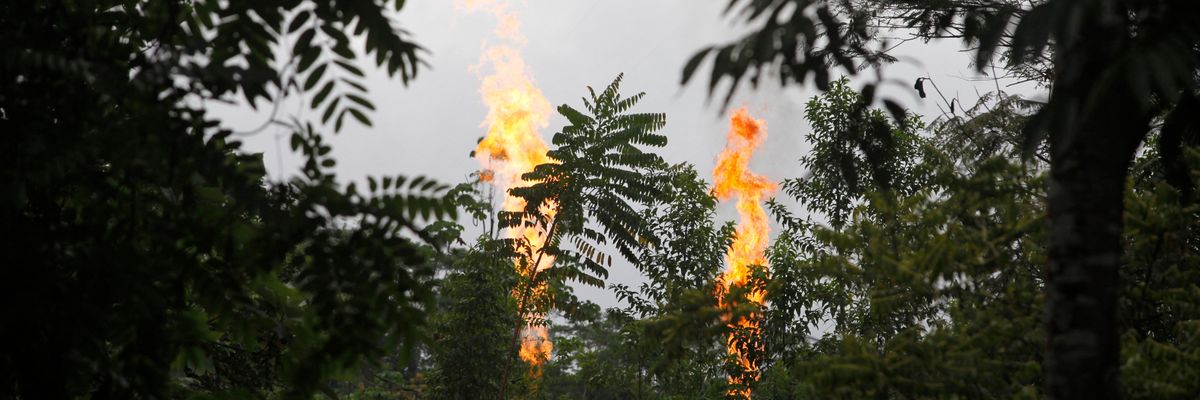
Gas flares from a refinery are seen in the Waorani Community of Bameno, Ecuador, on July 28, 2023.
"A remarkable example for other countries in democratizing climate politics."
Ecuadorians voted overwhelmingly on Sunday to reject oil drilling in a section of Yasuní National Park, the most biodiverse area of the imperiled Amazon rainforest.
Nearly 60% of Ecuadorian voters backed a binding referendum opposing oil exploration in Block 43 of the national park, which is home to uncontacted Indigenous tribes as well as hundreds of bird species and more than 1,000 tree species.
The Associated Press reported that "the outcome represents a significant blow to Ecuadorian President Guillermo Lasso, who advocated for oil drilling, asserting that its revenues are crucial to the country's economy. As a result of the vote, state oil company Petroecuador will be required to dismantle its operations in the coming months."
Yasunidos, the civil society group behind the referendum, celebrated the vote as "a historic victory for Ecuador and for the planet." Drilling operations in Block 43, which began in 2016, currently produce more than 55,000 barrels of oil per day.
Most of Ecuador's oil is
located under the Amazon rainforest, whose role as a critical carbon sink has been badly diminished in recent years due to deforestation and relentless corporate plunder.
Sunday's win was decades in the making. As The New York Times reported ahead of the vote, the referendum is "the culmination of a groundbreaking proposal suggested almost two decades ago when Rafael Correa, who was president of Ecuador at the time, tried to persuade wealthy nations to pay his country to keep the same oil field in Yasuní untouched. He asked for $3.6 billion, or half of the estimated value of the oil reserves."
"Mr. Correa spent six years in a campaign to advance the proposal but never managed to persuade wealthy nations to pay," the Times noted. "Many young Ecuadoreans, though, were persuaded. When Mr. Correa announced that the proposal had failed and that drilling would begin, many started protesting."
Yasunidos ultimately collected around 757,000 signatures for the proposed ban on oil exploration in Yasuní—nearly 200,000 more than required to bring a referendum to a vote in Ecuador.
"The uncontacted Tagaeri, Dugakaeri, and Taromenane have for years seen their lands invaded, firstly by evangelical missionaries, then by oil companies," said Sarah Shenker, head of the Survival International's Uncontacted Tribes campaign, following the vote. "Now, at last, they have some hope of living in peace once more. We hope this prompts greater recognition that all uncontacted peoples must have their territories protected if they're to survive, and thrive."
Sunday's vote makes Ecuador the first country to restrict fossil fuel extraction through the citizen referendum process, according to Nemonte Nenquimo, a Waorani leader.
"Yasuní, an area of one million hectares, is one of the most biodiverse places on Earth," Nenquimo wrote in a recent op-ed for The Guardian. "There are more tree species in a single hectare of Yasuní than across Canada and the United States combined. Yasuní is also the home of the Tagaeri and Taromenane communities: the last two Indigenous peoples living in voluntary isolation in Ecuador."
"Can you imagine the immense size of one million hectares?" Nenquimo added. "The recent fires in Quebec burned a million hectares of forest. And so the oil industry hopes to burn Yasuní. It has already begun in fact, with the Ishpingo-Tambococha-Tiputini (ITT) oil project on the eastern edge of the park."
Ecuadorians' decision to reject oil drilling in the precious ecosystem drew applause from around the world.
"Historic and wonderful," responded the climate group Extinction Rebellion Global. "Thank you and congratulations to the people of Ecuador for protecting their people, land, nature, future, and those of the rest of the world, too.
The Fossil Fuel Non-Proliferation Treaty Initiative—a global campaign that works to accelerate the transition to renewable energy— added that "the historic vote sets a remarkable example for other countries in democratizing climate politics."
This story has been updated to include a statement from Survival International.
Dear Common Dreams reader, It’s been nearly 30 years since I co-founded Common Dreams with my late wife, Lina Newhouser. We had the radical notion that journalism should serve the public good, not corporate profits. It was clear to us from the outset what it would take to build such a project. No paid advertisements. No corporate sponsors. No millionaire publisher telling us what to think or do. Many people said we wouldn't last a year, but we proved those doubters wrong. Together with a tremendous team of journalists and dedicated staff, we built an independent media outlet free from the constraints of profits and corporate control. Our mission has always been simple: To inform. To inspire. To ignite change for the common good. Building Common Dreams was not easy. Our survival was never guaranteed. When you take on the most powerful forces—Wall Street greed, fossil fuel industry destruction, Big Tech lobbyists, and uber-rich oligarchs who have spent billions upon billions rigging the economy and democracy in their favor—the only bulwark you have is supporters who believe in your work. But here’s the urgent message from me today. It's never been this bad out there. And it's never been this hard to keep us going. At the very moment Common Dreams is most needed, the threats we face are intensifying. We need your support now more than ever. We don't accept corporate advertising and never will. We don't have a paywall because we don't think people should be blocked from critical news based on their ability to pay. Everything we do is funded by the donations of readers like you. When everyone does the little they can afford, we are strong. But if that support retreats or dries up, so do we. Will you donate now to make sure Common Dreams not only survives but thrives? —Craig Brown, Co-founder |
Ecuadorians voted overwhelmingly on Sunday to reject oil drilling in a section of Yasuní National Park, the most biodiverse area of the imperiled Amazon rainforest.
Nearly 60% of Ecuadorian voters backed a binding referendum opposing oil exploration in Block 43 of the national park, which is home to uncontacted Indigenous tribes as well as hundreds of bird species and more than 1,000 tree species.
The Associated Press reported that "the outcome represents a significant blow to Ecuadorian President Guillermo Lasso, who advocated for oil drilling, asserting that its revenues are crucial to the country's economy. As a result of the vote, state oil company Petroecuador will be required to dismantle its operations in the coming months."
Yasunidos, the civil society group behind the referendum, celebrated the vote as "a historic victory for Ecuador and for the planet." Drilling operations in Block 43, which began in 2016, currently produce more than 55,000 barrels of oil per day.
Most of Ecuador's oil is
located under the Amazon rainforest, whose role as a critical carbon sink has been badly diminished in recent years due to deforestation and relentless corporate plunder.
Sunday's win was decades in the making. As The New York Times reported ahead of the vote, the referendum is "the culmination of a groundbreaking proposal suggested almost two decades ago when Rafael Correa, who was president of Ecuador at the time, tried to persuade wealthy nations to pay his country to keep the same oil field in Yasuní untouched. He asked for $3.6 billion, or half of the estimated value of the oil reserves."
"Mr. Correa spent six years in a campaign to advance the proposal but never managed to persuade wealthy nations to pay," the Times noted. "Many young Ecuadoreans, though, were persuaded. When Mr. Correa announced that the proposal had failed and that drilling would begin, many started protesting."
Yasunidos ultimately collected around 757,000 signatures for the proposed ban on oil exploration in Yasuní—nearly 200,000 more than required to bring a referendum to a vote in Ecuador.
"The uncontacted Tagaeri, Dugakaeri, and Taromenane have for years seen their lands invaded, firstly by evangelical missionaries, then by oil companies," said Sarah Shenker, head of the Survival International's Uncontacted Tribes campaign, following the vote. "Now, at last, they have some hope of living in peace once more. We hope this prompts greater recognition that all uncontacted peoples must have their territories protected if they're to survive, and thrive."
Sunday's vote makes Ecuador the first country to restrict fossil fuel extraction through the citizen referendum process, according to Nemonte Nenquimo, a Waorani leader.
"Yasuní, an area of one million hectares, is one of the most biodiverse places on Earth," Nenquimo wrote in a recent op-ed for The Guardian. "There are more tree species in a single hectare of Yasuní than across Canada and the United States combined. Yasuní is also the home of the Tagaeri and Taromenane communities: the last two Indigenous peoples living in voluntary isolation in Ecuador."
"Can you imagine the immense size of one million hectares?" Nenquimo added. "The recent fires in Quebec burned a million hectares of forest. And so the oil industry hopes to burn Yasuní. It has already begun in fact, with the Ishpingo-Tambococha-Tiputini (ITT) oil project on the eastern edge of the park."
Ecuadorians' decision to reject oil drilling in the precious ecosystem drew applause from around the world.
"Historic and wonderful," responded the climate group Extinction Rebellion Global. "Thank you and congratulations to the people of Ecuador for protecting their people, land, nature, future, and those of the rest of the world, too.
The Fossil Fuel Non-Proliferation Treaty Initiative—a global campaign that works to accelerate the transition to renewable energy— added that "the historic vote sets a remarkable example for other countries in democratizing climate politics."
This story has been updated to include a statement from Survival International.
Ecuadorians voted overwhelmingly on Sunday to reject oil drilling in a section of Yasuní National Park, the most biodiverse area of the imperiled Amazon rainforest.
Nearly 60% of Ecuadorian voters backed a binding referendum opposing oil exploration in Block 43 of the national park, which is home to uncontacted Indigenous tribes as well as hundreds of bird species and more than 1,000 tree species.
The Associated Press reported that "the outcome represents a significant blow to Ecuadorian President Guillermo Lasso, who advocated for oil drilling, asserting that its revenues are crucial to the country's economy. As a result of the vote, state oil company Petroecuador will be required to dismantle its operations in the coming months."
Yasunidos, the civil society group behind the referendum, celebrated the vote as "a historic victory for Ecuador and for the planet." Drilling operations in Block 43, which began in 2016, currently produce more than 55,000 barrels of oil per day.
Most of Ecuador's oil is
located under the Amazon rainforest, whose role as a critical carbon sink has been badly diminished in recent years due to deforestation and relentless corporate plunder.
Sunday's win was decades in the making. As The New York Times reported ahead of the vote, the referendum is "the culmination of a groundbreaking proposal suggested almost two decades ago when Rafael Correa, who was president of Ecuador at the time, tried to persuade wealthy nations to pay his country to keep the same oil field in Yasuní untouched. He asked for $3.6 billion, or half of the estimated value of the oil reserves."
"Mr. Correa spent six years in a campaign to advance the proposal but never managed to persuade wealthy nations to pay," the Times noted. "Many young Ecuadoreans, though, were persuaded. When Mr. Correa announced that the proposal had failed and that drilling would begin, many started protesting."
Yasunidos ultimately collected around 757,000 signatures for the proposed ban on oil exploration in Yasuní—nearly 200,000 more than required to bring a referendum to a vote in Ecuador.
"The uncontacted Tagaeri, Dugakaeri, and Taromenane have for years seen their lands invaded, firstly by evangelical missionaries, then by oil companies," said Sarah Shenker, head of the Survival International's Uncontacted Tribes campaign, following the vote. "Now, at last, they have some hope of living in peace once more. We hope this prompts greater recognition that all uncontacted peoples must have their territories protected if they're to survive, and thrive."
Sunday's vote makes Ecuador the first country to restrict fossil fuel extraction through the citizen referendum process, according to Nemonte Nenquimo, a Waorani leader.
"Yasuní, an area of one million hectares, is one of the most biodiverse places on Earth," Nenquimo wrote in a recent op-ed for The Guardian. "There are more tree species in a single hectare of Yasuní than across Canada and the United States combined. Yasuní is also the home of the Tagaeri and Taromenane communities: the last two Indigenous peoples living in voluntary isolation in Ecuador."
"Can you imagine the immense size of one million hectares?" Nenquimo added. "The recent fires in Quebec burned a million hectares of forest. And so the oil industry hopes to burn Yasuní. It has already begun in fact, with the Ishpingo-Tambococha-Tiputini (ITT) oil project on the eastern edge of the park."
Ecuadorians' decision to reject oil drilling in the precious ecosystem drew applause from around the world.
"Historic and wonderful," responded the climate group Extinction Rebellion Global. "Thank you and congratulations to the people of Ecuador for protecting their people, land, nature, future, and those of the rest of the world, too.
The Fossil Fuel Non-Proliferation Treaty Initiative—a global campaign that works to accelerate the transition to renewable energy— added that "the historic vote sets a remarkable example for other countries in democratizing climate politics."
This story has been updated to include a statement from Survival International.