
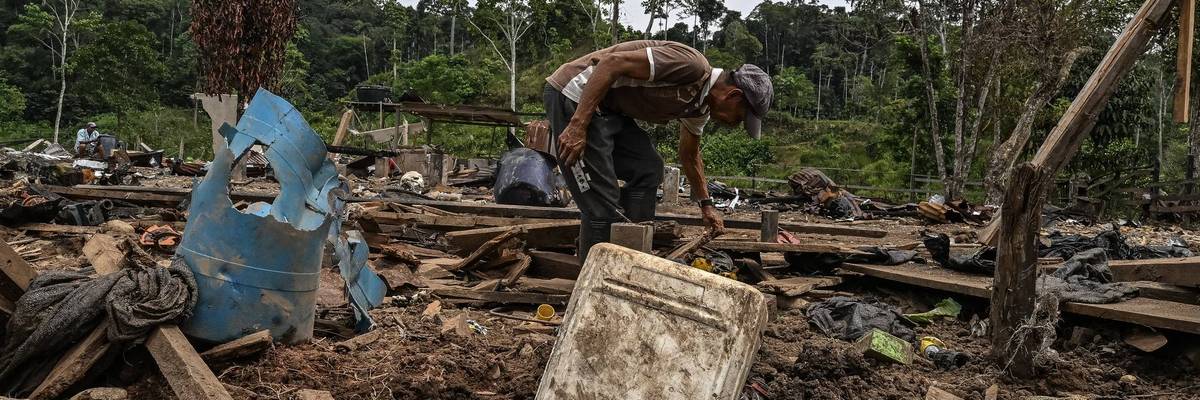
Farmer Jose Pena looks for belongings amid rubble after a bomb dropped by the Ecuadorian army in the Lago Agrio region, Sucumbios province, Ecuador, on the border with Colombia, on March 18, 2026.
US-Ecuador Military Partnership Brings Torture, Deadly Drone Strikes, and Disappearances
“US-Ecuador cooperation on security has been too opaque and too dangerous for Ecuadorians," said a representative for Human Rights Watch.
Human rights advocates are urging Congress to investigate the deepening military relationship between the US and Ecuador, which they say has been marred by severe abuses against civilians, including torture, arbitrary detentions, unexplained drone strikes, and disappearances.
A report out Tuesday from Human Rights Watch documents how the Trump administration's cooperation with the right-wing government of Ecuadorian President Daniel Noboa in response to organized crime in the country has been carried out under a veil of secrecy that has left few safeguards in place to protect human rights.
Dozens of victims, witnesses, lawyers, and others were interviewed for the report, which provides details about four incidents in which ordinary people were subject to abuse allegedly by Ecuadorian forces trained and armed by the United States as part of what the governments have called "Operation Total Extermination."
In one case—which was reported on by Common Dreams after being documented by local outlets in early March—Ecuadorian soldiers partnered with the US and stormed into the rural town of San Martín along the Colombian border in search of facilities owned by an armed group known as the Border Commandos.
Soldiers detained four dairy farmers without evidence of a crime and interrogated them for hours while beating, kicking, and striking them with rifle butts. One of the men said he was taken to the main house on the farm and waterboarded. According to the men, the soldiers doused the house with gasoline and set the property on fire.
Soldiers fired their weapons at another group of villagers who'd come to ask about the workers, which caused them to flee.
The four men were later taken to an unidentified military facility, where they said they were doused with water and electrocuted. Two of the men said soldiers pointed guns at them and threatened to kill them and cut off their fingers unless they confessed where they were keeping drugs and arms.
The men were released hours later without charges, and prosecutors said the soldiers failed to provide sufficient evidence to charge them. Human Rights Watch found they had no criminal records.
Days later, the military returned and dropped munitions on the remnants of the burned property and two others that had been abandoned. Human Rights Watch did not find evidence that the destroyed properties had any connection to armed criminal groups.
In a hearing before the US Senate Armed Services Committee, Gen. Francis L. Donovan described the operation as a "success" and said Ecuadorian forces had acted "professionally." The Trump administration has said US forces were "present" for the operation, but has not disclosed their role in the bombing of the houses or the torture of the farmworkers.
The Human Rights Watch report also details three attacks on fishing boats between January and March off the coast of the Galápagos Islands, which are possessed by Ecuador.
On January 20, the Fiorella disappeared along with eight crew members who remain missing more than six months later. Two surviving crew members, who'd left the main vessel to set fishing lines, said they suddenly lost contact with the ship while they were waiting to be picked up. As they searched for the vessel, they saw a "column of smoke" off in the distance, but no sign of the Fiorella.
They added that in the days before the ship went missing, they had seen what they thought were surveillance drones flying overhead as well as a gray patrol vessel flying an American flag nearby.
The families of the eight missing sailors have been demanding answers about their whereabouts for months with little response from the Ecuadorian government. The United Nations has issued urgent actions on behalf of the fishermen, calling on Ecuador to immediately search for them.
"The families of the eight individuals whose whereabouts are unknown fear that this is a case of enforced disappearance at the hands of the United States," said Ana Piquer, Americas director at Amnesty International, on Monday. "The US and Ecuadorian authorities must confirm or deny whether state agents from either country were involved, take all necessary steps to ascertain the fate and whereabouts of the victims, and provide reliable evidence showing what happened to them."
In March, two other boats—La Negra Francisca Duarte II and Don Maca—were hit with drones off the Galápagos. In both cases, the shipwrecked men were picked up by a blue and white ship by armed personnel wearing American military attire.
The fishermen were hooded, tied up, and in some cases beaten before being left on a hot metal deck for several hours without food, water, or adequate medical care.
Members of both crews said they saw the alleged US personnel destroy their fishing boats. They were then handed off to Salvadoran authorities and later sent back to Ecuador. Several of the men sustained serious injuries from the drone attacks, including severe burns, hearing loss, vision loss, broken and dislocated bones, and wounds from drone propellers.
Ecuadorian authorities have not confirmed that the attacks took place. According to the captain of La Negra Francisca Duarte II, and later an Ecuadorian port captain, Ecuadorian Coast Guard officers had boarded their ship for a routine inspection and found no evidence of illicit activity, just eight hours before the vessel was struck. No such inspections were reported aboard Don Maca.
The attacks closely resemble the ongoing campaign of extrajudicial boat bombings carried out by the United States, known as "Operation Southern Spear," in which at least 221 people have been killed across more than 60 attacks.
Though 13 of the survivors said they were detained by what appeared to be US personnel, the Department of Defense and Coast Guard denied involvement in all three attacks off the Galápagos.
“US-Ecuador cooperation on security has been too opaque and too dangerous for Ecuadorians,” said Juanita Goebertus, Americas director at Human Rights Watch. “Before more harm is done, the US Congress should demand real answers and effective safeguards.”
“Joint security operations against organized crime," Goebertus added, "should not become a cover for abuses."
We are at a crossroads
This country and this world are at a monumental crossroads. In a few short weeks, US voters will have an opportunity to beat back the forces of fascism and confront the billionaires who are rigging the economy, our media system, and our democracy, making it increasingly impossible for ordinary people to get by. We’re not just talking about the election. We’re talking about what must be done once these fascist elements are vanquished from power. We need a bolder set of solutions than what either major party has so far been willing to offer and a working-class movement ready to fight like hell for it. Trump didn't emerge from nowhere. The conditions that fueled MAGA authoritarianism were created by decades of radical neoliberal economic policies and a corrupt political system dominated by corporate interests. They slashed taxes on the super-rich, promising that the benefits would trickle down. They said giveaways to the corporate titans would make life more affordable for the rest of us. It was all bullshit. And when a bitter, betrayed populace searches for someone to blame, right-wing demagogues have little trouble finding scapegoats. People know when they're being lied to, but you won't hear any of this from the corporate media. Only independent journalism—powered and funded by people who believe in building a better world—can deliver truly trustworthy daily news. Our Fall Campaign is underway, and we need your help. To power our newsroom through the rest of the year, we need to raise $125,000 by midnight on October 31. So if you share our vision, please contribute whatever you can to sustain our work. |
Human rights advocates are urging Congress to investigate the deepening military relationship between the US and Ecuador, which they say has been marred by severe abuses against civilians, including torture, arbitrary detentions, unexplained drone strikes, and disappearances.
A report out Tuesday from Human Rights Watch documents how the Trump administration's cooperation with the right-wing government of Ecuadorian President Daniel Noboa in response to organized crime in the country has been carried out under a veil of secrecy that has left few safeguards in place to protect human rights.
Dozens of victims, witnesses, lawyers, and others were interviewed for the report, which provides details about four incidents in which ordinary people were subject to abuse allegedly by Ecuadorian forces trained and armed by the United States as part of what the governments have called "Operation Total Extermination."
In one case—which was reported on by Common Dreams after being documented by local outlets in early March—Ecuadorian soldiers partnered with the US and stormed into the rural town of San Martín along the Colombian border in search of facilities owned by an armed group known as the Border Commandos.
Soldiers detained four dairy farmers without evidence of a crime and interrogated them for hours while beating, kicking, and striking them with rifle butts. One of the men said he was taken to the main house on the farm and waterboarded. According to the men, the soldiers doused the house with gasoline and set the property on fire.
Soldiers fired their weapons at another group of villagers who'd come to ask about the workers, which caused them to flee.
The four men were later taken to an unidentified military facility, where they said they were doused with water and electrocuted. Two of the men said soldiers pointed guns at them and threatened to kill them and cut off their fingers unless they confessed where they were keeping drugs and arms.
The men were released hours later without charges, and prosecutors said the soldiers failed to provide sufficient evidence to charge them. Human Rights Watch found they had no criminal records.
Days later, the military returned and dropped munitions on the remnants of the burned property and two others that had been abandoned. Human Rights Watch did not find evidence that the destroyed properties had any connection to armed criminal groups.
In a hearing before the US Senate Armed Services Committee, Gen. Francis L. Donovan described the operation as a "success" and said Ecuadorian forces had acted "professionally." The Trump administration has said US forces were "present" for the operation, but has not disclosed their role in the bombing of the houses or the torture of the farmworkers.
The Human Rights Watch report also details three attacks on fishing boats between January and March off the coast of the Galápagos Islands, which are possessed by Ecuador.
On January 20, the Fiorella disappeared along with eight crew members who remain missing more than six months later. Two surviving crew members, who'd left the main vessel to set fishing lines, said they suddenly lost contact with the ship while they were waiting to be picked up. As they searched for the vessel, they saw a "column of smoke" off in the distance, but no sign of the Fiorella.
They added that in the days before the ship went missing, they had seen what they thought were surveillance drones flying overhead as well as a gray patrol vessel flying an American flag nearby.
The families of the eight missing sailors have been demanding answers about their whereabouts for months with little response from the Ecuadorian government. The United Nations has issued urgent actions on behalf of the fishermen, calling on Ecuador to immediately search for them.
"The families of the eight individuals whose whereabouts are unknown fear that this is a case of enforced disappearance at the hands of the United States," said Ana Piquer, Americas director at Amnesty International, on Monday. "The US and Ecuadorian authorities must confirm or deny whether state agents from either country were involved, take all necessary steps to ascertain the fate and whereabouts of the victims, and provide reliable evidence showing what happened to them."
In March, two other boats—La Negra Francisca Duarte II and Don Maca—were hit with drones off the Galápagos. In both cases, the shipwrecked men were picked up by a blue and white ship by armed personnel wearing American military attire.
The fishermen were hooded, tied up, and in some cases beaten before being left on a hot metal deck for several hours without food, water, or adequate medical care.
Members of both crews said they saw the alleged US personnel destroy their fishing boats. They were then handed off to Salvadoran authorities and later sent back to Ecuador. Several of the men sustained serious injuries from the drone attacks, including severe burns, hearing loss, vision loss, broken and dislocated bones, and wounds from drone propellers.
Ecuadorian authorities have not confirmed that the attacks took place. According to the captain of La Negra Francisca Duarte II, and later an Ecuadorian port captain, Ecuadorian Coast Guard officers had boarded their ship for a routine inspection and found no evidence of illicit activity, just eight hours before the vessel was struck. No such inspections were reported aboard Don Maca.
The attacks closely resemble the ongoing campaign of extrajudicial boat bombings carried out by the United States, known as "Operation Southern Spear," in which at least 221 people have been killed across more than 60 attacks.
Though 13 of the survivors said they were detained by what appeared to be US personnel, the Department of Defense and Coast Guard denied involvement in all three attacks off the Galápagos.
“US-Ecuador cooperation on security has been too opaque and too dangerous for Ecuadorians,” said Juanita Goebertus, Americas director at Human Rights Watch. “Before more harm is done, the US Congress should demand real answers and effective safeguards.”
“Joint security operations against organized crime," Goebertus added, "should not become a cover for abuses."
- Boat Strike Survivors Say They Were Captured, Tortured by US Forces ›
- More War in Latin America Feared as Farmers Describe Torture From US-Ecuadorian ‘Operation Total Extermination’ ›
- Calls for Independent Probe Into Reported US Bombing of Ecuadorian Boats Grow After Murder of Investigator | Common Dreams ›
- Mysterious Attacks on Ecuadorian Fishers Raise Fears of Expanded US Boat Bombings | Common Dreams ›
Human rights advocates are urging Congress to investigate the deepening military relationship between the US and Ecuador, which they say has been marred by severe abuses against civilians, including torture, arbitrary detentions, unexplained drone strikes, and disappearances.
A report out Tuesday from Human Rights Watch documents how the Trump administration's cooperation with the right-wing government of Ecuadorian President Daniel Noboa in response to organized crime in the country has been carried out under a veil of secrecy that has left few safeguards in place to protect human rights.
Dozens of victims, witnesses, lawyers, and others were interviewed for the report, which provides details about four incidents in which ordinary people were subject to abuse allegedly by Ecuadorian forces trained and armed by the United States as part of what the governments have called "Operation Total Extermination."
In one case—which was reported on by Common Dreams after being documented by local outlets in early March—Ecuadorian soldiers partnered with the US and stormed into the rural town of San Martín along the Colombian border in search of facilities owned by an armed group known as the Border Commandos.
Soldiers detained four dairy farmers without evidence of a crime and interrogated them for hours while beating, kicking, and striking them with rifle butts. One of the men said he was taken to the main house on the farm and waterboarded. According to the men, the soldiers doused the house with gasoline and set the property on fire.
Soldiers fired their weapons at another group of villagers who'd come to ask about the workers, which caused them to flee.
The four men were later taken to an unidentified military facility, where they said they were doused with water and electrocuted. Two of the men said soldiers pointed guns at them and threatened to kill them and cut off their fingers unless they confessed where they were keeping drugs and arms.
The men were released hours later without charges, and prosecutors said the soldiers failed to provide sufficient evidence to charge them. Human Rights Watch found they had no criminal records.
Days later, the military returned and dropped munitions on the remnants of the burned property and two others that had been abandoned. Human Rights Watch did not find evidence that the destroyed properties had any connection to armed criminal groups.
In a hearing before the US Senate Armed Services Committee, Gen. Francis L. Donovan described the operation as a "success" and said Ecuadorian forces had acted "professionally." The Trump administration has said US forces were "present" for the operation, but has not disclosed their role in the bombing of the houses or the torture of the farmworkers.
The Human Rights Watch report also details three attacks on fishing boats between January and March off the coast of the Galápagos Islands, which are possessed by Ecuador.
On January 20, the Fiorella disappeared along with eight crew members who remain missing more than six months later. Two surviving crew members, who'd left the main vessel to set fishing lines, said they suddenly lost contact with the ship while they were waiting to be picked up. As they searched for the vessel, they saw a "column of smoke" off in the distance, but no sign of the Fiorella.
They added that in the days before the ship went missing, they had seen what they thought were surveillance drones flying overhead as well as a gray patrol vessel flying an American flag nearby.
The families of the eight missing sailors have been demanding answers about their whereabouts for months with little response from the Ecuadorian government. The United Nations has issued urgent actions on behalf of the fishermen, calling on Ecuador to immediately search for them.
"The families of the eight individuals whose whereabouts are unknown fear that this is a case of enforced disappearance at the hands of the United States," said Ana Piquer, Americas director at Amnesty International, on Monday. "The US and Ecuadorian authorities must confirm or deny whether state agents from either country were involved, take all necessary steps to ascertain the fate and whereabouts of the victims, and provide reliable evidence showing what happened to them."
In March, two other boats—La Negra Francisca Duarte II and Don Maca—were hit with drones off the Galápagos. In both cases, the shipwrecked men were picked up by a blue and white ship by armed personnel wearing American military attire.
The fishermen were hooded, tied up, and in some cases beaten before being left on a hot metal deck for several hours without food, water, or adequate medical care.
Members of both crews said they saw the alleged US personnel destroy their fishing boats. They were then handed off to Salvadoran authorities and later sent back to Ecuador. Several of the men sustained serious injuries from the drone attacks, including severe burns, hearing loss, vision loss, broken and dislocated bones, and wounds from drone propellers.
Ecuadorian authorities have not confirmed that the attacks took place. According to the captain of La Negra Francisca Duarte II, and later an Ecuadorian port captain, Ecuadorian Coast Guard officers had boarded their ship for a routine inspection and found no evidence of illicit activity, just eight hours before the vessel was struck. No such inspections were reported aboard Don Maca.
The attacks closely resemble the ongoing campaign of extrajudicial boat bombings carried out by the United States, known as "Operation Southern Spear," in which at least 221 people have been killed across more than 60 attacks.
Though 13 of the survivors said they were detained by what appeared to be US personnel, the Department of Defense and Coast Guard denied involvement in all three attacks off the Galápagos.
“US-Ecuador cooperation on security has been too opaque and too dangerous for Ecuadorians,” said Juanita Goebertus, Americas director at Human Rights Watch. “Before more harm is done, the US Congress should demand real answers and effective safeguards.”
“Joint security operations against organized crime," Goebertus added, "should not become a cover for abuses."
- Boat Strike Survivors Say They Were Captured, Tortured by US Forces ›
- More War in Latin America Feared as Farmers Describe Torture From US-Ecuadorian ‘Operation Total Extermination’ ›
- Calls for Independent Probe Into Reported US Bombing of Ecuadorian Boats Grow After Murder of Investigator | Common Dreams ›
- Mysterious Attacks on Ecuadorian Fishers Raise Fears of Expanded US Boat Bombings | Common Dreams ›