

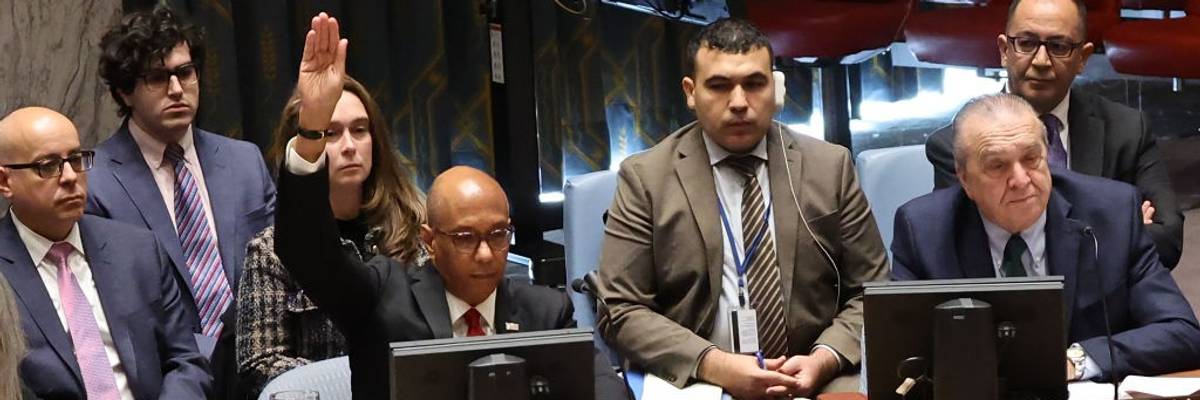
U.S. Ambassador Robert Wood raises his hands to veto a draft resolution during a United Nations Security Council meeting at the U.N. headquarters in New York City on November 20, 2024.
In 14-1 UN Security Council Vote, Lone US Veto Kills Gaza Cease-Fire Resolution
The U.S. government, said one human rights lawyer, "proves once again to the world that it is fully committed to the continuation of the genocide in Palestine."
The Biden administration faced fierce criticism on Wednesday after using its veto power at the United Nations Security Council to block a resolution demanding an immediate, unconditional, and permanent cease-fire in Israel's assault on the Gaza Strip.
The vetoed measure also called for all parties to implement a U.N. Security Council (UNSC) resolution passed in June—which would lead to the release of all hostages—and to enable Gaza civilians' immediate access to basic services and humanitarian assistance.
Jess Peake, who directs the International and Comparative Law Program at the University of California, Los Angeles, condemned the U.S. decision as "absolutely unforgivable" while Nina Turner, a senior fellow at the Institute on Race, Power, and Political Economy, declared that "this is absurd."
Mai El-Sadany, executive director of the Tahrir Institute for Middle East Policy in Washington, D.C., called it "yet another shameful abuse of the UNSC veto by the U.S. to perpetuate a war that violates U.S. law and U.S. international legal commitments."
"Today's message is clear to the Israeli occupying power—you may continue your genocide... with complete impunity."
Human rights attorney Craig Mokhiber, who last year resigned as the New York director for the Office of the High Commissioner for Human Rights over the United Nations' response to Gaza, said Wednesday that "the U.S. has just vetoed another cease-fire resolution in the U.N. Security Council, and, in doing so, proves once again to the world that it is fully committed to the continuation of the genocide in Palestine."
Mokhiber also called for action at the United Nations General Assembly (UNGA), where there is no U.S. veto power.
"Even as we seek accountability for Israeli perpetrators, we must also seek accountability for complicit U.S. actors," he said. "Israeli/U.S. impunity threatens the entire world. And the U.N. must now move to take concrete action in the UNGA."
The 14-1 vote at the UNSC marked the fourth time the United States has blocked a Gaza resolution since Israel began its retaliation for the Hamas-led October 7, 2023 attack. All five permanent members of the Security Council—the U.S., the United Kingdom, Russia, France, and China—have veto power. The other seats are filled on a rotating basis and lack that authority.
The 10 nonpermanent members—Algeria, Ecuador, Guyana, Japan, Malta, Mozambique, Sierra Leone, Slovenia, South Korea, and Switzerland—were behind the push to pass this draft resolution. Those who supported it represent "the collective will" of the international community, Algerian Ambassador Amar Bendjama said after the vote, according to U.N. News.
"It is sad day for the Security Council, for the United Nations, and the international community as a whole," Bendjama said, stressing that it has been "five months since the adoption of Resolution 2735, five months during which the Security Council remained idle—remained hand-tied."
"Today's message is clear to the Israeli occupying power—you may continue your genocide... with complete impunity. In this chamber—you enjoy immunity," he added. "To the Palestinian people, another clear message—while the overwhelming majority of the world stands in solidarity with your plight, others remain indifferent to your suffering."
Israel faces a South Africa-led genocide case at the International Court of Justice over its assault on Gaza, which as of Wednesday has killed at least 43,985 Palestinians, according to local officials. Another 104,092 people have been wounded, and most of the enclave's 2.3 million residents have been repeatedly displaced as Israeli forces have devastated civilian infrastructure.
U.S. Ambassador Robert Wood said Wednesday that "we made clear throughout negotiations we could not support an unconditional cease-fire that failed to release the hostages."
"This resolution abandoned that necessity," he argued. "For that reason, the United States could not support it."
The U.S. government has been widely accused of complicity in genocide for arming Israeli forces over the past 13 months—including by progressives in Congress. Sen. Bernie Sanders (I-Vt.) on Wednesday planned to force a vote on resolutions that would block American weapons sales to Israel on the grounds that they violate federal law.
We are at a crossroads
This country and this world are at a monumental crossroads. In a few short weeks, US voters will have an opportunity to beat back the forces of fascism and confront the billionaires who are rigging the economy, our media system, and our democracy, making it increasingly impossible for ordinary people to get by. We’re not just talking about the election. We’re talking about what must be done once these fascist elements are vanquished from power. We need a bolder set of solutions than what either major party has so far been willing to offer and a working-class movement ready to fight like hell for it. Trump didn't emerge from nowhere. The conditions that fueled MAGA authoritarianism were created by decades of radical neoliberal economic policies and a corrupt political system dominated by corporate interests. They slashed taxes on the super-rich, promising that the benefits would trickle down. They said giveaways to the corporate titans would make life more affordable for the rest of us. It was all bullshit. And when a bitter, betrayed populace searches for someone to blame, right-wing demagogues have little trouble finding scapegoats. People know when they're being lied to, but you won't hear any of this from the corporate media. Only independent journalism—powered and funded by people who believe in building a better world—can deliver truly trustworthy daily news. Our Fall Campaign is underway, and we need your help. To power our newsroom through the rest of the year, we need to raise $125,000 by midnight on October 31. So if you share our vision, please contribute whatever you can to sustain our work. |
The Biden administration faced fierce criticism on Wednesday after using its veto power at the United Nations Security Council to block a resolution demanding an immediate, unconditional, and permanent cease-fire in Israel's assault on the Gaza Strip.
The vetoed measure also called for all parties to implement a U.N. Security Council (UNSC) resolution passed in June—which would lead to the release of all hostages—and to enable Gaza civilians' immediate access to basic services and humanitarian assistance.
Jess Peake, who directs the International and Comparative Law Program at the University of California, Los Angeles, condemned the U.S. decision as "absolutely unforgivable" while Nina Turner, a senior fellow at the Institute on Race, Power, and Political Economy, declared that "this is absurd."
Mai El-Sadany, executive director of the Tahrir Institute for Middle East Policy in Washington, D.C., called it "yet another shameful abuse of the UNSC veto by the U.S. to perpetuate a war that violates U.S. law and U.S. international legal commitments."
"Today's message is clear to the Israeli occupying power—you may continue your genocide... with complete impunity."
Human rights attorney Craig Mokhiber, who last year resigned as the New York director for the Office of the High Commissioner for Human Rights over the United Nations' response to Gaza, said Wednesday that "the U.S. has just vetoed another cease-fire resolution in the U.N. Security Council, and, in doing so, proves once again to the world that it is fully committed to the continuation of the genocide in Palestine."
Mokhiber also called for action at the United Nations General Assembly (UNGA), where there is no U.S. veto power.
"Even as we seek accountability for Israeli perpetrators, we must also seek accountability for complicit U.S. actors," he said. "Israeli/U.S. impunity threatens the entire world. And the U.N. must now move to take concrete action in the UNGA."
The 14-1 vote at the UNSC marked the fourth time the United States has blocked a Gaza resolution since Israel began its retaliation for the Hamas-led October 7, 2023 attack. All five permanent members of the Security Council—the U.S., the United Kingdom, Russia, France, and China—have veto power. The other seats are filled on a rotating basis and lack that authority.
The 10 nonpermanent members—Algeria, Ecuador, Guyana, Japan, Malta, Mozambique, Sierra Leone, Slovenia, South Korea, and Switzerland—were behind the push to pass this draft resolution. Those who supported it represent "the collective will" of the international community, Algerian Ambassador Amar Bendjama said after the vote, according to U.N. News.
"It is sad day for the Security Council, for the United Nations, and the international community as a whole," Bendjama said, stressing that it has been "five months since the adoption of Resolution 2735, five months during which the Security Council remained idle—remained hand-tied."
"Today's message is clear to the Israeli occupying power—you may continue your genocide... with complete impunity. In this chamber—you enjoy immunity," he added. "To the Palestinian people, another clear message—while the overwhelming majority of the world stands in solidarity with your plight, others remain indifferent to your suffering."
Israel faces a South Africa-led genocide case at the International Court of Justice over its assault on Gaza, which as of Wednesday has killed at least 43,985 Palestinians, according to local officials. Another 104,092 people have been wounded, and most of the enclave's 2.3 million residents have been repeatedly displaced as Israeli forces have devastated civilian infrastructure.
U.S. Ambassador Robert Wood said Wednesday that "we made clear throughout negotiations we could not support an unconditional cease-fire that failed to release the hostages."
"This resolution abandoned that necessity," he argued. "For that reason, the United States could not support it."
The U.S. government has been widely accused of complicity in genocide for arming Israeli forces over the past 13 months—including by progressives in Congress. Sen. Bernie Sanders (I-Vt.) on Wednesday planned to force a vote on resolutions that would block American weapons sales to Israel on the grounds that they violate federal law.
- UN Security Council Caves to US Pressure to Prevent a Gaza Cease-Fire ›
- UN Security Council's Gaza Cease-Fire Resolution Is Not Enough—But It's a Start ›
- US Vetoes Brazil Security Council Resolution Calling for 'Humanitarian Pauses' in Gaza ›
- As Israeli Forces Fire on Starving Palestinians, US Again Vetoes UN Cease-Fire Resolution ›
- 'Disastrous': US Vetoes Cease-Fire Resolution at UN Security Council ›
- Opinion | US Pressure Made a Gaza Cease-Fire Possible; Will Trump Maintain It? | Common Dreams ›
- US Wields 'Hand of Genocide' by Vetoing Yet Another UN Gaza Cease-Fire Resolution | Common Dreams ›
- Israel's 'Weaponization' of Food Is a 'War Crime': UN | Common Dreams ›
- With Genocide Confirmed and Gaza City a 'Lifeless Wasteland,' US Vetoes Another UN Ceasefire Resolution | Common Dreams ›
The Biden administration faced fierce criticism on Wednesday after using its veto power at the United Nations Security Council to block a resolution demanding an immediate, unconditional, and permanent cease-fire in Israel's assault on the Gaza Strip.
The vetoed measure also called for all parties to implement a U.N. Security Council (UNSC) resolution passed in June—which would lead to the release of all hostages—and to enable Gaza civilians' immediate access to basic services and humanitarian assistance.
Jess Peake, who directs the International and Comparative Law Program at the University of California, Los Angeles, condemned the U.S. decision as "absolutely unforgivable" while Nina Turner, a senior fellow at the Institute on Race, Power, and Political Economy, declared that "this is absurd."
Mai El-Sadany, executive director of the Tahrir Institute for Middle East Policy in Washington, D.C., called it "yet another shameful abuse of the UNSC veto by the U.S. to perpetuate a war that violates U.S. law and U.S. international legal commitments."
"Today's message is clear to the Israeli occupying power—you may continue your genocide... with complete impunity."
Human rights attorney Craig Mokhiber, who last year resigned as the New York director for the Office of the High Commissioner for Human Rights over the United Nations' response to Gaza, said Wednesday that "the U.S. has just vetoed another cease-fire resolution in the U.N. Security Council, and, in doing so, proves once again to the world that it is fully committed to the continuation of the genocide in Palestine."
Mokhiber also called for action at the United Nations General Assembly (UNGA), where there is no U.S. veto power.
"Even as we seek accountability for Israeli perpetrators, we must also seek accountability for complicit U.S. actors," he said. "Israeli/U.S. impunity threatens the entire world. And the U.N. must now move to take concrete action in the UNGA."
The 14-1 vote at the UNSC marked the fourth time the United States has blocked a Gaza resolution since Israel began its retaliation for the Hamas-led October 7, 2023 attack. All five permanent members of the Security Council—the U.S., the United Kingdom, Russia, France, and China—have veto power. The other seats are filled on a rotating basis and lack that authority.
The 10 nonpermanent members—Algeria, Ecuador, Guyana, Japan, Malta, Mozambique, Sierra Leone, Slovenia, South Korea, and Switzerland—were behind the push to pass this draft resolution. Those who supported it represent "the collective will" of the international community, Algerian Ambassador Amar Bendjama said after the vote, according to U.N. News.
"It is sad day for the Security Council, for the United Nations, and the international community as a whole," Bendjama said, stressing that it has been "five months since the adoption of Resolution 2735, five months during which the Security Council remained idle—remained hand-tied."
"Today's message is clear to the Israeli occupying power—you may continue your genocide... with complete impunity. In this chamber—you enjoy immunity," he added. "To the Palestinian people, another clear message—while the overwhelming majority of the world stands in solidarity with your plight, others remain indifferent to your suffering."
Israel faces a South Africa-led genocide case at the International Court of Justice over its assault on Gaza, which as of Wednesday has killed at least 43,985 Palestinians, according to local officials. Another 104,092 people have been wounded, and most of the enclave's 2.3 million residents have been repeatedly displaced as Israeli forces have devastated civilian infrastructure.
U.S. Ambassador Robert Wood said Wednesday that "we made clear throughout negotiations we could not support an unconditional cease-fire that failed to release the hostages."
"This resolution abandoned that necessity," he argued. "For that reason, the United States could not support it."
The U.S. government has been widely accused of complicity in genocide for arming Israeli forces over the past 13 months—including by progressives in Congress. Sen. Bernie Sanders (I-Vt.) on Wednesday planned to force a vote on resolutions that would block American weapons sales to Israel on the grounds that they violate federal law.
- UN Security Council Caves to US Pressure to Prevent a Gaza Cease-Fire ›
- UN Security Council's Gaza Cease-Fire Resolution Is Not Enough—But It's a Start ›
- US Vetoes Brazil Security Council Resolution Calling for 'Humanitarian Pauses' in Gaza ›
- As Israeli Forces Fire on Starving Palestinians, US Again Vetoes UN Cease-Fire Resolution ›
- 'Disastrous': US Vetoes Cease-Fire Resolution at UN Security Council ›
- Opinion | US Pressure Made a Gaza Cease-Fire Possible; Will Trump Maintain It? | Common Dreams ›
- US Wields 'Hand of Genocide' by Vetoing Yet Another UN Gaza Cease-Fire Resolution | Common Dreams ›
- Israel's 'Weaponization' of Food Is a 'War Crime': UN | Common Dreams ›
- With Genocide Confirmed and Gaza City a 'Lifeless Wasteland,' US Vetoes Another UN Ceasefire Resolution | Common Dreams ›