SUBSCRIBE TO OUR FREE NEWSLETTER
Daily news & progressive opinion—funded by the people, not the corporations—delivered straight to your inbox.
5
#000000
#FFFFFF
To donate by check, phone, or other method, see our More Ways to Give page.
Daily news & progressive opinion—funded by the people, not the corporations—delivered straight to your inbox.
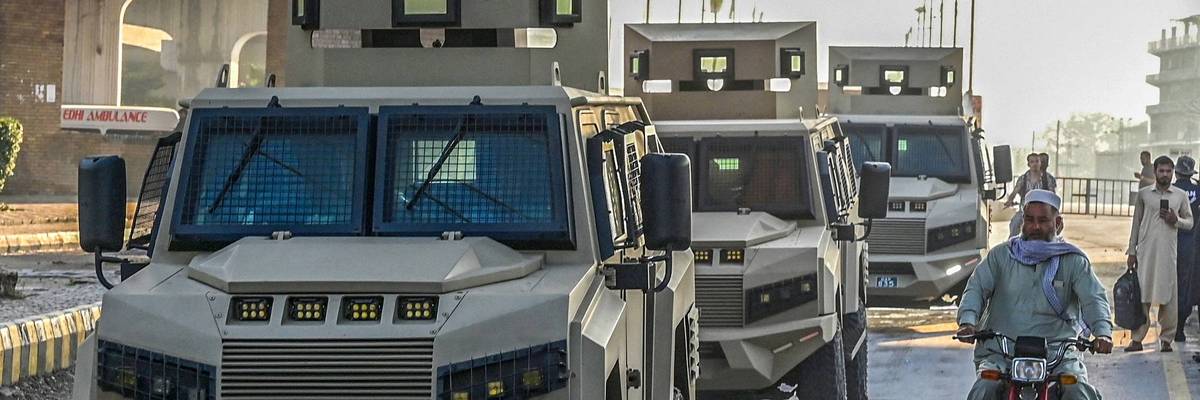
Armored police vehicles drive along a road as security tightens after the imposition of an emergency rule in Peshawar on October 12, 2026, following anti-government demonstrations by the opposition Pakistan Tehreek-e-Insaf (PTI) party demanding the release of jailed former prime minister Imran Khan.
"Everyone saw these pro-democracy protests," said a critic of Pakistan's US-backed military government. "This is a very transparent attempt to crush them by a military regime that is terrified of its own people."
As US President Donald Trump deepens his ties with Pakistan's powerful military chief, the nation's government has detained the elected leadership of the last province controlled by jailed former Prime Minister Imran Khan's opposition party—a move critics have condemned as a coup.
Pakistan's president, Asif Ali Zardari, declared a state of emergency on Sunday in the northwestern province of Khyber Pakhtunkhwa, suspending its elected government and transferring authority to a federally appointed governor. Hundreds of members of Khan's Pakistan Tehreek-e-Insaf (PTI) party, including its provincial chief minister, Sohail Afridi, have been arrested, as have Khan's three sisters, according to The Guardian.
The emergency measures come after days of protests calling for the release of Khan—who was forced to step down from power in 2022 by a parliamentary vote of no confidence under heavy pressure from the US government, then led by President Joe Biden. Khan was subsequently imprisoned by Pakistani authorities and accused the military of orchestrating his ouster.
Pakistan's government said it declared the state of emergency after local leadership failed to stop escalating attacks from Islamist terrorist groups. But PTI leaders described it as a thinly veiled pretext to squash protests, including a planned march on Islamabad to demand Khan's release.
Mehlaqa Samdani, the director of the Community Alliance for Peace and Justice—a group advocating against US support for political repression in Pakistan—described Khyber Pakhtunkhwa as "the last remaining province where the military regime had been unable to take control."
"The government has now declared a state of emergency and imposed governor's rule in the province, effectively removing its elected government from power," Samdani said in a video. "Just think about what that means: Millions of people voted for their representatives, only to see their elected government stripped of its authority."
"Everyone saw these pro-democracy protests," she added. "This is a very transparent attempt to crush them by a military regime that is terrified of its own people."
Amid mass protests calling for his release, Amnesty International has argued that Pakistani authorities have weaponized criminal proceedings to keep Khan out of power and crack down on dissent.
After the emergency measures went into effect this weekend, the internet monitoring organization NetBlocks reported major disruptions to internet service in parts of Khyber Pakhtunkhwa. Mobile phone networks have reportedly been disrupted, public transit closed, and several roads across the province shut down.
"Reports of arbitrary detentions of key leaders—including the provincial chief minister—and internet disruptions across the province raise concerns about the proportionality of these emergency measures," Babu Ram Pant, Amnesty International’s deputy director for South Asia, said on Sunday following news of the emergency declaration.
"While states may, in strictly limited circumstances, derogate from their human rights obligations to respond to a public emergency that threatens the existence of the nation, emergency measures are not a blank cheque to crack down on human rights, silence dissent, or concentrate power," he said.
Trump has warmly embraced Asim Munir, the military chief who has overseen the crackdown on Khan and his opposition party, spent recent years consolidating control over Pakistan's armed forces, and secured immunity from criminal prosecution.
Munir has regularly been heaped with praise by Trump, who hosted him for an unprecedented two-hour Oval Office meeting last year without any other Pakistani officials. Trump has referred to Munir as "my favorite field marshal," "a very important guy," and an "exceptional human being."
In December, the Trump administration approved a $686 million sale to upgrade Pakistan's F-16 fighter jets. Trump has also tapped Munir as a key intermediary between Washington and Tehran amid the US war with Iran.
Hussain Nadim, a Pakistani political analyst and lecturer at George Washington University, has argued that Munir has made himself useful to Trump because it "confers international legitimacy as his military rule faces deep questions at home."
"Pakistani generals have long understood how to capitalize on American fears, anxieties, and domestic political needs of a wide range of American presidents," Nadim wrote in August. "Military rulers position themselves around political changes in Washington, knowing urgent American political and security needs can override concerns about democracy and governance in countries like Pakistan."
Opponents of US intervention, including Samdani, have renewed calls for the US to cut off support for Pakistan's government.
"The US continues to train and work closely with the very military regime that is now attacking its own people," she said. "Members of Congress should speak out immediately. They should tell Pakistan's peaceful pro-democracy protesters that the world stands with them and tell the military dictatorship that we are watching and will not allow this repression to go unanswered."
"American taxpayers do not want to be involved in training a corrupt military regime that's oppressing its own people, including relatives of around one million Americans of Pakistani descent," said Erik Sperling, the executive director of Just Foreign Policy—a member of the Coalition to Change US Policy Towards Pakistan.
"If the Pakistani regime cannot allow its own people to protest and vote in free elections, they should not be receiving any training or support from the United States military or intelligence services," he told Common Dreams.
"The US is harming its relationship with the Pakistani people by continuing to side with the military regime that fraudulently stole elections and is now attacking its own people," he said. "There's a chance for the United States to stand up for freedom and democracy and build a genuine partnership with the people of Pakistan by siding with them as they fight for their freedom from military rule."
Dear Common Dreams reader, It’s been nearly 30 years since I co-founded Common Dreams with my late wife, Lina Newhouser. We had the radical notion that journalism should serve the public good, not corporate profits. It was clear to us from the outset what it would take to build such a project. No paid advertisements. No corporate sponsors. No millionaire publisher telling us what to think or do. Many people said we wouldn't last a year, but we proved those doubters wrong. Together with a tremendous team of journalists and dedicated staff, we built an independent media outlet free from the constraints of profits and corporate control. Our mission has always been simple: To inform. To inspire. To ignite change for the common good. Building Common Dreams was not easy. Our survival was never guaranteed. When you take on the most powerful forces—Wall Street greed, fossil fuel industry destruction, Big Tech lobbyists, and uber-rich oligarchs who have spent billions upon billions rigging the economy and democracy in their favor—the only bulwark you have is supporters who believe in your work. But here’s the urgent message from me today. It's never been this bad out there. And it's never been this hard to keep us going. At the very moment Common Dreams is most needed, the threats we face are intensifying. We need your support now more than ever. We don't accept corporate advertising and never will. We don't have a paywall because we don't think people should be blocked from critical news based on their ability to pay. Everything we do is funded by the donations of readers like you. When everyone does the little they can afford, we are strong. But if that support retreats or dries up, so do we. Will you donate now to make sure Common Dreams not only survives but thrives? —Craig Brown, Co-founder |
As US President Donald Trump deepens his ties with Pakistan's powerful military chief, the nation's government has detained the elected leadership of the last province controlled by jailed former Prime Minister Imran Khan's opposition party—a move critics have condemned as a coup.
Pakistan's president, Asif Ali Zardari, declared a state of emergency on Sunday in the northwestern province of Khyber Pakhtunkhwa, suspending its elected government and transferring authority to a federally appointed governor. Hundreds of members of Khan's Pakistan Tehreek-e-Insaf (PTI) party, including its provincial chief minister, Sohail Afridi, have been arrested, as have Khan's three sisters, according to The Guardian.
The emergency measures come after days of protests calling for the release of Khan—who was forced to step down from power in 2022 by a parliamentary vote of no confidence under heavy pressure from the US government, then led by President Joe Biden. Khan was subsequently imprisoned by Pakistani authorities and accused the military of orchestrating his ouster.
Pakistan's government said it declared the state of emergency after local leadership failed to stop escalating attacks from Islamist terrorist groups. But PTI leaders described it as a thinly veiled pretext to squash protests, including a planned march on Islamabad to demand Khan's release.
Mehlaqa Samdani, the director of the Community Alliance for Peace and Justice—a group advocating against US support for political repression in Pakistan—described Khyber Pakhtunkhwa as "the last remaining province where the military regime had been unable to take control."
"The government has now declared a state of emergency and imposed governor's rule in the province, effectively removing its elected government from power," Samdani said in a video. "Just think about what that means: Millions of people voted for their representatives, only to see their elected government stripped of its authority."
"Everyone saw these pro-democracy protests," she added. "This is a very transparent attempt to crush them by a military regime that is terrified of its own people."
Amid mass protests calling for his release, Amnesty International has argued that Pakistani authorities have weaponized criminal proceedings to keep Khan out of power and crack down on dissent.
After the emergency measures went into effect this weekend, the internet monitoring organization NetBlocks reported major disruptions to internet service in parts of Khyber Pakhtunkhwa. Mobile phone networks have reportedly been disrupted, public transit closed, and several roads across the province shut down.
"Reports of arbitrary detentions of key leaders—including the provincial chief minister—and internet disruptions across the province raise concerns about the proportionality of these emergency measures," Babu Ram Pant, Amnesty International’s deputy director for South Asia, said on Sunday following news of the emergency declaration.
"While states may, in strictly limited circumstances, derogate from their human rights obligations to respond to a public emergency that threatens the existence of the nation, emergency measures are not a blank cheque to crack down on human rights, silence dissent, or concentrate power," he said.
Trump has warmly embraced Asim Munir, the military chief who has overseen the crackdown on Khan and his opposition party, spent recent years consolidating control over Pakistan's armed forces, and secured immunity from criminal prosecution.
Munir has regularly been heaped with praise by Trump, who hosted him for an unprecedented two-hour Oval Office meeting last year without any other Pakistani officials. Trump has referred to Munir as "my favorite field marshal," "a very important guy," and an "exceptional human being."
In December, the Trump administration approved a $686 million sale to upgrade Pakistan's F-16 fighter jets. Trump has also tapped Munir as a key intermediary between Washington and Tehran amid the US war with Iran.
Hussain Nadim, a Pakistani political analyst and lecturer at George Washington University, has argued that Munir has made himself useful to Trump because it "confers international legitimacy as his military rule faces deep questions at home."
"Pakistani generals have long understood how to capitalize on American fears, anxieties, and domestic political needs of a wide range of American presidents," Nadim wrote in August. "Military rulers position themselves around political changes in Washington, knowing urgent American political and security needs can override concerns about democracy and governance in countries like Pakistan."
Opponents of US intervention, including Samdani, have renewed calls for the US to cut off support for Pakistan's government.
"The US continues to train and work closely with the very military regime that is now attacking its own people," she said. "Members of Congress should speak out immediately. They should tell Pakistan's peaceful pro-democracy protesters that the world stands with them and tell the military dictatorship that we are watching and will not allow this repression to go unanswered."
"American taxpayers do not want to be involved in training a corrupt military regime that's oppressing its own people, including relatives of around one million Americans of Pakistani descent," said Erik Sperling, the executive director of Just Foreign Policy—a member of the Coalition to Change US Policy Towards Pakistan.
"If the Pakistani regime cannot allow its own people to protest and vote in free elections, they should not be receiving any training or support from the United States military or intelligence services," he told Common Dreams.
"The US is harming its relationship with the Pakistani people by continuing to side with the military regime that fraudulently stole elections and is now attacking its own people," he said. "There's a chance for the United States to stand up for freedom and democracy and build a genuine partnership with the people of Pakistan by siding with them as they fight for their freedom from military rule."
As US President Donald Trump deepens his ties with Pakistan's powerful military chief, the nation's government has detained the elected leadership of the last province controlled by jailed former Prime Minister Imran Khan's opposition party—a move critics have condemned as a coup.
Pakistan's president, Asif Ali Zardari, declared a state of emergency on Sunday in the northwestern province of Khyber Pakhtunkhwa, suspending its elected government and transferring authority to a federally appointed governor. Hundreds of members of Khan's Pakistan Tehreek-e-Insaf (PTI) party, including its provincial chief minister, Sohail Afridi, have been arrested, as have Khan's three sisters, according to The Guardian.
The emergency measures come after days of protests calling for the release of Khan—who was forced to step down from power in 2022 by a parliamentary vote of no confidence under heavy pressure from the US government, then led by President Joe Biden. Khan was subsequently imprisoned by Pakistani authorities and accused the military of orchestrating his ouster.
Pakistan's government said it declared the state of emergency after local leadership failed to stop escalating attacks from Islamist terrorist groups. But PTI leaders described it as a thinly veiled pretext to squash protests, including a planned march on Islamabad to demand Khan's release.
Mehlaqa Samdani, the director of the Community Alliance for Peace and Justice—a group advocating against US support for political repression in Pakistan—described Khyber Pakhtunkhwa as "the last remaining province where the military regime had been unable to take control."
"The government has now declared a state of emergency and imposed governor's rule in the province, effectively removing its elected government from power," Samdani said in a video. "Just think about what that means: Millions of people voted for their representatives, only to see their elected government stripped of its authority."
"Everyone saw these pro-democracy protests," she added. "This is a very transparent attempt to crush them by a military regime that is terrified of its own people."
Amid mass protests calling for his release, Amnesty International has argued that Pakistani authorities have weaponized criminal proceedings to keep Khan out of power and crack down on dissent.
After the emergency measures went into effect this weekend, the internet monitoring organization NetBlocks reported major disruptions to internet service in parts of Khyber Pakhtunkhwa. Mobile phone networks have reportedly been disrupted, public transit closed, and several roads across the province shut down.
"Reports of arbitrary detentions of key leaders—including the provincial chief minister—and internet disruptions across the province raise concerns about the proportionality of these emergency measures," Babu Ram Pant, Amnesty International’s deputy director for South Asia, said on Sunday following news of the emergency declaration.
"While states may, in strictly limited circumstances, derogate from their human rights obligations to respond to a public emergency that threatens the existence of the nation, emergency measures are not a blank cheque to crack down on human rights, silence dissent, or concentrate power," he said.
Trump has warmly embraced Asim Munir, the military chief who has overseen the crackdown on Khan and his opposition party, spent recent years consolidating control over Pakistan's armed forces, and secured immunity from criminal prosecution.
Munir has regularly been heaped with praise by Trump, who hosted him for an unprecedented two-hour Oval Office meeting last year without any other Pakistani officials. Trump has referred to Munir as "my favorite field marshal," "a very important guy," and an "exceptional human being."
In December, the Trump administration approved a $686 million sale to upgrade Pakistan's F-16 fighter jets. Trump has also tapped Munir as a key intermediary between Washington and Tehran amid the US war with Iran.
Hussain Nadim, a Pakistani political analyst and lecturer at George Washington University, has argued that Munir has made himself useful to Trump because it "confers international legitimacy as his military rule faces deep questions at home."
"Pakistani generals have long understood how to capitalize on American fears, anxieties, and domestic political needs of a wide range of American presidents," Nadim wrote in August. "Military rulers position themselves around political changes in Washington, knowing urgent American political and security needs can override concerns about democracy and governance in countries like Pakistan."
Opponents of US intervention, including Samdani, have renewed calls for the US to cut off support for Pakistan's government.
"The US continues to train and work closely with the very military regime that is now attacking its own people," she said. "Members of Congress should speak out immediately. They should tell Pakistan's peaceful pro-democracy protesters that the world stands with them and tell the military dictatorship that we are watching and will not allow this repression to go unanswered."
"American taxpayers do not want to be involved in training a corrupt military regime that's oppressing its own people, including relatives of around one million Americans of Pakistani descent," said Erik Sperling, the executive director of Just Foreign Policy—a member of the Coalition to Change US Policy Towards Pakistan.
"If the Pakistani regime cannot allow its own people to protest and vote in free elections, they should not be receiving any training or support from the United States military or intelligence services," he told Common Dreams.
"The US is harming its relationship with the Pakistani people by continuing to side with the military regime that fraudulently stole elections and is now attacking its own people," he said. "There's a chance for the United States to stand up for freedom and democracy and build a genuine partnership with the people of Pakistan by siding with them as they fight for their freedom from military rule."