SUBSCRIBE TO OUR FREE NEWSLETTER
Daily news & progressive opinion—funded by the people, not the corporations—delivered straight to your inbox.
5
#000000
#FFFFFF
To donate by check, phone, or other method, see our More Ways to Give page.
Daily news & progressive opinion—funded by the people, not the corporations—delivered straight to your inbox.
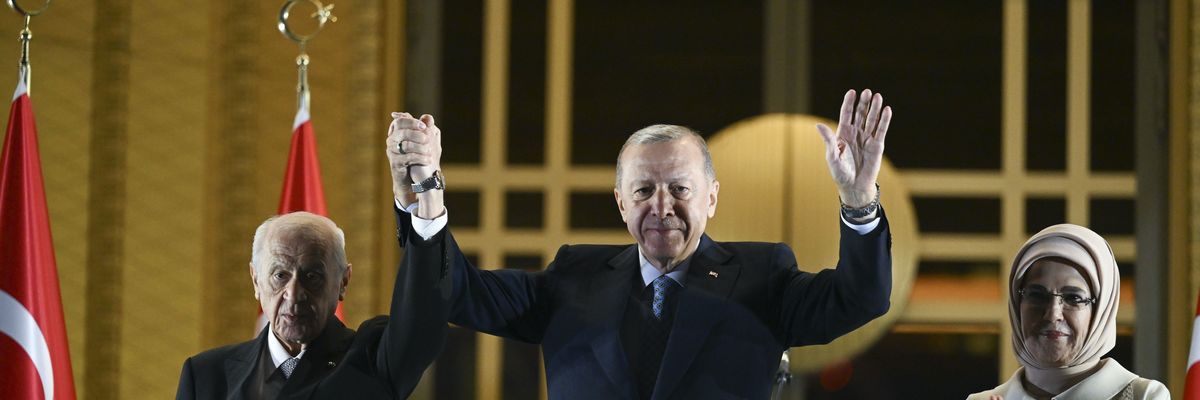
Turkish President Recep Tayyip Erdoğan, his wife Emine Erdoğan, and Turkish Nationalist Movement Party Leader Devlet Bahceli celebrate victory in a presidential runoff election in Ankara on May 29, 2023.
"Erdoğan's victory will consolidate one-man rule and pave the way for horrible practices, bringing completely dark days for all parts of society," warned one Kurdish opposition leader.
As supporters of Turkish President Recep Tayyip Erdoğan at home and abroad celebrated his win of Sunday's runoff election, human rights defenders and marginalized people including Kurds and LGBTQ+ activists voiced deep fears about how their lives will be adversely affected during the increasingly authoritarian leader's third term.
Turkey's Supreme Election Council confirmed Erdoğan's victory over Kemal Kılıçdaroğlu on Sunday evening. Erdoğan, the 69-year-old leader of the right-wing Justice and Development Party who has ruled the nation of 85 million people since 2014 and dominated its politics for two decades, won 52.18% of the vote. Kılıçdaroğlu, a 74-year-old social democrat who leads the left-of-center Republican People's Party, received 47.82%.
Erdoğan—who was seen handing out cash to supporters at a polling station in an apparent violation of Turkish election law—mocked his opponent's loss outside the president's home in Istanbul, saying, "Bye, bye, bye, Kemal" as the winner's supporters booed, according to Al Jazeera.
"The only winner today is Turkey," Erdoğan declared as he prepared for a third term in which his country faces severe economic woes—inflation has soared and the lira is at a record low against the U.S. dollar—and is struggling to recover from multiple devastating earthquakes earlier this year.
However, in Turkish Kurdistan—whose voters, along with a majority of people in most of Turkey's largest cities favored Kılıçdaroğlu—people expressed fears that the government will intensify a crackdown it has been waging for several years.
Ardelan Mese, a 26-year-old cafe owner in Diyarbakir, the country's largest Kurdish-majority city, called Sunday's election "a matter of life and death now."
"I can't imagine what he will be capable of after declaring victory," Mese said of Erdoğan in an interview with Reuters.
After initially courting the Kurds by expanding their political and cultural rights, Erdoğan returned to the repression that has long characterized Turkey's treatment of a people who make up one-fifth of the nation's population, while intensifying a war against the Kurdistan Workers' Party (PKK), a far-left separatist group that Turkey, the United States, and other nations consider a terrorist organization.
"Erdogan's victory will consolidate one-man rule and pave the way for horrible practices, bringing completely dark days for all parts of society," Tayip Temel, the deputy co-chair of Turkey's second-largest opposition party, the center-left and pro-Kurdish Peoples' Democratic Party (HDP)—which backed Kılıçdaroğlu—told Reuters.
Human rights defenders—many of whom have chosen or been forced into exile—also sounded the alarm over the prospect of a third Erdoğan term.
"If the opposition wins there will be space, even possibly limited, for discussions for a common future. With Erdoğan, there is no civic or political space for democracy and human rights," Murat Çelikkan, a journalist who founded human rights groups including Amnesty International Turkey, said in an interview with Civil Rights Defenders just before Sunday's runoff.
Çelikkan called Erdoğan a "very authoritarian, religious, pro-expansionist conservative."
"Turkey, according to judicial statistics, has the largest number of terrorists in the world, because the prosecutors and judges have an inclination to use anti-terror laws arbitrarily and lavishly," he continued. "There are tens of thousands of people who are being trialed or convicted by anti-terror laws. Thousands of people insulting the president."
"Nowhere in Turkey you can make a peaceful demonstration and protest," Çelikkan added. "The security forces directly attack and detain you. The minister of interior targets and criminalizes LGBTI+ people on a daily basis."
LGBTQ+ Turks voiced fears for their future following a campaign in which Erdoğan centered homophobia in his appeals to an overwhelmingly Muslim electorate and repeatedly accused Kılıçdaroğlu and other opposition figures of being gay. During his victory speech Sunday evening, Erdoğan again lashed out at the LGBTQ+ community while excoriating Kılıçdaroğlu for his campaign pledge to "respect everyone's beliefs, lifestyles, and identities."
Erdoğan vowed in his speech that gays would not "infiltrate" Turkey and that "we will not let the LGBT forces win." At one point during his address, an Al Jazeera interpreter stopped translating a 45-second portion when the president called members of the opposition gay.
Ilker Erdoğan, a 20-year-old university student and LGBTQ+ activist, told Agence France-Presse that "I feel deeply afraid."
"Feeling so afraid is affecting my psychology terribly. I couldn't breathe before, and now they will try to strangle my throat," he added. "From the moment I was born, I felt that discrimination, homophobia, and hatred in my bones."
Ameda Murat Karaguzu, a project assistant at an unnamed pro-LGBTQ+ group, told AFP that she has been "subjected to more hate speech and acts of hate than I have experienced in a long time."
Karaguzu blamed Erdoğan's government for the increasing hostility toward LGBTQ+ Turks, adding that bigots are keenly "aware that there will be no consequences for killing or harming us."
Ilker Erdoğan struck a defiant tone, telling AFP that "I am also part of this nation, my identity card says Turkish citizen."
"You cannot erase my existence," he added, "no matter how hard you try."
Dear Common Dreams reader, It’s been nearly 30 years since I co-founded Common Dreams with my late wife, Lina Newhouser. We had the radical notion that journalism should serve the public good, not corporate profits. It was clear to us from the outset what it would take to build such a project. No paid advertisements. No corporate sponsors. No millionaire publisher telling us what to think or do. Many people said we wouldn't last a year, but we proved those doubters wrong. Together with a tremendous team of journalists and dedicated staff, we built an independent media outlet free from the constraints of profits and corporate control. Our mission has always been simple: To inform. To inspire. To ignite change for the common good. Building Common Dreams was not easy. Our survival was never guaranteed. When you take on the most powerful forces—Wall Street greed, fossil fuel industry destruction, Big Tech lobbyists, and uber-rich oligarchs who have spent billions upon billions rigging the economy and democracy in their favor—the only bulwark you have is supporters who believe in your work. But here’s the urgent message from me today. It's never been this bad out there. And it's never been this hard to keep us going. At the very moment Common Dreams is most needed, the threats we face are intensifying. We need your support now more than ever. We don't accept corporate advertising and never will. We don't have a paywall because we don't think people should be blocked from critical news based on their ability to pay. Everything we do is funded by the donations of readers like you. When everyone does the little they can afford, we are strong. But if that support retreats or dries up, so do we. Will you donate now to make sure Common Dreams not only survives but thrives? —Craig Brown, Co-founder |
As supporters of Turkish President Recep Tayyip Erdoğan at home and abroad celebrated his win of Sunday's runoff election, human rights defenders and marginalized people including Kurds and LGBTQ+ activists voiced deep fears about how their lives will be adversely affected during the increasingly authoritarian leader's third term.
Turkey's Supreme Election Council confirmed Erdoğan's victory over Kemal Kılıçdaroğlu on Sunday evening. Erdoğan, the 69-year-old leader of the right-wing Justice and Development Party who has ruled the nation of 85 million people since 2014 and dominated its politics for two decades, won 52.18% of the vote. Kılıçdaroğlu, a 74-year-old social democrat who leads the left-of-center Republican People's Party, received 47.82%.
Erdoğan—who was seen handing out cash to supporters at a polling station in an apparent violation of Turkish election law—mocked his opponent's loss outside the president's home in Istanbul, saying, "Bye, bye, bye, Kemal" as the winner's supporters booed, according to Al Jazeera.
"The only winner today is Turkey," Erdoğan declared as he prepared for a third term in which his country faces severe economic woes—inflation has soared and the lira is at a record low against the U.S. dollar—and is struggling to recover from multiple devastating earthquakes earlier this year.
However, in Turkish Kurdistan—whose voters, along with a majority of people in most of Turkey's largest cities favored Kılıçdaroğlu—people expressed fears that the government will intensify a crackdown it has been waging for several years.
Ardelan Mese, a 26-year-old cafe owner in Diyarbakir, the country's largest Kurdish-majority city, called Sunday's election "a matter of life and death now."
"I can't imagine what he will be capable of after declaring victory," Mese said of Erdoğan in an interview with Reuters.
After initially courting the Kurds by expanding their political and cultural rights, Erdoğan returned to the repression that has long characterized Turkey's treatment of a people who make up one-fifth of the nation's population, while intensifying a war against the Kurdistan Workers' Party (PKK), a far-left separatist group that Turkey, the United States, and other nations consider a terrorist organization.
"Erdogan's victory will consolidate one-man rule and pave the way for horrible practices, bringing completely dark days for all parts of society," Tayip Temel, the deputy co-chair of Turkey's second-largest opposition party, the center-left and pro-Kurdish Peoples' Democratic Party (HDP)—which backed Kılıçdaroğlu—told Reuters.
Human rights defenders—many of whom have chosen or been forced into exile—also sounded the alarm over the prospect of a third Erdoğan term.
"If the opposition wins there will be space, even possibly limited, for discussions for a common future. With Erdoğan, there is no civic or political space for democracy and human rights," Murat Çelikkan, a journalist who founded human rights groups including Amnesty International Turkey, said in an interview with Civil Rights Defenders just before Sunday's runoff.
Çelikkan called Erdoğan a "very authoritarian, religious, pro-expansionist conservative."
"Turkey, according to judicial statistics, has the largest number of terrorists in the world, because the prosecutors and judges have an inclination to use anti-terror laws arbitrarily and lavishly," he continued. "There are tens of thousands of people who are being trialed or convicted by anti-terror laws. Thousands of people insulting the president."
"Nowhere in Turkey you can make a peaceful demonstration and protest," Çelikkan added. "The security forces directly attack and detain you. The minister of interior targets and criminalizes LGBTI+ people on a daily basis."
LGBTQ+ Turks voiced fears for their future following a campaign in which Erdoğan centered homophobia in his appeals to an overwhelmingly Muslim electorate and repeatedly accused Kılıçdaroğlu and other opposition figures of being gay. During his victory speech Sunday evening, Erdoğan again lashed out at the LGBTQ+ community while excoriating Kılıçdaroğlu for his campaign pledge to "respect everyone's beliefs, lifestyles, and identities."
Erdoğan vowed in his speech that gays would not "infiltrate" Turkey and that "we will not let the LGBT forces win." At one point during his address, an Al Jazeera interpreter stopped translating a 45-second portion when the president called members of the opposition gay.
Ilker Erdoğan, a 20-year-old university student and LGBTQ+ activist, told Agence France-Presse that "I feel deeply afraid."
"Feeling so afraid is affecting my psychology terribly. I couldn't breathe before, and now they will try to strangle my throat," he added. "From the moment I was born, I felt that discrimination, homophobia, and hatred in my bones."
Ameda Murat Karaguzu, a project assistant at an unnamed pro-LGBTQ+ group, told AFP that she has been "subjected to more hate speech and acts of hate than I have experienced in a long time."
Karaguzu blamed Erdoğan's government for the increasing hostility toward LGBTQ+ Turks, adding that bigots are keenly "aware that there will be no consequences for killing or harming us."
Ilker Erdoğan struck a defiant tone, telling AFP that "I am also part of this nation, my identity card says Turkish citizen."
"You cannot erase my existence," he added, "no matter how hard you try."
As supporters of Turkish President Recep Tayyip Erdoğan at home and abroad celebrated his win of Sunday's runoff election, human rights defenders and marginalized people including Kurds and LGBTQ+ activists voiced deep fears about how their lives will be adversely affected during the increasingly authoritarian leader's third term.
Turkey's Supreme Election Council confirmed Erdoğan's victory over Kemal Kılıçdaroğlu on Sunday evening. Erdoğan, the 69-year-old leader of the right-wing Justice and Development Party who has ruled the nation of 85 million people since 2014 and dominated its politics for two decades, won 52.18% of the vote. Kılıçdaroğlu, a 74-year-old social democrat who leads the left-of-center Republican People's Party, received 47.82%.
Erdoğan—who was seen handing out cash to supporters at a polling station in an apparent violation of Turkish election law—mocked his opponent's loss outside the president's home in Istanbul, saying, "Bye, bye, bye, Kemal" as the winner's supporters booed, according to Al Jazeera.
"The only winner today is Turkey," Erdoğan declared as he prepared for a third term in which his country faces severe economic woes—inflation has soared and the lira is at a record low against the U.S. dollar—and is struggling to recover from multiple devastating earthquakes earlier this year.
However, in Turkish Kurdistan—whose voters, along with a majority of people in most of Turkey's largest cities favored Kılıçdaroğlu—people expressed fears that the government will intensify a crackdown it has been waging for several years.
Ardelan Mese, a 26-year-old cafe owner in Diyarbakir, the country's largest Kurdish-majority city, called Sunday's election "a matter of life and death now."
"I can't imagine what he will be capable of after declaring victory," Mese said of Erdoğan in an interview with Reuters.
After initially courting the Kurds by expanding their political and cultural rights, Erdoğan returned to the repression that has long characterized Turkey's treatment of a people who make up one-fifth of the nation's population, while intensifying a war against the Kurdistan Workers' Party (PKK), a far-left separatist group that Turkey, the United States, and other nations consider a terrorist organization.
"Erdogan's victory will consolidate one-man rule and pave the way for horrible practices, bringing completely dark days for all parts of society," Tayip Temel, the deputy co-chair of Turkey's second-largest opposition party, the center-left and pro-Kurdish Peoples' Democratic Party (HDP)—which backed Kılıçdaroğlu—told Reuters.
Human rights defenders—many of whom have chosen or been forced into exile—also sounded the alarm over the prospect of a third Erdoğan term.
"If the opposition wins there will be space, even possibly limited, for discussions for a common future. With Erdoğan, there is no civic or political space for democracy and human rights," Murat Çelikkan, a journalist who founded human rights groups including Amnesty International Turkey, said in an interview with Civil Rights Defenders just before Sunday's runoff.
Çelikkan called Erdoğan a "very authoritarian, religious, pro-expansionist conservative."
"Turkey, according to judicial statistics, has the largest number of terrorists in the world, because the prosecutors and judges have an inclination to use anti-terror laws arbitrarily and lavishly," he continued. "There are tens of thousands of people who are being trialed or convicted by anti-terror laws. Thousands of people insulting the president."
"Nowhere in Turkey you can make a peaceful demonstration and protest," Çelikkan added. "The security forces directly attack and detain you. The minister of interior targets and criminalizes LGBTI+ people on a daily basis."
LGBTQ+ Turks voiced fears for their future following a campaign in which Erdoğan centered homophobia in his appeals to an overwhelmingly Muslim electorate and repeatedly accused Kılıçdaroğlu and other opposition figures of being gay. During his victory speech Sunday evening, Erdoğan again lashed out at the LGBTQ+ community while excoriating Kılıçdaroğlu for his campaign pledge to "respect everyone's beliefs, lifestyles, and identities."
Erdoğan vowed in his speech that gays would not "infiltrate" Turkey and that "we will not let the LGBT forces win." At one point during his address, an Al Jazeera interpreter stopped translating a 45-second portion when the president called members of the opposition gay.
Ilker Erdoğan, a 20-year-old university student and LGBTQ+ activist, told Agence France-Presse that "I feel deeply afraid."
"Feeling so afraid is affecting my psychology terribly. I couldn't breathe before, and now they will try to strangle my throat," he added. "From the moment I was born, I felt that discrimination, homophobia, and hatred in my bones."
Ameda Murat Karaguzu, a project assistant at an unnamed pro-LGBTQ+ group, told AFP that she has been "subjected to more hate speech and acts of hate than I have experienced in a long time."
Karaguzu blamed Erdoğan's government for the increasing hostility toward LGBTQ+ Turks, adding that bigots are keenly "aware that there will be no consequences for killing or harming us."
Ilker Erdoğan struck a defiant tone, telling AFP that "I am also part of this nation, my identity card says Turkish citizen."
"You cannot erase my existence," he added, "no matter how hard you try."