
SUBSCRIBE TO OUR FREE NEWSLETTER
Daily news & progressive opinion—funded by the people, not the corporations—delivered straight to your inbox.
5
#000000
#FFFFFF
To donate by check, phone, or other method, see our More Ways to Give page.


Daily news & progressive opinion—funded by the people, not the corporations—delivered straight to your inbox.
"Many Americans think this is something that only happens to others, and I think that mindset has to be fought," said Katalin Cseh, a member of Hungary's opposition Momentum Movement Party.
Eastern European dissidents are warning that the autocratic politics that took over their countries is in the process of taking over the United States as well.
At a web forum hosted Tuesday by the Center for American Progress, opposition politicians and journalists from Hungary, Serbia, and Turkey spoke about the tactics that strongman leaders used to rip up the foundations of their nations' democratic institutions. They urged Americans to resist President Donald Trump as he tries to do the same.
"I do believe that many Americans think this is something that only happens to others, and I think that mindset has to be fought," said Katalin Cseh, a member of Hungary's opposition Momentum Movement Party.
Her nation, under authoritarian Prime Minister Viktor Orbán, is often cited as a textbook example of "democratic backsliding" in the 21st century.
Since his election in 2010, with a supermajority in the parliament, Orbán has worked to steadily capture key political institutions like election authorities and the judiciary, and cultural ones like the media and universities to bend them toward a "nationalist conservative narrative."
Notably, Cseh says, Orbán did this not by formally abolishing institutions, but by purging dissent and taking them over:
The first month of the new government back in 2010 started with the complete overhaul of the Hungarian constitution without democratic discussion. Senior judges were forced into early retirement and a new judicial administration was created...
The freedom of the media is almost lost...The media authority was staffed by loyalists. A pro-government businessman acquired private media and later donated it to a foundation run by the government. This means that if you turn on almost any channel, it has Fox News running on it...
The electoral system is very heavily manipulated. The government, after they got into power, changed the electoral system to one that is more fitting to them and gerrymandering very heavily to disenfranchise more progressive voters and to change the districts to a more favorable one for them...
The universities' minds were centralized and now mostly run by foundations set up by the government. The curriculum was also centralized and was very heavily infused with nationalist and conservative theory, and minorities, LGBTQI+ and women's rights are almost obliterated.
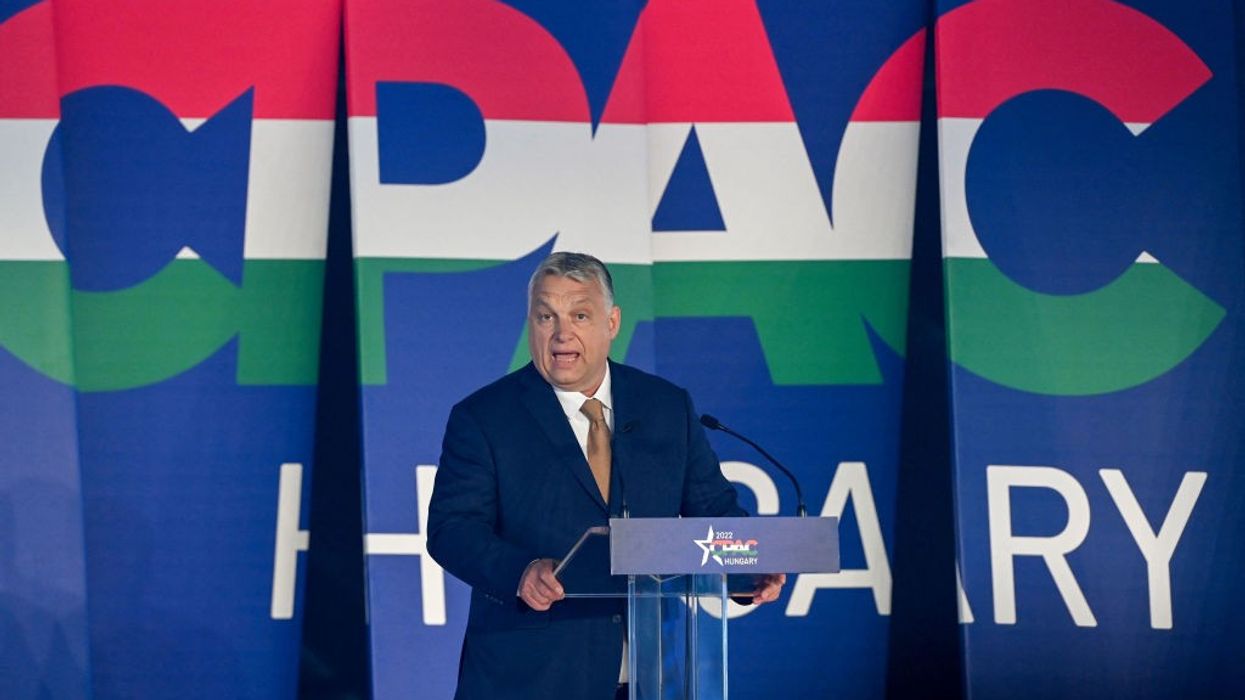
Cseh noted that the so-called "Hungarian blueprint" is heavily influential among American conservatives, who have hosted Orbán at conventions like CPAC and consulted pro-Orbán think tanks to create the 'Project 2025' agenda Trump has used during his second term.
Trump, moreover, has been carrying out similar ideological purges of government through the mass firings of disloyal public servants, threats to defund universities that refuse to teach the MAGA worldview as doctrine, and attempts to legally erase the government's recognition of nonwhite and LGBTQ+ individuals.
"What if this is a blueprint for MAGA? What if this is something you will see in your country?" she asked.
Szabolcs Panyi, a journalist with the Hungarian website Direkt36, likewise raised comparisons between Orbán and Trump's assaults on the press.
"It's not a coincidence that Orbán went after the free media," Panyi said. "He understood for him to grab power it's essential that people just don't see behind the curtains and don't understand what's happening."
He pointed to Trump's attacks on the free press, including his use of lawsuits, FCC investigations, and threats of prosecution against critical media outlets.
"It's interesting to see how large outlets or media owners or conglomerates try to appease Trump by settling lawsuits, firing journalists and editors," Panyi said. "It reminds me of what happened in Hungary in the 2010s."
Dissidents from Serbia and Turkey have dealt with a similar backslide and raised similar parallels to the situation in America.
Ceylan Akça, a member of the pro-Kurdish People's Equality and Democracy Party in the Turkish parliament, discussed President Recep Tayyip Erdoğan's use of citizenship as a political weapon against minorities like the Kurds. He has moved to strip the citizenship of naturalized Kurds, who he says support "terrorism" by militant groups like the PKK.
"We'll see people with Turkish citizenship, who were naturalized, stripped of their citizenship and being deported," Akça said, "which is the example you're having in the U.S. where you're having a discussion about naturalized citizens losing citizenship."
"We have to be aware that they are using [tools that] are usually legal but misused, institutional but hollowed out, democratic in appearance but authoritarian in essence," said Tamara Tripic, the chair of the Democratic Dialogue Network in Serbia.
Tripic said that the recent youth-led anti-corruption protests against President Aleksandar Vučić in her country provide a roadmap for how to resist. She cited the importance of mobilizing young people.
"Students actually started the process. They were the most powerful resistance we saw in recent years," she said.
Cseh said that part of building that engagement needed to come from creating a viable alternative to the right that promises people "tangible change" in their lives.
"Autocrats are not always good at governing," she said, "so the cost of living crisis, cost of healthcare, education, everything. Everybody senses that."
She said that Americans have "a very good opportunity ahead" in the next elections to reassert power.
"Start preparing for the midterms like yesterday," said Cseh. "Go to every protest, go to every march, stand right beside everybody who is being attacked, no matter if it is a group you belong to, or something that you do not share personally. You have to stand side by side [with] each other and help and support those who might feel isolated and alone."
The imprisonment of Istanbul Mayor Ekrem İmamoğlu, the far-right president's top political rival, has unleashed a new wave of protests against increasingly autocratic rule.
International outrage and charges of "viciousness" and "outright autocracy" have followed Sunday's imprisonment of Turkey President Recep Tayyip Erdoğan's top political rival, the popular Istanbul Mayor Ekrem İmamoğlu, who is seen as Erdogan's likeliest opposition challenger in upcoming national elections.
The corruption charges levied against İmamoğlu, a member of the Republican People's Party (CHP), are seen as politically motivated and follow days of sustained protests by opposition voices opposed to Erdoğan's increasingly authoritarian rule.
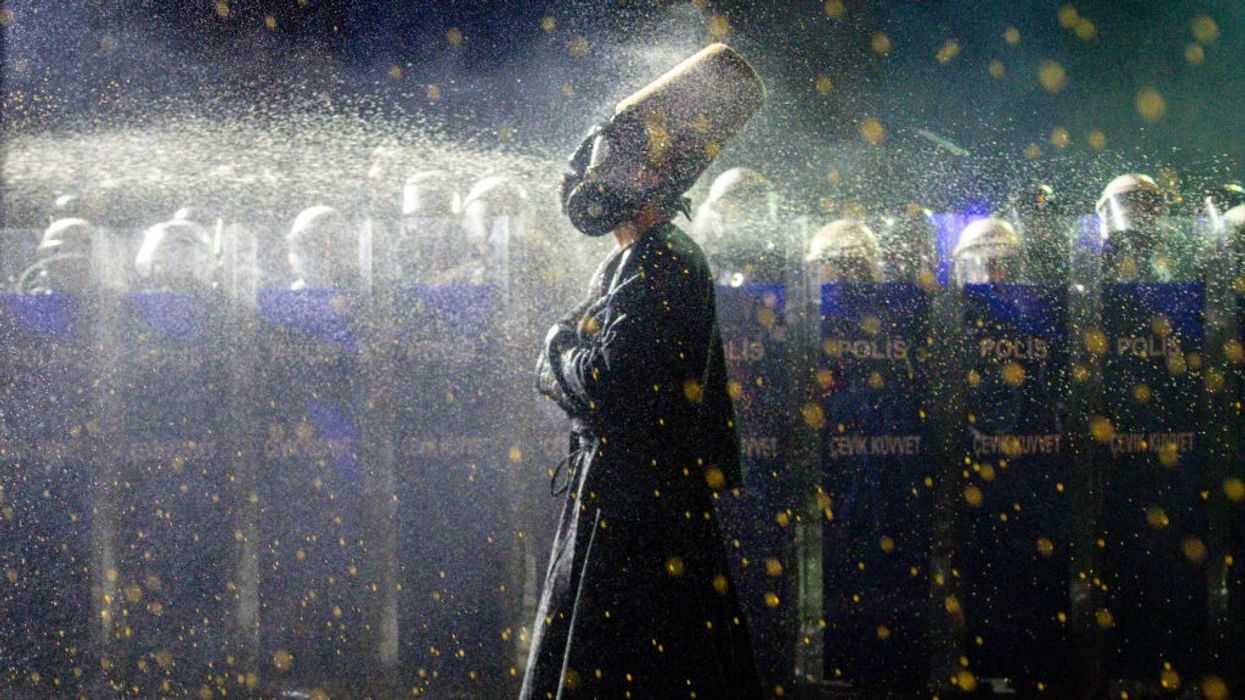
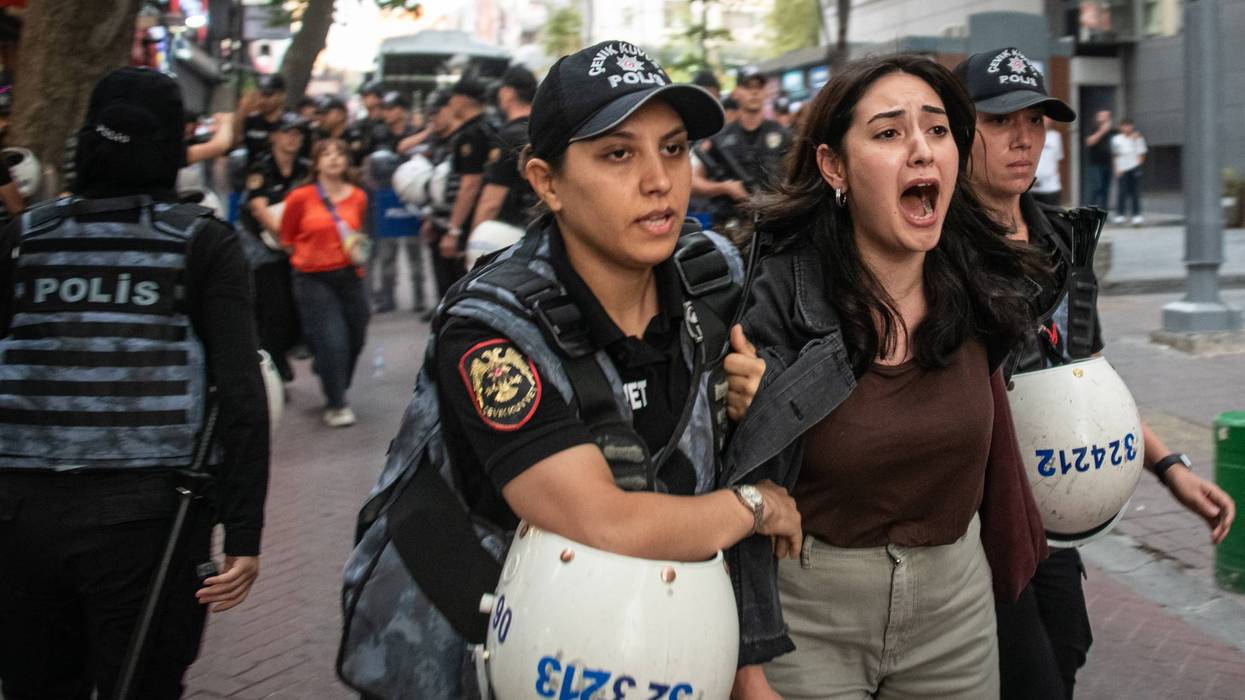
Tens of thousands marched and clashed with riot police after fresh protests erupted Sunday in Istanbul and elsewhere in the country following the court's actions against İmamoğlu and on Monday, the CHP announced that nearly 15 million people, members and non-members alike, participated in national primaries to support the jailed mayor's candidacy to face off against Erdoğan in the next election.
The non-member vote of more than 13 million, "could indicate," reports NBC News, "that İmamoğlu, 54, enjoys wide public support beyond the party faithful. The party's chairman said it showed the need for early elections."
Writing for Politico Europe, opinion editor Jamie Dettmer argues that that timing of Erdoğan's targeting of İmamoğlu has everything to do with the return of U.S. President Donald Trump to the international scene.
Erdoğan, Dettmer wrote on Saturday, "has spent years eroding democracy, stifling dissent and purging the country's army and civil service. Now, it looks as though he's chosen this geopolitical moment to bury the legacy of Mustafa Kemal Atatürk, the secular founder of the Republic of Turkey." He continued:
Erdoğan would harbor no worries as to Trump’s disapproval. The two have lavished priase on each other for years, and the Turkish leader has said he supports his American counterpart’s peace initiative in Ukraine—no doubt music to Trump’s ears.
Erdoğan isn't alone among the once embattled autocrats—and would-be autocrats—sniffing the change in the geopolitical air, and reckoning they're on the cusp of a new era, able to erase the rules and norms of old and replace them with ones more to their liking. It's influencing their behavior as they look to each other for inspiration and new ideas for running their respective countries—whether it be weaponizing policies affecting sexual minorities, scapegoating migrants, sharpening attacks on independent media, transforming public broadcasters into government mouthpieces or just closing them down.
Since his arrest on March 19, the ousted mayor has denied all charges against him and urged his supporters to continue protests in the face of the government crackdown.
"I totally believe these are bogus charges," Emre Can Erdogdu, a university student in Istanbul who attended street protests Sunday night, told the New York Times. "We entirely lost our trust in the government."
Erdogdu said he feared for the future of Turkey. "A person who could be the next president is now out of politics. It is not just about Istanbul. It is about all of Turkey."
A Turkish court jailed Istanbul Mayor Ekrem Imamoglu, President Erdogan's main rival, pending trial on corruption charges triggering the country's biggest protests in over a decade https://t.co/7P7PwrjZsi pic.twitter.com/e05k1sERXI
— Reuters (@Reuters) March 24, 2025
Özgür Özel, the CHP chair, said the imprisonment would not dampen the party's prospects, but only further ignite the growing opposition. "Starting from tomorrow morning," he said from Istanbul on Sunday evening, "we will initiate a great struggle by harnessing the power of organization and using this strength for the good sake of all of us."
He called for "all democrats and all those who care the future of Turkey" to come out in sustained protest.
According to the Hürriyet Daily News, over 1,100 people have been arrested since mass protests erupted last week over İmamoğlu's initial arrest. Criticism only grew the court on Sunday stripped him of his position and sent him to prison.
"By arresting his main political rival," said human rights advocate and scholar Kenneth Roth, "Erdoğan shows he is too fearful of losing to risk even a managed election."
Roth said Erdoğan, an ally of U.S. President Donald Trump, would rather "opt for an electoral charade" than hold free and fair elections.
Turkish protesters demand "freedom" as police fire rubber bullets and pepper spray at crowds rallying for detained Istanbul Mayor Ekrem Imamoglu.https://t.co/r7gKpPg0YJ pic.twitter.com/HqAL3Z4kay
— Sky News (@SkyNews) March 24, 2025
With Turkish officials set to visit the United States this week to visit with U.S. counterparts, world's richest man Elon Musk, who has taken a seat as a top advisor to Trump, is under fire for blocking accounts of opposition figures in Turkey on his social media platform X.
As Politico reported over the weekend:
The majority of the suspended accounts were "university-associated activist accounts, basically sharing protest information, locations for students to go," Yusuf Can, coordinator and analyst at the Wilson Center's Middle East Program, told POLITICO. Many of these accounts are "grassroots activists" with their followings in the low tens of thousands, said Can.
Some accounts appear to be suspended only in Turkey and not in the rest of the world. Activist Ömer Faruk Aslan created a second account to avoid censorship. "Yesterday, my account was blocked by a court order because the tweets exceeded 6 million views," he posted.
Last week, Human Rights Watch said that İmamoğlu's arrest, as well as the targeting of other opposition figures, was politically motivated and an assault on the rule of law.
"Ekrem İmamoğlu and others detained should be released from police custody immediately," said Hugh Williamson, Europe and Central Asia director for the group. "The Erdoğan presidency should ensure that the results of the Istanbul municipal elections are respected and that the criminal justice system is not weaponized for political ends."
"Yes, we watched hundreds of thousands of children being killed, maimed, and starved—and we just kept watching," one writer said in response to the powerful clip.
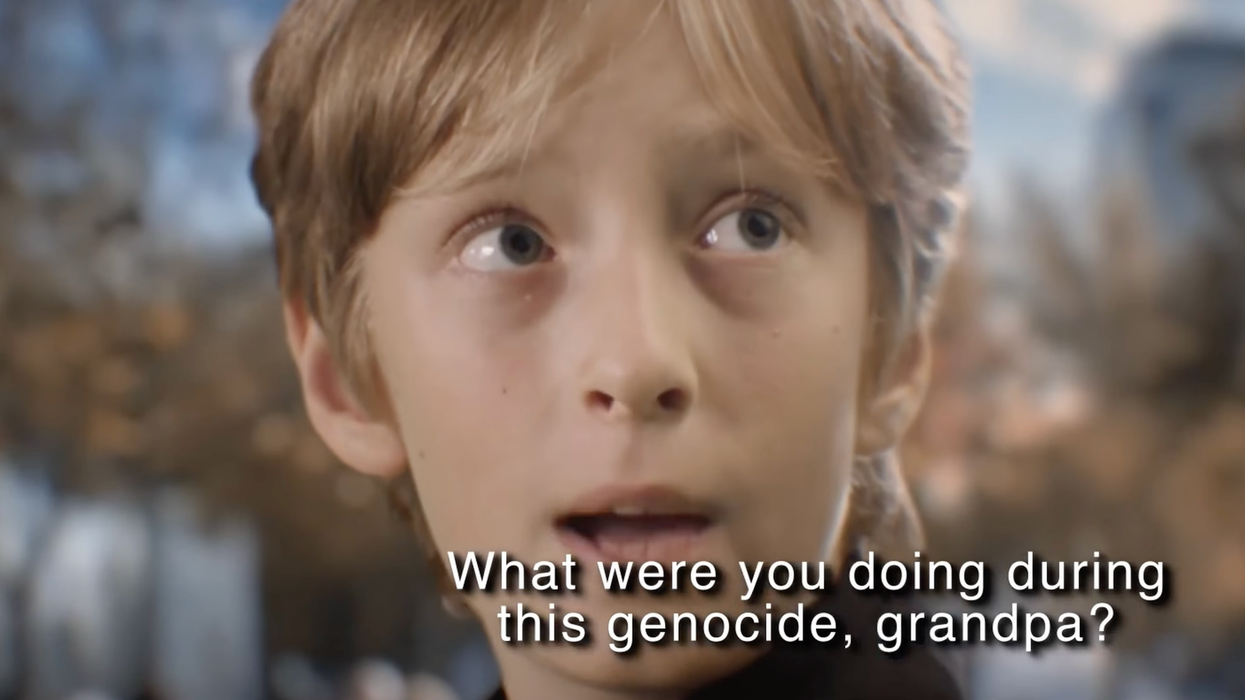
To mark this week's anniversary of Israel's yearlong assault on Gaza—which has killed, maimed, displaced, starved, and sickened millions of Palestinians with no end in sight—Palestine defenders shared a video set in the year 2040 in which children around the world ask their elders, "What were you doing during this genocide?"
The video—which is reportedly linked to the Turkish government—was reposted by prominent international figures including Turkish President Recep Tayyip Erdoğan, former Greek Finance Minister Yanis Varoufakis, and U.S. peace activist Medea Benjamin.
The clip shows the world commemorating Gaza in ceremonies, museums, and films, with kids asking their grandparents questions like, "What were you doing during this genocide?" and "Did you just watch it?" as the elders hang their heads in shame at images of slain and suffering Palestinian children.
The video ends with a message that fades from, "The genocide committed by Israel is killing Palestinians" to, "The genocide committed by Israel is killing humanity."
Benjamin called the video "haunting." Husam Zomlot, Palestine's ambassador to the United Kingdom, hailed it as "powerful." British author Jonathan Cook lamented that "yes, we watched hundreds of thousands of children being killed, maimed, and starved—and we just kept watching."
Varoufakis posted: "'Where were you,' they will be asking us, 'when this was happening? What did you do to stop it?'"
Erdoğan included a lengthy message with the video as he shared it on X, the social media platform formerly known as Twitter.
"Israel's long-standing policy of genocide, occupation, and invasion must now come to an end," he wrote. "It should not be forgotten that Israel will sooner or later pay the price for this genocide that it has been carrying out for a year and is still continuing."
"Just as [Nazi leader Adolf] Hitler was stopped by the common alliance of humanity, [Israeli Prime Minister Benjamin] Netanyahu and his murder network will be stopped in the same way," Erdoğan continued. "A world in which no account is held for the Gaza genocide will ever find peace."
He added that Turkey "will continue to stand against the Israeli government, no matter what the cost, and call on the world to take this honorable stance."
Turkey has been one of the most vocal critics of Israel's Gaza onslaught. The country officially supports the South Africa-led genocide case against Israel at the International Court of Justice. In 2024, the Turkish government halted direct trade with Israel over its invasion of Rafah, although commerce continued via third countries including Greece.
However, the Turkish government has also been criticized for not doing enough to support Palestine despite its scathing anti-Israel rhetoric. Some critics also noted the hypocrisy of Turkey vocally condemning Israel's genocide in Gaza while denying the 1915-17 Turkish genocide against Armenians in the disintegrating Ottoman Empire.
"You opened the door to the rise of democracy, equality, and freedom," Istanbul Mayor Ekrem Imamoğlu said following his re-election. "You ignited hope at the ballot box."
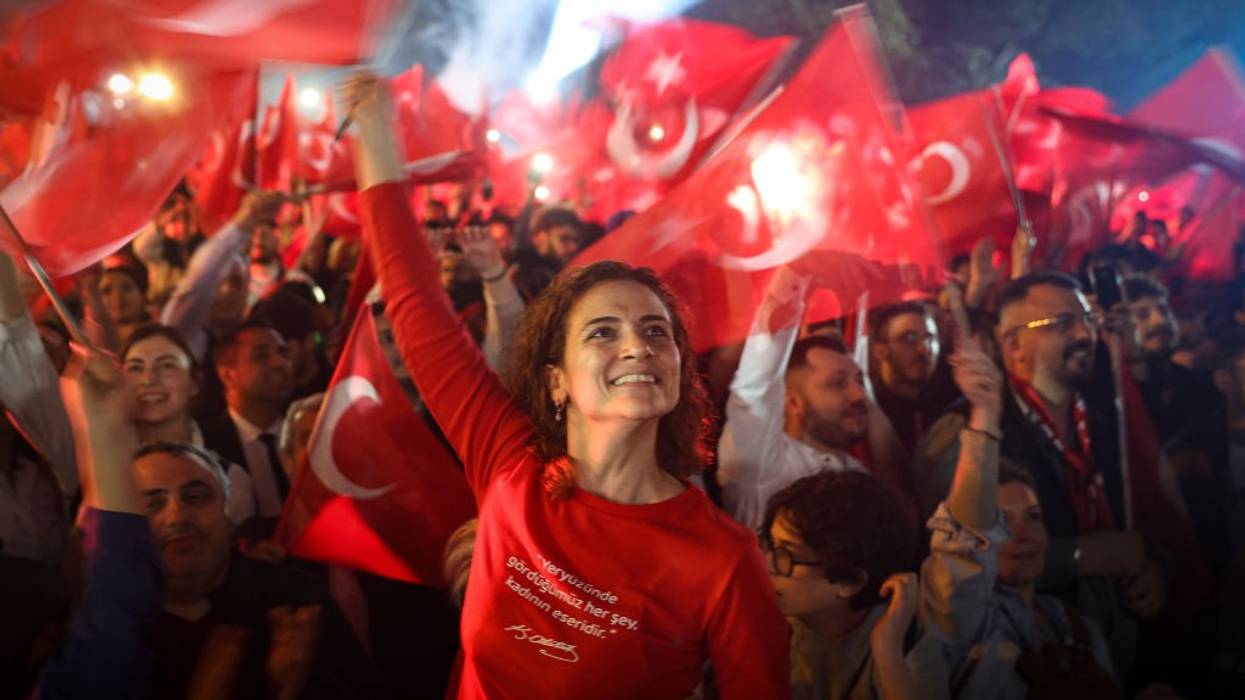
Turkish President Recep Tayyip Erdoğan's Justice and Development Party suffered its worst-ever defeat Sunday when the country's main opposition party scored major wins in municipal elections, including in all five of the nation's largest cities.
With nearly all ballots counted, candidates for the center-left Republican People's Party (CHP) emerged victorious in Istanbul, the capital Ankara, İzmir, Bursa, Adana, and other cities and towns. Turkish media reported CHP victories in 36 of the country's 81 provinces. The right-wing Justice and Development Party (AKP) performed best in the largely rural Anatolian interior.
It was the first time in Erdoğan's 21 years as Turkey's increasingly autocratic president that the AKP suffered such a nationwide electoral defeat.
"My dear Istanbulites, you opened the door to a new future today," incumbent CHP Istanbul Mayor Ekrem Imamoğlu told jubilant supporters during his victory speech following what's likely to be a double-digit win over AKP challenger Murat Kurum. "Starting from tomorrow, Turkey will be a different Turkey. You opened the door to the rise of democracy, equality, and freedom... You ignited hope at the ballot box."
Turkey’s main opposition Republican People’s Party (CHP) has dealt the biggest blow in two decades to President Erdogan’s AK Party by winning control of major cities in local elections. Ekrem Imamoglu secured a second term as Istanbul’s mayor ⤵️ pic.twitter.com/fjgsLzuEYg
— Al Jazeera English (@AJEnglish) April 1, 2024
Imamoğlu said that Sunday "marks the end of democratic erosion in Turkey and the resurgence of democracy."
"People oppressed under authoritarian regimes now turn their gaze to Istanbul," he added.
In Ankara—where an ecstatic crowd chanted "Turkey is secular and will remain secular!" and "Tayyip resign!" outside the city hall—CHP Mayor Mansur Yavaş promised his second term would be one of greater inclusion after beating his AKP rival by a stunning 25-point margin.
"Our political views may be different... But now the election is over," he told supporters. "We will... continue to serve 6 million Ankara residents without discrimination."
Erdoğan, meanwhile, acknowledged that the AKP "lost altitude" with Sunday's sweeping losses, vowing, "We will correct our mistakes and redress our shortcomings."
Imamoğlu's reelection was a personal blow to Erdoğan, an Istanbul native who launched his political career as the megacity's mayor in the 1990s. The AKP had set its sights on retaking control of Istanbul and Ankara but came up empty-handed.
Analysts said skyrocketing inflation, the collapsing value of the lira, disaffected Islamist voters, and Imamoğlu's popularity—which transcends the CHP's traditionally secular base—were major factors in Sunday's results.
So was the Gaza genocide. While Turkey is supporting the South Africa-led genocide case against Israel at the International Court of Justice, Erdoğan and the AKP have been accused—especially by Islamists—of paying little more than lip service to the cause of Palestinian liberation, while Imamoğlu has said that Turkey should immediately sever trade relations with Israel.
Experts said Imamoğlu's victory puts him, and the CHP, at the center of Turkish politics.
"Imamoglu demonstrated he could reach across the deep socio-political divisions that define Turkey's opposition electorate even without their institutional support," Mert Arslanalp, assistant professor of political science at Istanbul's Boğaziçi University, told Reuters. "This makes him the most politically competitive rival to Erdogan's regime."
In the predominantly Kurdish southeast, the progressive People's Equality and Democratic Party (DEM) won 10 provinces. Election-related violence erupted in parts of the region, including in the village of Ağaçlıdere in the Sur district of Diyarbakır, where DEM polling officer Emin Çelik was killed and around a dozen others were wounded. There were multiple reports of Turkish police violently dispersing Kurds celebrating election wins.
International leftists hailed the big wins by CHP and DEM candidates, with Party of European Socialists president Stefan Löfven cheering what he called "a great victory for democracy and a giant step towards a better future of the Turkish people."
"Erdoğan is losing the local elections in the entire country, leaving room for the opposition to breath and to come back victorious at the next national elections," he added. "We are looking forward to that."
Instead of supporting candidates who promise truly transformational change, voters are backing fast-food populists who advertise options that are even unhealthier than what’s currently on offer.
Panic does not produce prudent politics. Panic produces provocative populists. And it reduces pundits to Seussian spluttering.
How can voters choose such… panic-peddling panderers?!
The defeats of Donald Trump in the U.S. elections in 2020 and Jair Bolsonaro in the Brazilian elections in 2022 were supposed to prove that the wave of right-wing politicians had crested worldwide. Brazilians wisely barred Bolsonaro from running again for office until 2030.
The far right sees 2024 as its greatest opportunity since the 1930s to push the needle toward fascism.
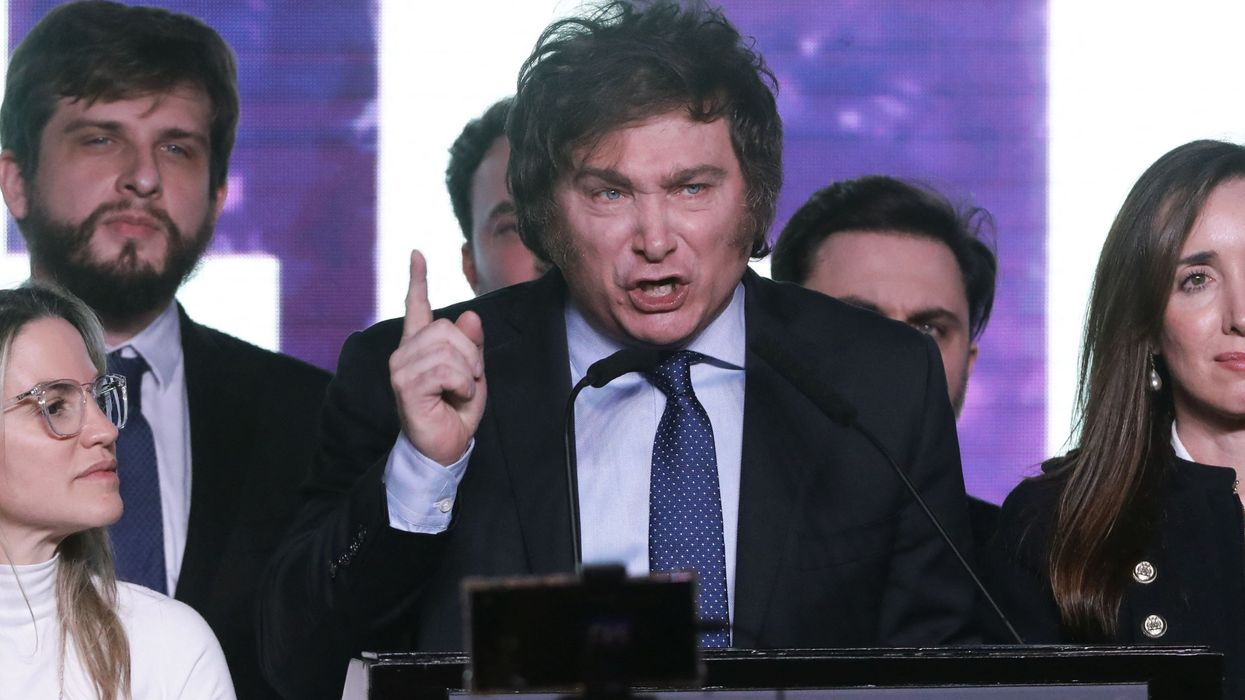
Trump, on the other hand, is on the rebound and leading the polls in the lead-up to the presidential elections in the United States next year. Even more troubling, the recent electoral victories of Javier Milei in Argentina and Geert Wilders in the Netherlands suggest that the world has not yet reached peak populism.
Brace yourself for the next potential tsunami. In 2024, elections will take place in 50 countries and engage up to 2 billion people. The Economist calls it the “biggest election year in history.” Voters will go to the polls in the United States, Russia, Mexico, South Africa, Indonesia, and the European Union, among other countries.
The far right sees 2024 as its greatest opportunity since the 1930s to push the needle toward fascism. If the recent victories of Milei and Wilders are any indication, they ain’t just whistling Dixie.
When I was studying Russian in Moscow in 1985, my fellow students complained about the food. It was your basic Soviet fare of meat and potatoes. It was rather monotonous, to be frank, but it was filling and plentiful.
After the semester was over, we all took the train to Helsinki. After checking in at the hotel, I went down to the city’s famous Harbor Market to buy fresh fruit and vegetables, which had been in short supply in Moscow. I had difficulty persuading my fellow students to come with me. A large number of them couldn’t wait to have their first, post-Soviet dinner at McDonald’s. That’s right: After all those Moscow meals of meat and potatoes, they immediately went to the Golden Arches to have… meat and potatoes.
“But it’s different!” they said, salivating over a Big Mac and French fries.
Voters in democracies across the world are tired of what’s on the political menu. They’re rejecting the “same old, same old” policies of Joe Biden even though the U.S. economy, by all standard measures, is doing pretty well. They’re souring on the European Green Deal of the Socialists and Greens even though the continent is at the forefront of addressing climate change.
Instead of supporting candidates who promise truly transformational change, voters are backing fast-food populists who advertise options that are even unhealthier than what’s currently on offer.
The desire for profound change is surely understandable. The conditions that generated victories for the far right that I describe in my 2021 book Right Around the World have not changed in any substantial way. Economic globalization, after all, continues to benefit the few and burden the many. As Zia Qureshi writes at Brookings:
Over the past four decades, there has been a broad trend of rising income inequality across countries. Income inequality has risen in most advanced economies and major emerging economies, which together account for about two-thirds of the world’s population and 85% of global GDP. The increase has been particularly large in the United States, among advanced economies, and in China, India, and Russia, among major emerging economies.
Note that the far right has prospered in precisely the countries that have experienced this rising income inequality: Donald Trump in the United States, Narendra Modi in India, and Vladimir Putin in Russia, as well as Giorgia Meloni in Italy, Viktor Orbán in Hungary, and now Geert Wilders in the Netherlands.
Voters have been disgusted by how parties of the center-right and center-left have done little to address this inequality. And they’re worried that an influx of immigrants, the very embodiment of globalization, will only make matters worse (and there’s evidence that immigrants do indeed exert a downward pressure on wages).
This is the triple whammy that helps the far right: increased economic inequality, increased disgust with conventional parties, and increased fear of immigration. It’s also the perfect storm that has put Geert Wilders so close to becoming the next Dutch prime minister.
Geert Wilders has been a platinum-haired presence on the Dutch political scene for two decades, chiefly as a mischief-maker on the margins. But in elections this month, his party won 37 seats in parliament, the most of any party and 20 more than in the last election.
If these were ordinary times, the informal prohibition of mainstream parties in Europe against working in coalition with the far right would hold and Wilders would remain in the wilderness. The former ruling party led by outgoing prime minister Mark Rutte has indeed refused to partner with Wilders’ Party for Freedom. So, too, have the coalition of socialists and Greens led by former European Commissioner Frans Timmermans and the center-right People’s Party for Freedom and Democracy.
Only the centrist New Social Contract party and some minor parties are available for the wooing. But cobbling together a coalition out of these disparate elements will not be easy. Indeed, the first negotiator to attempt this sausage-making on behalf of Wilders resigned in the wake of charges that he engaged in bribery and fraud in his previous job as director of Utrecht Holdings.
Let’s not overstate Wilders’ surprise victory. He won less than a quarter of the votes.
The real sticking point, however, will be Wilders himself and his wilder-than-wild political proposals. Most potentially destabilizing has been his support for Nexit, a withdrawal of the Netherlands from the European Union, about which he has promised to hold a referendum. This is as impractical as it is unpopular. According to the last major poll, the leavers could count on only 25% support. Dutch voters are well aware of what a mess the U.K. stepped in after voting for Brexit. According to one estimate, leaving the E.U. has cost the U.K. $100 billion a year in lost output.
Then there’s Wilders’ enthusiasm for Vladimir Putin and his channeling of Kremlin propaganda (such as his noxious notion that Ukraine is led by “National-Socialists, Jew-haters, and other anti-democrats”). Russia’s invasion of Ukraine reduced some of his fawning, but Wilders will undoubtedly try to cut back on Dutch aid for Kyiv.
On immigration, Wilders calls for “borders closed” and “zero asylum seekers.” The first is going to be hard to push in a Europe of open (internal) borders—thus his support for Nexit—while the second would violate international law. On Islam, he wants to ban the Quran, Islamic schools, and mosques. Ever the political opportunist, however, Wilders has offered to put those bans on hold in order to achieve his cherished dream of leading the country.
Finally, on the economy, Wilders has no patience for Green policies. His party backs the traditional, meat-and-potatoes positions of more drilling for oil and gas, no solar or wind farms, and a withdrawal from the Paris accord on climate change. Add to that the restriction of government assistance to immigrants and the far right promises to take the Netherlands one giant step backward.
The Dutch live in one of the richest per-capita countries in the world. But poverty has been projected to increase substantially from 4.7% of the population in 2023 to 5.8% in 2024. “Fear of falling” can easily slip into fear of immigrants.
Then there’s the rural-urban divide that has fueled the rise of the right in so many countries: Poland A versus Poland B, red state versus blue state in America, and countryside versus prosperous cities in the Netherlands as well. The industrial-strength nostalgia that the far right sells has appeal for farmers, unskilled laborers in rural factories, and pensioners in deserted villages. The past might not have been a golden age, but many things really were better back then for folks outside the big cities.
But let’s not overstate Wilders’ surprise victory. He won less than a quarter of the votes. The party of the even crazier Thierry Baudet—yes, as in Russia, there are even worse options lurking on the margins—actually lost more than half its seats in parliament. And the toxicity of Wilders’ persona and positions may well make him coalition-proof. Dutch common sense—on display in the expression meten is weten (measuring things brings knowledge)—may prove too large an obstacle for Wilders to overcome.
Unlike the Netherlands, Argentina truly is an economic mess. Annual inflation is more than 120%. The peso has given way to the dollar as the everyday currency. The government is perpetually at risk of debt default.
Economic polarization in Argentina is severe. The richest families have concentrated the wealth of the country into their hands, and this inequality only deepened during the Covid-19 pandemic. Seven Argentinians are on the Forbes list of richest entrepreneurs. Meanwhile, more than 40% of Argentinians live in poverty.
Then along comes economist Javier Milei who promises to fix everything. As a newcomer to politics, he has no track record to criticize and can safely rail against corrupt insiders. As an economist, his off-the-wall proposals have a veneer of credibility. Anyone else who would propose to eliminate the central bank, replace the peso with the U.S. dollar, and whittle the government down to the merest nub would be dismissed as insane within the Argentine context. But the average voter can easily be fooled into thinking that this “anarcho-capitalist” must know what he’s talking about.
Whether they succeed or not, Milei’s team will push through painful reforms that will eventually get them voted out of office.
He doesn’t. Get rid of the central bank and Argentina would no longer have any control over its own economy. Even though the dollar has become the de facto currency, making it the official one would require the government to have sufficient dollars at its disposal (it doesn’t). And taking an axe to the government would effectively take an axe to the poorest of the poor, who need government assistance.
Milei is globalization on steroids. He liked to campaign with a chainsaw in hand. And now he’s on the verge of turning the Argentina Chain Saw Massacre into reality.
However, as with Wilders, Milei doesn’t really have the political support to govern as he pleases. True, he won the presidential run-off by a convincing margin of 11 percentage points. But his party won less than a quarter of the legislature, leaving it in a distinct minority. It won’t be easy for Milei to push through his most radical suggestions.
Here’s what’s more likely to happen. Milei has already sent his “shock therapy” plan to an emergency session of the Argentine Congress, which is set to convene shortly after he takes office next month. The stabilization, which consists of rather conventional fixes to reduce inflation and government spending, has already won Milei favor in international financial circles.
“Our approach is fiscal and monetary shock from day one,” says Luis Caputo, the head of Milei’s economic team and likely to be the new economy minister. “The roadmap is orthodox and without crazy things.”
Whether they succeed or not, Milei’s team will push through painful reforms that will eventually get them voted out of office, just like the political victims of “shock therapy” in Eastern Europe in the 1990s. In other words, the so-called populist will ultimately be tripped up by the very unpopularity of his economic plans. Unless, of course, he manages to fix one thing in Argentina: elections.
The far right is able to stay in power only when it games the system. It does so not so much by outright vote-stealing but by restructuring government in its favor. Vladimir Putin turned the chaotic and ineffectual democracy of Boris Yeltsin into a petro-oligarchy. Viktor Orbán created a powerful patronage system that privileged members of his Fidesz party. Recep Tayyip Erdoğan pushed through a referendum that concentrated power in the hands of the executive. Putin has been in charge since 1999, Erdoğan since 2003, and Orbán since 2010.
That’s the model that Donald Trump wants to emulate. He didn’t want to leave office in 2020 but hadn’t prepared sufficient institutional power to launch a coup at that time. If he returns to office in 2024, he is determined to remake American politics so that his MAGA project will outlive him. To do this, he will depend on Project 2025—a plan hatched by right-wing thinktanks in Washington—to seek out and destroy opponents. He will attempt to use the Insurrection Act to deploy the military against domestic opposition. And he will not bother, in a second go-around, to appease his critics by appointing “compromise” figures in his administration. He wants nothing less than an all-out power grab.
Neither Wilders nor Milei will likely achieve such lasting influence. They will be undone by the very populist politics that have brought them to the top. Ruthless populists know that the very People that they laud are ultimately fickle; they manage to safeguard their positions from the winds of politics by cutting the People out of the loop and turning elections into farces.
That’s what separates the men from the monsters in the world of the far right. Unfortunately, on a planet in panic mode during an election year that will function as a stress test for global democracy, much damage will be done by men and monsters alike.
"Erdoğan's victory will consolidate one-man rule and pave the way for horrible practices, bringing completely dark days for all parts of society," warned one Kurdish opposition leader.
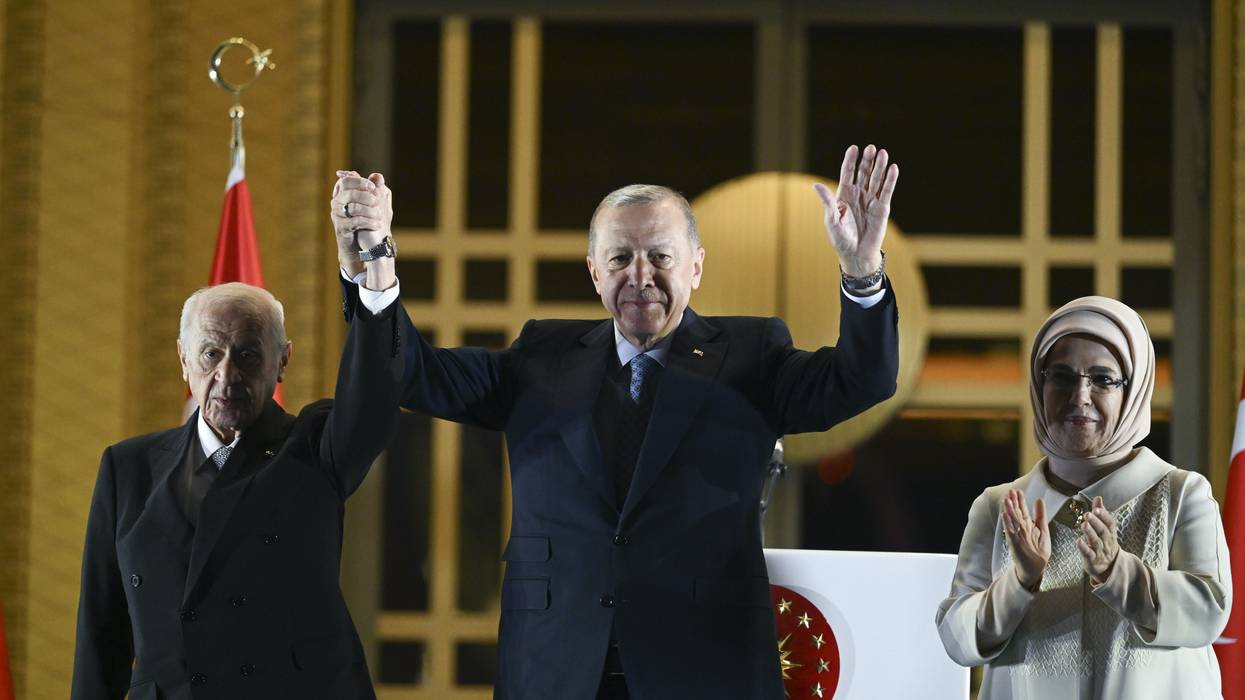
As supporters of Turkish President Recep Tayyip Erdoğan at home and abroad celebrated his win of Sunday's runoff election, human rights defenders and marginalized people including Kurds and LGBTQ+ activists voiced deep fears about how their lives will be adversely affected during the increasingly authoritarian leader's third term.
Turkey's Supreme Election Council confirmed Erdoğan's victory over Kemal Kılıçdaroğlu on Sunday evening. Erdoğan, the 69-year-old leader of the right-wing Justice and Development Party who has ruled the nation of 85 million people since 2014 and dominated its politics for two decades, won 52.18% of the vote. Kılıçdaroğlu, a 74-year-old social democrat who leads the left-of-center Republican People's Party, received 47.82%.
Erdoğan—who was seen handing out cash to supporters at a polling station in an apparent violation of Turkish election law—mocked his opponent's loss outside the president's home in Istanbul, saying, "Bye, bye, bye, Kemal" as the winner's supporters booed, according to Al Jazeera.
"The only winner today is Turkey," Erdoğan declared as he prepared for a third term in which his country faces severe economic woes—inflation has soared and the lira is at a record low against the U.S. dollar—and is struggling to recover from multiple devastating earthquakes earlier this year.
However, in Turkish Kurdistan—whose voters, along with a majority of people in most of Turkey's largest cities favored Kılıçdaroğlu—people expressed fears that the government will intensify a crackdown it has been waging for several years.
Ardelan Mese, a 26-year-old cafe owner in Diyarbakir, the country's largest Kurdish-majority city, called Sunday's election "a matter of life and death now."
"I can't imagine what he will be capable of after declaring victory," Mese said of Erdoğan in an interview with Reuters.
After initially courting the Kurds by expanding their political and cultural rights, Erdoğan returned to the repression that has long characterized Turkey's treatment of a people who make up one-fifth of the nation's population, while intensifying a war against the Kurdistan Workers' Party (PKK), a far-left separatist group that Turkey, the United States, and other nations consider a terrorist organization.
"Erdogan's victory will consolidate one-man rule and pave the way for horrible practices, bringing completely dark days for all parts of society," Tayip Temel, the deputy co-chair of Turkey's second-largest opposition party, the center-left and pro-Kurdish Peoples' Democratic Party (HDP)—which backed Kılıçdaroğlu—told Reuters.
Human rights defenders—many of whom have chosen or been forced into exile—also sounded the alarm over the prospect of a third Erdoğan term.
"If the opposition wins there will be space, even possibly limited, for discussions for a common future. With Erdoğan, there is no civic or political space for democracy and human rights," Murat Çelikkan, a journalist who founded human rights groups including Amnesty International Turkey, said in an interview with Civil Rights Defenders just before Sunday's runoff.
Çelikkan called Erdoğan a "very authoritarian, religious, pro-expansionist conservative."
"Turkey, according to judicial statistics, has the largest number of terrorists in the world, because the prosecutors and judges have an inclination to use anti-terror laws arbitrarily and lavishly," he continued. "There are tens of thousands of people who are being trialed or convicted by anti-terror laws. Thousands of people insulting the president."
"Nowhere in Turkey you can make a peaceful demonstration and protest," Çelikkan added. "The security forces directly attack and detain you. The minister of interior targets and criminalizes LGBTI+ people on a daily basis."
LGBTQ+ Turks voiced fears for their future following a campaign in which Erdoğan centered homophobia in his appeals to an overwhelmingly Muslim electorate and repeatedly accused Kılıçdaroğlu and other opposition figures of being gay. During his victory speech Sunday evening, Erdoğan again lashed out at the LGBTQ+ community while excoriating Kılıçdaroğlu for his campaign pledge to "respect everyone's beliefs, lifestyles, and identities."
Erdoğan vowed in his speech that gays would not "infiltrate" Turkey and that "we will not let the LGBT forces win." At one point during his address, an Al Jazeera interpreter stopped translating a 45-second portion when the president called members of the opposition gay.
Ilker Erdoğan, a 20-year-old university student and LGBTQ+ activist, told Agence France-Presse that "I feel deeply afraid."
"Feeling so afraid is affecting my psychology terribly. I couldn't breathe before, and now they will try to strangle my throat," he added. "From the moment I was born, I felt that discrimination, homophobia, and hatred in my bones."
Ameda Murat Karaguzu, a project assistant at an unnamed pro-LGBTQ+ group, told AFP that she has been "subjected to more hate speech and acts of hate than I have experienced in a long time."
Karaguzu blamed Erdoğan's government for the increasing hostility toward LGBTQ+ Turks, adding that bigots are keenly "aware that there will be no consequences for killing or harming us."
Ilker Erdoğan struck a defiant tone, telling AFP that "I am also part of this nation, my identity card says Turkish citizen."
"You cannot erase my existence," he added, "no matter how hard you try."
Neither the incumbent nor his main rival has secured the majority of votes needed to avoid a runoff election in two weeks.
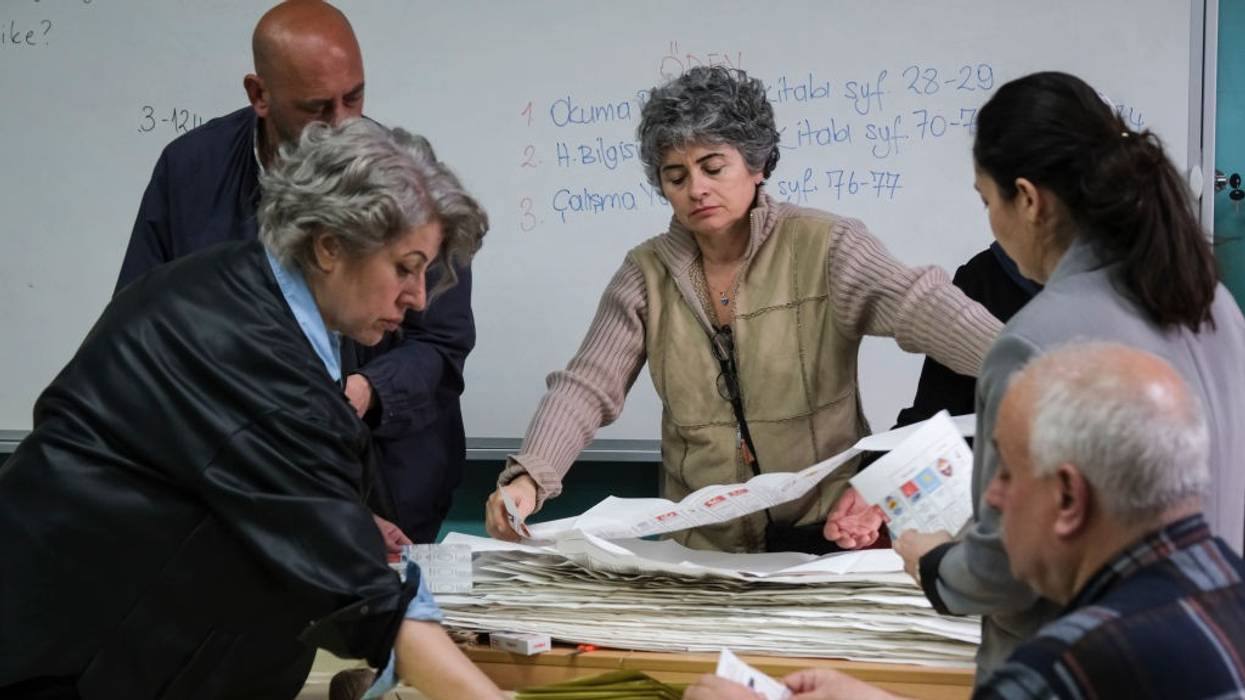
Whether Turkey's authoritarian president, Recep Tayyip Erdoğan, maintains power remains an open question as officials continue to count votes following Sunday's presidential and parliamentary elections.
Tens of millions of people cast ballots in the pivotal election before polls closed at 5:00 pm local time. Preliminary results indicate that Erdoğan of the right-wing Justice and Development Party (AKP) holds a dwindling lead over Kemal Kılıçdaroğlu, who heads the center-left Republican People's Party (CHP) and is the joint candidate of a six-party opposition coalition.
The state-run Anadolu news agency reports that Erdoğan is beating Kılıçdaroğlu by a margin of 49.56% to 44.71% with nearly 95% of votes counted. The private Anka news agency, meanwhile, reports that Erdoğan is ahead of Kılıçdaroğlu, 49.24% to 45.04%, with just over 98% of votes counted. Two other candidates have garnered support from a small percentage of voters.
As expected, the incumbent jumped out to an early lead as votes in his conservative central heartland were among the first counted, but his main challenger has gained ground as the tally proceeds in big cities and coastal areas. It may take up to three days for official results to be confirmed. If no candidate wins over 50% of first-round ballots, the top two vote-getters will compete again in a head-to-head runoff scheduled for May 28. Both Erdoğan and Kılıçdaroğlu's camps have acknowledged that this is an increasingly likely outcome.
Muharrem İnce, a former CHP member who dropped out of the contest just days ago, has received roughly 0.4% of the vote. Far-right nationalist candidate Sinan Oğan has secured about 5.3%, making him a potential kingmaker in the event the race goes to a second round.
Reporting of the results has proven controversial. Earlier on Sunday evening, when it was reported that Erdoğan had a substantial lead, opposition figures accused state-run media of deceiving the public and claimed that Kılıçdaroğlu is winning.
"Anadolu Agency is doing its traditional manipulation for the last time," said CHP spokesperson Faik Oztrak. "We ask our citizens to follow our statements."
Istanbul Mayor Ekrem Imamoglu, a CHP member who took office in 2019, also slammed the outlet. Citing similar actions in past elections, he said: "We are experiencing another Anadolu Agency case. The agency's reputation is below zero. They should not be trusted. Anadolu's data is null and void."
Imamoglu was echoed by Ankara Mayor Mansur Yavas, another CHP member elected in 2019, who said: "They mislead our nation by running the ballot boxes that work for them. They do not feel ashamed either. They have no credibility... According to the data we have, our President Kemal Kılıçdaroğlu is ahead."
Omer Celik, a spokesperson for the ruling AKP rebuked the opposition for criticizing Anadolu.
According to Progressive International: "AKP has challenged many votes in precincts where they are trailing all over the country. If these challenges are unfounded, it will delay the counting process several hours. This means we could see a late surge for opposition parties."
The group, which sent an election observation delegation to Turkey, sounded the alarm about possible dirty tricks being carried out on behalf of Erdoğan.
According to Al Jazeera correspondent Abdelazeem Mohammed, the election is "most likely heading to a second round."
"The opposition is saying that the ruling alliance... deliberately started the vote count in its strongholds," said Mohammed.
Al Jazeera's Hashem Ahelbarra, reporting from CHP headquarters in Ankara, said the party is feeling "more and more confident" as the additional ballots are tallied and Erdoğan's initial lead shrinks.
"CHP, along with the opposition coalition, is looking forward to increasing numbers in major cities, and that the numbers in Istanbul and Ankara could be [a] strong indication that they are going to go to a runoff," said Ahelbarra.
"In 2022, they put together this coalition from all walks of life with different affiliations," Ahelbarra explained. "The reason why they did this was to consolidate gains because they know that the AKP, with the leadership of Erdoğan for the past 20 years, makes it extremely difficult for them to win the elections."
Speaking from Istanbul, political analyst Cengiz Tomar told Al Jazeera that "the results so far spell out a great failure for the opposition."
"The results so far do not align at all with the sociological make-up of the Turkish people, where 35% of them are religious, conservative, and on the right, and the remaining 65% are secular and Kurdish," he said.
Ahead of the election, polling data gave Kılıçdaroğlu a slight lead and also suggested that Erdoğan’s governing coalition, led by the AKP, could lose its majority in parliament.
In the run-up to Sunday, however, human rights groups warned that Erdoğan’s right-wing government would "exert considerable control over the digital ecosystem in an effort to undermine the outcome," and there is fresh reporting of "foul play" on the day of the election.
Erdoğan has ruled Turkey for the past two decades, first as prime minister from 2003 to 2014 and as president since 2014. Before he was reelected in 2018, Erdoğan convinced enough Turkish voters to approve constitutional changes that transformed the nation's parliamentary system into a highly centralized presidential regime with few checks and balances.
Erdoğan "fell behind in the polls as voters react to the results of 20 years of his rule, including a brutal economic crisis that caused the lira to devalue by half last year alone and soaring inflation," The Guardian reported Sunday. "Criticism of his government increased after a slow and patchy state response to deadly twin earthquakes in the country's southeast that killed more than 50,000 people and destroyed homes and infrastructure across 11 provinces."
Progressives have argued that a Kılıçdaroğlu victory is necessary to revive Turkey's economy, restore its democracy, and protect women's rights, among other goals.
There is a lot at stake in these upcoming elections – women’s rights, in particular, hang in the balance.
“It will be like the Taliban regime,” says Melek Önder, asked what will happen to women’s rights if Recep Tayyip Erdoğan is re-elected as president of Turkey in the election on Sunday.
Önder is a spokesperson for We Will Stop Femicides (Kadin Cinayetlerini Durduracagiz), one of the most active groups in Turkey’s women’s movement. The platform was founded in 2010 after Cem Garipoğlu, 17, murdered his girlfriend Münevver Karabulut, also 17. It collects data on femicides and campaigns against violence against women.
“We see that all kinds of dictators do the same – at the beginning they take away women’s rights, and then they ban other things, like music,” says the 35-year-old as she sips tea in a coffee shop in the Şişli district of Istanbul. “[Erdoğan’s government] is a threat – not only for women, but also for men. They are against modernity.”
Önder grew up in Bursa, a city that lies just across the Sea of Marmara from Istanbul, and joined We Will Stop Femicides in 2015. She is bursting with energy and speaks in volleys of words, barely pausing to take a breath. There is a lot at stake in these upcoming elections – women’s rights, in particular, hang in the balance.
During the 20 years Erdoğan has been in power, the increasingly autocratic leader of the conservative Justice and Development Party (AKP) has attacked gender equality (saying it is “against nature”), rolled back women’s rights, and cracked down on women’s rights groups.
In a decision that sparked outrage and condemnation in 2021, he withdrew the country from the Istanbul Convention, the Council of Europe’s landmark treaty on preventing violence against women and domestic violence. Turkey was the first country to sign the convention, which is named after its commercial capital, and it is now the first – and only – country to have pulled out of it.
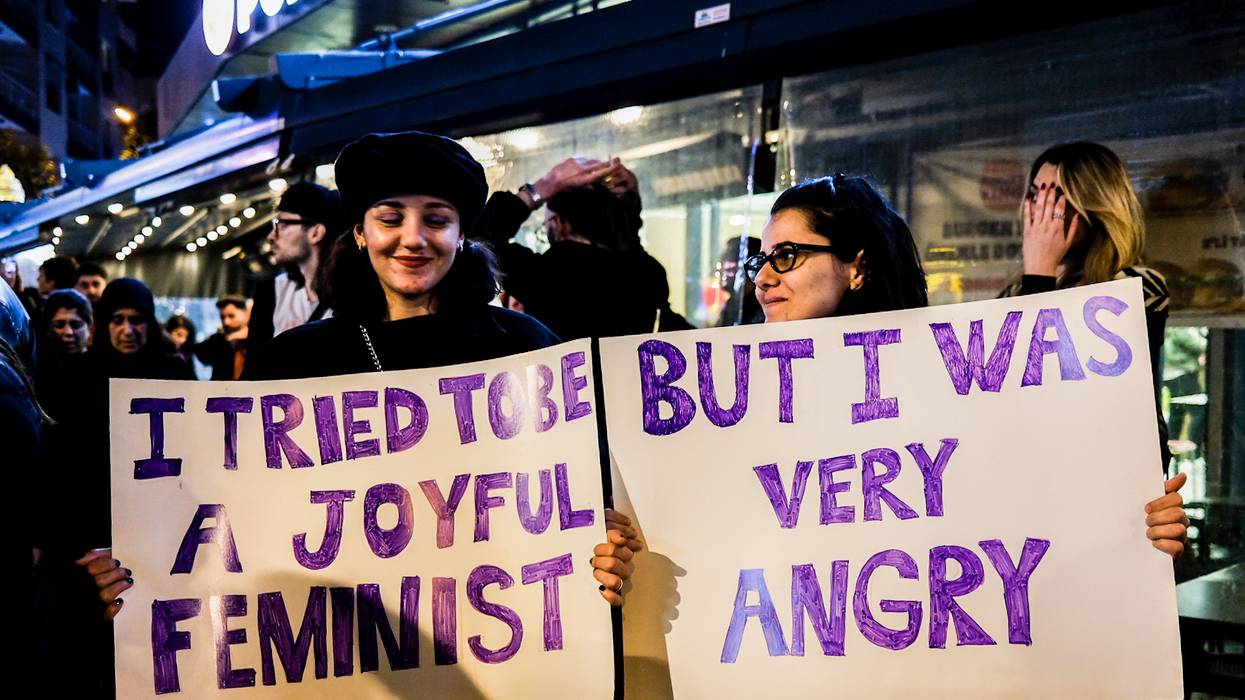
Turkish women took to the streets to voice their anger after Erdoğan issued the decree, with We Will Stop Femicides being one of the loudest voices – many women waved the platform’s purple flags, which have become a regular feature of women’s rights protests across the country. In a statement, the Turkish presidential Communications Directorate said its reason for leaving was because the treaty had been “hijacked by a group of people attempting to normali[s]e homosexuality – which is incompatible with Turkey's social and family values.”
Since the withdrawal there has been a spike in femicides in Turkey. According to data collected by We Will Stop Femicides from news reports and information from victims’ families, there were at least 334 femicides and 245 suspicious deaths of women (potential femicides framed as suicides or accidents) in 2022. That makes 579 deaths in total, an increase of 16% since 2021, when there were 497, which was itself an increase from the estimated 470 in 2020.
Femicides have increased almost every year since the platform began counting in 2010; the only decrease came in 2011, the year the Istanbul Convention was signed. So far in 2023, there has been a total of 165 femicides and suspicious deaths of women.
Önder and others fear that, if Erdoğan and his political alliance win on Sunday, the national law (‘Law 6284’) on violence against women and children could be under threat, leaving women with little protection and further eroding women’s rights in Turkey. Two Islamist parties, the New Welfare Party (YRP) and the Free Cause Party, known as Huda-Par, which have joined the president’s ‘People’s Alliance,’ had insisted their backing was conditional on amending Law 6284.
“They are trying to reshape this law in Erdoğan’s alliance. It is nothing new for Turkey, but it is worrying,” says Önder. She believes changes to 6284 could cause a domino effect for other rights – such as the right to abortion, which is already being restricted. “This is why we are saying this election is so important for women and for LGBTQ people.”
The group has seen a correlation between politicians attacking women’s rights and a subsequent rise in femicides. “People think: ‘We can do whatever we want to do to women,’” she says. “They get courage from these political decisions.”
We Will Stop Femicides has stepped up its campaigning ahead of the parliamentary and presidential elections, with social media posts urging women to “stand up for their lives and rights.” The group also took part in Labour Day protests on 1 May in Istanbul’s Maltepe Square, waving LGBTQ rainbow flags and a large purple banner that read: “We will end the era of the anti-women alliance. We will cast our votes for freedom.”
A statement on the platform’s website says the election is “between civilization and barbarism.” The statement lists a series of demands, including the implementation of the Istanbul Convention and the 6284 law – which they say has never been fully enforced – as well as equal representation in politics and equal pay. The main opposition candidate and leader of the Republican People’s Party, Kemal Kılıçdaroğlu, has said Turkey will rejoin the Istanbul Convention if his opposition alliance wins, but Önder says that is not enough. She adds that Kılıçdaroğlu has been too quiet on the issue of LGBTQ rights.
The election will have far-reaching consequences, not only for women but also for We Will Stop Femicides. In 2021, after the country withdrew from the Istanbul Convention, prosecutors charged the feminist group with allegedly carrying out “illegal and immoral activities.” Its next legal hearing is in September.
Önder believes the charges are politically motivated. “They see our platform as an opposition,” she says, “as a threat to their government, because We Will Stop Femicides is one of the biggest and most important women’s organisations in Turkey. We’ve made many big demonstrations over femicide, over the Istanbul Convention, and over the 6284 protection law.”
She says that the evidence against the group is mainly tweets the platform has posted on Twitter – she references one calling for the release of a politician who had been imprisoned. There is also evidence of their members attending demonstrations.
Asked if she is worried that the platform could be shut down, Önder says: “It depends on the election results; if the opposition wins then probably we won’t close, but if the AKP government is re-elected… we are not sure. Even if they do close our platform, our struggle won’t stop; we will find new ways to fight.”
Despite the pressure she and others like her are facing, Önder is still hopeful. “You can’t live without hope,” she says. “After over 10 years of working, we have seen that society in Turkey has changed – women are fighting for their rights. If they are subject to violence, then they are not staying silent – they are applying to our platform for help or using social media. They are making their voices heard everywhere.” There is a desire for change in Turkey, she adds: “Our society is ready and waiting for it.”
George Wallace ran for president in 1968 and garnered a great deal of support from white working class voters, though by then he had learned to use code words and phrases to substitute for overtly racist language--hence his focus on "welfare" and "crime," "drugs," "thugs," and "law and order." His base comprised white nationalists, largely from the South. Northern white working-class voters were mostly solidly Democrat--until black people finally grew tired of waiting and waiting for economic equality, and until Dr. Martin Luther King Jr. was assassinated.
Then came the riots in many northern and far Western cities. Then came the white fear that had been virtually eliminated by the nonviolence of the 1955-1965 Civil Rights Movement, led in part by Rep. John Lewis, the last surviving speaker at the historic 1963 March on Washington where MLK delivered his I Have a Dream speech. Lewis was on fire that day, promising a nonviolent fight that would not stop until segregation and inequality were done.
In the aftermath of the riots that followed Dr. King's assassination, white voters in much more of the country were drawn to a more sophisticated Republican candidate who saw that opening, Richard Nixon, and his coded language was lifted from Wallace but Nixon had a less overtly racist image and a deeper political machinery connection. His "Southern strategy" was to out-Wallace George Wallace, but in a more nationally sellable fashion.
That plus his "secret plan" to end the war in Vietnam got him elected. His opponent, Hubert Humphrey, was associated strongly with the stupid escalation of the war, since he was Lyndon Johnson's Vice-President while LBJ ratcheted up the war and thus the daily death toll of American boys.
LBJ was anathema to white Southerners who saw his flip to support civil rights as a betrayal to his race. So the 1968 election saw the gains of the Civil Rights Movement slide backward and the dogwhistle language appealing to race-based animus grow popular across the country.
Now we see the trailing effects in Trump and his base.
Trump appeals to his white nationalist base again and again:
- "I play to people's fantasies."--1987 Art of the Deal
- "They're bringing drugs. They're bringing crime. They're rapists."--from his July 16 campaign kickoff rally in Laredo, Texas, when he announced that he would build a 2,000-mile wall across the border to keep out Mexicans and that Mexico would pay for it.
- Muslims are the enemy. Shortly after his inauguration, Trump delivered on his hate for Muslims promises that he made in his campaign rallies--less than two weeks into his presidency he issued his Executive Order banning Muslims from entering the US. Very specifically: "This executive order banned entry into the United States for 90 days of nationals from seven Muslim-majority countries (Iran, Iraq, Libya, Somalia, Syrian, Sudan, and Yemen), banned the entry of all refugees for 120 days, and indefinitely banned the entry of all Syrian refugees." And despite his campaign pledge to get us out of endless wars that take a terrible toll on US armed forces, including great numbers of the white working class, Trump has actually expanded the numbers of troops fighting in various Middle East and Central Asia countries, and just now bombed Iraq and Syria yet again, guaranteed to escalate resentments in those countries.
All this fear and hatred is felt by his white nationalist base as support. His strong suit is that he hurts them less than he hurts people of color--but he still hurts his white nationalist base. Examples:
- Faking out his white nationalist base with his false stories about Obamacare and false promises to bring health care to them--and lower prescription drug prices. He has not made any of this happen. Instead his base are the most frequent addicts to opioids, which is hurting them too. His rhetoric about all this is belied by lack of achievement.
- "Mortality rates have risen for members of the white working class in midlife, mainly due to increases in drug overdoses, suicides, and alcohol-related liver mortality," notes Proceedings from National Academy of Sciences in 2018.
- Fortune magazine points out that his infamous wall with its projected scores of $billions price tag, could fund health insurance for virtually every American.
- For the first time in years, the numbers of uninsured Americans are again on the rise under Trump's regime, up more than seven million Americans without health insurance last year. Yes, this hurts people of color more, which is Trump's coded "victory," but it is, for his white nationalist base, a Pyrrhic victory indeed (from the ancient general Pyrrhus, who noted after a devasting battle in which he "won" at a cost of a great many of his warriors, "Another such victory and I shall be undone.").
"You are kept apart that you may be separately fleeced of your earnings," the famous Georgia populist leader Tom Watson told a crowd of black and white laborers in 1892," noted writer Keri Leigh Merritt.
How have we overcome such shenanigans?
Yes, there is a trend across much of the world toward the strongman ruler, the Trump/Putin/Erdogan/Duterte/Jong-un model, but that is reversible and is indeed being reversed on the continent historically noted for that strongman model, Africa, where a number of countries have seen a rise in metrics of democracy over the past few years. Nothing about this is permanent or inevitable. We always have a choice.
We can regain our global image as champion of human rights, which is currently undone. We can be the leader in environmental protection, which Trump is wrecking. And we may even catch up to the rest of the tech-advanced world in universal health care if we choose to drop the politics of division and start the politics of unity. We can start small--sign a petition calling for equity in health care--and think big as we consider the stakes of the 2020 election.
Turkish President Recep Tayyip Erdogan could on Thursday receive permission from his country's parliament to send military personnel and equipment to Libya to support the North African country's United Nations-recognized leader Fayez al-Serraj, who is facing an uprising.
If approved, the deployment could further inflame tensions in the region.
The Erdogan government submitted the request to parliament on Monday while Foreign Minister Mevlut Cavusoglu met with legislators. Opposition leader Unal Cevikoz, deputy chairman for the Republican People's Party (CHP), told reporters that he opposed the proposed deployment in the strongest of terms.
"We will never accept Turkey to be a part of the proxy war in Libya and, by siding with one of the sides of the conflict, for it to be a cause of the shedding of Muslim blood," said Cevikoz.
Erdogan is widely believed to be engaging in the conflict to further Turkish territorial aims in the Mediterranean. Soner Cagaptay, director of the Turkish Research Program at The Washington Institute for Near East Policy, showed how Turkey is looking to expand its footprint in the region.
"Contact with Libyan sea space allows Ankara to cut into Israeli-Egyptian-Cypriot-Greek axis boxing Turkey in eastern Mediterranean," Cagaptay tweeted.
Libya is riven by a civil war between al-Serraj, who is backed by Turkey and Italy, and rebel leader General Khalifa Haftar, who is backed by Russia, Egypt, Jordan, and the United Arab Emirates.
The U.S., despite its status as a major regional player, has been noncomittal about getting involved in the most recent phase of the war, which began in 2011 with the participation of then-President Barack Obama and then-Secretary of State Hillary Clinton. The campaign, though brief, has had major consequences for the people of Libya and North Africa, including the reopening of slave markets for the first time in decades.
On Monday, French President Emmanuel Macron and Egypt's dictator President Abdel Fattah el-Sisi issued a joint statement urging "restraint" on the part of Turkey.
Around 1,000 Russian mercenaries are reportedly helping Haftar. If Turkey joins the battle, the country's troops could be joined by Syrian fighters allied with the Erdogan government.
"The military's experience abroad will be very useful in Libya," a Turkish security official told Lebanon's The Daily Star. "However, there is the possibility of using the experience of Syrian fighters as well...and this is being evaluated."
CHP's Cevikoz said his party would try to find another solution for Turkish involvement in Libya.
"We believe diplomacy should be prioritized, rather than being a party to a proxy war," said Cevikoz. "What is being done is making preparations to worsen the current situation, and we conveyed to the minister that this is not right."