SUBSCRIBE TO OUR FREE NEWSLETTER
Daily news & progressive opinion—funded by the people, not the corporations—delivered straight to your inbox.
5
#000000
#FFFFFF
To donate by check, phone, or other method, see our More Ways to Give page.
Daily news & progressive opinion—funded by the people, not the corporations—delivered straight to your inbox.

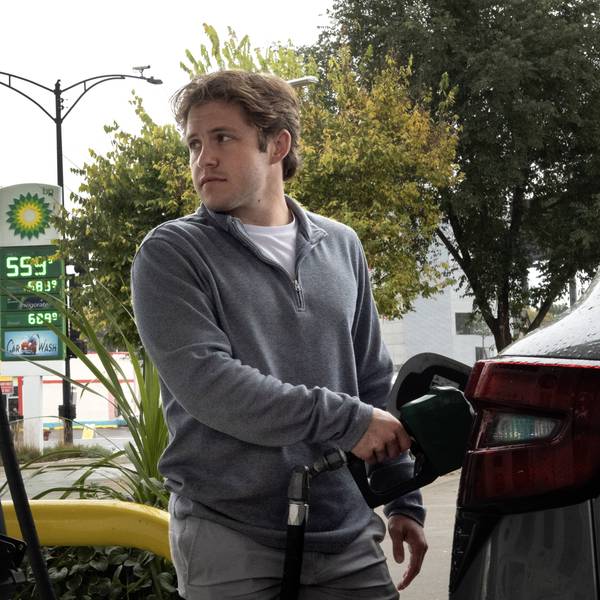
People get $40 of free fuel at a gas giveaway event at a Shell gas station on July 18, 2022 in Oak Park, Michigan.
The price of cheap oil is exploitation and death, including death of children and the destabilization of our climate, which all risk future generations' viability on Earth.
When I was a sociology graduate student and teaching assistant, we learned about the global fight over oil, that the center of oil dependence is in the Middle East, and that eventually we would go to war with Iran. Fast forward 20 years later and the predictions of my professor have reached fruition. As many of us are now catching up to, roughly 20% of the world’s oil supply flows through the Strait of Hormuz, whose shipping lanes are currently closed and controlled by Iran and Oman.
As fraught relations with Iran continue to play out, and regardless of our political alliances, it is important for us to realize and remind ourselves that crude oil, petroleum, is a finite and non-renewable resource. Earth’s reserves took millions of years to form, and we are using them up at an alarming rate. If oil demand continues to increase over the next few decades, we are not in a position to meet that demand.
Scientists have been predicting that peak oil, the time when oil production and demand is highest, will come and go, but AI will change that. Data centers, large buildings housing servers, data storage, and related equipment, require elaborate power and cooling systems to run and further tax our energy grid. According to research, there are over 4,000 data centers in the United States with 643 in Virginia alone. In 2024, these data centers consumed more than 4% of our country’s total electricity and 26% of total electricity supply in Virginia. Fifty-six percent of the energy needed for AI data centers is from gas and coal; natural gas supplies over 40% of this electricity. In order to meet these needs, utility companies are expected to increase the average residential bill. The AI trajectory is not only fossil fuel dependence, it is continued extraction where environmental problems are converted into revenue. This trend of profit for some at the expense of many people and the environment will accelerate our depletion of our natural resources, and we should all be concerned.
Access to cheap fuel is not a right. It is a subsidy built on violence, both societal and environmental harm. The price of cheap oil is exploitation and death, including death of children and the destabilization of our climate, which all risk future generations' viability on Earth. In the face of such consequences, surely we can do better.
In learning how to decouple our existence from consumerism and fossil fuel overdependence, we need to move beyond our shopping choices.
The only solution to expensive gas is to consume less gas. To be sure, this is a rock and a hard place conundrum. We rely on our vehicles to get to work. Most of our cities lack high bikeability. And, most Americans live paycheck to paycheck and a small increase in the price of gas is too much on an already strained budget. The federal minimum wage of $7.25 per hour has not changed since 2009.
Meanwhile, our federal government has gutted The Environmental Protection Agency, climate change policy, and environmental regulations and the supreme court has developed a shadow docket whose first action was to roll back environmental protections. Our structure is crumbling any semblance of respect for our planet and leaning hard into anthropocentrism, the “humans first” logic that parallels President Donald Trump’s America first faulty logic.
What are the costs of being first? From a sociological viewpoint, increased demands for goods, technological pursuit, militarization, and war without long-term risk assessment and a society overly dependent on consumerism and endless growth needs to be checked. A society unwilling to critically reflect on nor willing to change its self-destructive trajectory is not a sustainable one. Gas prices should reflect their true costs, not only to us, but to our planet and to future generations.
How we move forward from this mess is up to us. While individual actions, such as knowing what we buy, how large our ecological footprint is, and that eating less meat is good for the environment, are important, they will not be impactful at scale unless we can connect them to organized and sustained collective action. We need viable political options. In learning how to decouple our existence from consumerism and fossil fuel overdependence, we need to move beyond our shopping choices. We need to get to know our political candidates and vote for people who prioritize both social and environmental sustainability. Elections are right around the corner, and we can all learn more about the candidates and measures.
This country and this world are at a monumental crossroads. US voters have an opportunity to beat back the forces of fascism and confront the billionaires who are rigging the economy, our media system, and our democracy, making it increasingly impossible for ordinary people to get by. We’re not just talking about the election. We’re talking about what must be done once these fascist elements are vanquished from power. We need a bolder set of solutions than what either major party has so far been willing to offer and a working-class movement ready to fight like hell for it. Trump didn't emerge from nowhere. The conditions that fueled MAGA authoritarianism were created by decades of radical neoliberal economic policies and a corrupt political system dominated by corporate interests. They slashed taxes on the super-rich, promising that the benefits would trickle down. They said giveaways to the corporate titans would make life more affordable for the rest of us. It was all bullshit. And when a bitter, betrayed populace searches for someone to blame, right-wing demagogues have little trouble finding scapegoats. People know when they're being lied to, but you won't hear any of this from the corporate media. Only independent journalism—powered and funded by people who believe in building a better world—can deliver truly trustworthy daily news. If you share our vision, please contribute whatever you can to sustain our work. |
When I was a sociology graduate student and teaching assistant, we learned about the global fight over oil, that the center of oil dependence is in the Middle East, and that eventually we would go to war with Iran. Fast forward 20 years later and the predictions of my professor have reached fruition. As many of us are now catching up to, roughly 20% of the world’s oil supply flows through the Strait of Hormuz, whose shipping lanes are currently closed and controlled by Iran and Oman.
As fraught relations with Iran continue to play out, and regardless of our political alliances, it is important for us to realize and remind ourselves that crude oil, petroleum, is a finite and non-renewable resource. Earth’s reserves took millions of years to form, and we are using them up at an alarming rate. If oil demand continues to increase over the next few decades, we are not in a position to meet that demand.
Scientists have been predicting that peak oil, the time when oil production and demand is highest, will come and go, but AI will change that. Data centers, large buildings housing servers, data storage, and related equipment, require elaborate power and cooling systems to run and further tax our energy grid. According to research, there are over 4,000 data centers in the United States with 643 in Virginia alone. In 2024, these data centers consumed more than 4% of our country’s total electricity and 26% of total electricity supply in Virginia. Fifty-six percent of the energy needed for AI data centers is from gas and coal; natural gas supplies over 40% of this electricity. In order to meet these needs, utility companies are expected to increase the average residential bill. The AI trajectory is not only fossil fuel dependence, it is continued extraction where environmental problems are converted into revenue. This trend of profit for some at the expense of many people and the environment will accelerate our depletion of our natural resources, and we should all be concerned.
Access to cheap fuel is not a right. It is a subsidy built on violence, both societal and environmental harm. The price of cheap oil is exploitation and death, including death of children and the destabilization of our climate, which all risk future generations' viability on Earth. In the face of such consequences, surely we can do better.
In learning how to decouple our existence from consumerism and fossil fuel overdependence, we need to move beyond our shopping choices.
The only solution to expensive gas is to consume less gas. To be sure, this is a rock and a hard place conundrum. We rely on our vehicles to get to work. Most of our cities lack high bikeability. And, most Americans live paycheck to paycheck and a small increase in the price of gas is too much on an already strained budget. The federal minimum wage of $7.25 per hour has not changed since 2009.
Meanwhile, our federal government has gutted The Environmental Protection Agency, climate change policy, and environmental regulations and the supreme court has developed a shadow docket whose first action was to roll back environmental protections. Our structure is crumbling any semblance of respect for our planet and leaning hard into anthropocentrism, the “humans first” logic that parallels President Donald Trump’s America first faulty logic.
What are the costs of being first? From a sociological viewpoint, increased demands for goods, technological pursuit, militarization, and war without long-term risk assessment and a society overly dependent on consumerism and endless growth needs to be checked. A society unwilling to critically reflect on nor willing to change its self-destructive trajectory is not a sustainable one. Gas prices should reflect their true costs, not only to us, but to our planet and to future generations.
How we move forward from this mess is up to us. While individual actions, such as knowing what we buy, how large our ecological footprint is, and that eating less meat is good for the environment, are important, they will not be impactful at scale unless we can connect them to organized and sustained collective action. We need viable political options. In learning how to decouple our existence from consumerism and fossil fuel overdependence, we need to move beyond our shopping choices. We need to get to know our political candidates and vote for people who prioritize both social and environmental sustainability. Elections are right around the corner, and we can all learn more about the candidates and measures.