

SUBSCRIBE TO OUR FREE NEWSLETTER
Daily news & progressive opinion—funded by the people, not the corporations—delivered straight to your inbox.
5
#000000
#FFFFFF
To donate by check, phone, or other method, see our More Ways to Give page.
Daily news & progressive opinion—funded by the people, not the corporations—delivered straight to your inbox.
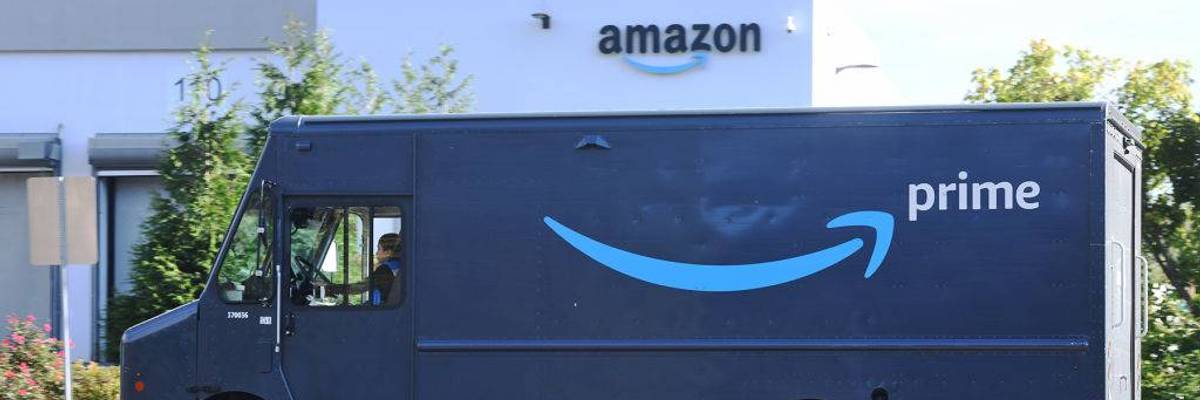
The retail giant said the surcharge was needed due to "elevated costs in fulfillment and logistics" that "have increased the cost of operating across the industry."
Americans having been paying more for gasoline since the start of President Donald Trump's illegal war with Iran, and now it seems the war's costs are spreading to other areas of the economy.
Amazon announced on Thursday that, beginning April 17, it would add a "3.5% fuel and logistics-related surcharge" to vendors that use its Fulfillment by Amazon (FBA) service in the US and Canada.
The company said that it needed to add the surcharge due to "elevated costs in fulfillment and logistics" that "have increased the cost of operating across the industry."
"We have absorbed these increased costs so far," Amazon said. "However, similar to other major carriers, when costs remain elevated, we implement temporary surcharges on our fulfillment fees to recover a portion of the actual cost increases we are experiencing."
Amazon spokesperson Ashley Vanicek told CNBC that the company's surcharge will be "meaningfully lower" than rival carriers, and insisted that "we remain committed to our selling partners' success and to maintaining broad selection and low prices for customers."
Tahra Hoops, director of economic analysis at Chamber of Progress, said that Amazon's surcharge is "yet another example of more increased costs to come," as "the ongoing supply shock" caused by the Iran war "has lasted longer than expected."
Amazon isn't alone in adding surcharges due to the war's impact on fuel costs.
According to a Tuesday report in The New York Times, fresh food distributors across the US have been adding surcharges to deliveries to make up for the increased fuel costs caused by the Iran war, with the result being that "grocery stores, restaurants, hospitals, and even schools are most likely seeing costs for their food shipping climb."
John Ross, the chief executive of the Independent Grocers Alliance, told the Times that the increased shipping costs from the surge in diesel fuel costs have come at a particularly inopportune time since many Americans were already stretched thin financially before Trump attacked Iran.
"For people who spend every nickel they have on daily expenses, if grocery prices go up $5, that $5 has to come from something else," Ross said. "But it’s hard for the grocers to eat it also. For every $1 that consumers spend at the register, the grocery store is keeping about two pennies. There’s very little room there."
The price of fuel isn't the only factor seen driving food prices higher, as CNBC on Thursday reported that experts expect to see a spike in food prices later this year thanks to the Iran war's impact on fertilizer prices.
University of Minnesota economist Kjetil Storesletten told CNBC that "the price of food is going to move quite a lot" in the coming months, predicting that "all of the increased price in fertilizer is going to be passed through to food."
Storesletten said that food prices won't jump immediately, but warned that coming grocery sticker shock will grow more severe if Iran keeps its stranglehold on the Strait of Hormuz for the foreseeable future.
"Imagine [the strait] remains closed until the summer," the economist said. "We will see substantial increases in food prices."
Dear Common Dreams reader, It’s been nearly 30 years since I co-founded Common Dreams with my late wife, Lina Newhouser. We had the radical notion that journalism should serve the public good, not corporate profits. It was clear to us from the outset what it would take to build such a project. No paid advertisements. No corporate sponsors. No millionaire publisher telling us what to think or do. Many people said we wouldn't last a year, but we proved those doubters wrong. Together with a tremendous team of journalists and dedicated staff, we built an independent media outlet free from the constraints of profits and corporate control. Our mission has always been simple: To inform. To inspire. To ignite change for the common good. Building Common Dreams was not easy. Our survival was never guaranteed. When you take on the most powerful forces—Wall Street greed, fossil fuel industry destruction, Big Tech lobbyists, and uber-rich oligarchs who have spent billions upon billions rigging the economy and democracy in their favor—the only bulwark you have is supporters who believe in your work. But here’s the urgent message from me today. It's never been this bad out there. And it's never been this hard to keep us going. At the very moment Common Dreams is most needed, the threats we face are intensifying. We need your support now more than ever. We don't accept corporate advertising and never will. We don't have a paywall because we don't think people should be blocked from critical news based on their ability to pay. Everything we do is funded by the donations of readers like you. When everyone does the little they can afford, we are strong. But if that support retreats or dries up, so do we. Will you donate now to make sure Common Dreams not only survives but thrives? —Craig Brown, Co-founder |
Americans having been paying more for gasoline since the start of President Donald Trump's illegal war with Iran, and now it seems the war's costs are spreading to other areas of the economy.
Amazon announced on Thursday that, beginning April 17, it would add a "3.5% fuel and logistics-related surcharge" to vendors that use its Fulfillment by Amazon (FBA) service in the US and Canada.
The company said that it needed to add the surcharge due to "elevated costs in fulfillment and logistics" that "have increased the cost of operating across the industry."
"We have absorbed these increased costs so far," Amazon said. "However, similar to other major carriers, when costs remain elevated, we implement temporary surcharges on our fulfillment fees to recover a portion of the actual cost increases we are experiencing."
Amazon spokesperson Ashley Vanicek told CNBC that the company's surcharge will be "meaningfully lower" than rival carriers, and insisted that "we remain committed to our selling partners' success and to maintaining broad selection and low prices for customers."
Tahra Hoops, director of economic analysis at Chamber of Progress, said that Amazon's surcharge is "yet another example of more increased costs to come," as "the ongoing supply shock" caused by the Iran war "has lasted longer than expected."
Amazon isn't alone in adding surcharges due to the war's impact on fuel costs.
According to a Tuesday report in The New York Times, fresh food distributors across the US have been adding surcharges to deliveries to make up for the increased fuel costs caused by the Iran war, with the result being that "grocery stores, restaurants, hospitals, and even schools are most likely seeing costs for their food shipping climb."
John Ross, the chief executive of the Independent Grocers Alliance, told the Times that the increased shipping costs from the surge in diesel fuel costs have come at a particularly inopportune time since many Americans were already stretched thin financially before Trump attacked Iran.
"For people who spend every nickel they have on daily expenses, if grocery prices go up $5, that $5 has to come from something else," Ross said. "But it’s hard for the grocers to eat it also. For every $1 that consumers spend at the register, the grocery store is keeping about two pennies. There’s very little room there."
The price of fuel isn't the only factor seen driving food prices higher, as CNBC on Thursday reported that experts expect to see a spike in food prices later this year thanks to the Iran war's impact on fertilizer prices.
University of Minnesota economist Kjetil Storesletten told CNBC that "the price of food is going to move quite a lot" in the coming months, predicting that "all of the increased price in fertilizer is going to be passed through to food."
Storesletten said that food prices won't jump immediately, but warned that coming grocery sticker shock will grow more severe if Iran keeps its stranglehold on the Strait of Hormuz for the foreseeable future.
"Imagine [the strait] remains closed until the summer," the economist said. "We will see substantial increases in food prices."
Americans having been paying more for gasoline since the start of President Donald Trump's illegal war with Iran, and now it seems the war's costs are spreading to other areas of the economy.
Amazon announced on Thursday that, beginning April 17, it would add a "3.5% fuel and logistics-related surcharge" to vendors that use its Fulfillment by Amazon (FBA) service in the US and Canada.
The company said that it needed to add the surcharge due to "elevated costs in fulfillment and logistics" that "have increased the cost of operating across the industry."
"We have absorbed these increased costs so far," Amazon said. "However, similar to other major carriers, when costs remain elevated, we implement temporary surcharges on our fulfillment fees to recover a portion of the actual cost increases we are experiencing."
Amazon spokesperson Ashley Vanicek told CNBC that the company's surcharge will be "meaningfully lower" than rival carriers, and insisted that "we remain committed to our selling partners' success and to maintaining broad selection and low prices for customers."
Tahra Hoops, director of economic analysis at Chamber of Progress, said that Amazon's surcharge is "yet another example of more increased costs to come," as "the ongoing supply shock" caused by the Iran war "has lasted longer than expected."
Amazon isn't alone in adding surcharges due to the war's impact on fuel costs.
According to a Tuesday report in The New York Times, fresh food distributors across the US have been adding surcharges to deliveries to make up for the increased fuel costs caused by the Iran war, with the result being that "grocery stores, restaurants, hospitals, and even schools are most likely seeing costs for their food shipping climb."
John Ross, the chief executive of the Independent Grocers Alliance, told the Times that the increased shipping costs from the surge in diesel fuel costs have come at a particularly inopportune time since many Americans were already stretched thin financially before Trump attacked Iran.
"For people who spend every nickel they have on daily expenses, if grocery prices go up $5, that $5 has to come from something else," Ross said. "But it’s hard for the grocers to eat it also. For every $1 that consumers spend at the register, the grocery store is keeping about two pennies. There’s very little room there."
The price of fuel isn't the only factor seen driving food prices higher, as CNBC on Thursday reported that experts expect to see a spike in food prices later this year thanks to the Iran war's impact on fertilizer prices.
University of Minnesota economist Kjetil Storesletten told CNBC that "the price of food is going to move quite a lot" in the coming months, predicting that "all of the increased price in fertilizer is going to be passed through to food."
Storesletten said that food prices won't jump immediately, but warned that coming grocery sticker shock will grow more severe if Iran keeps its stranglehold on the Strait of Hormuz for the foreseeable future.
"Imagine [the strait] remains closed until the summer," the economist said. "We will see substantial increases in food prices."

