SUBSCRIBE TO OUR FREE NEWSLETTER
Daily news & progressive opinion—funded by the people, not the corporations—delivered straight to your inbox.
5
#000000
#FFFFFF
To donate by check, phone, or other method, see our More Ways to Give page.
Daily news & progressive opinion—funded by the people, not the corporations—delivered straight to your inbox.
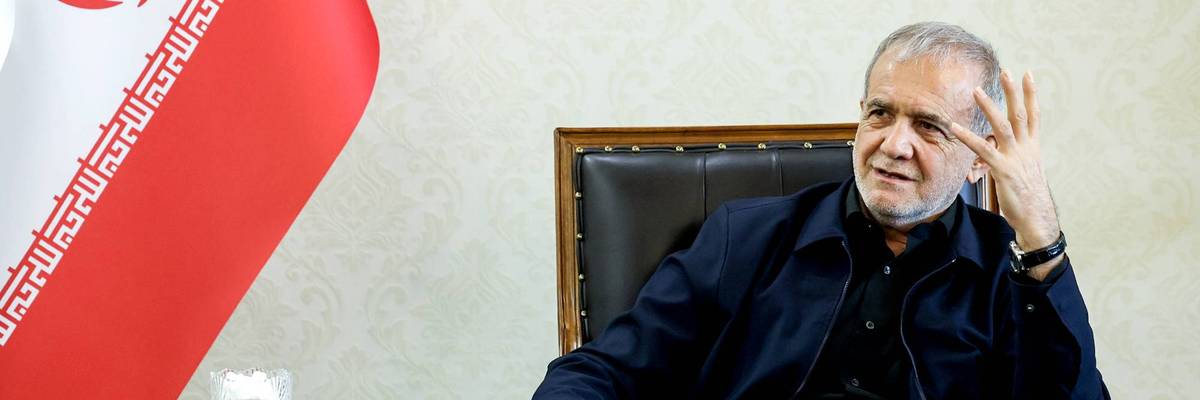
Iranian President Masoud Pezeshkian delivers a speech during an inspection visit to the Ministry of Sports and Youth in Tehran, Iran on April 19, 2026.
Another Iranian official, Foreign Ministry spokesperson Esmail Baghaei, said the US is "claiming diplomacy and readiness for negotiations" while still engaging in acts of aggression.
Iranian President Masoud Pezeshkian on Monday criticized what he called "unconstructive and contradictory signals" by US officials as the two sides weighed another round of peace talks in the Pakistani capital of Islamabad, where an earlier summit failed to produce a deal to end the conflict that the Trump administration and its Israeli counterparts launched in late February.
"Honoring commitments is the basis of meaningful dialogue," Pezeshkian wrote in a social media post, adding that Iranians harbor "deep historical mistrust" toward the US government given its record of aggression against the Middle Eastern country.
"They seek Iran's surrender," Pezeshkian wrote of Trump administration officials. "Iranians do not submit to force."
The Iranian president's comments came as his US counterpart, President Donald Trump, threatened to continue the bombing campaign that has so far killed more than 3,300 Iranians—and displaced millions—if the current two-week ceasefire expires Wednesday evening without an agreement to end the war.
"Lots of bombs start going off," Trump told PBS News when asked what happens if the ceasefire lapses without a deal.
Trump's remarks came after he warned that if Iranian leaders don't accept his administration's terms for an end to the war, "the United States is going to knock out every single Power Plant, and every single Bridge, in Iran." Experts have said Trump's threats are themselves war crimes even if he doesn't follow through with the attacks on civilian infrastructure, which is protected under international law.
Iran is considering attending another round of peace talks with the Trump administration in Islamabad this week, even after Iran's top diplomat accused the US delegation of sabotaging the previous round with maximalist demands and "shifting goal posts."
The spokesperson for Iran's Foreign Ministry, Esmail Baghaei, said in a press briefing on Monday that "no decision has been made" regarding Iranian attendance at another round of talks.
"While claiming diplomacy and readiness for negotiations, the US is carrying out behaviors that do not in any way indicate seriousness in pursuing a diplomatic process," Baghaei told reporters, pointing to the US military's attack on and seizure of an Iranian-flagged cargo ship in the Gulf of Oman over the weekend.
Dear Common Dreams reader, It’s been nearly 30 years since I co-founded Common Dreams with my late wife, Lina Newhouser. We had the radical notion that journalism should serve the public good, not corporate profits. It was clear to us from the outset what it would take to build such a project. No paid advertisements. No corporate sponsors. No millionaire publisher telling us what to think or do. Many people said we wouldn't last a year, but we proved those doubters wrong. Together with a tremendous team of journalists and dedicated staff, we built an independent media outlet free from the constraints of profits and corporate control. Our mission has always been simple: To inform. To inspire. To ignite change for the common good. Building Common Dreams was not easy. Our survival was never guaranteed. When you take on the most powerful forces—Wall Street greed, fossil fuel industry destruction, Big Tech lobbyists, and uber-rich oligarchs who have spent billions upon billions rigging the economy and democracy in their favor—the only bulwark you have is supporters who believe in your work. But here’s the urgent message from me today. It's never been this bad out there. And it's never been this hard to keep us going. At the very moment Common Dreams is most needed, the threats we face are intensifying. We need your support now more than ever. We don't accept corporate advertising and never will. We don't have a paywall because we don't think people should be blocked from critical news based on their ability to pay. Everything we do is funded by the donations of readers like you. When everyone does the little they can afford, we are strong. But if that support retreats or dries up, so do we. Will you donate now to make sure Common Dreams not only survives but thrives? —Craig Brown, Co-founder |
Iranian President Masoud Pezeshkian on Monday criticized what he called "unconstructive and contradictory signals" by US officials as the two sides weighed another round of peace talks in the Pakistani capital of Islamabad, where an earlier summit failed to produce a deal to end the conflict that the Trump administration and its Israeli counterparts launched in late February.
"Honoring commitments is the basis of meaningful dialogue," Pezeshkian wrote in a social media post, adding that Iranians harbor "deep historical mistrust" toward the US government given its record of aggression against the Middle Eastern country.
"They seek Iran's surrender," Pezeshkian wrote of Trump administration officials. "Iranians do not submit to force."
The Iranian president's comments came as his US counterpart, President Donald Trump, threatened to continue the bombing campaign that has so far killed more than 3,300 Iranians—and displaced millions—if the current two-week ceasefire expires Wednesday evening without an agreement to end the war.
"Lots of bombs start going off," Trump told PBS News when asked what happens if the ceasefire lapses without a deal.
Trump's remarks came after he warned that if Iranian leaders don't accept his administration's terms for an end to the war, "the United States is going to knock out every single Power Plant, and every single Bridge, in Iran." Experts have said Trump's threats are themselves war crimes even if he doesn't follow through with the attacks on civilian infrastructure, which is protected under international law.
Iran is considering attending another round of peace talks with the Trump administration in Islamabad this week, even after Iran's top diplomat accused the US delegation of sabotaging the previous round with maximalist demands and "shifting goal posts."
The spokesperson for Iran's Foreign Ministry, Esmail Baghaei, said in a press briefing on Monday that "no decision has been made" regarding Iranian attendance at another round of talks.
"While claiming diplomacy and readiness for negotiations, the US is carrying out behaviors that do not in any way indicate seriousness in pursuing a diplomatic process," Baghaei told reporters, pointing to the US military's attack on and seizure of an Iranian-flagged cargo ship in the Gulf of Oman over the weekend.
Iranian President Masoud Pezeshkian on Monday criticized what he called "unconstructive and contradictory signals" by US officials as the two sides weighed another round of peace talks in the Pakistani capital of Islamabad, where an earlier summit failed to produce a deal to end the conflict that the Trump administration and its Israeli counterparts launched in late February.
"Honoring commitments is the basis of meaningful dialogue," Pezeshkian wrote in a social media post, adding that Iranians harbor "deep historical mistrust" toward the US government given its record of aggression against the Middle Eastern country.
"They seek Iran's surrender," Pezeshkian wrote of Trump administration officials. "Iranians do not submit to force."
The Iranian president's comments came as his US counterpart, President Donald Trump, threatened to continue the bombing campaign that has so far killed more than 3,300 Iranians—and displaced millions—if the current two-week ceasefire expires Wednesday evening without an agreement to end the war.
"Lots of bombs start going off," Trump told PBS News when asked what happens if the ceasefire lapses without a deal.
Trump's remarks came after he warned that if Iranian leaders don't accept his administration's terms for an end to the war, "the United States is going to knock out every single Power Plant, and every single Bridge, in Iran." Experts have said Trump's threats are themselves war crimes even if he doesn't follow through with the attacks on civilian infrastructure, which is protected under international law.
Iran is considering attending another round of peace talks with the Trump administration in Islamabad this week, even after Iran's top diplomat accused the US delegation of sabotaging the previous round with maximalist demands and "shifting goal posts."
The spokesperson for Iran's Foreign Ministry, Esmail Baghaei, said in a press briefing on Monday that "no decision has been made" regarding Iranian attendance at another round of talks.
"While claiming diplomacy and readiness for negotiations, the US is carrying out behaviors that do not in any way indicate seriousness in pursuing a diplomatic process," Baghaei told reporters, pointing to the US military's attack on and seizure of an Iranian-flagged cargo ship in the Gulf of Oman over the weekend.