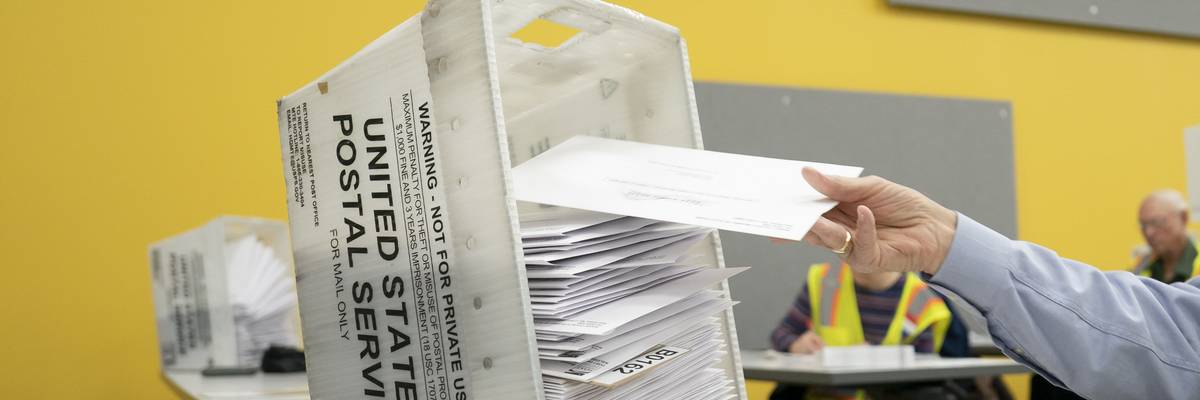
Absentee ballots are prepared to be mailed at the Wake County Board of Elections on September 17, 2024 in Raleigh, North Carolina.
Trump's War on Mail-in Voting is Hitting a Brick Wall—But the Danger is Far From Over
Allowing Trump's mail-in voting restrictions to take effect "would be a break-glass moment for our democracy," said one critic.
President Donald Trump's crusade against mail-in voting is running into a brick wall, although many critics are warning that the dangers to democracy are far from over.
The Washington Post reported on Sunday that Trump is "running out of options" to change mail-in voting rules that "don't involve significant upheaval," as states have already started sending out ballots to voters.
In March, Trump signed an executive order that instructed the United States Postal Service to not deliver ballots in any states that have not given the federal government access to its voter lists.
However, that order is currently tied up in court, and both Wisconsin and North Carolina last week began mailing out ballots to voters, the Post reported.
Don Millis, a Republican who chairs the Wisconsin Elections Commission, told the Post that "there's no practical way for Wisconsin clerks to comply" with Trump's orders, adding that the president's schemes targeting mail-in voting are likely to "hurt the Republican turnout more than the Democratic turnout."
The Trump administration has been pushing the US Supreme Court to intervene to allow the president's executive order to take effect.
However, as noted in a Politico report published on Friday, nine other states are set to send ballots to voters over the next two weeks, which would make a last-minute ruling by the court an unprecedented disruption in the democratic process.
"It would be so outrageous to try to let this go into effect," Ben Hovland, senior fellow for democracy at the Center for American Progress, told Politico. "It's hard to even imagine... It would be a break-glass moment for our democracy."
However, Hovland said that Trump's election meddling effort could still do real damage to the country because it can "dissuade people from participating or coming out to vote" and "establish a pretext to make bad faith claims about election results."
Hovland's concerns about the president's intentions were echoed in a Sunday report in The New York Times, which found voters across the country expressing confusion about the voting process and anxiety over whether their votes will be counted this year.
Pima County, Arizona Recorder Gabriella Cázares-Kelly told the Times that her office has received a flood of calls from worried voters, and she said that the president's relentless push to restrict voting by mail has left her unable to provide reassuring answers.
"I wish that I could tell my constituents to not worry," said Cázares-Kelly, "and I can’t."
Rich Cooper, elections manager in Clark County, Washington, similarly told the Times he has been unable to ease voters' worries about what rules will govern this year's elections.
“The biggest thing they want to know is if things are going to change,” Cooper said of voters expressing concerns. “We have to tell them we just don’t know yet.”
We are at a crossroads
This country and this world are at a monumental crossroads. In a few short weeks, US voters will have an opportunity to beat back the forces of fascism and confront the billionaires who are rigging the economy, our media system, and our democracy, making it increasingly impossible for ordinary people to get by. We’re not just talking about the election. We’re talking about what must be done once these fascist elements are vanquished from power. We need a bolder set of solutions than what either major party has so far been willing to offer and a working-class movement ready to fight like hell for it. Trump didn't emerge from nowhere. The conditions that fueled MAGA authoritarianism were created by decades of radical neoliberal economic policies and a corrupt political system dominated by corporate interests. They slashed taxes on the super-rich, promising that the benefits would trickle down. They said giveaways to the corporate titans would make life more affordable for the rest of us. It was all bullshit. And when a bitter, betrayed populace searches for someone to blame, right-wing demagogues have little trouble finding scapegoats. People know when they're being lied to, but you won't hear any of this from the corporate media. Only independent journalism—powered and funded by people who believe in building a better world—can deliver truly trustworthy daily news. Our Fall Campaign is underway, and we need your help. To power our newsroom through the rest of the year, we need to raise $125,000 by midnight on October 31. So if you share our vision, please contribute whatever you can to sustain our work. |
President Donald Trump's crusade against mail-in voting is running into a brick wall, although many critics are warning that the dangers to democracy are far from over.
The Washington Post reported on Sunday that Trump is "running out of options" to change mail-in voting rules that "don't involve significant upheaval," as states have already started sending out ballots to voters.
In March, Trump signed an executive order that instructed the United States Postal Service to not deliver ballots in any states that have not given the federal government access to its voter lists.
However, that order is currently tied up in court, and both Wisconsin and North Carolina last week began mailing out ballots to voters, the Post reported.
Don Millis, a Republican who chairs the Wisconsin Elections Commission, told the Post that "there's no practical way for Wisconsin clerks to comply" with Trump's orders, adding that the president's schemes targeting mail-in voting are likely to "hurt the Republican turnout more than the Democratic turnout."
The Trump administration has been pushing the US Supreme Court to intervene to allow the president's executive order to take effect.
However, as noted in a Politico report published on Friday, nine other states are set to send ballots to voters over the next two weeks, which would make a last-minute ruling by the court an unprecedented disruption in the democratic process.
"It would be so outrageous to try to let this go into effect," Ben Hovland, senior fellow for democracy at the Center for American Progress, told Politico. "It's hard to even imagine... It would be a break-glass moment for our democracy."
However, Hovland said that Trump's election meddling effort could still do real damage to the country because it can "dissuade people from participating or coming out to vote" and "establish a pretext to make bad faith claims about election results."
Hovland's concerns about the president's intentions were echoed in a Sunday report in The New York Times, which found voters across the country expressing confusion about the voting process and anxiety over whether their votes will be counted this year.
Pima County, Arizona Recorder Gabriella Cázares-Kelly told the Times that her office has received a flood of calls from worried voters, and she said that the president's relentless push to restrict voting by mail has left her unable to provide reassuring answers.
"I wish that I could tell my constituents to not worry," said Cázares-Kelly, "and I can’t."
Rich Cooper, elections manager in Clark County, Washington, similarly told the Times he has been unable to ease voters' worries about what rules will govern this year's elections.
“The biggest thing they want to know is if things are going to change,” Cooper said of voters expressing concerns. “We have to tell them we just don’t know yet.”
- 'We Must Stop Trump’s Authoritarian Power Grab,' Sanders Says of Assault on Mail-In Voting ›
- 'Direct Violation of the Constitution': Democratic States Sue to Stop Trump Assault on Mail-In Voting ›
- Democrats, Groups Fight Back After Supreme Court Clears Way for Trump Attack on Mail Voting ›
- Young Voters Disrupt Meeting to Urge USPS Board of Governors to Reject Trump Attack on Voting | Common Dreams ›
- Appeals Court Rejects 'Likely Unlawful' Trump Push to Undermine Mail-In Voting as Supreme Court Looms | Common Dreams ›
President Donald Trump's crusade against mail-in voting is running into a brick wall, although many critics are warning that the dangers to democracy are far from over.
The Washington Post reported on Sunday that Trump is "running out of options" to change mail-in voting rules that "don't involve significant upheaval," as states have already started sending out ballots to voters.
In March, Trump signed an executive order that instructed the United States Postal Service to not deliver ballots in any states that have not given the federal government access to its voter lists.
However, that order is currently tied up in court, and both Wisconsin and North Carolina last week began mailing out ballots to voters, the Post reported.
Don Millis, a Republican who chairs the Wisconsin Elections Commission, told the Post that "there's no practical way for Wisconsin clerks to comply" with Trump's orders, adding that the president's schemes targeting mail-in voting are likely to "hurt the Republican turnout more than the Democratic turnout."
The Trump administration has been pushing the US Supreme Court to intervene to allow the president's executive order to take effect.
However, as noted in a Politico report published on Friday, nine other states are set to send ballots to voters over the next two weeks, which would make a last-minute ruling by the court an unprecedented disruption in the democratic process.
"It would be so outrageous to try to let this go into effect," Ben Hovland, senior fellow for democracy at the Center for American Progress, told Politico. "It's hard to even imagine... It would be a break-glass moment for our democracy."
However, Hovland said that Trump's election meddling effort could still do real damage to the country because it can "dissuade people from participating or coming out to vote" and "establish a pretext to make bad faith claims about election results."
Hovland's concerns about the president's intentions were echoed in a Sunday report in The New York Times, which found voters across the country expressing confusion about the voting process and anxiety over whether their votes will be counted this year.
Pima County, Arizona Recorder Gabriella Cázares-Kelly told the Times that her office has received a flood of calls from worried voters, and she said that the president's relentless push to restrict voting by mail has left her unable to provide reassuring answers.
"I wish that I could tell my constituents to not worry," said Cázares-Kelly, "and I can’t."
Rich Cooper, elections manager in Clark County, Washington, similarly told the Times he has been unable to ease voters' worries about what rules will govern this year's elections.
“The biggest thing they want to know is if things are going to change,” Cooper said of voters expressing concerns. “We have to tell them we just don’t know yet.”
- 'We Must Stop Trump’s Authoritarian Power Grab,' Sanders Says of Assault on Mail-In Voting ›
- 'Direct Violation of the Constitution': Democratic States Sue to Stop Trump Assault on Mail-In Voting ›
- Democrats, Groups Fight Back After Supreme Court Clears Way for Trump Attack on Mail Voting ›
- Young Voters Disrupt Meeting to Urge USPS Board of Governors to Reject Trump Attack on Voting | Common Dreams ›
- Appeals Court Rejects 'Likely Unlawful' Trump Push to Undermine Mail-In Voting as Supreme Court Looms | Common Dreams ›