As corporate influence grows, independent journalism is more important than ever. If you value reporting that puts people and the planet first, please support Common Dreams this Giving Tuesday. We couldn’t do it without you—thank you for keeping us alive and strong.
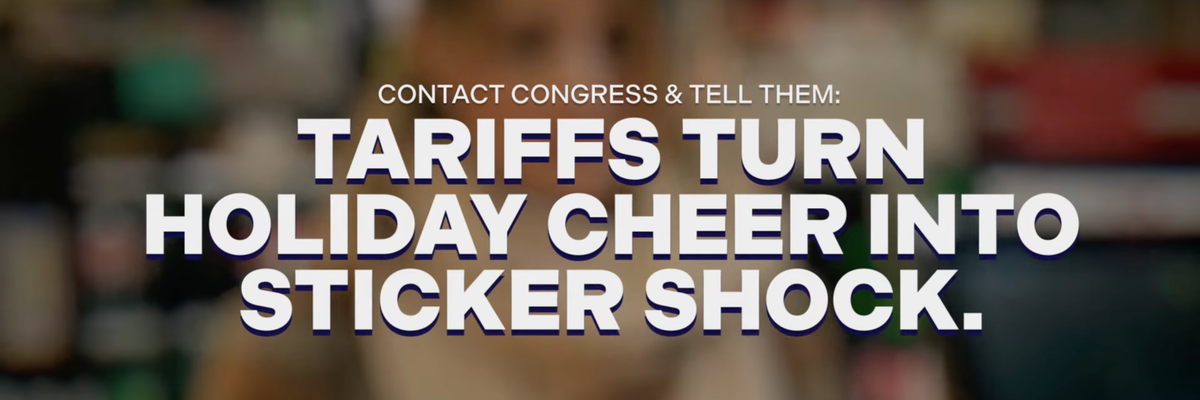
A message at the end of a Tariffs Cost US advertisement urges Americans to contact Congress about the Trump administration's tariffs causing "sticker shock."
(Image: Tariffs Cost US/YouTube)
New Ad Campaign Targets Holiday Price Spike From Trump Tariffs
"Tariffs have increased the cost of doing business, and we find ourselves working harder for even less," said a boutique owner. "I just placed a $700 jewelry order and was hit with a $100 tariff bill."
Tariffs Cost US on Monday announced a holiday campaign highlighting how President Donald Trump's sweeping tariffs are driving up the prices of food, gifts, and more for American families and businesses during the busiest shopping season of the year.
"Tariffs are the Grinch this year," declares one visual advertisement from the organization. Another features a woman with a frustrated expression and says, "Joy shouldn't cost extra."
The effort comes as many Americans plan large family meals for Thanksgiving on Thursday. A third ad says, "Tariffs don't belong at the table."
The campaign also features a 30-second video showing a woman checking out and reacting to the high price of each item, with clips of Trump's actual remarks about his import taxes playing in the background.
Tariffs Cost US also circulated comments from business leaders across the country, such as Mary Carroll Dodd, owner of Red Scout Farm in North Carolina.
"The cost of many of the materials we use for farming has increased this year," she said. "That increases the price of the fresh produce we sell in our community, and it means the food on your Thanksgiving table costs more too."
The shrinking population is expected to cause wholesale turkey prices to rise 44% this year, according to the US Department of Agriculture. Despite the increase, many stores are offering discounted or even free turkeys to soften the potential blow to Thanksgiving meal budgets. But even if the bird is cheaper than last year, the ingredients to prepare the rest of the holiday feast may not be. Tariffs on imported steel, for example, have increased prices for canned goods.
As of November 17, a basket of 11 Thanksgiving staples—including a 10-pound frozen turkey, 10 Russet potatoes, a box of stuffing, and cans of corn, green beans, and cranberry sauce—cost $58.81, or 4.1% more than last year, according to Datasembly, a market research company that surveys weekly prices at 150,000 US stores. That’s higher than the average price increase for food eaten at home, which rose 2.7% in September, according to the US Bureau of Labor Statistics.
As Common Dreamsreported last week, polling by the think tank Data for Progress found that 53% of Americans said it would be harder to afford a typical Thanksgiving meal than last year.
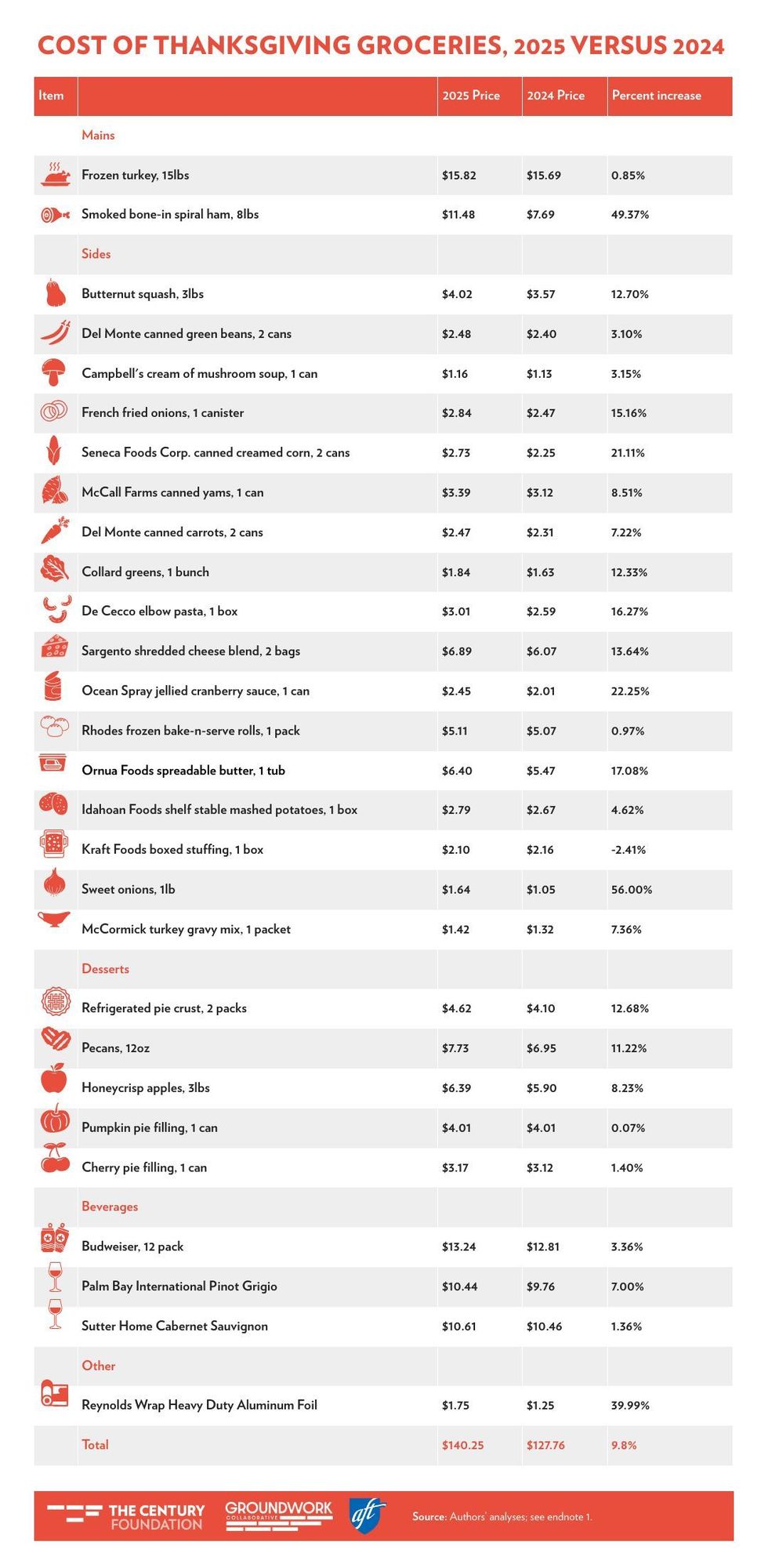
That polling was conducted in collaboration with the American Federation of Teachers, Century Foundation, and Groundwork Collaborative. They also published a report showing the soaring cost of holiday staples, which includes the graphic below.
Graphic by the American Federation of Teachers, Century Foundation, and Groundwork Collaborative
"Everything from cheeses to spices to chocolates are costing more this year," said Mary Chapman Sissle, co-owner of Maine's Sissle & Daughters Cheesemongers & Grocers, in a statement from the new campaign. "Tariffs drive up costs at every stop on the supply chain, and by the holidays those increases are impossible to ignore. It affects every part of our business, and what's on your holiday shopping list."
The day after Thanksgiving is known as Black Friday. It's widely considered the beginning of the winter holiday gift shopping season, and businesses big and small often aim to attract customers with major deals.
"Most of the beauty products our customers count on are imported," said Trinita Rhodes, co-owner of Beauty Supply Refresh in Missouri. "Tariffs have raised costs at every step, and by the time products reach our shelves we have no choice but to increase prices. During the holidays, people are buying gifts and stocking up, and these added costs make it harder for us to offer the prices they expect."
Rachel Lutz, who owns the Peacock Room, a boutique with two locations in Michigan, shared a specific example of how Trump's tariffs have recently impacted her business.
"As a small business, we are already feeling the squeeze heading into the holiday season," Lutz explained. "Tariffs have increased the cost of doing business, and we find ourselves working harder for even less. I just placed a $700 jewelry order and was hit with a $100 tariff bill."
"That adds up fast and is unsustainable in the long run," she continued. "It has been heartbreaking to wake up so many mornings and see yet another family-owned business closing in our community because they cannot absorb these costs. Some of these businesses have been around for generations, and it's hard to watch."
A message at the end of a Tariffs Cost US video ad urges Americans to contact Congress about tariffs causing "sticker shock." So far, the Republican-controlled chambers have declined to take action to rein in the president's trade war—despite proposals such as Sen. Jacky Rosen's (D-Nev.) No Tariffs on Groceries Act.
"Donald Trump lied to the American people when he promised to bring prices down 'on day one,'" Rosen charged last week. "His reckless tariffs have done the opposite, raising grocery costs and making it harder for hardworking families to put food on the table."
"I'm proud to introduce this bill to help lower the cost of groceries by stopping Donald Trump from putting tariffs on the everyday essentials Americans rely on most," she added. "I'm going to do everything in my power to pass this bill to fight against Trump's harmful trade policies."
Ahead of a looming US Supreme Court ruling that could take out Trump's import taxes, he announced earlier this month that he's dropping tariffs on beef; cocoa and spices; coffee and tea; bananas, oranges, and tomatoes; other tropical fruits and fruit juices; and fertilizers.
"After months of increasing grocery prices, Donald Trump is finally admitting he was wrong," US Sen. Elizabeth Warren (D-Mass.) said at the time. "Americans are literally paying the price for Trump's mistakes."
This country and this world are at a monumental crossroads.
US voters have an opportunity to beat back the forces of fascism and confront the billionaires who are rigging the economy, our media system, and our democracy, making it increasingly impossible for ordinary people to get by.
We’re not just talking about the election. We’re talking about what must be done once these fascist elements are vanquished from power. We need a bolder set of solutions than what either major party has so far been willing to offer and a working-class movement ready to fight like hell for it.
Trump didn't emerge from nowhere. The conditions that fueled MAGA authoritarianism were created by decades of radical neoliberal economic policies and a corrupt political system dominated by corporate interests.
They slashed taxes on the super-rich, promising that the benefits would trickle down. They said giveaways to the corporate titans would make life more affordable for the rest of us.
It was all bullshit. And when a bitter, betrayed populace searches for someone to blame, right-wing demagogues have little trouble finding scapegoats.
People know when they're being lied to, but you won't hear any of this from the corporate media. Only independent journalism—powered and funded by people who believe in building a better world—can deliver truly trustworthy daily news.
If you share our vision, please contribute whatever you can to sustain our work.
Our work is licensed under Creative Commons (CC BY-NC-ND 3.0). Feel free to republish and share widely.
Jessica Corbett is a senior editor and staff writer for Common Dreams.
Tariffs Cost US on Monday announced a holiday campaign highlighting how President Donald Trump's sweeping tariffs are driving up the prices of food, gifts, and more for American families and businesses during the busiest shopping season of the year.
"Tariffs are the Grinch this year," declares one visual advertisement from the organization. Another features a woman with a frustrated expression and says, "Joy shouldn't cost extra."
The effort comes as many Americans plan large family meals for Thanksgiving on Thursday. A third ad says, "Tariffs don't belong at the table."
The campaign also features a 30-second video showing a woman checking out and reacting to the high price of each item, with clips of Trump's actual remarks about his import taxes playing in the background.
Tariffs Cost US also circulated comments from business leaders across the country, such as Mary Carroll Dodd, owner of Red Scout Farm in North Carolina.
"The cost of many of the materials we use for farming has increased this year," she said. "That increases the price of the fresh produce we sell in our community, and it means the food on your Thanksgiving table costs more too."
The shrinking population is expected to cause wholesale turkey prices to rise 44% this year, according to the US Department of Agriculture. Despite the increase, many stores are offering discounted or even free turkeys to soften the potential blow to Thanksgiving meal budgets. But even if the bird is cheaper than last year, the ingredients to prepare the rest of the holiday feast may not be. Tariffs on imported steel, for example, have increased prices for canned goods.
As of November 17, a basket of 11 Thanksgiving staples—including a 10-pound frozen turkey, 10 Russet potatoes, a box of stuffing, and cans of corn, green beans, and cranberry sauce—cost $58.81, or 4.1% more than last year, according to Datasembly, a market research company that surveys weekly prices at 150,000 US stores. That’s higher than the average price increase for food eaten at home, which rose 2.7% in September, according to the US Bureau of Labor Statistics.
As Common Dreamsreported last week, polling by the think tank Data for Progress found that 53% of Americans said it would be harder to afford a typical Thanksgiving meal than last year.
That polling was conducted in collaboration with the American Federation of Teachers, Century Foundation, and Groundwork Collaborative. They also published a report showing the soaring cost of holiday staples, which includes the graphic below.
Graphic by the American Federation of Teachers, Century Foundation, and Groundwork Collaborative
"Everything from cheeses to spices to chocolates are costing more this year," said Mary Chapman Sissle, co-owner of Maine's Sissle & Daughters Cheesemongers & Grocers, in a statement from the new campaign. "Tariffs drive up costs at every stop on the supply chain, and by the holidays those increases are impossible to ignore. It affects every part of our business, and what's on your holiday shopping list."
The day after Thanksgiving is known as Black Friday. It's widely considered the beginning of the winter holiday gift shopping season, and businesses big and small often aim to attract customers with major deals.
"Most of the beauty products our customers count on are imported," said Trinita Rhodes, co-owner of Beauty Supply Refresh in Missouri. "Tariffs have raised costs at every step, and by the time products reach our shelves we have no choice but to increase prices. During the holidays, people are buying gifts and stocking up, and these added costs make it harder for us to offer the prices they expect."
Rachel Lutz, who owns the Peacock Room, a boutique with two locations in Michigan, shared a specific example of how Trump's tariffs have recently impacted her business.
"As a small business, we are already feeling the squeeze heading into the holiday season," Lutz explained. "Tariffs have increased the cost of doing business, and we find ourselves working harder for even less. I just placed a $700 jewelry order and was hit with a $100 tariff bill."
"That adds up fast and is unsustainable in the long run," she continued. "It has been heartbreaking to wake up so many mornings and see yet another family-owned business closing in our community because they cannot absorb these costs. Some of these businesses have been around for generations, and it's hard to watch."
A message at the end of a Tariffs Cost US video ad urges Americans to contact Congress about tariffs causing "sticker shock." So far, the Republican-controlled chambers have declined to take action to rein in the president's trade war—despite proposals such as Sen. Jacky Rosen's (D-Nev.) No Tariffs on Groceries Act.
"Donald Trump lied to the American people when he promised to bring prices down 'on day one,'" Rosen charged last week. "His reckless tariffs have done the opposite, raising grocery costs and making it harder for hardworking families to put food on the table."
"I'm proud to introduce this bill to help lower the cost of groceries by stopping Donald Trump from putting tariffs on the everyday essentials Americans rely on most," she added. "I'm going to do everything in my power to pass this bill to fight against Trump's harmful trade policies."
Ahead of a looming US Supreme Court ruling that could take out Trump's import taxes, he announced earlier this month that he's dropping tariffs on beef; cocoa and spices; coffee and tea; bananas, oranges, and tomatoes; other tropical fruits and fruit juices; and fertilizers.
"After months of increasing grocery prices, Donald Trump is finally admitting he was wrong," US Sen. Elizabeth Warren (D-Mass.) said at the time. "Americans are literally paying the price for Trump's mistakes."
We've had enough. The 1% own and operate the corporate media. They are doing everything they can to defend the status quo, squash dissent and protect the wealthy and the powerful. The Common Dreams media model is different. We cover the news that matters to the 99%. Our mission? To inform. To inspire. To ignite change for the common good. How? Nonprofit. Independent. Reader-supported. Free to read. Free to republish. Free to share. With no advertising. No paywalls. No selling of your data. Thousands of small donations fund our newsroom and allow us to continue publishing. Can you chip in? We can't do it without you. Thank you.
SUBSCRIBE TO OUR FREE NEWSLETTER
Daily news & progressive opinion—funded by the people, not the corporations—delivered straight to your inbox.



 Graphic by the American Federation of Teachers, Century Foundation, and Groundwork Collaborative