SUBSCRIBE TO OUR FREE NEWSLETTER
Daily news & progressive opinion—funded by the people, not the corporations—delivered straight to your inbox.
5
#000000
#FFFFFF
To donate by check, phone, or other method, see our More Ways to Give page.
Daily news & progressive opinion—funded by the people, not the corporations—delivered straight to your inbox.
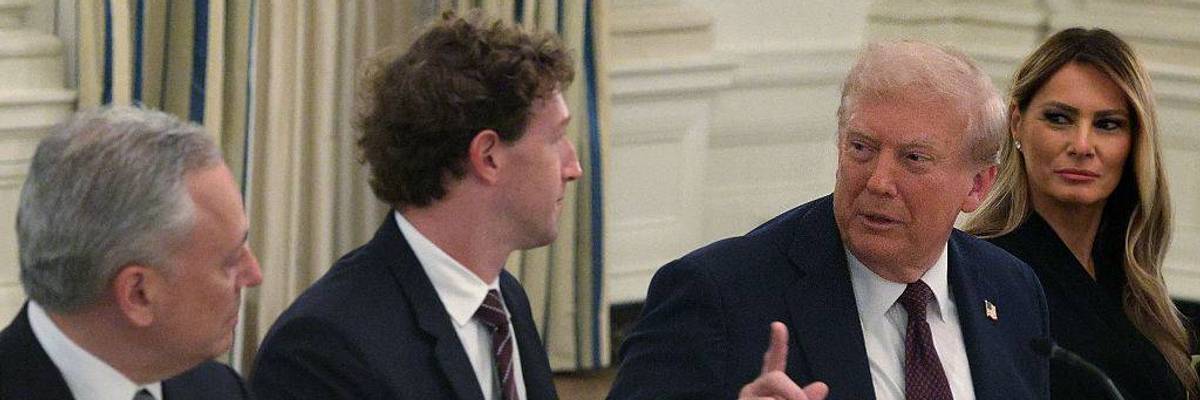
White House 'AI and Crypto Czar' David Scahs, Meta CEO Mark Zuckerberg, US President Donald Trump and first lady Melania Trump share a moment at the White House on September 4, 2025 in Washington, DC.
"Written by Big Tech, for Big Tech," said Rep. Yvette Clarke of the Trump administration proposal.
The Trump administration on Friday released its national policy framework for regulating artificial intelligence, and critics said it gave Silicon Valley a massive gift by coming out in favor of barring state regulation of the technology.
Specifically, Big Tech critics pointed to the framework's recommendation that the federal government preempt state laws regulating AI that could otherwise "act contrary to the United States’ national strategy to achieve global AI dominance."
"States should not be permitted to regulate AI development," the framework stated, "because it is an inherently interstate phenomenon with key foreign policy and national security implications."
The Trump administration's paper also argued that states "should not unduly burden Americans’ use of AI for activity that would be lawful if performed without AI" and "should not be permitted to penalize AI developers for a third party’s unlawful conduct involving their models."
Robert Weissman, co-president of Public Citizen, slammed the AI policy framework, which he said appeared designed "to protect Big Tech at the expense of everyday Americans."
"Trump’s AI framework is a hollow document with only one tough and meaningfully binding provision, delivering Big Tech’s top policy priority: It aims to preempt all state laws and rules dealing with AI," said Weissman. "Preemption would effectively mean no US regulation of AI at all, with the narrow exception of rules to deal with nonconsensual intimate deepfakes, because there are no national rules in place—and this framework would impose no additional standards of consequence."
Weissman added that while states' actions to regulate AI are inadequate, they are at least "trying to meet the novel and enormous challenges of the moment," which "is exactly why Big Tech wants to shut down their efforts."
Brad Carson, president of Americans for Responsible Innovation, called the White House's preemption of state AI laws a mistake, predicting that it would lead to even worse problems than the ones created by unregulated social media over the past two decades.
"I think it's like this: if you think the current state of play in social media guardrails are A-OK, then you'll be fine with the framework," he wrote. "If—like most—you believe we made catastrophic mistakes re social media, then you should fervently oppose this vacuous 'framework.'"
Rep. Don Beyer (D-Va.) singled out the proposed ban on state AI regulations as a particularly troubling aspect of the framework.
"The White House National AI Policy Framework reinforces the Trump administration’s commitment to preempting state-level AI laws without the establishment of clear, enforceable federal guardrails to address the urgent risks posed by AI systems," he wrote. "It even seeks to limit congressional regulatory action. But until federal action ensures safe and responsible AI development, deployment, and use, states must retain the ability to implement policies to protect the American public."
Matt Stoller, an antitrust researcher and author of the BIG newsletter, argued that the Trump AI framework should be one of the first things a future Democratic president throws in the garbage after taking office.
Rep. Yvette Clarke (D-NY) delivered a pithy analysis of the White House framework, describing it as being "written by Big Tech, for Big Tech."
Dear Common Dreams reader, It’s been nearly 30 years since I co-founded Common Dreams with my late wife, Lina Newhouser. We had the radical notion that journalism should serve the public good, not corporate profits. It was clear to us from the outset what it would take to build such a project. No paid advertisements. No corporate sponsors. No millionaire publisher telling us what to think or do. Many people said we wouldn't last a year, but we proved those doubters wrong. Together with a tremendous team of journalists and dedicated staff, we built an independent media outlet free from the constraints of profits and corporate control. Our mission has always been simple: To inform. To inspire. To ignite change for the common good. Building Common Dreams was not easy. Our survival was never guaranteed. When you take on the most powerful forces—Wall Street greed, fossil fuel industry destruction, Big Tech lobbyists, and uber-rich oligarchs who have spent billions upon billions rigging the economy and democracy in their favor—the only bulwark you have is supporters who believe in your work. But here’s the urgent message from me today. It's never been this bad out there. And it's never been this hard to keep us going. At the very moment Common Dreams is most needed, the threats we face are intensifying. We need your support now more than ever. We don't accept corporate advertising and never will. We don't have a paywall because we don't think people should be blocked from critical news based on their ability to pay. Everything we do is funded by the donations of readers like you. When everyone does the little they can afford, we are strong. But if that support retreats or dries up, so do we. Will you donate now to make sure Common Dreams not only survives but thrives? —Craig Brown, Co-founder |
The Trump administration on Friday released its national policy framework for regulating artificial intelligence, and critics said it gave Silicon Valley a massive gift by coming out in favor of barring state regulation of the technology.
Specifically, Big Tech critics pointed to the framework's recommendation that the federal government preempt state laws regulating AI that could otherwise "act contrary to the United States’ national strategy to achieve global AI dominance."
"States should not be permitted to regulate AI development," the framework stated, "because it is an inherently interstate phenomenon with key foreign policy and national security implications."
The Trump administration's paper also argued that states "should not unduly burden Americans’ use of AI for activity that would be lawful if performed without AI" and "should not be permitted to penalize AI developers for a third party’s unlawful conduct involving their models."
Robert Weissman, co-president of Public Citizen, slammed the AI policy framework, which he said appeared designed "to protect Big Tech at the expense of everyday Americans."
"Trump’s AI framework is a hollow document with only one tough and meaningfully binding provision, delivering Big Tech’s top policy priority: It aims to preempt all state laws and rules dealing with AI," said Weissman. "Preemption would effectively mean no US regulation of AI at all, with the narrow exception of rules to deal with nonconsensual intimate deepfakes, because there are no national rules in place—and this framework would impose no additional standards of consequence."
Weissman added that while states' actions to regulate AI are inadequate, they are at least "trying to meet the novel and enormous challenges of the moment," which "is exactly why Big Tech wants to shut down their efforts."
Brad Carson, president of Americans for Responsible Innovation, called the White House's preemption of state AI laws a mistake, predicting that it would lead to even worse problems than the ones created by unregulated social media over the past two decades.
"I think it's like this: if you think the current state of play in social media guardrails are A-OK, then you'll be fine with the framework," he wrote. "If—like most—you believe we made catastrophic mistakes re social media, then you should fervently oppose this vacuous 'framework.'"
Rep. Don Beyer (D-Va.) singled out the proposed ban on state AI regulations as a particularly troubling aspect of the framework.
"The White House National AI Policy Framework reinforces the Trump administration’s commitment to preempting state-level AI laws without the establishment of clear, enforceable federal guardrails to address the urgent risks posed by AI systems," he wrote. "It even seeks to limit congressional regulatory action. But until federal action ensures safe and responsible AI development, deployment, and use, states must retain the ability to implement policies to protect the American public."
Matt Stoller, an antitrust researcher and author of the BIG newsletter, argued that the Trump AI framework should be one of the first things a future Democratic president throws in the garbage after taking office.
Rep. Yvette Clarke (D-NY) delivered a pithy analysis of the White House framework, describing it as being "written by Big Tech, for Big Tech."
The Trump administration on Friday released its national policy framework for regulating artificial intelligence, and critics said it gave Silicon Valley a massive gift by coming out in favor of barring state regulation of the technology.
Specifically, Big Tech critics pointed to the framework's recommendation that the federal government preempt state laws regulating AI that could otherwise "act contrary to the United States’ national strategy to achieve global AI dominance."
"States should not be permitted to regulate AI development," the framework stated, "because it is an inherently interstate phenomenon with key foreign policy and national security implications."
The Trump administration's paper also argued that states "should not unduly burden Americans’ use of AI for activity that would be lawful if performed without AI" and "should not be permitted to penalize AI developers for a third party’s unlawful conduct involving their models."
Robert Weissman, co-president of Public Citizen, slammed the AI policy framework, which he said appeared designed "to protect Big Tech at the expense of everyday Americans."
"Trump’s AI framework is a hollow document with only one tough and meaningfully binding provision, delivering Big Tech’s top policy priority: It aims to preempt all state laws and rules dealing with AI," said Weissman. "Preemption would effectively mean no US regulation of AI at all, with the narrow exception of rules to deal with nonconsensual intimate deepfakes, because there are no national rules in place—and this framework would impose no additional standards of consequence."
Weissman added that while states' actions to regulate AI are inadequate, they are at least "trying to meet the novel and enormous challenges of the moment," which "is exactly why Big Tech wants to shut down their efforts."
Brad Carson, president of Americans for Responsible Innovation, called the White House's preemption of state AI laws a mistake, predicting that it would lead to even worse problems than the ones created by unregulated social media over the past two decades.
"I think it's like this: if you think the current state of play in social media guardrails are A-OK, then you'll be fine with the framework," he wrote. "If—like most—you believe we made catastrophic mistakes re social media, then you should fervently oppose this vacuous 'framework.'"
Rep. Don Beyer (D-Va.) singled out the proposed ban on state AI regulations as a particularly troubling aspect of the framework.
"The White House National AI Policy Framework reinforces the Trump administration’s commitment to preempting state-level AI laws without the establishment of clear, enforceable federal guardrails to address the urgent risks posed by AI systems," he wrote. "It even seeks to limit congressional regulatory action. But until federal action ensures safe and responsible AI development, deployment, and use, states must retain the ability to implement policies to protect the American public."
Matt Stoller, an antitrust researcher and author of the BIG newsletter, argued that the Trump AI framework should be one of the first things a future Democratic president throws in the garbage after taking office.
Rep. Yvette Clarke (D-NY) delivered a pithy analysis of the White House framework, describing it as being "written by Big Tech, for Big Tech."