SUBSCRIBE TO OUR FREE NEWSLETTER
Daily news & progressive opinion—funded by the people, not the corporations—delivered straight to your inbox.
5
#000000
#FFFFFF
To donate by check, phone, or other method, see our More Ways to Give page.

Daily news & progressive opinion—funded by the people, not the corporations—delivered straight to your inbox.
"Our system isn’t broken," said one progressive critic. "It’s working exactly how billionaires want it to work."
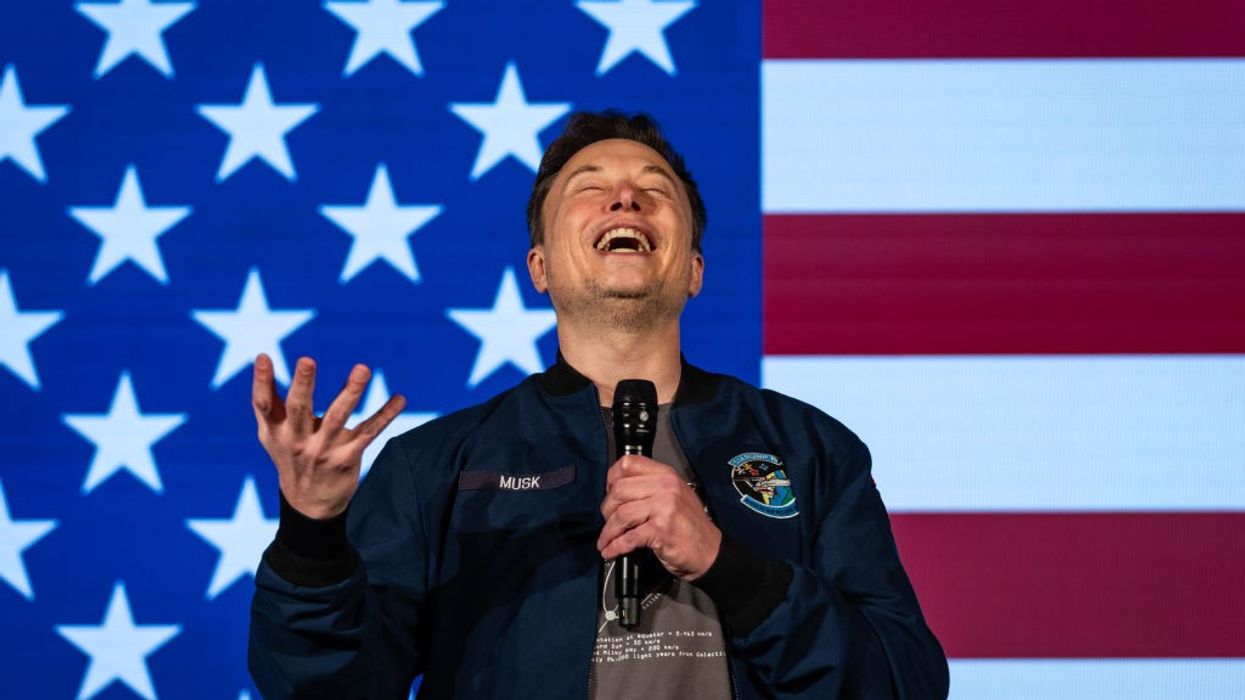
Elon Musk became the first person in history with a net worth $500 billion as the Tesla and SpaceX CEO's fortune briefly topped the half-trillion dollar mark on Wednesday, according to Forbes' Real-Time Billionaires tracker.
According to this year's International Monetary Fund figures, that makes Musk's net worth higher than the gross domestic product of 165 of the world's 195 nations.
Rooted in apartheid South Africa, built on a foundation of unethical business practices, and boosted by staggering sums of corporate welfare, Musk's fortune soared to even greater heights after he played a key role in buying the 2024 election for President Donald Trump and other Republican candidates by pouring over a quarter billion dollars into their campaign coffers.
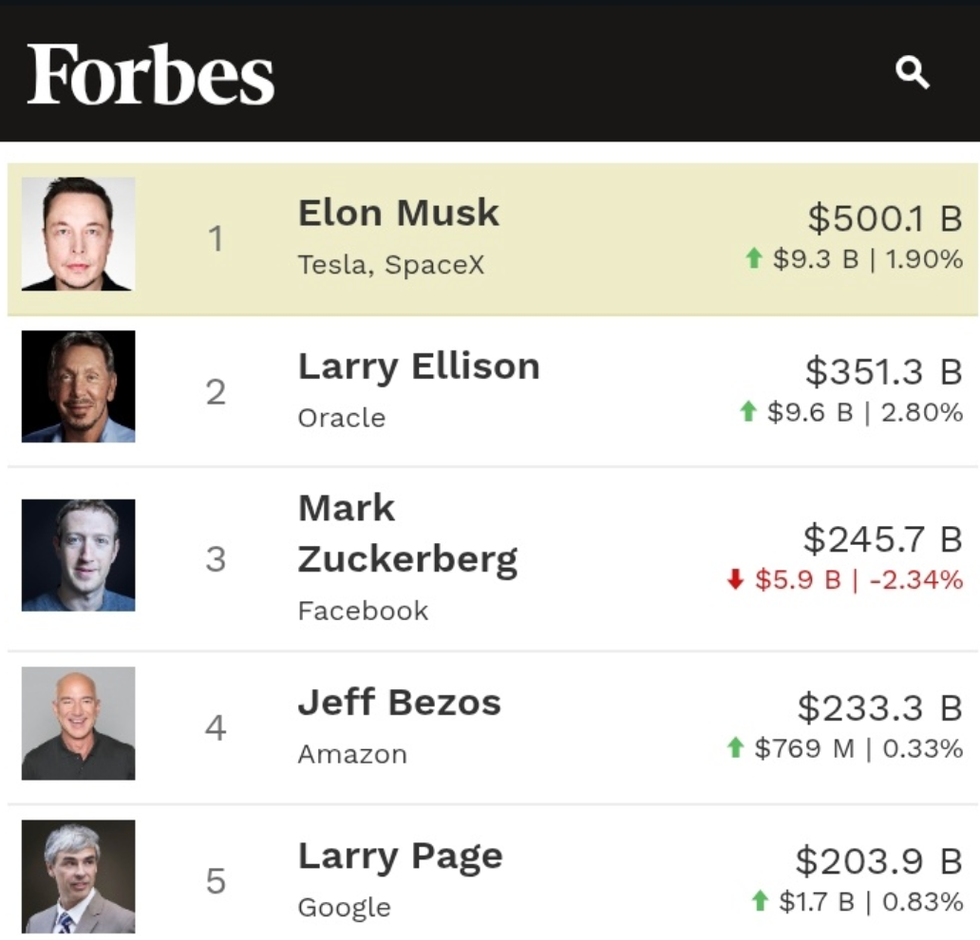
As Forbes noted:
Worth just $24.6 billion in March 2020, soaring Tesla shares made him the fifth person ever worth $100 billion, in August 2020. He became the world’s richest person for the first time in January 2021, with a nearly $190 billion net worth. Then, in September 2021, he became the third person ever worth $200 billion (after Amazon’s Jeff Bezos and Frenchman Bernard Arnault of luxury goods conglomerate LVMH). Musk went on to hit $300 billion in November 2021 and $400 billion in December 2024.
Musk was rewarded for his 2024 largesse by being named the de facto head of the so-called Department of Government Efficiency (DOGE), a job he has since left after overseeing the Project 2025-inspired evisceration of numerous federal agencies.
As progressives argue that the existence of billionaires is a public policy failure, Musk apparently no longer wants to be one. That's because he's seeking to leave the realm of mere multicentibillionaires behind and become the world's first trillionaire. Such an outcome is possible under a compensation package recently proposed by Tesla's board, and Forbes says it could happen by 2033.
Addressing this possibility, Musk—who has long warned about the existential threat posed by artificial intelligence, even as his companies pioneer such technology—said on his social media site X last year that “it’s not about ‘compensation’, but about me having enough influence over Tesla to ensure safety if we build millions of robots."
“If I can just get kicked out in the future by activist shareholder advisory firms who don’t even own Tesla shares themselves, I’m not comfortable with that future," he added.
Progressive observers expressed dismay at the news of Musk's latest money milestone.
44% of Americans are paid less than a living wage, while a union-buster who pays poverty wages, and buys elections to get more tax breaks hits $500 billion. Our system isn’t broken.It’s working exactly how billionaires want it to work.
[image or embed]
— Melanie D’Arrigo (@darrigomelanie.bsky.social) October 1, 2025 at 1:00 PM
Campaign for New York Health executive director Melanie D'Arrigo said Wednesday on social media that "Elon Musk hitting $500 billion while 60% of Americans can’t afford basic necessities is what it looks like when billionaires buy elections to get laws written to benefit themselves at the expense of everyone else."
"Elon Musk is a result of decades of policy failures," she added.
Podcaster Brian Allen alluded to United Nations World Food Program Director David Beasley's challenge to Musk to contribute toward the $6.6 trillion needed to combat world hunger.
"He could’ve solved it 83 times, but chose to buy Twitter, pump Dogecoin, and lay off workers instead," Allen said of Musk. "Welcome to late-stage capitalism."
At this point, just 813 U.S. billionaires hold a combined $6.7 trillion in wealth while 15 of them each have over $100 billion for a combined wealth over $2.4 trillion.
Based on an Institute for Policy Studies analysis of data from the Forbes Real-Time billionaire list from December 31, 2024, the last day of market activity, there are 813 billionaires with combined wealth totaling $6.72 trillion.
The total number of billionaires has remained constant at 813 when Forbes published their 38th annual World’s Billionaire List on April 2, 2024. But the combined wealth of U.S. billionaires increased over the last 9 months by $1 trillion, from $5.7 trillion at the beginning of April 2024 rising to $6.72 trillion at the end of 2024.
The top five billionaires and their individual wealth are:
There are now 15 U.S. billionaires with more than $100 billion each and combined wealth totaling $2.4 trillion.
Among the wealthiest dynastic families on the Forbes list, these dynastic families closed 2024 with huge pools of wealth:
Many top billionaires have seen their wealth surge during and after the Covid-19 pandemic.
On March 18, 2020, Elon Musk had wealth valued just under $25 billion. By 2024 year’s end, his wealth was $428 billion.
Jeff Bezos saw his wealth rise from $113 billion on March 18, 2020 to $235.2 billion in the Dec 31, 2024 analysis survey.
Three Walton family members—Jim, Alice and Rob—saw their combined assets increase from $161.1 billion on March 18, 2020 to $317 billion in the September 13, 2024 survey.
Despite a decline in the total number of U.S. billionaires, the total wealth of the exclusive nine-figure-club grew by $500 billion over the last five months.
There are now 801 billionaires based in the United States with a combined wealth totaling $6.22 trillion, according to an Institute for Policy Studies analysis of the Forbes Real Time Billionaire List.
The total number of billionaires is down 11 people as of September 13, 2024 from April when Forbes published their 38th annual World’s Billionaire List. Despite that decline in the number of billionaires, the total wealth of the exclusive nine-figure-club grew by $500 billion over the last five months.
The top five billionaires and by individual wealth are:
There are now a total of 12 billionaires with more than $100 billion each. For context, the first person to cross the $100 billion personal wealth threshold—Jeff Bezos—only did so in 2018.
When Forbes started tracking wealth in 1982 there were only 13 billionaires on the Forbes 400 list and it took $75 million to join the list. Today, a person needs have a minimum of $3.2 billion to make the cut.
Among the wealthiest families on the Forbes list:
Many top billionaires have seen their wealth surge since the onset of the Covid-19 pandemic.
On March 18, 2020, Elon Musk had wealth valued just under $25 billion. By the start of the next year he became the richest person in the world with a net worth of $185 billion.
After a decline of his assets from the acquisition of Twitter (now X) and falling Tesla valuations, Musk’s wealth has almost reached its 2022 peak with $252 billion.
Jeff Bezos saw his wealth rise from $113 billion on March 18, 2020 to $204 billion in the September 13, 2024 survey.
Three Walton family members—Jim, Alice, and Rob—saw their combined assets increase from $161.1 billion on March 18, 2020 to $286 billion this September.
The Forbes Billionaires List "is essentially an annual calculation of how much of the wealth created by the global economy is captured by a tiny caste of oligarchs rather than being used to benefit humanity as a whole."
Forbes on Tuesday released its latest catalog of, as one economic justice campaigner put it, people who should be regulated "out of existence" as the business magazine unveiled its 2024 Billionaires List, featuring near the top a number of U.S. tech billionaires who have aggressively opposed workers' rights movements and fair taxation.
The magazine reported that the number of worldwide billionaires grew by 141 in the past year, with 2,781 people holding wealth that exceeds $1 billion.
Those people own combined assets of $14.2 trillion, exceeding the gross domestic product of every country in the world except the U.S. and China.
Bernard Arnault, head of the LVMH fashion and cosmetics empire in France, currently holds the top slot on the Billionaires List, while Tesla and SpaceX founder Elon Musk and Amazon founder Jeff Bezos are No. 2 and No. 3 on the list.
Both Musk and Bezos have garnered international attention in recent years for their companies' illegal anti-union activity, and Tesla and Amazon have both avoided billions of dollars in federal taxes in recent years.
"It is utterly unconscionable that at a time where masses of the world's population are living in dire poverty, a few individuals are allowed to amass staggering wealth," said Daisy Pearson, campaigns and activism officer at Global Justice Now. "This is only possible through exploitation, and their monopolization of wealth and resources further allows them to amass huge power and influence over decisions that affect our everyday lives. Enough is enough—we should be regulating these barons out of existence."
"It is utterly unconscionable that at a time where masses of the world's population are living in dire poverty, a few individuals are allowed to amass staggering wealth."
Chase Peterson-Withorn, wealth editor at Forbes, told The Guardian that "the superrich continue to thrive" as people across the planet face higher prices of goods, cost-of-living crises, and the costs associated with increasingly frequent extreme weather events and the climate emergency.
"A record-breaking 14 centibillionaires [$100 billion] have 12-figure fortunes," Peterson-Whithorn said.
Luke Hildyard, executive director of the High Pay Center, told the outlet that the Forbes list, rather than an accounting of those who have earned the most money, "is essentially an annual calculation of how much of the wealth created by the global economy is captured by a tiny caste of oligarchs rather than being used to benefit humanity as a whole."
While the global population is "living through incredibly unequal times, lurching from one crisis to the next," added Robert Palmer, executive director of Tax Justice U.K., the richest people in the world amass "extraordinary levels of wealth."
"World leaders need to ensure the superrich are paying their fair share, for example through introducing wealth taxes," said Palmer. "This would help provide the resources needed to tackle multiple crises from inequality to climate change."
Let's cut Mitt Romney some slack. Not every off-the-cuff comment he made at that now infamous, secretly taped $50,000-a-plate fundraiser in Boca Raton reveals an utterly shocking personal failing. Take, for instance, Mitt's remark that he has "inherited nothing."
A variety of commentators have jumped on Romney for that. They've pointed out that Mitt, the son of a wealthy CEO, has enjoyed plenty of privilege -- everything from an elite private school education to a rolodex full of rich family friends he could tap to start up his business career. On top of that, the struggling young Mitt had $1 million worth of stock his father threw his way to tide him over until the big paydays started arriving.
Not quite "nothing." But there's no reason to pick on Mitt either. Most deep pockets, not just Mitt, consider themselves "self-made." The best evidence of this predilection to claim "self-made" status? The annual September release of the Forbes magazine list of the 400 richest Americans.
Each year Forbes celebrates the billionaires who populate its 400 list as paragons of get-up-and-go. The latest list, according to Forbes itself, "instills confidence that the American dream is still very much alive." Of America's current 400 richest, says the magazine, 70 percent "made their fortunes entirely from scratch."
Forbes made the same observation last year, too, and most news outlets took that claim at face value. But United for a Fair Economy did not. The Boston-based group's analysts took the time to investigate the actual backgrounds of last year's Forbes 400. They released their findings on the same day Forbes released the new 2012 list.
The basic conclusion from these findings: Forbes is spinning "a misleading tale of what it takes to become wealthy in America." Most of the Forbes 400, like Mitt, have benefitted from a level of privilege unknown to the vast majority of Americans.
As commentator Jim Hightower has colorfully put it, most of our super-rich were born on third base and think they hit a triple.
United for a Fair Economy extends this baseball analogy in its new Forbes 400 analysis. UFE defines as "born in the batter's box" those Forbes 400 rich who hail from poor to middle-class circumstances. Some had nothing growing up. Others had parents who ran small businesses.
About 95 percent of Americans, overall, currently live in these "batter's box" situations. Just over a third, 35 percent, of the Forbes 400 come from these backgrounds.
Just over 3 percent of the Forbes 400, United for a Fair Economy found, have left no good paper trail on their economic backgrounds. Of the over 60 percent remaining, all grew up in substantial privilege.
Those "born on first base" -- in upper-class families, with inheritances up to $1 million -- make up 22 percent of the 400. On "second base," from households wealthy enough to generate inheritances over $1 million, UFE found another 11.5 percent.
On "third base," with inherited wealth of more than $50 million, sits 7 percent of America's 400 richest. Last but not least, is the "born on home plate" crowd. These high-rollers, 21.25 percent of the total Forbes list, all inherited enough to "earn" their Forbes 400 status.
Forbes, the United for a Fair Economy researchers sum up, has glamorized the myth of the "self-made man" and minimized "the many other factors that enable wealth," including tax breaks and other government policies that help the really rich get ever richer.
The narrative of wealth and achievement that Forbes is pushing, the new UFE study adds, "ignores the other side of the coin -- namely, that the opportunity to build wealth is not equally or broadly shared in contemporary society."
And many of those who do have that opportunity -- like the mega millionaires in Boca Raton who applauded Mitt Romney's bogus assertion that he "inherited nothing" -- see absolutely no reason to turn that coin over.