SUBSCRIBE TO OUR FREE NEWSLETTER
Daily news & progressive opinion—funded by the people, not the corporations—delivered straight to your inbox.
5
#000000
#FFFFFF
To donate by check, phone, or other method, see our More Ways to Give page.
Daily news & progressive opinion—funded by the people, not the corporations—delivered straight to your inbox.
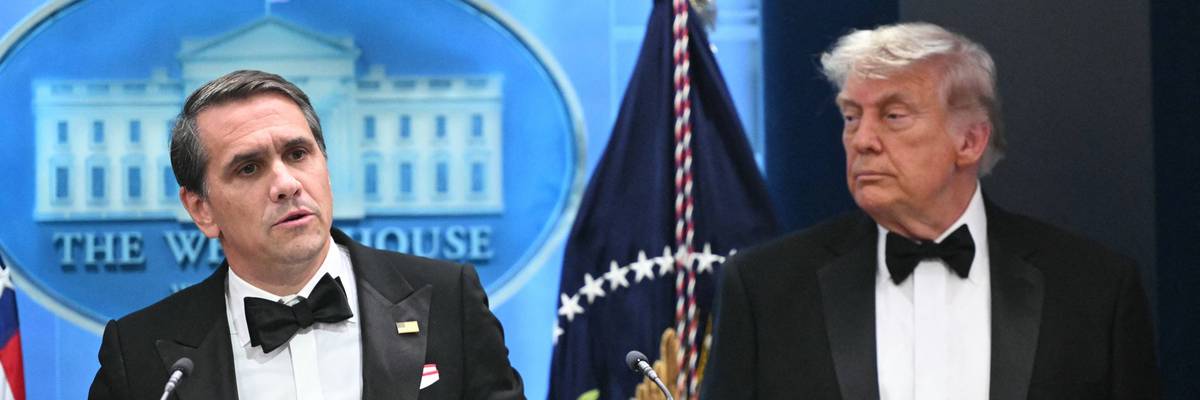
Acting US Attorney General Todd Blanche speaks beside President Donald Trump during a press briefing at the White House in Washington, DC, shortly after a shooting incident on April 25, 2026.
"This opinion is about protecting Trump and his allies from any real accountability, no matter where the questions come from—Congress, the courts, or investigators of any kind."
Just days after Senate Republicans confirmed US Attorney General Todd Blanche, the Department of Justice this week issued a legal opinion on executive privilege that was swiftly condemned as an attempt to unfairly protect some of President Donald Trump's top advisers from any accountability.
Historically, the president has been allowed to assert executive privilege over communications with executive branch staff, protecting them from disclosure.
However, the DOJ’s Office of Legal Counsel (OLC) said in a Monday memo that "presidential communications with private advisers can fall within the scope of executive privilege so long as they relate to official presidential decisionmaking, involve or reflect communications with the president or his direct advisers, and are confidential."
The memo is signed by Assistant Attorney General T. Elliot Gaiser. HuffPost reported that a DOJ official "argued its veracity by comparing it to a similar one made by President George W. Bush's attorney general in 2007."
"While the issue has not been litigated frequently, the opinion reaffirms the long-standing position of the office going back at least as far as Paul Clement in 2007 and arguably as far back as 1972," the unnamed official said.
Jonathan Shaub, a University of Kentucky School of Law professor who served in the Obama administration’s OLC, told CNN: "I would say it's not inconsistent with past positions... But it's never been stated publicly."
Shaub also told Axios that "it really could be a pretty significant weapon" for the second Trump administration "to deflect a lot of that congressional investigation of private parties."
Republicans are at risk of losing control of both chambers of Congress in the November midterm elections, and if they do, Democratic majorities could move to impeach Trump a historic third time—for everything from the Trump family's profiteering off of the presidency to his illegal war on Iran.
The Not Above the Law coalition's co-chairs—Brett Edkins of Stand Up America, Praveen Fernandes of the Constitutional Accountability Center, Lisa Gilbert of Public Citizen, and Kelsey Herbert of MoveOn—said Tuesday that "Todd Blanche's Justice Department is doing what it always does: attempting to shield Donald Trump and the people around him before anyone can hold them accountable."
"This opinion is about protecting Trump and his allies from any real accountability, no matter where the questions come from—Congress, the courts, or investigators of any kind," they argued. "Every senator who voted to confirm Blanche knew exactly what kind of Justice Department they were signing off on. They own it now."
Senate Minority Leader Chuck Schumer (D-NY)—who may not have enough support to lead Democrats even if they reclaim the upper chamber in November—was similarly critical, concluding: "Donald Trump is scared. He knows accountability is coming."
"He’s using his newly installed attorney general/personal lawyer, Todd Blanche, to cover up his communications with private advisers and special interest cronies," Schumer said on Facebook. "These are the actions of someone with something to hide. And it shows he is petrified of the questions a Democratic Congress will demand answers to. We will not let Trump escape the accountability he deserves."
Dear Common Dreams reader, It’s been nearly 30 years since I co-founded Common Dreams with my late wife, Lina Newhouser. We had the radical notion that journalism should serve the public good, not corporate profits. It was clear to us from the outset what it would take to build such a project. No paid advertisements. No corporate sponsors. No millionaire publisher telling us what to think or do. Many people said we wouldn't last a year, but we proved those doubters wrong. Together with a tremendous team of journalists and dedicated staff, we built an independent media outlet free from the constraints of profits and corporate control. Our mission has always been simple: To inform. To inspire. To ignite change for the common good. Building Common Dreams was not easy. Our survival was never guaranteed. When you take on the most powerful forces—Wall Street greed, fossil fuel industry destruction, Big Tech lobbyists, and uber-rich oligarchs who have spent billions upon billions rigging the economy and democracy in their favor—the only bulwark you have is supporters who believe in your work. But here’s the urgent message from me today. It's never been this bad out there. And it's never been this hard to keep us going. At the very moment Common Dreams is most needed, the threats we face are intensifying. We need your support now more than ever. We don't accept corporate advertising and never will. We don't have a paywall because we don't think people should be blocked from critical news based on their ability to pay. Everything we do is funded by the donations of readers like you. When everyone does the little they can afford, we are strong. But if that support retreats or dries up, so do we. Will you donate now to make sure Common Dreams not only survives but thrives? —Craig Brown, Co-founder |
Just days after Senate Republicans confirmed US Attorney General Todd Blanche, the Department of Justice this week issued a legal opinion on executive privilege that was swiftly condemned as an attempt to unfairly protect some of President Donald Trump's top advisers from any accountability.
Historically, the president has been allowed to assert executive privilege over communications with executive branch staff, protecting them from disclosure.
However, the DOJ’s Office of Legal Counsel (OLC) said in a Monday memo that "presidential communications with private advisers can fall within the scope of executive privilege so long as they relate to official presidential decisionmaking, involve or reflect communications with the president or his direct advisers, and are confidential."
The memo is signed by Assistant Attorney General T. Elliot Gaiser. HuffPost reported that a DOJ official "argued its veracity by comparing it to a similar one made by President George W. Bush's attorney general in 2007."
"While the issue has not been litigated frequently, the opinion reaffirms the long-standing position of the office going back at least as far as Paul Clement in 2007 and arguably as far back as 1972," the unnamed official said.
Jonathan Shaub, a University of Kentucky School of Law professor who served in the Obama administration’s OLC, told CNN: "I would say it's not inconsistent with past positions... But it's never been stated publicly."
Shaub also told Axios that "it really could be a pretty significant weapon" for the second Trump administration "to deflect a lot of that congressional investigation of private parties."
Republicans are at risk of losing control of both chambers of Congress in the November midterm elections, and if they do, Democratic majorities could move to impeach Trump a historic third time—for everything from the Trump family's profiteering off of the presidency to his illegal war on Iran.
The Not Above the Law coalition's co-chairs—Brett Edkins of Stand Up America, Praveen Fernandes of the Constitutional Accountability Center, Lisa Gilbert of Public Citizen, and Kelsey Herbert of MoveOn—said Tuesday that "Todd Blanche's Justice Department is doing what it always does: attempting to shield Donald Trump and the people around him before anyone can hold them accountable."
"This opinion is about protecting Trump and his allies from any real accountability, no matter where the questions come from—Congress, the courts, or investigators of any kind," they argued. "Every senator who voted to confirm Blanche knew exactly what kind of Justice Department they were signing off on. They own it now."
Senate Minority Leader Chuck Schumer (D-NY)—who may not have enough support to lead Democrats even if they reclaim the upper chamber in November—was similarly critical, concluding: "Donald Trump is scared. He knows accountability is coming."
"He’s using his newly installed attorney general/personal lawyer, Todd Blanche, to cover up his communications with private advisers and special interest cronies," Schumer said on Facebook. "These are the actions of someone with something to hide. And it shows he is petrified of the questions a Democratic Congress will demand answers to. We will not let Trump escape the accountability he deserves."
Just days after Senate Republicans confirmed US Attorney General Todd Blanche, the Department of Justice this week issued a legal opinion on executive privilege that was swiftly condemned as an attempt to unfairly protect some of President Donald Trump's top advisers from any accountability.
Historically, the president has been allowed to assert executive privilege over communications with executive branch staff, protecting them from disclosure.
However, the DOJ’s Office of Legal Counsel (OLC) said in a Monday memo that "presidential communications with private advisers can fall within the scope of executive privilege so long as they relate to official presidential decisionmaking, involve or reflect communications with the president or his direct advisers, and are confidential."
The memo is signed by Assistant Attorney General T. Elliot Gaiser. HuffPost reported that a DOJ official "argued its veracity by comparing it to a similar one made by President George W. Bush's attorney general in 2007."
"While the issue has not been litigated frequently, the opinion reaffirms the long-standing position of the office going back at least as far as Paul Clement in 2007 and arguably as far back as 1972," the unnamed official said.
Jonathan Shaub, a University of Kentucky School of Law professor who served in the Obama administration’s OLC, told CNN: "I would say it's not inconsistent with past positions... But it's never been stated publicly."
Shaub also told Axios that "it really could be a pretty significant weapon" for the second Trump administration "to deflect a lot of that congressional investigation of private parties."
Republicans are at risk of losing control of both chambers of Congress in the November midterm elections, and if they do, Democratic majorities could move to impeach Trump a historic third time—for everything from the Trump family's profiteering off of the presidency to his illegal war on Iran.
The Not Above the Law coalition's co-chairs—Brett Edkins of Stand Up America, Praveen Fernandes of the Constitutional Accountability Center, Lisa Gilbert of Public Citizen, and Kelsey Herbert of MoveOn—said Tuesday that "Todd Blanche's Justice Department is doing what it always does: attempting to shield Donald Trump and the people around him before anyone can hold them accountable."
"This opinion is about protecting Trump and his allies from any real accountability, no matter where the questions come from—Congress, the courts, or investigators of any kind," they argued. "Every senator who voted to confirm Blanche knew exactly what kind of Justice Department they were signing off on. They own it now."
Senate Minority Leader Chuck Schumer (D-NY)—who may not have enough support to lead Democrats even if they reclaim the upper chamber in November—was similarly critical, concluding: "Donald Trump is scared. He knows accountability is coming."
"He’s using his newly installed attorney general/personal lawyer, Todd Blanche, to cover up his communications with private advisers and special interest cronies," Schumer said on Facebook. "These are the actions of someone with something to hide. And it shows he is petrified of the questions a Democratic Congress will demand answers to. We will not let Trump escape the accountability he deserves."