5
#000000
#FFFFFF
To donate by check, phone, or other method, see our More Ways to Give page.
Daily news & progressive opinion—funded by the people, not the corporations—delivered straight to your inbox.
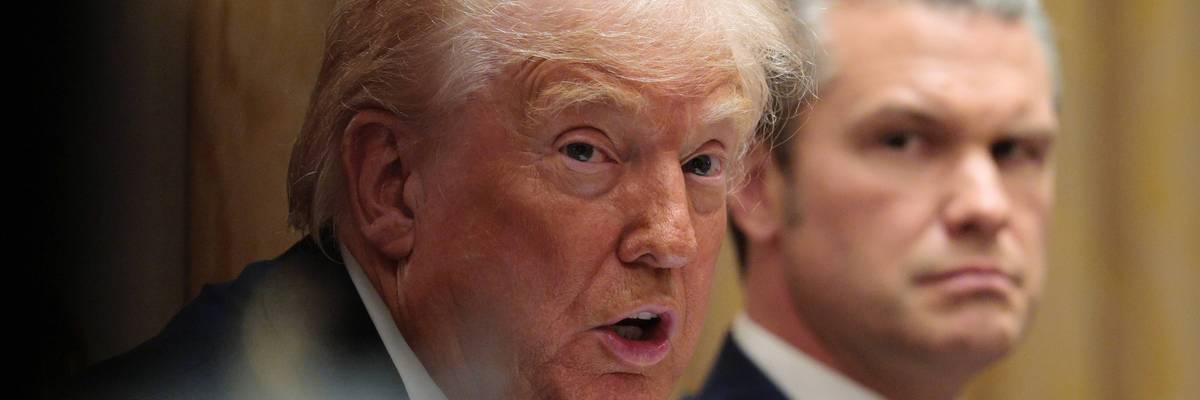
US Secretary of Defense Pete Hegseth (R) looks on as US President Donald Trump speaks during a meeting of his Cabinet in the Cabinet Room of the White House on December 2, 2025 in Washington, DC.
“No president can arbitrarily assassinate people from the sky based on their sole say-so,” said one legal expert.
A key memo from the Office of Legal Counsel at President Donald Trump's Department of Justice has underpinned the administration's yearlong campaign of bombing boats in the Caribbean Sea and eastern Pacific Ocean, and the White House has been adamant that the document should be kept secret.
But on Wednesday, Judge Paul Engelmayer in the US District Court for the Southern District of New York rejected the administration's rationale for keeping the memo hidden, saying that the Department of Defense and US Southern Command have adopted its contents as its "working law" while conducting 70 strikes on boats and killing at least 234 people who officials claimed, without evidence, were "narco-terrorists."
After the ACLU and the Center for Constitutional Rights (CCR) filed a Freedom of Information Act request calling for the release of the 40-page memo, the administration argued it needed to remain secret to protect confidential deliberations and attorney-client communications.
Engelmayer noted that administration officials have repeatedly cited the memo in public statements to explain why it was bombing dozens of boats that it claimed were operated by drug cartels—which experts and family members of some of the victims have called into question.
“The agency defendants cannot claim surprise from this consequence of the executive branch’s repeated public statements embracing the OLC memo—and it only—as setting out the legal parameters for the boat strikes,” Engelmayer wrote.
Jeffrey Stein, staff attorney with the ACLU's National Security Project, called the order "a huge step in the right direction of ensuring that the government does not get to summarily execute people based on secret law."
“The public deserves to know how our government is justifying the cold-blooded murder of hundreds of civilians," said Stein.
The judge ordered the administration to turn the memo over to him so he can determine whether it should be released to the public. He also ordered officials to provide information about who has seen the memo and how they have used it, and called on the administration to provide details on whether the memo could be protected from public view as a "closely held presidential advice document."
Engelmayer gave the administration until October 14 to comply with the order.
The boat strikes have been carried out as part of Trump's stated push to defeat drug cartels in Latin America. Sen. Tim Kaine (D-Va.) has pointed out that there is little evidence the administration is ensuring it is targeting drug boats, as the presence of drugs on a boat has not been identified as "targeting criteria" for the operation in congressional briefings. Some victims have been identified as fishermen and other people who had little, if any, involvement with drug trafficking.
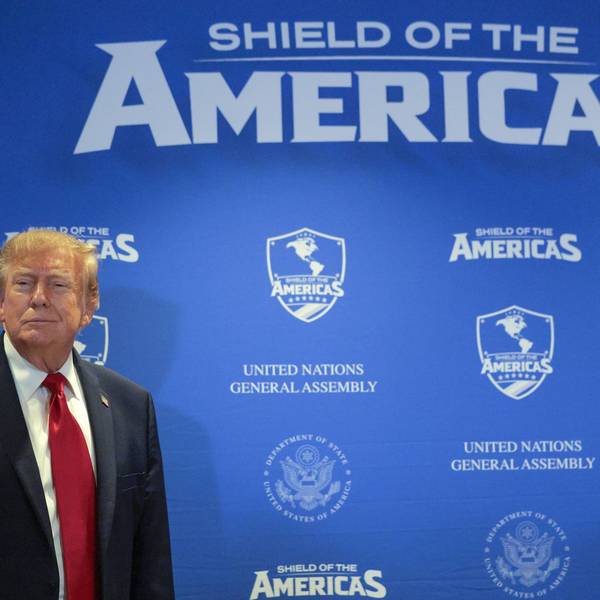
Beyond that, legal experts say that even if the 234 victims were drug traffickers, the boat bombings constitute extrajudicial killings and violations of international law—something Trump himself appeared to brag about last week when he said at the United Nations General Assembly that "we don’t waste our time" addressing alleged drug crimes in the court system.
“No president can arbitrarily assassinate people from the sky based on their sole say-so,” said Baher Azmy, legal director for CCR. “If the OLC opinion seeks to dress up the obvious illegality of these serial murders in legalese to provide Trump cover, the public needs to see that analysis and ultimately hold accountable all those who facilitate murder in the United States’ name.”
Dear Common Dreams reader, It’s been nearly 30 years since I co-founded Common Dreams with my late wife, Lina Newhouser. We had the radical notion that journalism should serve the public good, not corporate profits. It was clear to us from the outset what it would take to build such a project. No paid advertisements. No corporate sponsors. No millionaire publisher telling us what to think or do. Many people said we wouldn't last a year, but we proved those doubters wrong. Together with a tremendous team of journalists and dedicated staff, we built an independent media outlet free from the constraints of profits and corporate control. Our mission has always been simple: To inform. To inspire. To ignite change for the common good. Building Common Dreams was not easy. Our survival was never guaranteed. When you take on the most powerful forces—Wall Street greed, fossil fuel industry destruction, Big Tech lobbyists, and uber-rich oligarchs who have spent billions upon billions rigging the economy and democracy in their favor—the only bulwark you have is supporters who believe in your work. But here’s the urgent message from me today. It's never been this bad out there. And it's never been this hard to keep us going. At the very moment Common Dreams is most needed, the threats we face are intensifying. We need your support now more than ever. We don't accept corporate advertising and never will. We don't have a paywall because we don't think people should be blocked from critical news based on their ability to pay. Everything we do is funded by the donations of readers like you. When everyone does the little they can afford, we are strong. But if that support retreats or dries up, so do we. Will you donate now to make sure Common Dreams not only survives but thrives? —Craig Brown, Co-founder |
A key memo from the Office of Legal Counsel at President Donald Trump's Department of Justice has underpinned the administration's yearlong campaign of bombing boats in the Caribbean Sea and eastern Pacific Ocean, and the White House has been adamant that the document should be kept secret.
But on Wednesday, Judge Paul Engelmayer in the US District Court for the Southern District of New York rejected the administration's rationale for keeping the memo hidden, saying that the Department of Defense and US Southern Command have adopted its contents as its "working law" while conducting 70 strikes on boats and killing at least 234 people who officials claimed, without evidence, were "narco-terrorists."
After the ACLU and the Center for Constitutional Rights (CCR) filed a Freedom of Information Act request calling for the release of the 40-page memo, the administration argued it needed to remain secret to protect confidential deliberations and attorney-client communications.
Engelmayer noted that administration officials have repeatedly cited the memo in public statements to explain why it was bombing dozens of boats that it claimed were operated by drug cartels—which experts and family members of some of the victims have called into question.
“The agency defendants cannot claim surprise from this consequence of the executive branch’s repeated public statements embracing the OLC memo—and it only—as setting out the legal parameters for the boat strikes,” Engelmayer wrote.
Jeffrey Stein, staff attorney with the ACLU's National Security Project, called the order "a huge step in the right direction of ensuring that the government does not get to summarily execute people based on secret law."
“The public deserves to know how our government is justifying the cold-blooded murder of hundreds of civilians," said Stein.
The judge ordered the administration to turn the memo over to him so he can determine whether it should be released to the public. He also ordered officials to provide information about who has seen the memo and how they have used it, and called on the administration to provide details on whether the memo could be protected from public view as a "closely held presidential advice document."
Engelmayer gave the administration until October 14 to comply with the order.
The boat strikes have been carried out as part of Trump's stated push to defeat drug cartels in Latin America. Sen. Tim Kaine (D-Va.) has pointed out that there is little evidence the administration is ensuring it is targeting drug boats, as the presence of drugs on a boat has not been identified as "targeting criteria" for the operation in congressional briefings. Some victims have been identified as fishermen and other people who had little, if any, involvement with drug trafficking.
Beyond that, legal experts say that even if the 234 victims were drug traffickers, the boat bombings constitute extrajudicial killings and violations of international law—something Trump himself appeared to brag about last week when he said at the United Nations General Assembly that "we don’t waste our time" addressing alleged drug crimes in the court system.
“No president can arbitrarily assassinate people from the sky based on their sole say-so,” said Baher Azmy, legal director for CCR. “If the OLC opinion seeks to dress up the obvious illegality of these serial murders in legalese to provide Trump cover, the public needs to see that analysis and ultimately hold accountable all those who facilitate murder in the United States’ name.”
A key memo from the Office of Legal Counsel at President Donald Trump's Department of Justice has underpinned the administration's yearlong campaign of bombing boats in the Caribbean Sea and eastern Pacific Ocean, and the White House has been adamant that the document should be kept secret.
But on Wednesday, Judge Paul Engelmayer in the US District Court for the Southern District of New York rejected the administration's rationale for keeping the memo hidden, saying that the Department of Defense and US Southern Command have adopted its contents as its "working law" while conducting 70 strikes on boats and killing at least 234 people who officials claimed, without evidence, were "narco-terrorists."
After the ACLU and the Center for Constitutional Rights (CCR) filed a Freedom of Information Act request calling for the release of the 40-page memo, the administration argued it needed to remain secret to protect confidential deliberations and attorney-client communications.
Engelmayer noted that administration officials have repeatedly cited the memo in public statements to explain why it was bombing dozens of boats that it claimed were operated by drug cartels—which experts and family members of some of the victims have called into question.
“The agency defendants cannot claim surprise from this consequence of the executive branch’s repeated public statements embracing the OLC memo—and it only—as setting out the legal parameters for the boat strikes,” Engelmayer wrote.
Jeffrey Stein, staff attorney with the ACLU's National Security Project, called the order "a huge step in the right direction of ensuring that the government does not get to summarily execute people based on secret law."
“The public deserves to know how our government is justifying the cold-blooded murder of hundreds of civilians," said Stein.
The judge ordered the administration to turn the memo over to him so he can determine whether it should be released to the public. He also ordered officials to provide information about who has seen the memo and how they have used it, and called on the administration to provide details on whether the memo could be protected from public view as a "closely held presidential advice document."
Engelmayer gave the administration until October 14 to comply with the order.
The boat strikes have been carried out as part of Trump's stated push to defeat drug cartels in Latin America. Sen. Tim Kaine (D-Va.) has pointed out that there is little evidence the administration is ensuring it is targeting drug boats, as the presence of drugs on a boat has not been identified as "targeting criteria" for the operation in congressional briefings. Some victims have been identified as fishermen and other people who had little, if any, involvement with drug trafficking.
Beyond that, legal experts say that even if the 234 victims were drug traffickers, the boat bombings constitute extrajudicial killings and violations of international law—something Trump himself appeared to brag about last week when he said at the United Nations General Assembly that "we don’t waste our time" addressing alleged drug crimes in the court system.
“No president can arbitrarily assassinate people from the sky based on their sole say-so,” said Baher Azmy, legal director for CCR. “If the OLC opinion seeks to dress up the obvious illegality of these serial murders in legalese to provide Trump cover, the public needs to see that analysis and ultimately hold accountable all those who facilitate murder in the United States’ name.”