SUBSCRIBE TO OUR FREE NEWSLETTER
Daily news & progressive opinion—funded by the people, not the corporations—delivered straight to your inbox.
5
#000000
#FFFFFF
To donate by check, phone, or other method, see our More Ways to Give page.
Daily news & progressive opinion—funded by the people, not the corporations—delivered straight to your inbox.
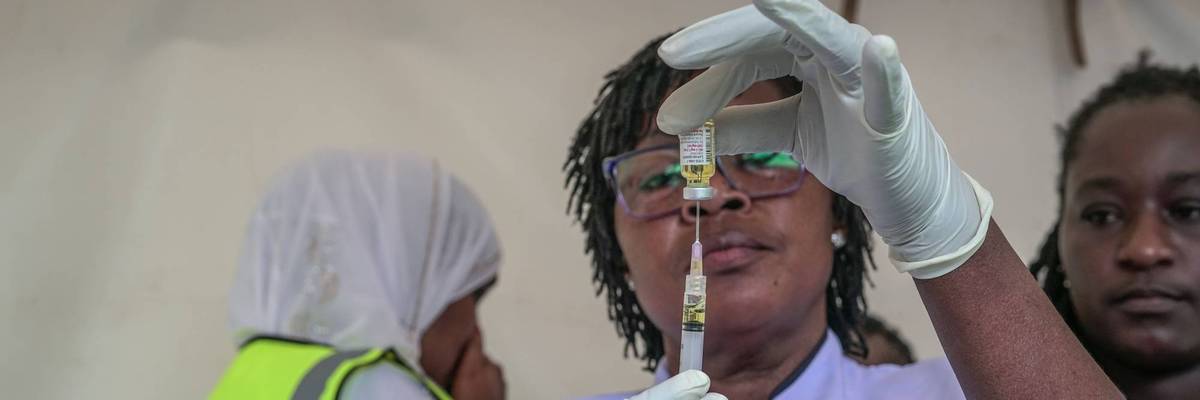
A healthcare worker fills a syringe with a dose of lenacapavir, a long-acting HIV pre-exposure prophylaxis (PrEP) injection, during the drug's rollout in Nakuru, Kenya on March 26, 2026.
“After the sudden and devastating pullback from US assistance in 2025, governments are now being pressured to accept agreements with contingencies that jeopardize human rights."
The Trump administration is requiring African nations to agree to a series of "troubling conditions" to restore lifesaving health aid, according to a Human Rights Watch report on Monday.
The administration's abrupt shuttering of the US Agency for International Development (USAID) last year shut off billions of dollars and caused havoc across Africa's healthcare system, resulting in what public health models project could be hundreds of thousands of preventable deaths.
But under what has been dubbed the “America First” Global Health Strategy, the administration has negotiated secretive agreements with dozens of these countries to restore some of the funding. Most of them have been kept under lock and key by the US.
Those that have been made public have come with terms that Human Rights Watch said "raise concerns that health aid is being inappropriately leveraged to extract terms beneficial to the US in negotiations around natural resources and access to sensitive health data from recipient countries."
In March, a draft memorandum of understanding with the government of Zambia was revealed to have conditioned $1 billion for HIV, tuberculosis, malaria, and other disease prevention for millions of people, on the country's acceptance of a separate bilateral treaty that would have given US companies greater access to the country's minerals.
A leaked State Department memo, prepared for Secretary Marco Rubio, put the exploitative terms plainly: “We will only secure our priorities by demonstrating willingness to publicly take support away from Zambia on a massive scale.”
After the details of that agreement were met with backlash, the text of agreements with several other countries—Ethiopia, Kenya, Mozambique, Nigeria, and Uganda—were suddenly removed from the State Department’s Freedom of Information Act Library.
A Human Rights Watch assessment of the agreements with those five countries—as well as agreements with Rwanda and Liberia that were leaked—revealed that in order to restore a portion of the more than $800 million collectively stripped from them by the US, they'd have to agree to several coercive measures that jeopardize the reproductive and privacy rights of their citizens.
“The agreements show the US intends to condition vital health assistance for millions of people on acquiescence to troubling conditions,” said Julia Bleckner, senior health researcher at Human Rights Watch. “After the sudden and devastating pullback from US assistance in 2025, governments are now being pressured to accept agreements with contingencies that jeopardize human rights.”
All seven of the agreements require the governments to provide the US with "broad access to data and information" to monitor compliance with the Helms Amendment, which forbids the use of US foreign assistance to pay for abortion care.
The agreements with Mozambique, Rwanda, and Liberia require them to provide “any data” requested by the US to ensure compliance with the amendment, while Uganda's permits the US to conduct unannounced spot checks of health facilities and clinics.
"By making a broad package of health aid contingent on broad and potentially invasive surveillance of Helms compliance, the agreement could encourage a more restrictive regulation of abortion than national law mandates and give rise to further violations of the right to healthcare,” says the report.
The agreements also give the US permission to directly audit clinics, laboratories, and health programs to ensure compliance with the conditions. Six of them require clinics to provide access to "any data" requested by the US at a sample of facilities it chooses.
Agreements with five countries also mandate that they share biological specimens taken from patients and associated information related to novel infectious diseases, which HRW described as part of an effort to undermine a global pathogen access and sharing system being created by the World Health Organization, from which Trump has removed the US.
HRW said in a news release:
The agreements raise serious concerns about use of people’s private health data, without clear limits, uniform safeguards, or meaningful protections for patient confidentiality, including in several countries with weak or absent domestic data protection laws. The agreements contain no prohibition on this data being shared with US pharmaceutical companies without patient consent.
“Governments negotiating health assistance agreements with the United States face difficult choices,” Bleckner said. “They should be wary of terms asking them to sign away their populations’ rights and push for the inclusion of civil society representatives and multilateral global health organizations like the Global Fund in deliberations.”
Dear Common Dreams reader, It’s been nearly 30 years since I co-founded Common Dreams with my late wife, Lina Newhouser. We had the radical notion that journalism should serve the public good, not corporate profits. It was clear to us from the outset what it would take to build such a project. No paid advertisements. No corporate sponsors. No millionaire publisher telling us what to think or do. Many people said we wouldn't last a year, but we proved those doubters wrong. Together with a tremendous team of journalists and dedicated staff, we built an independent media outlet free from the constraints of profits and corporate control. Our mission has always been simple: To inform. To inspire. To ignite change for the common good. Building Common Dreams was not easy. Our survival was never guaranteed. When you take on the most powerful forces—Wall Street greed, fossil fuel industry destruction, Big Tech lobbyists, and uber-rich oligarchs who have spent billions upon billions rigging the economy and democracy in their favor—the only bulwark you have is supporters who believe in your work. But here’s the urgent message from me today. It's never been this bad out there. And it's never been this hard to keep us going. At the very moment Common Dreams is most needed, the threats we face are intensifying. We need your support now more than ever. We don't accept corporate advertising and never will. We don't have a paywall because we don't think people should be blocked from critical news based on their ability to pay. Everything we do is funded by the donations of readers like you. When everyone does the little they can afford, we are strong. But if that support retreats or dries up, so do we. Will you donate now to make sure Common Dreams not only survives but thrives? —Craig Brown, Co-founder |
The Trump administration is requiring African nations to agree to a series of "troubling conditions" to restore lifesaving health aid, according to a Human Rights Watch report on Monday.
The administration's abrupt shuttering of the US Agency for International Development (USAID) last year shut off billions of dollars and caused havoc across Africa's healthcare system, resulting in what public health models project could be hundreds of thousands of preventable deaths.
But under what has been dubbed the “America First” Global Health Strategy, the administration has negotiated secretive agreements with dozens of these countries to restore some of the funding. Most of them have been kept under lock and key by the US.
Those that have been made public have come with terms that Human Rights Watch said "raise concerns that health aid is being inappropriately leveraged to extract terms beneficial to the US in negotiations around natural resources and access to sensitive health data from recipient countries."
In March, a draft memorandum of understanding with the government of Zambia was revealed to have conditioned $1 billion for HIV, tuberculosis, malaria, and other disease prevention for millions of people, on the country's acceptance of a separate bilateral treaty that would have given US companies greater access to the country's minerals.
A leaked State Department memo, prepared for Secretary Marco Rubio, put the exploitative terms plainly: “We will only secure our priorities by demonstrating willingness to publicly take support away from Zambia on a massive scale.”
After the details of that agreement were met with backlash, the text of agreements with several other countries—Ethiopia, Kenya, Mozambique, Nigeria, and Uganda—were suddenly removed from the State Department’s Freedom of Information Act Library.
A Human Rights Watch assessment of the agreements with those five countries—as well as agreements with Rwanda and Liberia that were leaked—revealed that in order to restore a portion of the more than $800 million collectively stripped from them by the US, they'd have to agree to several coercive measures that jeopardize the reproductive and privacy rights of their citizens.
“The agreements show the US intends to condition vital health assistance for millions of people on acquiescence to troubling conditions,” said Julia Bleckner, senior health researcher at Human Rights Watch. “After the sudden and devastating pullback from US assistance in 2025, governments are now being pressured to accept agreements with contingencies that jeopardize human rights.”
All seven of the agreements require the governments to provide the US with "broad access to data and information" to monitor compliance with the Helms Amendment, which forbids the use of US foreign assistance to pay for abortion care.
The agreements with Mozambique, Rwanda, and Liberia require them to provide “any data” requested by the US to ensure compliance with the amendment, while Uganda's permits the US to conduct unannounced spot checks of health facilities and clinics.
"By making a broad package of health aid contingent on broad and potentially invasive surveillance of Helms compliance, the agreement could encourage a more restrictive regulation of abortion than national law mandates and give rise to further violations of the right to healthcare,” says the report.
The agreements also give the US permission to directly audit clinics, laboratories, and health programs to ensure compliance with the conditions. Six of them require clinics to provide access to "any data" requested by the US at a sample of facilities it chooses.
Agreements with five countries also mandate that they share biological specimens taken from patients and associated information related to novel infectious diseases, which HRW described as part of an effort to undermine a global pathogen access and sharing system being created by the World Health Organization, from which Trump has removed the US.
HRW said in a news release:
The agreements raise serious concerns about use of people’s private health data, without clear limits, uniform safeguards, or meaningful protections for patient confidentiality, including in several countries with weak or absent domestic data protection laws. The agreements contain no prohibition on this data being shared with US pharmaceutical companies without patient consent.
“Governments negotiating health assistance agreements with the United States face difficult choices,” Bleckner said. “They should be wary of terms asking them to sign away their populations’ rights and push for the inclusion of civil society representatives and multilateral global health organizations like the Global Fund in deliberations.”
The Trump administration is requiring African nations to agree to a series of "troubling conditions" to restore lifesaving health aid, according to a Human Rights Watch report on Monday.
The administration's abrupt shuttering of the US Agency for International Development (USAID) last year shut off billions of dollars and caused havoc across Africa's healthcare system, resulting in what public health models project could be hundreds of thousands of preventable deaths.
But under what has been dubbed the “America First” Global Health Strategy, the administration has negotiated secretive agreements with dozens of these countries to restore some of the funding. Most of them have been kept under lock and key by the US.
Those that have been made public have come with terms that Human Rights Watch said "raise concerns that health aid is being inappropriately leveraged to extract terms beneficial to the US in negotiations around natural resources and access to sensitive health data from recipient countries."
In March, a draft memorandum of understanding with the government of Zambia was revealed to have conditioned $1 billion for HIV, tuberculosis, malaria, and other disease prevention for millions of people, on the country's acceptance of a separate bilateral treaty that would have given US companies greater access to the country's minerals.
A leaked State Department memo, prepared for Secretary Marco Rubio, put the exploitative terms plainly: “We will only secure our priorities by demonstrating willingness to publicly take support away from Zambia on a massive scale.”
After the details of that agreement were met with backlash, the text of agreements with several other countries—Ethiopia, Kenya, Mozambique, Nigeria, and Uganda—were suddenly removed from the State Department’s Freedom of Information Act Library.
A Human Rights Watch assessment of the agreements with those five countries—as well as agreements with Rwanda and Liberia that were leaked—revealed that in order to restore a portion of the more than $800 million collectively stripped from them by the US, they'd have to agree to several coercive measures that jeopardize the reproductive and privacy rights of their citizens.
“The agreements show the US intends to condition vital health assistance for millions of people on acquiescence to troubling conditions,” said Julia Bleckner, senior health researcher at Human Rights Watch. “After the sudden and devastating pullback from US assistance in 2025, governments are now being pressured to accept agreements with contingencies that jeopardize human rights.”
All seven of the agreements require the governments to provide the US with "broad access to data and information" to monitor compliance with the Helms Amendment, which forbids the use of US foreign assistance to pay for abortion care.
The agreements with Mozambique, Rwanda, and Liberia require them to provide “any data” requested by the US to ensure compliance with the amendment, while Uganda's permits the US to conduct unannounced spot checks of health facilities and clinics.
"By making a broad package of health aid contingent on broad and potentially invasive surveillance of Helms compliance, the agreement could encourage a more restrictive regulation of abortion than national law mandates and give rise to further violations of the right to healthcare,” says the report.
The agreements also give the US permission to directly audit clinics, laboratories, and health programs to ensure compliance with the conditions. Six of them require clinics to provide access to "any data" requested by the US at a sample of facilities it chooses.
Agreements with five countries also mandate that they share biological specimens taken from patients and associated information related to novel infectious diseases, which HRW described as part of an effort to undermine a global pathogen access and sharing system being created by the World Health Organization, from which Trump has removed the US.
HRW said in a news release:
The agreements raise serious concerns about use of people’s private health data, without clear limits, uniform safeguards, or meaningful protections for patient confidentiality, including in several countries with weak or absent domestic data protection laws. The agreements contain no prohibition on this data being shared with US pharmaceutical companies without patient consent.
“Governments negotiating health assistance agreements with the United States face difficult choices,” Bleckner said. “They should be wary of terms asking them to sign away their populations’ rights and push for the inclusion of civil society representatives and multilateral global health organizations like the Global Fund in deliberations.”