SUBSCRIBE TO OUR FREE NEWSLETTER
Daily news & progressive opinion—funded by the people, not the corporations—delivered straight to your inbox.
5
#000000
#FFFFFF
To donate by check, phone, or other method, see our More Ways to Give page.
Daily news & progressive opinion—funded by the people, not the corporations—delivered straight to your inbox.
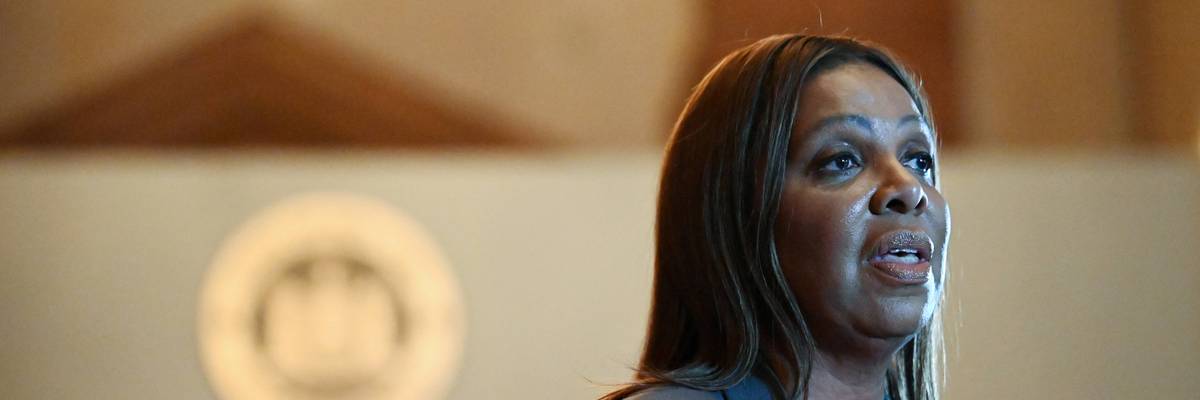
New York Attorney General Letitia James leads a news conference in Albany, New York on Monday, March 16, 2026.
"We are fighting back to stop this illegal agreement that threatens to erase over a thousand union jobs and cheat millions of New Yorkers out of clean, affordable energy,” said New York AG Letitia James.
A group of state attorneys general sued the Trump administration on Tuesday, in an effort to block an unprecedented deal it made to pay an energy company to abandon a pair of large East Coast wind energy projects and invest in more polluting fossil fuel infrastructure instead.
As part of efforts to unilaterally block private wind power construction across the US while revving up fossil fuel production, the Interior Department agreed to pay $928 million in taxpayer funds to the French energy company TotalEnergies to scrap construction plans for a large wind project off the coast of New York and another off North Carolina, the leases for which had been approved back in 2022.
In exchange, the company agreed to halt any future development of clean power in the US and invest hundreds of millions of dollars in oil and gas projects instead.
On Tuesday, New York Attorney General Letitia James announced that she was leading a coalition of seven northeastern state AGs—from New Jersey, Connecticut, Maine, Massachusetts, Rhode Island, and Vermont—in a lawsuit seeking to block the agreement.
James described the deal as an unlawful attempt to get around a previous court rejection of President Donald Trump’s Day One executive order halting all wind energy development in the US.
“The Trump administration is once again trying to kill clean energy projects and destroy good-paying jobs for New Yorkers," James said. "After repeatedly losing in court, this administration cooked up a sham deal to pay a foreign energy company hundreds of millions of taxpayer dollars to abandon offshore wind and invest in oil and gas instead. We are fighting back to stop this illegal agreement that threatens to erase over a thousand union jobs and cheat millions of New Yorkers out of clean, affordable energy.”
The canceled New York project was expected to produce up to 1.4 gigawatts of energy for the state, powering more than 700,000 homes annually. According to a press release from James' office, it was projected to save New Yorkers $10 billion over its 25-year lifespan.
Another section of the Bight construction lease was slated for a wind farm projected to provide about 1.3 gigawatts to homes in New Jersey, powering 650,000 homes and generating $3 billion in economic benefits, according to state officials.
The other project set for North Carolina was projected by TotalEnergies to generate more than 1 gigawatt of power, enough for 300,000 homes.
The Oceantic Network, a nonprofit that supports the construction of offshore wind projects, estimated that the cancellation of a single 1-gigawatt offshore wind project costs between $8.5-9.5 billion in US economic output and about 3,350 construction jobs, along with hundreds of millions of dollars in lost wages.
Liz Burdock, the president and CEO of Oceantic, commended the states attempting to stop the Trump administration from killing the projects at a time when oil and gas costs are skyrocketing, largely due to Trump's war with Iran.
"For more than a year, offshore wind has faced an unprecedented and unrelenting campaign of political interference despite billions in private investment, state commitments, and court rulings," Burdock said. "These continued attacks on offshore wind are not just an assault on a single industry—they are an attack on American workers, energy affordability, national security, and the states’ right to shape their own energy future."
Dear Common Dreams reader, It’s been nearly 30 years since I co-founded Common Dreams with my late wife, Lina Newhouser. We had the radical notion that journalism should serve the public good, not corporate profits. It was clear to us from the outset what it would take to build such a project. No paid advertisements. No corporate sponsors. No millionaire publisher telling us what to think or do. Many people said we wouldn't last a year, but we proved those doubters wrong. Together with a tremendous team of journalists and dedicated staff, we built an independent media outlet free from the constraints of profits and corporate control. Our mission has always been simple: To inform. To inspire. To ignite change for the common good. Building Common Dreams was not easy. Our survival was never guaranteed. When you take on the most powerful forces—Wall Street greed, fossil fuel industry destruction, Big Tech lobbyists, and uber-rich oligarchs who have spent billions upon billions rigging the economy and democracy in their favor—the only bulwark you have is supporters who believe in your work. But here’s the urgent message from me today. It's never been this bad out there. And it's never been this hard to keep us going. At the very moment Common Dreams is most needed, the threats we face are intensifying. We need your support now more than ever. We don't accept corporate advertising and never will. We don't have a paywall because we don't think people should be blocked from critical news based on their ability to pay. Everything we do is funded by the donations of readers like you. When everyone does the little they can afford, we are strong. But if that support retreats or dries up, so do we. Will you donate now to make sure Common Dreams not only survives but thrives? —Craig Brown, Co-founder |
A group of state attorneys general sued the Trump administration on Tuesday, in an effort to block an unprecedented deal it made to pay an energy company to abandon a pair of large East Coast wind energy projects and invest in more polluting fossil fuel infrastructure instead.
As part of efforts to unilaterally block private wind power construction across the US while revving up fossil fuel production, the Interior Department agreed to pay $928 million in taxpayer funds to the French energy company TotalEnergies to scrap construction plans for a large wind project off the coast of New York and another off North Carolina, the leases for which had been approved back in 2022.
In exchange, the company agreed to halt any future development of clean power in the US and invest hundreds of millions of dollars in oil and gas projects instead.
On Tuesday, New York Attorney General Letitia James announced that she was leading a coalition of seven northeastern state AGs—from New Jersey, Connecticut, Maine, Massachusetts, Rhode Island, and Vermont—in a lawsuit seeking to block the agreement.
James described the deal as an unlawful attempt to get around a previous court rejection of President Donald Trump’s Day One executive order halting all wind energy development in the US.
“The Trump administration is once again trying to kill clean energy projects and destroy good-paying jobs for New Yorkers," James said. "After repeatedly losing in court, this administration cooked up a sham deal to pay a foreign energy company hundreds of millions of taxpayer dollars to abandon offshore wind and invest in oil and gas instead. We are fighting back to stop this illegal agreement that threatens to erase over a thousand union jobs and cheat millions of New Yorkers out of clean, affordable energy.”
The canceled New York project was expected to produce up to 1.4 gigawatts of energy for the state, powering more than 700,000 homes annually. According to a press release from James' office, it was projected to save New Yorkers $10 billion over its 25-year lifespan.
Another section of the Bight construction lease was slated for a wind farm projected to provide about 1.3 gigawatts to homes in New Jersey, powering 650,000 homes and generating $3 billion in economic benefits, according to state officials.
The other project set for North Carolina was projected by TotalEnergies to generate more than 1 gigawatt of power, enough for 300,000 homes.
The Oceantic Network, a nonprofit that supports the construction of offshore wind projects, estimated that the cancellation of a single 1-gigawatt offshore wind project costs between $8.5-9.5 billion in US economic output and about 3,350 construction jobs, along with hundreds of millions of dollars in lost wages.
Liz Burdock, the president and CEO of Oceantic, commended the states attempting to stop the Trump administration from killing the projects at a time when oil and gas costs are skyrocketing, largely due to Trump's war with Iran.
"For more than a year, offshore wind has faced an unprecedented and unrelenting campaign of political interference despite billions in private investment, state commitments, and court rulings," Burdock said. "These continued attacks on offshore wind are not just an assault on a single industry—they are an attack on American workers, energy affordability, national security, and the states’ right to shape their own energy future."
A group of state attorneys general sued the Trump administration on Tuesday, in an effort to block an unprecedented deal it made to pay an energy company to abandon a pair of large East Coast wind energy projects and invest in more polluting fossil fuel infrastructure instead.
As part of efforts to unilaterally block private wind power construction across the US while revving up fossil fuel production, the Interior Department agreed to pay $928 million in taxpayer funds to the French energy company TotalEnergies to scrap construction plans for a large wind project off the coast of New York and another off North Carolina, the leases for which had been approved back in 2022.
In exchange, the company agreed to halt any future development of clean power in the US and invest hundreds of millions of dollars in oil and gas projects instead.
On Tuesday, New York Attorney General Letitia James announced that she was leading a coalition of seven northeastern state AGs—from New Jersey, Connecticut, Maine, Massachusetts, Rhode Island, and Vermont—in a lawsuit seeking to block the agreement.
James described the deal as an unlawful attempt to get around a previous court rejection of President Donald Trump’s Day One executive order halting all wind energy development in the US.
“The Trump administration is once again trying to kill clean energy projects and destroy good-paying jobs for New Yorkers," James said. "After repeatedly losing in court, this administration cooked up a sham deal to pay a foreign energy company hundreds of millions of taxpayer dollars to abandon offshore wind and invest in oil and gas instead. We are fighting back to stop this illegal agreement that threatens to erase over a thousand union jobs and cheat millions of New Yorkers out of clean, affordable energy.”
The canceled New York project was expected to produce up to 1.4 gigawatts of energy for the state, powering more than 700,000 homes annually. According to a press release from James' office, it was projected to save New Yorkers $10 billion over its 25-year lifespan.
Another section of the Bight construction lease was slated for a wind farm projected to provide about 1.3 gigawatts to homes in New Jersey, powering 650,000 homes and generating $3 billion in economic benefits, according to state officials.
The other project set for North Carolina was projected by TotalEnergies to generate more than 1 gigawatt of power, enough for 300,000 homes.
The Oceantic Network, a nonprofit that supports the construction of offshore wind projects, estimated that the cancellation of a single 1-gigawatt offshore wind project costs between $8.5-9.5 billion in US economic output and about 3,350 construction jobs, along with hundreds of millions of dollars in lost wages.
Liz Burdock, the president and CEO of Oceantic, commended the states attempting to stop the Trump administration from killing the projects at a time when oil and gas costs are skyrocketing, largely due to Trump's war with Iran.
"For more than a year, offshore wind has faced an unprecedented and unrelenting campaign of political interference despite billions in private investment, state commitments, and court rulings," Burdock said. "These continued attacks on offshore wind are not just an assault on a single industry—they are an attack on American workers, energy affordability, national security, and the states’ right to shape their own energy future."