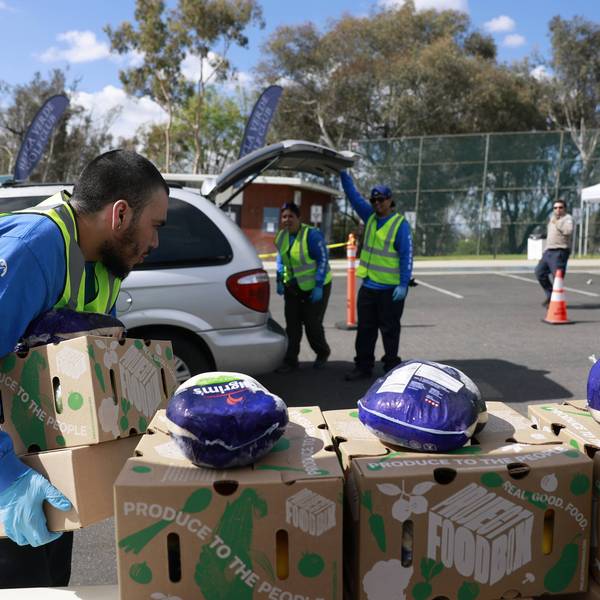
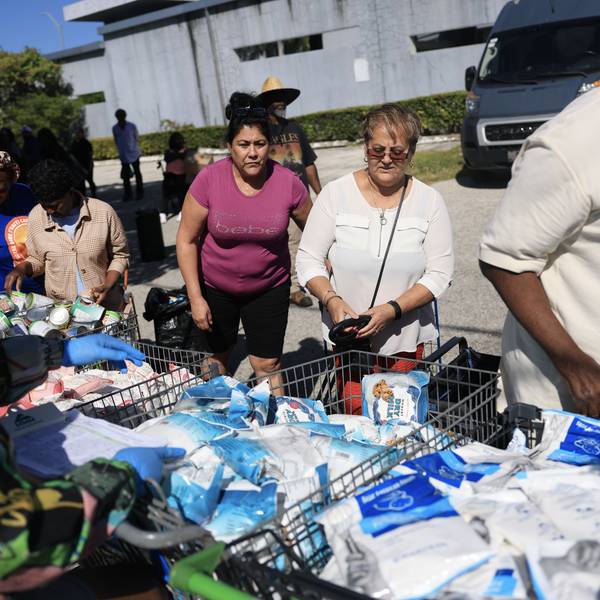
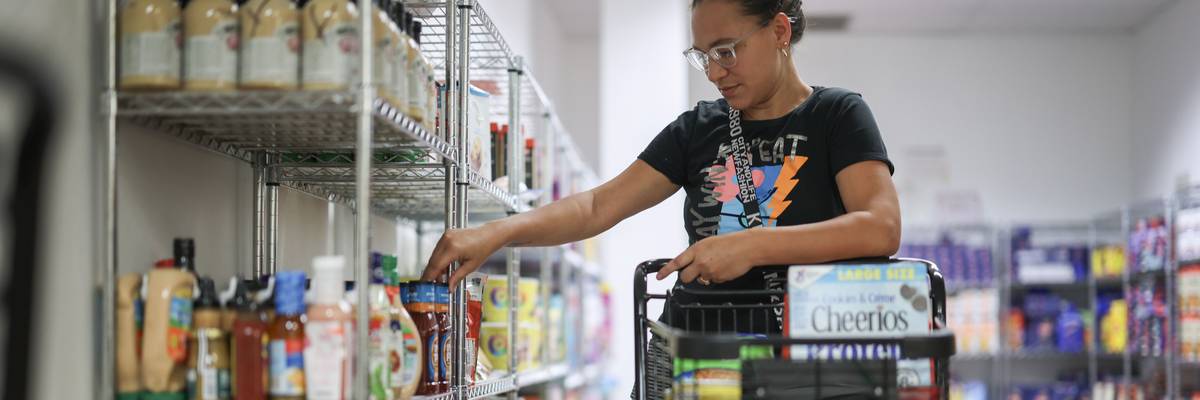
A woman shops at the Feeding South Florida food pantry on October 27, 2025 in Pembroke Park.
Trump-GOP Budget Law Pushes SNAP Enrollment to 17-Year Low as Millions Lose Aid
"These cuts are not filtering out 'waste, fraud, and abuse'... they are parents deciding between paying the electric bill and putting food on the table, or skipping meals."
Participation in the Supplemental Nutrition Assistance Program is now at its lowest point in 17 years thanks to cuts made in the Republican Party's One Big Beautiful Bill Act.
The Center for Budget and Policy Priorities (CBPP) on Wednesday published the latest update to its series of reports tracking the impact of SNAP cuts, and it found that there are roughly 5 million fewer people participating in SNAP thanks in large part to the cuts made in the 2025 GOP budget law.
Since the law's passage, enrollment in SNAP has decreased in every US state except Alaska.
While enrollment has fallen by an average of 12% across the US over the last year, eight states have seen participation plummet by 20% or higher. Arizona has seen the largest overall drop in participation, with 45% fewer people enrolled in the program over the last year.
"The declines started before the harmful 2025 Republican reconciliation law’s enactment, suggesting factors at play in addition to that law," CBPP explained. "But in almost all states, declines in SNAP participation accelerated after the 2025 Republican reconciliation law, and we expect that trend to continue."
CBPP also projected participation would fall even further in the next year given that the biggest changes made to SNAP funding won't fully kick in until 2027, when "most states will have to pay between 5% and 15% of SNAP benefit costs, totaling hundreds of millions of dollars a year in many states."
"The amount a state will have to pay will be based on current error rates, factoring in errors that states are making today," CBPP emphasized. "The magnitude of the cost shift and the urgency surrounding error rates may incentivize states to take drastic measures to reduce their payment error rates quickly and cut program costs, even if it means delaying or improperly denying benefits to eligible people."
CBPP's latest report on SNAP cuts comes after ParentsTogether Action released a survey of SNAP beneficiaries on Tuesday finding that two-thirds of families who rely on the program have already seen benefits decrease over the last year.
The survey shows 75% of SNAP beneficiaries also report that affording food is one of their biggest economic challenges, echoing earlier surveys showing that buying groceries has become a major source of stress for Americans overall.
SNAP recipients described to ParentsTogether Action how the SNAP cuts have impacted their finances.
"They took over $120 off our SNAP," said a Kansas mother named Brandi. "We have a hard time keeping up with bills. I get [Supplemental Security Income], and that is my only income for my daughter and myself."
An Oregon woman named Amanda, meanwhile, described seeing her benefits cut by more than half after she found a job.
"We were receiving $400 a month, but after I reported my new income and reapplied, our benefits dropped to just under $200," she said. "We also didn’t receive any benefits for one month during the process."
Ailen Arreaza, executive director of ParentsTogether Action, said the SNAP cuts are forcing families to make an "impossible choice" on whether to prioritize paying for food, healthcare, or their utility bills.
"These cuts are not filtering out 'waste, fraud, and abuse' like the administration would like us to believe," Arreaza explained, "they are parents deciding between paying the electric bill and putting food on the table, or skipping meals so their kids can eat. Families should not have to make these choices."
We are at a crossroads
This country and this world are at a monumental crossroads. In a few short weeks, US voters will have an opportunity to beat back the forces of fascism and confront the billionaires who are rigging the economy, our media system, and our democracy, making it increasingly impossible for ordinary people to get by. We’re not just talking about the election. We’re talking about what must be done once these fascist elements are vanquished from power. We need a bolder set of solutions than what either major party has so far been willing to offer and a working-class movement ready to fight like hell for it. Trump didn't emerge from nowhere. The conditions that fueled MAGA authoritarianism were created by decades of radical neoliberal economic policies and a corrupt political system dominated by corporate interests. They slashed taxes on the super-rich, promising that the benefits would trickle down. They said giveaways to the corporate titans would make life more affordable for the rest of us. It was all bullshit. And when a bitter, betrayed populace searches for someone to blame, right-wing demagogues have little trouble finding scapegoats. People know when they're being lied to, but you won't hear any of this from the corporate media. Only independent journalism—powered and funded by people who believe in building a better world—can deliver truly trustworthy daily news. Our Fall Campaign is underway, and we need your help. To power our newsroom through the rest of the year, we need to raise $125,000 by midnight on October 31. So if you share our vision, please contribute whatever you can to sustain our work. |
Participation in the Supplemental Nutrition Assistance Program is now at its lowest point in 17 years thanks to cuts made in the Republican Party's One Big Beautiful Bill Act.
The Center for Budget and Policy Priorities (CBPP) on Wednesday published the latest update to its series of reports tracking the impact of SNAP cuts, and it found that there are roughly 5 million fewer people participating in SNAP thanks in large part to the cuts made in the 2025 GOP budget law.
Since the law's passage, enrollment in SNAP has decreased in every US state except Alaska.
While enrollment has fallen by an average of 12% across the US over the last year, eight states have seen participation plummet by 20% or higher. Arizona has seen the largest overall drop in participation, with 45% fewer people enrolled in the program over the last year.
"The declines started before the harmful 2025 Republican reconciliation law’s enactment, suggesting factors at play in addition to that law," CBPP explained. "But in almost all states, declines in SNAP participation accelerated after the 2025 Republican reconciliation law, and we expect that trend to continue."
CBPP also projected participation would fall even further in the next year given that the biggest changes made to SNAP funding won't fully kick in until 2027, when "most states will have to pay between 5% and 15% of SNAP benefit costs, totaling hundreds of millions of dollars a year in many states."
"The amount a state will have to pay will be based on current error rates, factoring in errors that states are making today," CBPP emphasized. "The magnitude of the cost shift and the urgency surrounding error rates may incentivize states to take drastic measures to reduce their payment error rates quickly and cut program costs, even if it means delaying or improperly denying benefits to eligible people."
CBPP's latest report on SNAP cuts comes after ParentsTogether Action released a survey of SNAP beneficiaries on Tuesday finding that two-thirds of families who rely on the program have already seen benefits decrease over the last year.
The survey shows 75% of SNAP beneficiaries also report that affording food is one of their biggest economic challenges, echoing earlier surveys showing that buying groceries has become a major source of stress for Americans overall.
SNAP recipients described to ParentsTogether Action how the SNAP cuts have impacted their finances.
"They took over $120 off our SNAP," said a Kansas mother named Brandi. "We have a hard time keeping up with bills. I get [Supplemental Security Income], and that is my only income for my daughter and myself."
An Oregon woman named Amanda, meanwhile, described seeing her benefits cut by more than half after she found a job.
"We were receiving $400 a month, but after I reported my new income and reapplied, our benefits dropped to just under $200," she said. "We also didn’t receive any benefits for one month during the process."
Ailen Arreaza, executive director of ParentsTogether Action, said the SNAP cuts are forcing families to make an "impossible choice" on whether to prioritize paying for food, healthcare, or their utility bills.
"These cuts are not filtering out 'waste, fraud, and abuse' like the administration would like us to believe," Arreaza explained, "they are parents deciding between paying the electric bill and putting food on the table, or skipping meals so their kids can eat. Families should not have to make these choices."
- '4.3 Million Off SNAP and Counting!' Trump Official Celebrates Mass Loss of Food Aid ›
- Trump USDA Chief Calls Kicking 5 Million People Off Food Aid 'A Pretty Big Win' ›
- Over 800,000 Kids Thrown Off SNAP Since Passage of GOP's Big Ugly Bill: Analysis ›
Participation in the Supplemental Nutrition Assistance Program is now at its lowest point in 17 years thanks to cuts made in the Republican Party's One Big Beautiful Bill Act.
The Center for Budget and Policy Priorities (CBPP) on Wednesday published the latest update to its series of reports tracking the impact of SNAP cuts, and it found that there are roughly 5 million fewer people participating in SNAP thanks in large part to the cuts made in the 2025 GOP budget law.
Since the law's passage, enrollment in SNAP has decreased in every US state except Alaska.
While enrollment has fallen by an average of 12% across the US over the last year, eight states have seen participation plummet by 20% or higher. Arizona has seen the largest overall drop in participation, with 45% fewer people enrolled in the program over the last year.
"The declines started before the harmful 2025 Republican reconciliation law’s enactment, suggesting factors at play in addition to that law," CBPP explained. "But in almost all states, declines in SNAP participation accelerated after the 2025 Republican reconciliation law, and we expect that trend to continue."
CBPP also projected participation would fall even further in the next year given that the biggest changes made to SNAP funding won't fully kick in until 2027, when "most states will have to pay between 5% and 15% of SNAP benefit costs, totaling hundreds of millions of dollars a year in many states."
"The amount a state will have to pay will be based on current error rates, factoring in errors that states are making today," CBPP emphasized. "The magnitude of the cost shift and the urgency surrounding error rates may incentivize states to take drastic measures to reduce their payment error rates quickly and cut program costs, even if it means delaying or improperly denying benefits to eligible people."
CBPP's latest report on SNAP cuts comes after ParentsTogether Action released a survey of SNAP beneficiaries on Tuesday finding that two-thirds of families who rely on the program have already seen benefits decrease over the last year.
The survey shows 75% of SNAP beneficiaries also report that affording food is one of their biggest economic challenges, echoing earlier surveys showing that buying groceries has become a major source of stress for Americans overall.
SNAP recipients described to ParentsTogether Action how the SNAP cuts have impacted their finances.
"They took over $120 off our SNAP," said a Kansas mother named Brandi. "We have a hard time keeping up with bills. I get [Supplemental Security Income], and that is my only income for my daughter and myself."
An Oregon woman named Amanda, meanwhile, described seeing her benefits cut by more than half after she found a job.
"We were receiving $400 a month, but after I reported my new income and reapplied, our benefits dropped to just under $200," she said. "We also didn’t receive any benefits for one month during the process."
Ailen Arreaza, executive director of ParentsTogether Action, said the SNAP cuts are forcing families to make an "impossible choice" on whether to prioritize paying for food, healthcare, or their utility bills.
"These cuts are not filtering out 'waste, fraud, and abuse' like the administration would like us to believe," Arreaza explained, "they are parents deciding between paying the electric bill and putting food on the table, or skipping meals so their kids can eat. Families should not have to make these choices."
- '4.3 Million Off SNAP and Counting!' Trump Official Celebrates Mass Loss of Food Aid ›
- Trump USDA Chief Calls Kicking 5 Million People Off Food Aid 'A Pretty Big Win' ›
- Over 800,000 Kids Thrown Off SNAP Since Passage of GOP's Big Ugly Bill: Analysis ›