5
#000000
#FFFFFF
To donate by check, phone, or other method, see our More Ways to Give page.
Daily news & progressive opinion—funded by the people, not the corporations—delivered straight to your inbox.
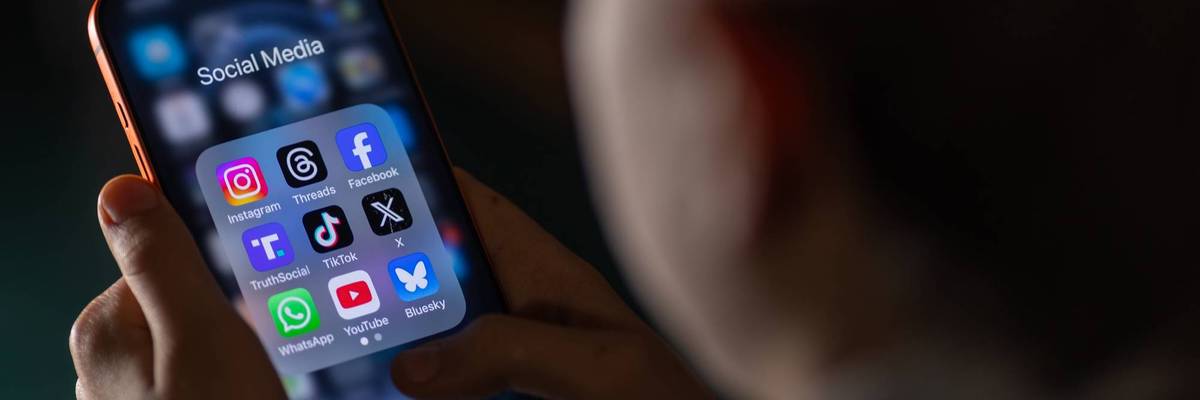
A 14-year-old boy holds an iPhone screen displaying various social media and messaging apps on February 23, 2026 in Bath, England.
"Banning under-16s risks treating children as the problem rather than addressing the companies and systems that create the risks in the first place."
It's not yet clear whether Australia's ban on social media for children under age 16 has had a positive impact on kids' mental health and safety, but British Prime Minister Keir Starmer said Monday that the country's law is being used as a model for the United Kingdom's own blanket ban—leading critics, including the parent of a child who died by suicide after viewing harmful content on social media, to question whether Starmer was simply opting for a "politically expedient" solution to the harms of online platforms.
Banning young teenagers and children from using social media, said advocacy groups, does nothing to ensure powerful tech companies will make their products safer by design for all users.
Starmer announced the ban online in a video in which he highlighted his support for the policy "as a parent as much as a prime minister," and noted that in public comments, "thousands of parents" said their children "are addicted to social media."
We are banning social media access for under 16s.
These days kids must find their feet in a world where technology intrudes into every area of their life.
I just can’t let that go on anymore. So we’re giving children their childhoods back. pic.twitter.com/jn7iQrcwk8
— Keir Starmer (@Keir_Starmer) June 15, 2026
"It can leave them trapped in a cycle of endless scrolling that displaces play, sleep, and time with the family," said the prime minister, who leads the Labour Party and is facing threats to his leadership following the party's major losses in May's elections. "It can harm their mental health, and frankly, parents need our support on this. That is why today the government has decided to ban social media access for children under 16."
Starmer said new age-related regulations for social media platforms including TikTok, Instagram, and Snapchat, as well as gaming and livestreaming platforms, will be introduced by the end of this year, with the new laws going into effect in early 2027. The government also said it was examining restrictions for users under 18, such as "overnight curfews" and mandated blocking of "infinite scrolling."
More details about the ban are expected to be released next month.
But Kerry Moscoguiri, chief executive of Amnesty International UK, said that removing children from platforms that broadcast harmful content is "a case of the right diagnosis but the wrong prescription."
“The UK government is right to recognize that many children face serious harms online," said Moscoguiri. "Too many social media companies have built products and business models that prioritize keeping children engaged for longer, often at the expense of their well-being, privacy, and rights."
“But the problem is not that children exist on social media; it’s that social media companies have built platforms that are unsafe by design," she added. "Banning under-16s risks treating children as the problem rather than addressing the companies and systems that create the risks in the first place."
The ban comes after mounting reports of Big Tech companies' efforts to keep all users, including young people, on their platforms for as long as possible using algorithms and "infinite scrolling." Numerous cases have linked children's suicides to their exposure to thousands of posts regarding self-harm and suicidal ideation, as well as to cyberbullying through social media. And reporting by Reuters last year revealed that Meta's artificial intelligence chatbots were permitted by the company to have sexually provocative conversations with minors.
Advocacy groups like Amnesty have called for restrictions on social media platforms' most addictive and manipulative features, such as infinite scrolling, autoplay, and hyper-personalized recommendations.
Moscoguiri warned that bans like the one imposed by Australia last year will force children "to surrender their privacy in order to participate in modern digital life." In Australia, companies are required to perform age verification by collecting data from bank accounts or scanning users' photo IDs.
Instead of a blanket ban, she said, "we need strong regulation that tackles surveillance-based business models, protects children’s data, and puts safety ahead of profit.”
“The responsibility for children’s safety should rest first and foremost with the companies that build and profit from these platforms," said Moscoguiri. "Government action should focus on ending invasive profiling of children, [and] tackling addictive and manipulative design features."
As children's safety groups in the UK were expecting Starmer's announcement in recent days, Ian Russell, chair of the Molly Rose Foundation and the father of a 14-year-old girl who died by suicide in 2017 after viewing content related to self-harm and suicide on social media, told the BBC that he was, "quite frankly, dismayed" that a blanket ban was likely coming to the UK.
"Keir Starmer promised to tighten up the online safety world by regulating better," said Russell, who has called for social media giants like Meta to remove and regulate content that's harmful to young users' mental health. "If he's playing politics, what he's doing is gambling with young people's lives, and I find that deplorable."
https://t.co/oqDAdFFI8p
Very strong words ahead of expected social media ban from @mollyroseorg -
Ian Russell tells us govt is rushing in a blanket ban, rather than more sophisticated controls, under political pressure, in a 'deplorable way' pic.twitter.com/AMxcleLixU
— Laura Kuenssberg (@bbclaurak) June 13, 2026
In Australia, which last year became the first country to impose a nationwide blanket ban on kids under 16 using social media, the law has had unclear benefits, with many young teens still managing to use the platforms—where Big Tech has not been forced to place controls that would make it safer for young users to be there.
Carole Cadwalladr, an investigative journalist, said that imposing a ban that includes age verification, as Australia's does, "looks like rushed populist techsolutionism that will hand more power to the platforms."
"This is going to hand even more surveillance powers to the very companies that already know way too much about us. Do you want [X executive chair] Elon [Musk] to have a copy of your biometrics? Do you want [Meta CEO Mark Zuckerberg] to scan your face? That’s what we will all be doing," Cadwalladr added. "This isn’t reining in Silicon Valley power. It’s gifting them even more power. Of course, parents want these companies safe and regulated but that’s a job for government, not the end user."
Sadiq Khan, the mayor of London, acknowledged that he has advocated for a ban on social media for children under 16 and called it "the right step to protect young people"—but said the UK government must impose restrictions on social media giants themselves, not just their most vulnerable users.
"Bans only treat the symptom, not the problem," said Khan. "Social media companies need to reimagine their platforms so they can offer a safe and healthy environment for all users, where restricting access wouldn’t be necessary."
"There’s nothing inevitable about algorithms which feed us a diet of dangerous content," he added. "Londoners deserve platforms which prioritize people, not just profit."
Dear Common Dreams reader, It’s been nearly 30 years since I co-founded Common Dreams with my late wife, Lina Newhouser. We had the radical notion that journalism should serve the public good, not corporate profits. It was clear to us from the outset what it would take to build such a project. No paid advertisements. No corporate sponsors. No millionaire publisher telling us what to think or do. Many people said we wouldn't last a year, but we proved those doubters wrong. Together with a tremendous team of journalists and dedicated staff, we built an independent media outlet free from the constraints of profits and corporate control. Our mission has always been simple: To inform. To inspire. To ignite change for the common good. Building Common Dreams was not easy. Our survival was never guaranteed. When you take on the most powerful forces—Wall Street greed, fossil fuel industry destruction, Big Tech lobbyists, and uber-rich oligarchs who have spent billions upon billions rigging the economy and democracy in their favor—the only bulwark you have is supporters who believe in your work. But here’s the urgent message from me today. It's never been this bad out there. And it's never been this hard to keep us going. At the very moment Common Dreams is most needed, the threats we face are intensifying. We need your support now more than ever. We don't accept corporate advertising and never will. We don't have a paywall because we don't think people should be blocked from critical news based on their ability to pay. Everything we do is funded by the donations of readers like you. When everyone does the little they can afford, we are strong. But if that support retreats or dries up, so do we. Will you donate now to make sure Common Dreams not only survives but thrives? —Craig Brown, Co-founder |
It's not yet clear whether Australia's ban on social media for children under age 16 has had a positive impact on kids' mental health and safety, but British Prime Minister Keir Starmer said Monday that the country's law is being used as a model for the United Kingdom's own blanket ban—leading critics, including the parent of a child who died by suicide after viewing harmful content on social media, to question whether Starmer was simply opting for a "politically expedient" solution to the harms of online platforms.
Banning young teenagers and children from using social media, said advocacy groups, does nothing to ensure powerful tech companies will make their products safer by design for all users.
Starmer announced the ban online in a video in which he highlighted his support for the policy "as a parent as much as a prime minister," and noted that in public comments, "thousands of parents" said their children "are addicted to social media."
We are banning social media access for under 16s.
These days kids must find their feet in a world where technology intrudes into every area of their life.
I just can’t let that go on anymore. So we’re giving children their childhoods back. pic.twitter.com/jn7iQrcwk8
— Keir Starmer (@Keir_Starmer) June 15, 2026
"It can leave them trapped in a cycle of endless scrolling that displaces play, sleep, and time with the family," said the prime minister, who leads the Labour Party and is facing threats to his leadership following the party's major losses in May's elections. "It can harm their mental health, and frankly, parents need our support on this. That is why today the government has decided to ban social media access for children under 16."
Starmer said new age-related regulations for social media platforms including TikTok, Instagram, and Snapchat, as well as gaming and livestreaming platforms, will be introduced by the end of this year, with the new laws going into effect in early 2027. The government also said it was examining restrictions for users under 18, such as "overnight curfews" and mandated blocking of "infinite scrolling."
More details about the ban are expected to be released next month.
But Kerry Moscoguiri, chief executive of Amnesty International UK, said that removing children from platforms that broadcast harmful content is "a case of the right diagnosis but the wrong prescription."
“The UK government is right to recognize that many children face serious harms online," said Moscoguiri. "Too many social media companies have built products and business models that prioritize keeping children engaged for longer, often at the expense of their well-being, privacy, and rights."
“But the problem is not that children exist on social media; it’s that social media companies have built platforms that are unsafe by design," she added. "Banning under-16s risks treating children as the problem rather than addressing the companies and systems that create the risks in the first place."
The ban comes after mounting reports of Big Tech companies' efforts to keep all users, including young people, on their platforms for as long as possible using algorithms and "infinite scrolling." Numerous cases have linked children's suicides to their exposure to thousands of posts regarding self-harm and suicidal ideation, as well as to cyberbullying through social media. And reporting by Reuters last year revealed that Meta's artificial intelligence chatbots were permitted by the company to have sexually provocative conversations with minors.
Advocacy groups like Amnesty have called for restrictions on social media platforms' most addictive and manipulative features, such as infinite scrolling, autoplay, and hyper-personalized recommendations.
Moscoguiri warned that bans like the one imposed by Australia last year will force children "to surrender their privacy in order to participate in modern digital life." In Australia, companies are required to perform age verification by collecting data from bank accounts or scanning users' photo IDs.
Instead of a blanket ban, she said, "we need strong regulation that tackles surveillance-based business models, protects children’s data, and puts safety ahead of profit.”
“The responsibility for children’s safety should rest first and foremost with the companies that build and profit from these platforms," said Moscoguiri. "Government action should focus on ending invasive profiling of children, [and] tackling addictive and manipulative design features."
As children's safety groups in the UK were expecting Starmer's announcement in recent days, Ian Russell, chair of the Molly Rose Foundation and the father of a 14-year-old girl who died by suicide in 2017 after viewing content related to self-harm and suicide on social media, told the BBC that he was, "quite frankly, dismayed" that a blanket ban was likely coming to the UK.
"Keir Starmer promised to tighten up the online safety world by regulating better," said Russell, who has called for social media giants like Meta to remove and regulate content that's harmful to young users' mental health. "If he's playing politics, what he's doing is gambling with young people's lives, and I find that deplorable."
https://t.co/oqDAdFFI8p
Very strong words ahead of expected social media ban from @mollyroseorg -
Ian Russell tells us govt is rushing in a blanket ban, rather than more sophisticated controls, under political pressure, in a 'deplorable way' pic.twitter.com/AMxcleLixU
— Laura Kuenssberg (@bbclaurak) June 13, 2026
In Australia, which last year became the first country to impose a nationwide blanket ban on kids under 16 using social media, the law has had unclear benefits, with many young teens still managing to use the platforms—where Big Tech has not been forced to place controls that would make it safer for young users to be there.
Carole Cadwalladr, an investigative journalist, said that imposing a ban that includes age verification, as Australia's does, "looks like rushed populist techsolutionism that will hand more power to the platforms."
"This is going to hand even more surveillance powers to the very companies that already know way too much about us. Do you want [X executive chair] Elon [Musk] to have a copy of your biometrics? Do you want [Meta CEO Mark Zuckerberg] to scan your face? That’s what we will all be doing," Cadwalladr added. "This isn’t reining in Silicon Valley power. It’s gifting them even more power. Of course, parents want these companies safe and regulated but that’s a job for government, not the end user."
Sadiq Khan, the mayor of London, acknowledged that he has advocated for a ban on social media for children under 16 and called it "the right step to protect young people"—but said the UK government must impose restrictions on social media giants themselves, not just their most vulnerable users.
"Bans only treat the symptom, not the problem," said Khan. "Social media companies need to reimagine their platforms so they can offer a safe and healthy environment for all users, where restricting access wouldn’t be necessary."
"There’s nothing inevitable about algorithms which feed us a diet of dangerous content," he added. "Londoners deserve platforms which prioritize people, not just profit."
It's not yet clear whether Australia's ban on social media for children under age 16 has had a positive impact on kids' mental health and safety, but British Prime Minister Keir Starmer said Monday that the country's law is being used as a model for the United Kingdom's own blanket ban—leading critics, including the parent of a child who died by suicide after viewing harmful content on social media, to question whether Starmer was simply opting for a "politically expedient" solution to the harms of online platforms.
Banning young teenagers and children from using social media, said advocacy groups, does nothing to ensure powerful tech companies will make their products safer by design for all users.
Starmer announced the ban online in a video in which he highlighted his support for the policy "as a parent as much as a prime minister," and noted that in public comments, "thousands of parents" said their children "are addicted to social media."
We are banning social media access for under 16s.
These days kids must find their feet in a world where technology intrudes into every area of their life.
I just can’t let that go on anymore. So we’re giving children their childhoods back. pic.twitter.com/jn7iQrcwk8
— Keir Starmer (@Keir_Starmer) June 15, 2026
"It can leave them trapped in a cycle of endless scrolling that displaces play, sleep, and time with the family," said the prime minister, who leads the Labour Party and is facing threats to his leadership following the party's major losses in May's elections. "It can harm their mental health, and frankly, parents need our support on this. That is why today the government has decided to ban social media access for children under 16."
Starmer said new age-related regulations for social media platforms including TikTok, Instagram, and Snapchat, as well as gaming and livestreaming platforms, will be introduced by the end of this year, with the new laws going into effect in early 2027. The government also said it was examining restrictions for users under 18, such as "overnight curfews" and mandated blocking of "infinite scrolling."
More details about the ban are expected to be released next month.
But Kerry Moscoguiri, chief executive of Amnesty International UK, said that removing children from platforms that broadcast harmful content is "a case of the right diagnosis but the wrong prescription."
“The UK government is right to recognize that many children face serious harms online," said Moscoguiri. "Too many social media companies have built products and business models that prioritize keeping children engaged for longer, often at the expense of their well-being, privacy, and rights."
“But the problem is not that children exist on social media; it’s that social media companies have built platforms that are unsafe by design," she added. "Banning under-16s risks treating children as the problem rather than addressing the companies and systems that create the risks in the first place."
The ban comes after mounting reports of Big Tech companies' efforts to keep all users, including young people, on their platforms for as long as possible using algorithms and "infinite scrolling." Numerous cases have linked children's suicides to their exposure to thousands of posts regarding self-harm and suicidal ideation, as well as to cyberbullying through social media. And reporting by Reuters last year revealed that Meta's artificial intelligence chatbots were permitted by the company to have sexually provocative conversations with minors.
Advocacy groups like Amnesty have called for restrictions on social media platforms' most addictive and manipulative features, such as infinite scrolling, autoplay, and hyper-personalized recommendations.
Moscoguiri warned that bans like the one imposed by Australia last year will force children "to surrender their privacy in order to participate in modern digital life." In Australia, companies are required to perform age verification by collecting data from bank accounts or scanning users' photo IDs.
Instead of a blanket ban, she said, "we need strong regulation that tackles surveillance-based business models, protects children’s data, and puts safety ahead of profit.”
“The responsibility for children’s safety should rest first and foremost with the companies that build and profit from these platforms," said Moscoguiri. "Government action should focus on ending invasive profiling of children, [and] tackling addictive and manipulative design features."
As children's safety groups in the UK were expecting Starmer's announcement in recent days, Ian Russell, chair of the Molly Rose Foundation and the father of a 14-year-old girl who died by suicide in 2017 after viewing content related to self-harm and suicide on social media, told the BBC that he was, "quite frankly, dismayed" that a blanket ban was likely coming to the UK.
"Keir Starmer promised to tighten up the online safety world by regulating better," said Russell, who has called for social media giants like Meta to remove and regulate content that's harmful to young users' mental health. "If he's playing politics, what he's doing is gambling with young people's lives, and I find that deplorable."
https://t.co/oqDAdFFI8p
Very strong words ahead of expected social media ban from @mollyroseorg -
Ian Russell tells us govt is rushing in a blanket ban, rather than more sophisticated controls, under political pressure, in a 'deplorable way' pic.twitter.com/AMxcleLixU
— Laura Kuenssberg (@bbclaurak) June 13, 2026
In Australia, which last year became the first country to impose a nationwide blanket ban on kids under 16 using social media, the law has had unclear benefits, with many young teens still managing to use the platforms—where Big Tech has not been forced to place controls that would make it safer for young users to be there.
Carole Cadwalladr, an investigative journalist, said that imposing a ban that includes age verification, as Australia's does, "looks like rushed populist techsolutionism that will hand more power to the platforms."
"This is going to hand even more surveillance powers to the very companies that already know way too much about us. Do you want [X executive chair] Elon [Musk] to have a copy of your biometrics? Do you want [Meta CEO Mark Zuckerberg] to scan your face? That’s what we will all be doing," Cadwalladr added. "This isn’t reining in Silicon Valley power. It’s gifting them even more power. Of course, parents want these companies safe and regulated but that’s a job for government, not the end user."
Sadiq Khan, the mayor of London, acknowledged that he has advocated for a ban on social media for children under 16 and called it "the right step to protect young people"—but said the UK government must impose restrictions on social media giants themselves, not just their most vulnerable users.
"Bans only treat the symptom, not the problem," said Khan. "Social media companies need to reimagine their platforms so they can offer a safe and healthy environment for all users, where restricting access wouldn’t be necessary."
"There’s nothing inevitable about algorithms which feed us a diet of dangerous content," he added. "Londoners deserve platforms which prioritize people, not just profit."