

SUBSCRIBE TO OUR FREE NEWSLETTER
Daily news & progressive opinion—funded by the people, not the corporations—delivered straight to your inbox.
5
#000000
#FFFFFF
To donate by check, phone, or other method, see our More Ways to Give page.
Daily news & progressive opinion—funded by the people, not the corporations—delivered straight to your inbox.
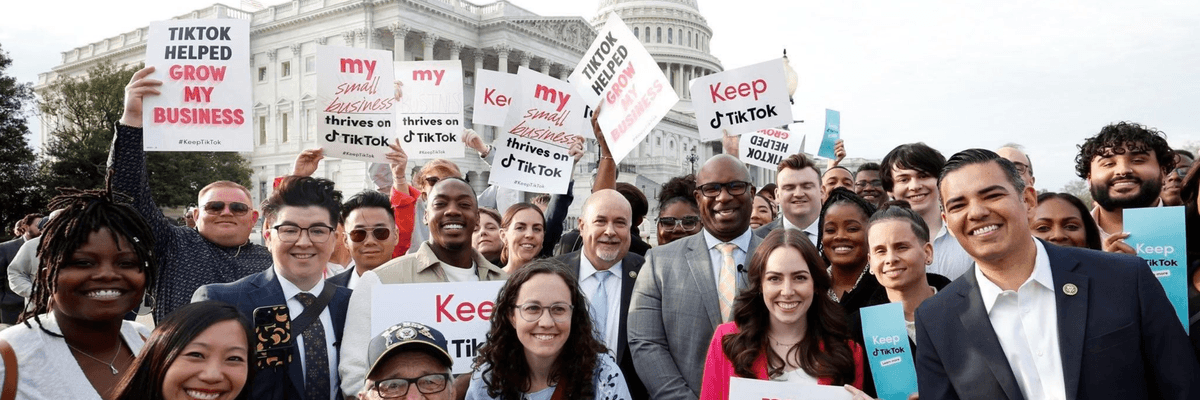
Progressive U.S. lawmakers, TikTok content creators and entrepreneurs, and activists pose for a photo at a #KeepTikTok rally outside the U.S. Capitol in Washingon, D.C. on March 22, 2023.
"Don't ban TikTok," said Fight for the Future. "Pass a goddamn privacy law."
U.S. progressives on Wednesday decried what they called a xenophobic censorship bill passed by House lawmakers that would ban TikTok if its Chinese parent company doesn't sell its stake in the popular social media app, with critics arguing that Congress should instead pass a comprehensive digital privacy law.
Lawmakers passed the Protecting Americans From Foreign Adversary Controlled Applications Act in an overwhelmingly bipartisan 352-65 vote. The legislation "prohibits distributing, maintaining, or providing internet hosting services for a foreign adversary-controlled application" like TikTok, a wholly owned subsidiary of the Chinese tech company ByteDance.
Fifty House Democrats and 15 Republicans voted against the bill.
"I voted no on the TikTok forced sale bill," Rep. Greg Casar (D-Texas) said in a statement. "While I have serious data privacy concerns with TikTok, this bill was rapidly rushed to a vote by the Republicans with almost no public scrutiny—and that's a recipe for unintended consequences."
"We need well-vetted, robust protections for TikTok users," Casar added. "Today's bill simply may not work."
Congresswoman Ilhan Omar (D-Minn.), who also voted no, said on social media that "not only are there First Amendment concerns, this is bad policy."
"We should create actual standards and regulations around privacy violations across social media companies—not target platforms we don't like," she added.
Rep. Barbara Lee (D-Calif.), another no vote, said that "rather than target one company in a rushed and secretive process, Congress should pass comprehensive data privacy protections and do a better job of informing the public of the threats these companies may pose to national security."
Proponents of the bill, which was rushed to a vote after a closed-door hearing, argue that because ByteDance is beholden to the Chinese government, TikTok could be compelled to disclose data on the approximately 170 million Americans who use the app.
If passed by the Senate and signed into law by President Joe Biden—who has vowed to approve the legislation—ByteDance will have six months to divest from TikTok or it will be banned from U.S. app stores and web hosts.
Responding to the vote, Chinese Foreign Ministry spokesperson Wang Wenbin accused the U.S. government of "resorting to hegemonic moves when one could not succeed in fair competition."
Wang added that the move "disrupts the normal operation of businesses, undermines the confidence of international investors in the investment environment, sabotages the normal economic and trade order in the world, and will eventually backfire on the U.S. itself."
"The rhetoric fueling a TikTok ban is a xenophobic, moral panic about the content on TikTok."
Civil liberties and digital rights groups blasted the House vote, with the ACLU accusing lawmakers of "violating the free speech rights of millions of Americans who use the platform daily to communicate and stay informed."
Fight for the Future said that "the rhetoric fueling a TikTok ban is a xenophobic, moral panic about the content on TikTok, disregarding... users in the U.S. that use the app for news, small business, community organizing, and free expression."
"Don't ban TikTok," the group asserted on social media. "Pass a goddamn privacy law."
Other critics highlighted U.S. tech giants' rampant abuse of user privacy. RootsAction called the bill a "serious First Amendment violation and an infringement upon free speech" that "does very little to address broader concerns about privacy rights, as U.S. based social media companies extensively violate those rights."
Jenna Ruddock, an attorney at Free Press Action, said in a
statement:
TikTok isn't perfect, but banning it is the wrong solution. Like all popular platforms, including those that Meta and Google own, TikTok collects too much data on its users. But unilaterally dismantling spaces for free expression limits people's access to information and cuts off avenues for creators to build community. The legislation also fails to meaningfully protect our privacy or address the national security concerns the bill's sponsors have raised.
"Banning a single platform will not address the problem at the root of the entire tech landscape," Ruddock contended, for "at any given time, dozens of corporations are tracking us, analyzing our behavior, and profiting off of our private information."
"It's ridiculous for Congress to single out one app while failing to act on this huge problem that's prevalent across all social media," she added. "Lawmakers should instead pass a federal privacy law that would limit how all companies collect, store, analyze, and sell our personal data."
Some critics linked the legislation to U.S. support for Israel's genocide in Gaza and TikTok users' prolific advocacy for Palestine, with RootsAction noting that the American Israel Public Affairs Committee was the leading campaign contributor to bill author Rep. Mike Gallagher (R-Wis.) during the 2021-22 election cycle.
The peace group CodePink quipped, "As Israel drops U.S. bombs on civilians daily, they'd rather ban an app than a genocide."
The legislation now heads to the Senate, where Majority Leader Chuck Schumer (D-N.Y.) only said that the chamber "will review" the bill.
"Make no mistake: The House's TikTok bill is a ban, and it's blatant censorship," ACLU senior policy counsel Jenna Leventoff argued. "Today, the House of Representatives voted to violate the First Amendment rights of more than half of the country. The Senate must reject this unconstitutional and reckless bill."
Dear Common Dreams reader, It’s been nearly 30 years since I co-founded Common Dreams with my late wife, Lina Newhouser. We had the radical notion that journalism should serve the public good, not corporate profits. It was clear to us from the outset what it would take to build such a project. No paid advertisements. No corporate sponsors. No millionaire publisher telling us what to think or do. Many people said we wouldn't last a year, but we proved those doubters wrong. Together with a tremendous team of journalists and dedicated staff, we built an independent media outlet free from the constraints of profits and corporate control. Our mission has always been simple: To inform. To inspire. To ignite change for the common good. Building Common Dreams was not easy. Our survival was never guaranteed. When you take on the most powerful forces—Wall Street greed, fossil fuel industry destruction, Big Tech lobbyists, and uber-rich oligarchs who have spent billions upon billions rigging the economy and democracy in their favor—the only bulwark you have is supporters who believe in your work. But here’s the urgent message from me today. It's never been this bad out there. And it's never been this hard to keep us going. At the very moment Common Dreams is most needed, the threats we face are intensifying. We need your support now more than ever. We don't accept corporate advertising and never will. We don't have a paywall because we don't think people should be blocked from critical news based on their ability to pay. Everything we do is funded by the donations of readers like you. When everyone does the little they can afford, we are strong. But if that support retreats or dries up, so do we. Will you donate now to make sure Common Dreams not only survives but thrives? —Craig Brown, Co-founder |
U.S. progressives on Wednesday decried what they called a xenophobic censorship bill passed by House lawmakers that would ban TikTok if its Chinese parent company doesn't sell its stake in the popular social media app, with critics arguing that Congress should instead pass a comprehensive digital privacy law.
Lawmakers passed the Protecting Americans From Foreign Adversary Controlled Applications Act in an overwhelmingly bipartisan 352-65 vote. The legislation "prohibits distributing, maintaining, or providing internet hosting services for a foreign adversary-controlled application" like TikTok, a wholly owned subsidiary of the Chinese tech company ByteDance.
Fifty House Democrats and 15 Republicans voted against the bill.
"I voted no on the TikTok forced sale bill," Rep. Greg Casar (D-Texas) said in a statement. "While I have serious data privacy concerns with TikTok, this bill was rapidly rushed to a vote by the Republicans with almost no public scrutiny—and that's a recipe for unintended consequences."
"We need well-vetted, robust protections for TikTok users," Casar added. "Today's bill simply may not work."
Congresswoman Ilhan Omar (D-Minn.), who also voted no, said on social media that "not only are there First Amendment concerns, this is bad policy."
"We should create actual standards and regulations around privacy violations across social media companies—not target platforms we don't like," she added.
Rep. Barbara Lee (D-Calif.), another no vote, said that "rather than target one company in a rushed and secretive process, Congress should pass comprehensive data privacy protections and do a better job of informing the public of the threats these companies may pose to national security."
Proponents of the bill, which was rushed to a vote after a closed-door hearing, argue that because ByteDance is beholden to the Chinese government, TikTok could be compelled to disclose data on the approximately 170 million Americans who use the app.
If passed by the Senate and signed into law by President Joe Biden—who has vowed to approve the legislation—ByteDance will have six months to divest from TikTok or it will be banned from U.S. app stores and web hosts.
Responding to the vote, Chinese Foreign Ministry spokesperson Wang Wenbin accused the U.S. government of "resorting to hegemonic moves when one could not succeed in fair competition."
Wang added that the move "disrupts the normal operation of businesses, undermines the confidence of international investors in the investment environment, sabotages the normal economic and trade order in the world, and will eventually backfire on the U.S. itself."
"The rhetoric fueling a TikTok ban is a xenophobic, moral panic about the content on TikTok."
Civil liberties and digital rights groups blasted the House vote, with the ACLU accusing lawmakers of "violating the free speech rights of millions of Americans who use the platform daily to communicate and stay informed."
Fight for the Future said that "the rhetoric fueling a TikTok ban is a xenophobic, moral panic about the content on TikTok, disregarding... users in the U.S. that use the app for news, small business, community organizing, and free expression."
"Don't ban TikTok," the group asserted on social media. "Pass a goddamn privacy law."
Other critics highlighted U.S. tech giants' rampant abuse of user privacy. RootsAction called the bill a "serious First Amendment violation and an infringement upon free speech" that "does very little to address broader concerns about privacy rights, as U.S. based social media companies extensively violate those rights."
Jenna Ruddock, an attorney at Free Press Action, said in a
statement:
TikTok isn't perfect, but banning it is the wrong solution. Like all popular platforms, including those that Meta and Google own, TikTok collects too much data on its users. But unilaterally dismantling spaces for free expression limits people's access to information and cuts off avenues for creators to build community. The legislation also fails to meaningfully protect our privacy or address the national security concerns the bill's sponsors have raised.
"Banning a single platform will not address the problem at the root of the entire tech landscape," Ruddock contended, for "at any given time, dozens of corporations are tracking us, analyzing our behavior, and profiting off of our private information."
"It's ridiculous for Congress to single out one app while failing to act on this huge problem that's prevalent across all social media," she added. "Lawmakers should instead pass a federal privacy law that would limit how all companies collect, store, analyze, and sell our personal data."
Some critics linked the legislation to U.S. support for Israel's genocide in Gaza and TikTok users' prolific advocacy for Palestine, with RootsAction noting that the American Israel Public Affairs Committee was the leading campaign contributor to bill author Rep. Mike Gallagher (R-Wis.) during the 2021-22 election cycle.
The peace group CodePink quipped, "As Israel drops U.S. bombs on civilians daily, they'd rather ban an app than a genocide."
The legislation now heads to the Senate, where Majority Leader Chuck Schumer (D-N.Y.) only said that the chamber "will review" the bill.
"Make no mistake: The House's TikTok bill is a ban, and it's blatant censorship," ACLU senior policy counsel Jenna Leventoff argued. "Today, the House of Representatives voted to violate the First Amendment rights of more than half of the country. The Senate must reject this unconstitutional and reckless bill."
U.S. progressives on Wednesday decried what they called a xenophobic censorship bill passed by House lawmakers that would ban TikTok if its Chinese parent company doesn't sell its stake in the popular social media app, with critics arguing that Congress should instead pass a comprehensive digital privacy law.
Lawmakers passed the Protecting Americans From Foreign Adversary Controlled Applications Act in an overwhelmingly bipartisan 352-65 vote. The legislation "prohibits distributing, maintaining, or providing internet hosting services for a foreign adversary-controlled application" like TikTok, a wholly owned subsidiary of the Chinese tech company ByteDance.
Fifty House Democrats and 15 Republicans voted against the bill.
"I voted no on the TikTok forced sale bill," Rep. Greg Casar (D-Texas) said in a statement. "While I have serious data privacy concerns with TikTok, this bill was rapidly rushed to a vote by the Republicans with almost no public scrutiny—and that's a recipe for unintended consequences."
"We need well-vetted, robust protections for TikTok users," Casar added. "Today's bill simply may not work."
Congresswoman Ilhan Omar (D-Minn.), who also voted no, said on social media that "not only are there First Amendment concerns, this is bad policy."
"We should create actual standards and regulations around privacy violations across social media companies—not target platforms we don't like," she added.
Rep. Barbara Lee (D-Calif.), another no vote, said that "rather than target one company in a rushed and secretive process, Congress should pass comprehensive data privacy protections and do a better job of informing the public of the threats these companies may pose to national security."
Proponents of the bill, which was rushed to a vote after a closed-door hearing, argue that because ByteDance is beholden to the Chinese government, TikTok could be compelled to disclose data on the approximately 170 million Americans who use the app.
If passed by the Senate and signed into law by President Joe Biden—who has vowed to approve the legislation—ByteDance will have six months to divest from TikTok or it will be banned from U.S. app stores and web hosts.
Responding to the vote, Chinese Foreign Ministry spokesperson Wang Wenbin accused the U.S. government of "resorting to hegemonic moves when one could not succeed in fair competition."
Wang added that the move "disrupts the normal operation of businesses, undermines the confidence of international investors in the investment environment, sabotages the normal economic and trade order in the world, and will eventually backfire on the U.S. itself."
"The rhetoric fueling a TikTok ban is a xenophobic, moral panic about the content on TikTok."
Civil liberties and digital rights groups blasted the House vote, with the ACLU accusing lawmakers of "violating the free speech rights of millions of Americans who use the platform daily to communicate and stay informed."
Fight for the Future said that "the rhetoric fueling a TikTok ban is a xenophobic, moral panic about the content on TikTok, disregarding... users in the U.S. that use the app for news, small business, community organizing, and free expression."
"Don't ban TikTok," the group asserted on social media. "Pass a goddamn privacy law."
Other critics highlighted U.S. tech giants' rampant abuse of user privacy. RootsAction called the bill a "serious First Amendment violation and an infringement upon free speech" that "does very little to address broader concerns about privacy rights, as U.S. based social media companies extensively violate those rights."
Jenna Ruddock, an attorney at Free Press Action, said in a
statement:
TikTok isn't perfect, but banning it is the wrong solution. Like all popular platforms, including those that Meta and Google own, TikTok collects too much data on its users. But unilaterally dismantling spaces for free expression limits people's access to information and cuts off avenues for creators to build community. The legislation also fails to meaningfully protect our privacy or address the national security concerns the bill's sponsors have raised.
"Banning a single platform will not address the problem at the root of the entire tech landscape," Ruddock contended, for "at any given time, dozens of corporations are tracking us, analyzing our behavior, and profiting off of our private information."
"It's ridiculous for Congress to single out one app while failing to act on this huge problem that's prevalent across all social media," she added. "Lawmakers should instead pass a federal privacy law that would limit how all companies collect, store, analyze, and sell our personal data."
Some critics linked the legislation to U.S. support for Israel's genocide in Gaza and TikTok users' prolific advocacy for Palestine, with RootsAction noting that the American Israel Public Affairs Committee was the leading campaign contributor to bill author Rep. Mike Gallagher (R-Wis.) during the 2021-22 election cycle.
The peace group CodePink quipped, "As Israel drops U.S. bombs on civilians daily, they'd rather ban an app than a genocide."
The legislation now heads to the Senate, where Majority Leader Chuck Schumer (D-N.Y.) only said that the chamber "will review" the bill.
"Make no mistake: The House's TikTok bill is a ban, and it's blatant censorship," ACLU senior policy counsel Jenna Leventoff argued. "Today, the House of Representatives voted to violate the First Amendment rights of more than half of the country. The Senate must reject this unconstitutional and reckless bill."

