5
#000000
#FFFFFF
To donate by check, phone, or other method, see our More Ways to Give page.
Daily news & progressive opinion—funded by the people, not the corporations—delivered straight to your inbox.
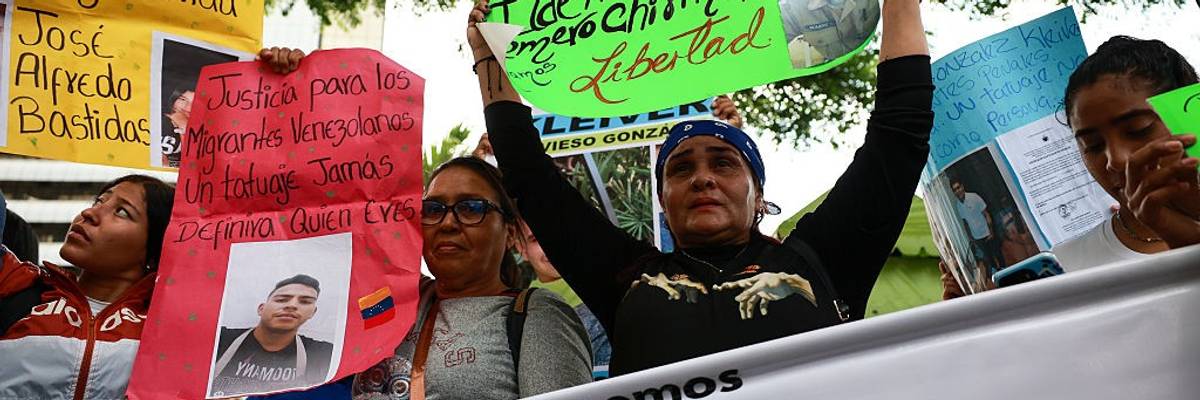
People take part in an April 9, 2025 protest in Caracas, Venezuela against the deportation of alleged Venezuelan criminals from the United States to a high-security prison in El Salvador.
“The harms caused by this US government scheme are no longer hypothetical,” UN experts stressed. “For migrants in situations of particular vulnerability, the consequences can be deadly.”
The US Supreme Court on Tuesday temporarily cleared the way for the Trump administration to resume rapidly deporting immigrants to countries other than their own, even as United Nations experts warned that the policy is putting deportees at heightened risk of human rights violations.
In a one-page order, the justices—who did not rule on the legality of the policy—stayed a lower court ruling that required the administration to give people facing a so-called third-country deportation notice wan opportunity to raise concerns that they could face persecution or torture in the destination country. The court agreed to hear the administration's appeal, with oral arguments scheduled for December.
The high court said it will consider whether the US District Court for the District of Massachusetts has jurisdiction over the case, whether it had authority to issue classwide relief, and whether the Trump administration's policy violates federal immigration law, the Constitution's due process clause, the Foreign Affairs Reform and Restructuring Act, or the Convention Against Torture.
The court's three liberal justices—Sonia Sotomayor, Elena Kagan, and Ketanji Brown Jackson—said they would have rejected the administration's request to lift the lower-court order.
NEW: The Supreme Court, over the objections of the 3 liberal justices, grants a stay in the D.V.D. litigation, authorizing the Trump admin to resume third country removals without any notice to people being sent to countries they've never been to.The Court also agrees to hear the case in December.
[image or embed]
— Aaron Reichlin-Melnick (@reichlinmelnick.bsky.social) September 29, 2026 at 12:16 PM
US Attorney General Todd Blanch responded to the order on social media, posting, "Now for the second time, SCOTUS just granted our stay in conducting all third-country removals of illegal aliens."
"Again, this is entirely lawful and a critical tool for immigration enforcement," he added. "Unlike the lower court, SCOTUS waited to hear from both sides before making the decision."
Tuesday's ruling came one day after two dozen United Nations human rights experts urged the United States and 35 countries that have entered deportation agreements with the Trump administration to halt the practice, which is "triggering [a] cascade of human rights violations including torture."
“These migrants are being transferred to countries or territories with which they have no ties, which can be a traumatizing and isolating experience that compounds harms already suffered,” the experts said, warning that they face “further violence or discrimination based on gender, sexual orientation, gender identity, or human rights advocacy.”
“The harms caused by this US government scheme are no longer hypothetical,” the experts stressed. “For migrants in situations of particular vulnerability, the consequences can be deadly.”
The UN experts' warning followed an urgent appeal issued earlier this month by Amnesty International that two men deported to Equatorial Guinea under a secret deal—one of them Egyptian and the other Eritrean—were at risk of being tortured in detention in the African nation, which has an abysmal human rights record. Amnesty said that the men had already been beaten and violently arrested by police after arriving in the country.
The Trump administration has deported roughly 25,000 people to more than two dozen countries under often secret agreements and at a cost to taxpayers of tens of millions of dollars. Most have been sent to Mexico, while others have been transported to countries including Liberia, Guyana, and Equatorial Guinea.
The Supreme Court has already intervened in a related case involving eight men whom the administration sought to deport to war-torn South Sudan, although only one was originally from that country. In that case, Sotomayor warned that the policy exposed “thousands to the risk of torture or death.”
The justices' latest order will remain in effect until the court issues its judgment in the case. Until then, the administration can resume the expedited removals that the lower court had sought to restrict.
Dear Common Dreams reader, It’s been nearly 30 years since I co-founded Common Dreams with my late wife, Lina Newhouser. We had the radical notion that journalism should serve the public good, not corporate profits. It was clear to us from the outset what it would take to build such a project. No paid advertisements. No corporate sponsors. No millionaire publisher telling us what to think or do. Many people said we wouldn't last a year, but we proved those doubters wrong. Together with a tremendous team of journalists and dedicated staff, we built an independent media outlet free from the constraints of profits and corporate control. Our mission has always been simple: To inform. To inspire. To ignite change for the common good. Building Common Dreams was not easy. Our survival was never guaranteed. When you take on the most powerful forces—Wall Street greed, fossil fuel industry destruction, Big Tech lobbyists, and uber-rich oligarchs who have spent billions upon billions rigging the economy and democracy in their favor—the only bulwark you have is supporters who believe in your work. But here’s the urgent message from me today. It's never been this bad out there. And it's never been this hard to keep us going. At the very moment Common Dreams is most needed, the threats we face are intensifying. We need your support now more than ever. We don't accept corporate advertising and never will. We don't have a paywall because we don't think people should be blocked from critical news based on their ability to pay. Everything we do is funded by the donations of readers like you. When everyone does the little they can afford, we are strong. But if that support retreats or dries up, so do we. Will you donate now to make sure Common Dreams not only survives but thrives? —Craig Brown, Co-founder |
The US Supreme Court on Tuesday temporarily cleared the way for the Trump administration to resume rapidly deporting immigrants to countries other than their own, even as United Nations experts warned that the policy is putting deportees at heightened risk of human rights violations.
In a one-page order, the justices—who did not rule on the legality of the policy—stayed a lower court ruling that required the administration to give people facing a so-called third-country deportation notice wan opportunity to raise concerns that they could face persecution or torture in the destination country. The court agreed to hear the administration's appeal, with oral arguments scheduled for December.
The high court said it will consider whether the US District Court for the District of Massachusetts has jurisdiction over the case, whether it had authority to issue classwide relief, and whether the Trump administration's policy violates federal immigration law, the Constitution's due process clause, the Foreign Affairs Reform and Restructuring Act, or the Convention Against Torture.
The court's three liberal justices—Sonia Sotomayor, Elena Kagan, and Ketanji Brown Jackson—said they would have rejected the administration's request to lift the lower-court order.
NEW: The Supreme Court, over the objections of the 3 liberal justices, grants a stay in the D.V.D. litigation, authorizing the Trump admin to resume third country removals without any notice to people being sent to countries they've never been to.The Court also agrees to hear the case in December.
[image or embed]
— Aaron Reichlin-Melnick (@reichlinmelnick.bsky.social) September 29, 2026 at 12:16 PM
US Attorney General Todd Blanch responded to the order on social media, posting, "Now for the second time, SCOTUS just granted our stay in conducting all third-country removals of illegal aliens."
"Again, this is entirely lawful and a critical tool for immigration enforcement," he added. "Unlike the lower court, SCOTUS waited to hear from both sides before making the decision."
Tuesday's ruling came one day after two dozen United Nations human rights experts urged the United States and 35 countries that have entered deportation agreements with the Trump administration to halt the practice, which is "triggering [a] cascade of human rights violations including torture."
“These migrants are being transferred to countries or territories with which they have no ties, which can be a traumatizing and isolating experience that compounds harms already suffered,” the experts said, warning that they face “further violence or discrimination based on gender, sexual orientation, gender identity, or human rights advocacy.”
“The harms caused by this US government scheme are no longer hypothetical,” the experts stressed. “For migrants in situations of particular vulnerability, the consequences can be deadly.”
The UN experts' warning followed an urgent appeal issued earlier this month by Amnesty International that two men deported to Equatorial Guinea under a secret deal—one of them Egyptian and the other Eritrean—were at risk of being tortured in detention in the African nation, which has an abysmal human rights record. Amnesty said that the men had already been beaten and violently arrested by police after arriving in the country.
The Trump administration has deported roughly 25,000 people to more than two dozen countries under often secret agreements and at a cost to taxpayers of tens of millions of dollars. Most have been sent to Mexico, while others have been transported to countries including Liberia, Guyana, and Equatorial Guinea.
The Supreme Court has already intervened in a related case involving eight men whom the administration sought to deport to war-torn South Sudan, although only one was originally from that country. In that case, Sotomayor warned that the policy exposed “thousands to the risk of torture or death.”
The justices' latest order will remain in effect until the court issues its judgment in the case. Until then, the administration can resume the expedited removals that the lower court had sought to restrict.
The US Supreme Court on Tuesday temporarily cleared the way for the Trump administration to resume rapidly deporting immigrants to countries other than their own, even as United Nations experts warned that the policy is putting deportees at heightened risk of human rights violations.
In a one-page order, the justices—who did not rule on the legality of the policy—stayed a lower court ruling that required the administration to give people facing a so-called third-country deportation notice wan opportunity to raise concerns that they could face persecution or torture in the destination country. The court agreed to hear the administration's appeal, with oral arguments scheduled for December.
The high court said it will consider whether the US District Court for the District of Massachusetts has jurisdiction over the case, whether it had authority to issue classwide relief, and whether the Trump administration's policy violates federal immigration law, the Constitution's due process clause, the Foreign Affairs Reform and Restructuring Act, or the Convention Against Torture.
The court's three liberal justices—Sonia Sotomayor, Elena Kagan, and Ketanji Brown Jackson—said they would have rejected the administration's request to lift the lower-court order.
NEW: The Supreme Court, over the objections of the 3 liberal justices, grants a stay in the D.V.D. litigation, authorizing the Trump admin to resume third country removals without any notice to people being sent to countries they've never been to.The Court also agrees to hear the case in December.
[image or embed]
— Aaron Reichlin-Melnick (@reichlinmelnick.bsky.social) September 29, 2026 at 12:16 PM
US Attorney General Todd Blanch responded to the order on social media, posting, "Now for the second time, SCOTUS just granted our stay in conducting all third-country removals of illegal aliens."
"Again, this is entirely lawful and a critical tool for immigration enforcement," he added. "Unlike the lower court, SCOTUS waited to hear from both sides before making the decision."
Tuesday's ruling came one day after two dozen United Nations human rights experts urged the United States and 35 countries that have entered deportation agreements with the Trump administration to halt the practice, which is "triggering [a] cascade of human rights violations including torture."
“These migrants are being transferred to countries or territories with which they have no ties, which can be a traumatizing and isolating experience that compounds harms already suffered,” the experts said, warning that they face “further violence or discrimination based on gender, sexual orientation, gender identity, or human rights advocacy.”
“The harms caused by this US government scheme are no longer hypothetical,” the experts stressed. “For migrants in situations of particular vulnerability, the consequences can be deadly.”
The UN experts' warning followed an urgent appeal issued earlier this month by Amnesty International that two men deported to Equatorial Guinea under a secret deal—one of them Egyptian and the other Eritrean—were at risk of being tortured in detention in the African nation, which has an abysmal human rights record. Amnesty said that the men had already been beaten and violently arrested by police after arriving in the country.
The Trump administration has deported roughly 25,000 people to more than two dozen countries under often secret agreements and at a cost to taxpayers of tens of millions of dollars. Most have been sent to Mexico, while others have been transported to countries including Liberia, Guyana, and Equatorial Guinea.
The Supreme Court has already intervened in a related case involving eight men whom the administration sought to deport to war-torn South Sudan, although only one was originally from that country. In that case, Sotomayor warned that the policy exposed “thousands to the risk of torture or death.”
The justices' latest order will remain in effect until the court issues its judgment in the case. Until then, the administration can resume the expedited removals that the lower court had sought to restrict.