SUBSCRIBE TO OUR FREE NEWSLETTER
Daily news & progressive opinion—funded by the people, not the corporations—delivered straight to your inbox.
5
#000000
#FFFFFF
To donate by check, phone, or other method, see our More Ways to Give page.
Daily news & progressive opinion—funded by the people, not the corporations—delivered straight to your inbox.
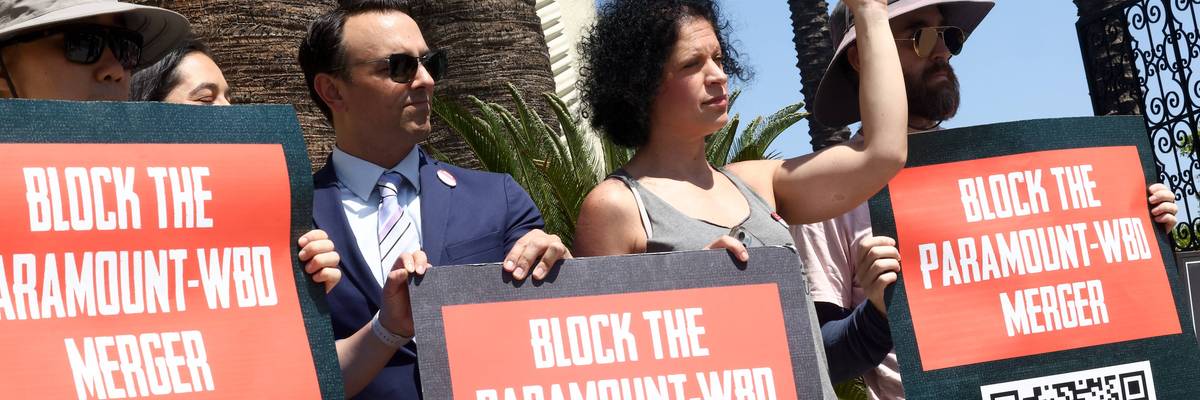
Demonstrators protest the proposed merger of Paramount and Warner Bros. Discovery at Paramount Pictures Studio on September 3, 2026 in Los Angeles, California.
Lina Khan, former head of the Federal Trade Commission, called ongoing settlement talks "troubling."
Paramount and a coalition of state attorneys general led by California's Rob Bonta are reportedly in advanced talks to settle a high-stakes lawsuit and allow the media conglomerate's proposed merger with Warner Bros. Discovery to proceed.
The Wall Street Journal reported late Sunday that Bonta and Paramount executives have "discussed a series of potential concessions" as part of the ongoing settlement negotiations, "including a $1.5 billion investment by the company in production in California." The talks have also explored a potential promise by Paramount to stay in California and a requirement that the company sell off some cable channels and establish "a board to ensure that CNN retains editorial independence," according to the Journal. (Warner Bros. is CNN's parent company.)
Lina Khan, the former head of the Federal Trade Commission, was among those raising concerns about details trickling out of settlement talks between state attorneys general and Paramount, which is led by David Ellison—the son of billionaire Republican megadonor Larry Ellison. In a social media post, Khan wrote that the proposed megamerger "seems facially illegal, and the state AG lawsuit challenging it is very strong."
"It’s troubling to hear that the states may now settle for behavioral remedies, allowing the deal to go through subject to various promises from the firms," Khan wrote. "Behavioral remedies routinely fail, and the stakes here are particularly high given that a strong democracy requires open markets for sound journalism and creative expression."
"The states were right to step up," she added, "and I hope they keep fighting to protect this market, its workers, and the millions of Americans who value a free press and a vibrant film industry."
Matt Stoller, an antitrust researcher and author of the BIG newsletter, was more blunt, calling the settlement talks "fucking pathetic."
"Bonta's reputation will never recover," Stoller wrote.
The coalition of 12 state attorneys general sued to block the proposed merger in July after the Trump Justice Department shut down its antitrust investigation into the Paramount-Warner Bros. merger and backed the deal. The Writers Guild of America has also sued over the proposed merger, arguing it "violates federal antitrust law and would cause specific harm to writers."
The state AGs' lawsuit warned that the merger would "extinguish competition between Paramount and Warner Bros. and inflict substantial harm on movie theatres, basic cable distributors, and, ultimately, audiences nationwide," as well as "tens of thousands of workers across the production ecosystem."
Some attorneys general in the coalition are reportedly pushing back against some of the terms sought by Bonta and others. New York Attorney General Letitia James "has been resisting the deal terms and seeking additional protections for workers," according to CNN.
"Connecticut and at least two other states also have reservations about the settlement and are not currently on board," CNN added. "The holdouts are seeking additional remedies from Paramount."
Actor Mark Ruffalo, one of the most prominent opponents of the megamerger, implored the state attorneys general to reject a settlement deal and take the lawsuit to trial.
"Don't you dare," Ruffalo wrote in a message directed at Bonta. "Do not cave."
"You work for the people," he added, "the very people who will be hurt if you let this lousy deal filled with empty promises go forward."
Dear Common Dreams reader, It’s been nearly 30 years since I co-founded Common Dreams with my late wife, Lina Newhouser. We had the radical notion that journalism should serve the public good, not corporate profits. It was clear to us from the outset what it would take to build such a project. No paid advertisements. No corporate sponsors. No millionaire publisher telling us what to think or do. Many people said we wouldn't last a year, but we proved those doubters wrong. Together with a tremendous team of journalists and dedicated staff, we built an independent media outlet free from the constraints of profits and corporate control. Our mission has always been simple: To inform. To inspire. To ignite change for the common good. Building Common Dreams was not easy. Our survival was never guaranteed. When you take on the most powerful forces—Wall Street greed, fossil fuel industry destruction, Big Tech lobbyists, and uber-rich oligarchs who have spent billions upon billions rigging the economy and democracy in their favor—the only bulwark you have is supporters who believe in your work. But here’s the urgent message from me today. It's never been this bad out there. And it's never been this hard to keep us going. At the very moment Common Dreams is most needed, the threats we face are intensifying. We need your support now more than ever. We don't accept corporate advertising and never will. We don't have a paywall because we don't think people should be blocked from critical news based on their ability to pay. Everything we do is funded by the donations of readers like you. When everyone does the little they can afford, we are strong. But if that support retreats or dries up, so do we. Will you donate now to make sure Common Dreams not only survives but thrives? —Craig Brown, Co-founder |
Paramount and a coalition of state attorneys general led by California's Rob Bonta are reportedly in advanced talks to settle a high-stakes lawsuit and allow the media conglomerate's proposed merger with Warner Bros. Discovery to proceed.
The Wall Street Journal reported late Sunday that Bonta and Paramount executives have "discussed a series of potential concessions" as part of the ongoing settlement negotiations, "including a $1.5 billion investment by the company in production in California." The talks have also explored a potential promise by Paramount to stay in California and a requirement that the company sell off some cable channels and establish "a board to ensure that CNN retains editorial independence," according to the Journal. (Warner Bros. is CNN's parent company.)
Lina Khan, the former head of the Federal Trade Commission, was among those raising concerns about details trickling out of settlement talks between state attorneys general and Paramount, which is led by David Ellison—the son of billionaire Republican megadonor Larry Ellison. In a social media post, Khan wrote that the proposed megamerger "seems facially illegal, and the state AG lawsuit challenging it is very strong."
"It’s troubling to hear that the states may now settle for behavioral remedies, allowing the deal to go through subject to various promises from the firms," Khan wrote. "Behavioral remedies routinely fail, and the stakes here are particularly high given that a strong democracy requires open markets for sound journalism and creative expression."
"The states were right to step up," she added, "and I hope they keep fighting to protect this market, its workers, and the millions of Americans who value a free press and a vibrant film industry."
Matt Stoller, an antitrust researcher and author of the BIG newsletter, was more blunt, calling the settlement talks "fucking pathetic."
"Bonta's reputation will never recover," Stoller wrote.
The coalition of 12 state attorneys general sued to block the proposed merger in July after the Trump Justice Department shut down its antitrust investigation into the Paramount-Warner Bros. merger and backed the deal. The Writers Guild of America has also sued over the proposed merger, arguing it "violates federal antitrust law and would cause specific harm to writers."
The state AGs' lawsuit warned that the merger would "extinguish competition between Paramount and Warner Bros. and inflict substantial harm on movie theatres, basic cable distributors, and, ultimately, audiences nationwide," as well as "tens of thousands of workers across the production ecosystem."
Some attorneys general in the coalition are reportedly pushing back against some of the terms sought by Bonta and others. New York Attorney General Letitia James "has been resisting the deal terms and seeking additional protections for workers," according to CNN.
"Connecticut and at least two other states also have reservations about the settlement and are not currently on board," CNN added. "The holdouts are seeking additional remedies from Paramount."
Actor Mark Ruffalo, one of the most prominent opponents of the megamerger, implored the state attorneys general to reject a settlement deal and take the lawsuit to trial.
"Don't you dare," Ruffalo wrote in a message directed at Bonta. "Do not cave."
"You work for the people," he added, "the very people who will be hurt if you let this lousy deal filled with empty promises go forward."
Paramount and a coalition of state attorneys general led by California's Rob Bonta are reportedly in advanced talks to settle a high-stakes lawsuit and allow the media conglomerate's proposed merger with Warner Bros. Discovery to proceed.
The Wall Street Journal reported late Sunday that Bonta and Paramount executives have "discussed a series of potential concessions" as part of the ongoing settlement negotiations, "including a $1.5 billion investment by the company in production in California." The talks have also explored a potential promise by Paramount to stay in California and a requirement that the company sell off some cable channels and establish "a board to ensure that CNN retains editorial independence," according to the Journal. (Warner Bros. is CNN's parent company.)
Lina Khan, the former head of the Federal Trade Commission, was among those raising concerns about details trickling out of settlement talks between state attorneys general and Paramount, which is led by David Ellison—the son of billionaire Republican megadonor Larry Ellison. In a social media post, Khan wrote that the proposed megamerger "seems facially illegal, and the state AG lawsuit challenging it is very strong."
"It’s troubling to hear that the states may now settle for behavioral remedies, allowing the deal to go through subject to various promises from the firms," Khan wrote. "Behavioral remedies routinely fail, and the stakes here are particularly high given that a strong democracy requires open markets for sound journalism and creative expression."
"The states were right to step up," she added, "and I hope they keep fighting to protect this market, its workers, and the millions of Americans who value a free press and a vibrant film industry."
Matt Stoller, an antitrust researcher and author of the BIG newsletter, was more blunt, calling the settlement talks "fucking pathetic."
"Bonta's reputation will never recover," Stoller wrote.
The coalition of 12 state attorneys general sued to block the proposed merger in July after the Trump Justice Department shut down its antitrust investigation into the Paramount-Warner Bros. merger and backed the deal. The Writers Guild of America has also sued over the proposed merger, arguing it "violates federal antitrust law and would cause specific harm to writers."
The state AGs' lawsuit warned that the merger would "extinguish competition between Paramount and Warner Bros. and inflict substantial harm on movie theatres, basic cable distributors, and, ultimately, audiences nationwide," as well as "tens of thousands of workers across the production ecosystem."
Some attorneys general in the coalition are reportedly pushing back against some of the terms sought by Bonta and others. New York Attorney General Letitia James "has been resisting the deal terms and seeking additional protections for workers," according to CNN.
"Connecticut and at least two other states also have reservations about the settlement and are not currently on board," CNN added. "The holdouts are seeking additional remedies from Paramount."
Actor Mark Ruffalo, one of the most prominent opponents of the megamerger, implored the state attorneys general to reject a settlement deal and take the lawsuit to trial.
"Don't you dare," Ruffalo wrote in a message directed at Bonta. "Do not cave."
"You work for the people," he added, "the very people who will be hurt if you let this lousy deal filled with empty promises go forward."