
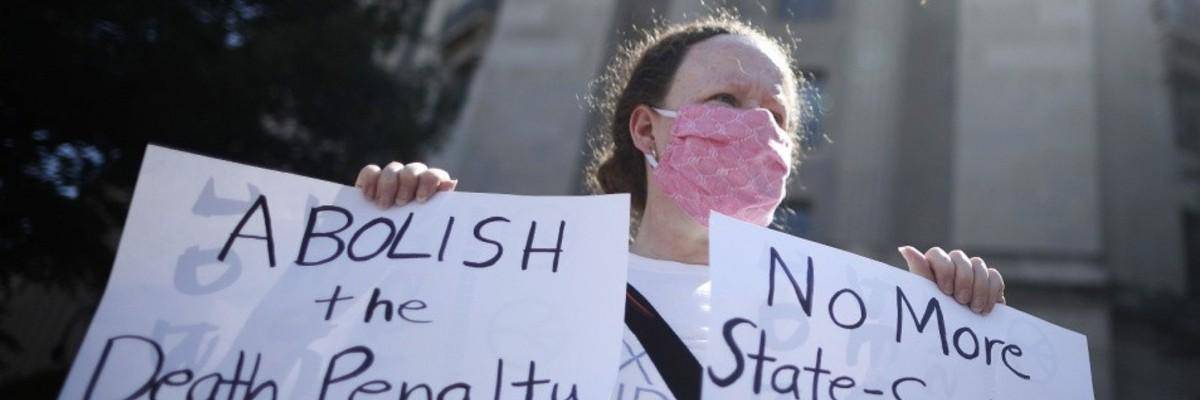
Anti-death penalty activist Judy Coode of Pax Christi International demonstrates in front of the U.S. Justice Department's Robert F. Kennedy Building July 13, 2020 in Washington, D.C. (Photo: Chip Somodevilla/Getty Images)
California Halted Executions, Now It Should End the Death Penalty Once and for All
Newsom should use his political capital to persuade Californians that ending the death penalty is the right thing to do.
It has been five years since California voters approved Proposition 66, a measure that ostensibly was going to speed up the time between handing down a death sentence and an execution. But as a practical matter, nothing has really changed. In fact, it has been 15 years since California last executed someone, leaving us with a Death Row population of nearly 700 people, none of whom face execution in the foreseeable future.
So much for the fix that death penalty advocates promised. Here's a better one: End the death penalty in California once and for all.
That's a failed justice system. And when the final step in the process is an execution, the potential for putting the innocent to death is unconscionable.
Of course, there are stronger reasons for getting rid of capital punishment than the slowness of the legal process. The moral arguments align against killing even convicted murderers, and a legal system as imperfect as ours has proved to be should never be used to determine whether someone lives or dies. In fact, the California Committee on Revision of the Penal Code finalized a report last month calling for abolition primarily because "the death penalty as created and enforced in California has not and cannot ensure justice and fairness for all Californians."
"More than forty years of experience have shown that the death penalty is the opposite of a simple and rational scheme," the Committee on Revision of the Penal Code concluded. "It has become so complicated and costly that it takes decades for cases to be fully resolved and it is imposed so arbitrarily--and in such a discriminatory fashion--that it cannot be called rational, fair, or constitutional."
Capital punishment magnifies broader racial and class divides in the United States. Death sentences fall disproportionately on Black and Latino defendants, and on the poor. It's no accident of history that former slave states cling stubbornly to this barbaric sentence. And capital punishment is applied inconsistently. For instance, whether to seek a death sentence depends on the views of local prosecutors, so a murder charge filed under California law might be deemed a capital offense in one county but not in a neighboring jurisdiction. That can't be called justice.
Since 1978, according to the office of the state public defender, California juries have handed down more than 1,000 death sentences. Over those 43 years, only 13 of the condemned have been executed (two more were put to death in other states for convictions there). More than 235 of the condemned have had their sentences reversed, which means at least one in five death sentences or convictions were legally flawed, with hundreds more appeals in other cases still pending. A parade of death row exonerations nationwide has made more people aware of how susceptible the legal system is to manipulation by law enforcement and prosecutors, and by witnesses who are either mistaken or who lie.
That's a failed justice system. And when the final step in the process is an execution, the potential for putting the innocent to death is unconscionable. It's remarkable that so many conservatives support such an expensive exertion of government power over the individual (let alone believe the government can get capital punishment right), though it's heartening that in recent years more conservatives have joined the call for abolition.
One of California's more vocal opponents of the death penalty is Gov. Gavin Newsom, whose personal convictions on the issue led him in March 2019 to declare a moratorium on executions. He also shut down the unused execution chamber at San Quentin and withdrew the state's lethal injection protocol, leaving the state with no place and no method for carrying out death sentences. If Newsom wins reelection next year--he just breezed through a recall and faces no current significant opposition--his moratorium can continue until his successor takes office in January 2027.
Unfortunately, a gubernatorial pledge of inaction is not a solution. California voters affirmed capital punishment in a 1972 initiative, so it is up to them to get rid of it. And yes, voters have been asked to do this before, and declined. When they approved Proposition 66 five years ago, they also rejected the alternative Proposition 62, which would have ended capital punishment.
But public sentiment has been changing. A UC Berkeley Institute of Governmental Studies poll in May found that 44% of those surveyed said they would vote to repeal the death penalty and only 35% said they would keep it, with 21% undecided. If those undecided voters split evenly, the poll suggests repeal is possible.
So the ground is prepared for another initiative to end this inhumane and unjust practice. Over the next few months Newsom should work with legislative leaders to move a bill introduced by Assemblyman Marc Levine (D-Greenbrae), to put the issue before the voters once again in 2024. And then Newsom should use his political capital to persuade Californians that ending the death penalty is the right thing to do.
An Urgent Message From Our Co-Founder
Dear Common Dreams reader, It’s been nearly 30 years since I co-founded Common Dreams with my late wife, Lina Newhouser. We had the radical notion that journalism should serve the public good, not corporate profits. It was clear to us from the outset what it would take to build such a project. No paid advertisements. No corporate sponsors. No millionaire publisher telling us what to think or do. Many people said we wouldn't last a year, but we proved those doubters wrong. Together with a tremendous team of journalists and dedicated staff, we built an independent media outlet free from the constraints of profits and corporate control. Our mission has always been simple: To inform. To inspire. To ignite change for the common good. Building Common Dreams was not easy. Our survival was never guaranteed. When you take on the most powerful forces—Wall Street greed, fossil fuel industry destruction, Big Tech lobbyists, and uber-rich oligarchs who have spent billions upon billions rigging the economy and democracy in their favor—the only bulwark you have is supporters who believe in your work. But here’s the urgent message from me today. It's never been this bad out there. And it's never been this hard to keep us going. At the very moment Common Dreams is most needed, the threats we face are intensifying. We need your support now more than ever. We don't accept corporate advertising and never will. We don't have a paywall because we don't think people should be blocked from critical news based on their ability to pay. Everything we do is funded by the donations of readers like you. When everyone does the little they can afford, we are strong. But if that support retreats or dries up, so do we. Will you donate now to make sure Common Dreams not only survives but thrives? —Craig Brown, Co-founder |
It has been five years since California voters approved Proposition 66, a measure that ostensibly was going to speed up the time between handing down a death sentence and an execution. But as a practical matter, nothing has really changed. In fact, it has been 15 years since California last executed someone, leaving us with a Death Row population of nearly 700 people, none of whom face execution in the foreseeable future.
So much for the fix that death penalty advocates promised. Here's a better one: End the death penalty in California once and for all.
That's a failed justice system. And when the final step in the process is an execution, the potential for putting the innocent to death is unconscionable.
Of course, there are stronger reasons for getting rid of capital punishment than the slowness of the legal process. The moral arguments align against killing even convicted murderers, and a legal system as imperfect as ours has proved to be should never be used to determine whether someone lives or dies. In fact, the California Committee on Revision of the Penal Code finalized a report last month calling for abolition primarily because "the death penalty as created and enforced in California has not and cannot ensure justice and fairness for all Californians."
"More than forty years of experience have shown that the death penalty is the opposite of a simple and rational scheme," the Committee on Revision of the Penal Code concluded. "It has become so complicated and costly that it takes decades for cases to be fully resolved and it is imposed so arbitrarily--and in such a discriminatory fashion--that it cannot be called rational, fair, or constitutional."
Capital punishment magnifies broader racial and class divides in the United States. Death sentences fall disproportionately on Black and Latino defendants, and on the poor. It's no accident of history that former slave states cling stubbornly to this barbaric sentence. And capital punishment is applied inconsistently. For instance, whether to seek a death sentence depends on the views of local prosecutors, so a murder charge filed under California law might be deemed a capital offense in one county but not in a neighboring jurisdiction. That can't be called justice.
Since 1978, according to the office of the state public defender, California juries have handed down more than 1,000 death sentences. Over those 43 years, only 13 of the condemned have been executed (two more were put to death in other states for convictions there). More than 235 of the condemned have had their sentences reversed, which means at least one in five death sentences or convictions were legally flawed, with hundreds more appeals in other cases still pending. A parade of death row exonerations nationwide has made more people aware of how susceptible the legal system is to manipulation by law enforcement and prosecutors, and by witnesses who are either mistaken or who lie.
That's a failed justice system. And when the final step in the process is an execution, the potential for putting the innocent to death is unconscionable. It's remarkable that so many conservatives support such an expensive exertion of government power over the individual (let alone believe the government can get capital punishment right), though it's heartening that in recent years more conservatives have joined the call for abolition.
One of California's more vocal opponents of the death penalty is Gov. Gavin Newsom, whose personal convictions on the issue led him in March 2019 to declare a moratorium on executions. He also shut down the unused execution chamber at San Quentin and withdrew the state's lethal injection protocol, leaving the state with no place and no method for carrying out death sentences. If Newsom wins reelection next year--he just breezed through a recall and faces no current significant opposition--his moratorium can continue until his successor takes office in January 2027.
Unfortunately, a gubernatorial pledge of inaction is not a solution. California voters affirmed capital punishment in a 1972 initiative, so it is up to them to get rid of it. And yes, voters have been asked to do this before, and declined. When they approved Proposition 66 five years ago, they also rejected the alternative Proposition 62, which would have ended capital punishment.
But public sentiment has been changing. A UC Berkeley Institute of Governmental Studies poll in May found that 44% of those surveyed said they would vote to repeal the death penalty and only 35% said they would keep it, with 21% undecided. If those undecided voters split evenly, the poll suggests repeal is possible.
So the ground is prepared for another initiative to end this inhumane and unjust practice. Over the next few months Newsom should work with legislative leaders to move a bill introduced by Assemblyman Marc Levine (D-Greenbrae), to put the issue before the voters once again in 2024. And then Newsom should use his political capital to persuade Californians that ending the death penalty is the right thing to do.
It has been five years since California voters approved Proposition 66, a measure that ostensibly was going to speed up the time between handing down a death sentence and an execution. But as a practical matter, nothing has really changed. In fact, it has been 15 years since California last executed someone, leaving us with a Death Row population of nearly 700 people, none of whom face execution in the foreseeable future.
So much for the fix that death penalty advocates promised. Here's a better one: End the death penalty in California once and for all.
That's a failed justice system. And when the final step in the process is an execution, the potential for putting the innocent to death is unconscionable.
Of course, there are stronger reasons for getting rid of capital punishment than the slowness of the legal process. The moral arguments align against killing even convicted murderers, and a legal system as imperfect as ours has proved to be should never be used to determine whether someone lives or dies. In fact, the California Committee on Revision of the Penal Code finalized a report last month calling for abolition primarily because "the death penalty as created and enforced in California has not and cannot ensure justice and fairness for all Californians."
"More than forty years of experience have shown that the death penalty is the opposite of a simple and rational scheme," the Committee on Revision of the Penal Code concluded. "It has become so complicated and costly that it takes decades for cases to be fully resolved and it is imposed so arbitrarily--and in such a discriminatory fashion--that it cannot be called rational, fair, or constitutional."
Capital punishment magnifies broader racial and class divides in the United States. Death sentences fall disproportionately on Black and Latino defendants, and on the poor. It's no accident of history that former slave states cling stubbornly to this barbaric sentence. And capital punishment is applied inconsistently. For instance, whether to seek a death sentence depends on the views of local prosecutors, so a murder charge filed under California law might be deemed a capital offense in one county but not in a neighboring jurisdiction. That can't be called justice.
Since 1978, according to the office of the state public defender, California juries have handed down more than 1,000 death sentences. Over those 43 years, only 13 of the condemned have been executed (two more were put to death in other states for convictions there). More than 235 of the condemned have had their sentences reversed, which means at least one in five death sentences or convictions were legally flawed, with hundreds more appeals in other cases still pending. A parade of death row exonerations nationwide has made more people aware of how susceptible the legal system is to manipulation by law enforcement and prosecutors, and by witnesses who are either mistaken or who lie.
That's a failed justice system. And when the final step in the process is an execution, the potential for putting the innocent to death is unconscionable. It's remarkable that so many conservatives support such an expensive exertion of government power over the individual (let alone believe the government can get capital punishment right), though it's heartening that in recent years more conservatives have joined the call for abolition.
One of California's more vocal opponents of the death penalty is Gov. Gavin Newsom, whose personal convictions on the issue led him in March 2019 to declare a moratorium on executions. He also shut down the unused execution chamber at San Quentin and withdrew the state's lethal injection protocol, leaving the state with no place and no method for carrying out death sentences. If Newsom wins reelection next year--he just breezed through a recall and faces no current significant opposition--his moratorium can continue until his successor takes office in January 2027.
Unfortunately, a gubernatorial pledge of inaction is not a solution. California voters affirmed capital punishment in a 1972 initiative, so it is up to them to get rid of it. And yes, voters have been asked to do this before, and declined. When they approved Proposition 66 five years ago, they also rejected the alternative Proposition 62, which would have ended capital punishment.
But public sentiment has been changing. A UC Berkeley Institute of Governmental Studies poll in May found that 44% of those surveyed said they would vote to repeal the death penalty and only 35% said they would keep it, with 21% undecided. If those undecided voters split evenly, the poll suggests repeal is possible.
So the ground is prepared for another initiative to end this inhumane and unjust practice. Over the next few months Newsom should work with legislative leaders to move a bill introduced by Assemblyman Marc Levine (D-Greenbrae), to put the issue before the voters once again in 2024. And then Newsom should use his political capital to persuade Californians that ending the death penalty is the right thing to do.