

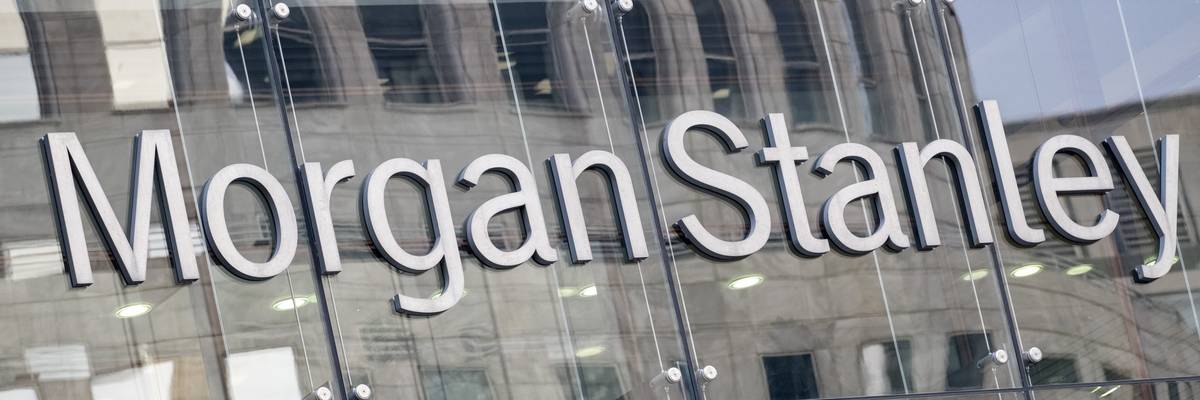
Morgan Stanley offices at Canary Wharf financial district on 5th November 2024 in London, United Kingdom.
Morgan Stanley Latest Wall Street Giant to Ditch Net-Zero Coalition
Earlier this week, Bank of America and Citigroup also said they were leaving the Net-Zero Banking Alliance.
On Thursday, the Wall Street titan Morgan Stanley became the latest financial institution to leave the Net-Zero Banking Alliance, a United Nations-convened group of banks committed to "aligning their lending, investment, and capital markets activities with net-zero greenhouse gas emissions by 2050."
The defections keep piling up. Earlier this week, Bank of America and Citigroup said they were leaving the alliance, and earlier in December Goldman Sachs Group and Wells Fargo announced they were doing the same.
“We will continue to report on our progress as we work towards our 2030 interim financed-emissions targets,” Morgan Stanley told Bloomberg in an email.
While Morgan Stanley didn't offer an explanation for the exit, according to Reuters, financial firms have repeatedly found themselves in the crosshairs of some members of the GOP who argue that corporate efforts to limit fossil fuels run afoul of antitrust law.
Last summer, the Republican members of the House Judiciary Committee published a report accusing financial institutions colluding to impose "radical environmental, social, and governance (ESG) goals on American companies." Their probe was largely focused on another climate group, Climate Action 100+, which is made up of financial institutions who strive to engage companies they invest in on climate issues. That coalition has also experienced a number of defections.
In December, 11 GOP-led states sued three asset managers in federal court, arguing that the firms had "artificially constrained the supply of coal, significantly diminished competition in the markets for coal, increased energy prices for American consumers, and produced cartel-level profits" for the firms in violation of antitrust law.
Despite the stated goals of the Net-Zero Banking Alliance, Morgan Stanley and other firms who are a part of the alliance have remained a major financial life lines for fossil fuel companies.
According to a report published by a group of NGOs in 2023, 56 of the largest banks in the Net-Zero Banking Alliance—including Morgan Stanley—have provided nearly $270 billion in the form of loans and underwriting to more than 100 "major fossil fuel expanders," from Saudi Aramco to ExxonMobil to Shell.
We are at a crossroads
This country and this world are at a monumental crossroads. In a few short weeks, US voters will have an opportunity to beat back the forces of fascism and confront the billionaires who are rigging the economy, our media system, and our democracy, making it increasingly impossible for ordinary people to get by. We’re not just talking about the election. We’re talking about what must be done once these fascist elements are vanquished from power. We need a bolder set of solutions than what either major party has so far been willing to offer and a working-class movement ready to fight like hell for it. Trump didn't emerge from nowhere. The conditions that fueled MAGA authoritarianism were created by decades of radical neoliberal economic policies and a corrupt political system dominated by corporate interests. They slashed taxes on the super-rich, promising that the benefits would trickle down. They said giveaways to the corporate titans would make life more affordable for the rest of us. It was all bullshit. And when a bitter, betrayed populace searches for someone to blame, right-wing demagogues have little trouble finding scapegoats. People know when they're being lied to, but you won't hear any of this from the corporate media. Only independent journalism—powered and funded by people who believe in building a better world—can deliver truly trustworthy daily news. Our Fall Campaign is underway, and we need your help. To power our newsroom through the rest of the year, we need to raise $125,000 by midnight on October 31. So if you share our vision, please contribute whatever you can to sustain our work. |
On Thursday, the Wall Street titan Morgan Stanley became the latest financial institution to leave the Net-Zero Banking Alliance, a United Nations-convened group of banks committed to "aligning their lending, investment, and capital markets activities with net-zero greenhouse gas emissions by 2050."
The defections keep piling up. Earlier this week, Bank of America and Citigroup said they were leaving the alliance, and earlier in December Goldman Sachs Group and Wells Fargo announced they were doing the same.
“We will continue to report on our progress as we work towards our 2030 interim financed-emissions targets,” Morgan Stanley told Bloomberg in an email.
While Morgan Stanley didn't offer an explanation for the exit, according to Reuters, financial firms have repeatedly found themselves in the crosshairs of some members of the GOP who argue that corporate efforts to limit fossil fuels run afoul of antitrust law.
Last summer, the Republican members of the House Judiciary Committee published a report accusing financial institutions colluding to impose "radical environmental, social, and governance (ESG) goals on American companies." Their probe was largely focused on another climate group, Climate Action 100+, which is made up of financial institutions who strive to engage companies they invest in on climate issues. That coalition has also experienced a number of defections.
In December, 11 GOP-led states sued three asset managers in federal court, arguing that the firms had "artificially constrained the supply of coal, significantly diminished competition in the markets for coal, increased energy prices for American consumers, and produced cartel-level profits" for the firms in violation of antitrust law.
Despite the stated goals of the Net-Zero Banking Alliance, Morgan Stanley and other firms who are a part of the alliance have remained a major financial life lines for fossil fuel companies.
According to a report published by a group of NGOs in 2023, 56 of the largest banks in the Net-Zero Banking Alliance—including Morgan Stanley—have provided nearly $270 billion in the form of loans and underwriting to more than 100 "major fossil fuel expanders," from Saudi Aramco to ExxonMobil to Shell.
On Thursday, the Wall Street titan Morgan Stanley became the latest financial institution to leave the Net-Zero Banking Alliance, a United Nations-convened group of banks committed to "aligning their lending, investment, and capital markets activities with net-zero greenhouse gas emissions by 2050."
The defections keep piling up. Earlier this week, Bank of America and Citigroup said they were leaving the alliance, and earlier in December Goldman Sachs Group and Wells Fargo announced they were doing the same.
“We will continue to report on our progress as we work towards our 2030 interim financed-emissions targets,” Morgan Stanley told Bloomberg in an email.
While Morgan Stanley didn't offer an explanation for the exit, according to Reuters, financial firms have repeatedly found themselves in the crosshairs of some members of the GOP who argue that corporate efforts to limit fossil fuels run afoul of antitrust law.
Last summer, the Republican members of the House Judiciary Committee published a report accusing financial institutions colluding to impose "radical environmental, social, and governance (ESG) goals on American companies." Their probe was largely focused on another climate group, Climate Action 100+, which is made up of financial institutions who strive to engage companies they invest in on climate issues. That coalition has also experienced a number of defections.
In December, 11 GOP-led states sued three asset managers in federal court, arguing that the firms had "artificially constrained the supply of coal, significantly diminished competition in the markets for coal, increased energy prices for American consumers, and produced cartel-level profits" for the firms in violation of antitrust law.
Despite the stated goals of the Net-Zero Banking Alliance, Morgan Stanley and other firms who are a part of the alliance have remained a major financial life lines for fossil fuel companies.
According to a report published by a group of NGOs in 2023, 56 of the largest banks in the Net-Zero Banking Alliance—including Morgan Stanley—have provided nearly $270 billion in the form of loans and underwriting to more than 100 "major fossil fuel expanders," from Saudi Aramco to ExxonMobil to Shell.