SUBSCRIBE TO OUR FREE NEWSLETTER
Daily news & progressive opinion—funded by the people, not the corporations—delivered straight to your inbox.
5
#000000
#FFFFFF
To donate by check, phone, or other method, see our More Ways to Give page.
Daily news & progressive opinion—funded by the people, not the corporations—delivered straight to your inbox.
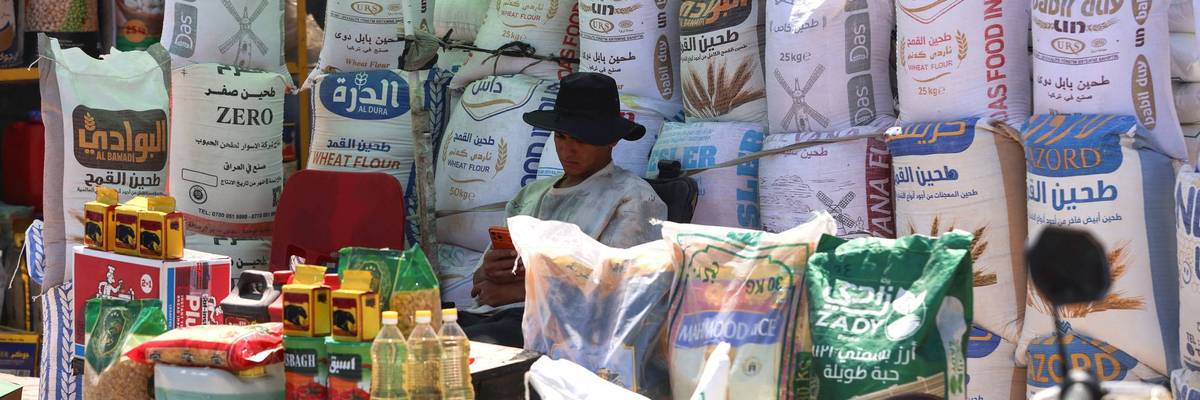
The impact on fuel prices due to the closure of the Strait of Hormuz is the canary in the agrifood coal mine.
What does Big Ag have to do with the Strait of Hormuz? A lot, actually, when you consider that almost every so-called efficiency that industrial agriculture relies on to operate flows through this waterway. And now it is closed, threatening global food security.
And what is the primary source of the problem? Our reliance on fossil fuels.
What do fertilizers, pesticides, and plastics have in common?
First of all, each is a leg of the stool that makes up the rickety foundation of our global agrifood system.
Plastics are involved in every stage of our food and farming systems from soil to spoon: plastic polymers are used in some mulches, agrichemical containers are generally made of plastics, harvest crates and produce packages are often plastic, most processed foods are packaged in plastic or plastic-lined containers, and single-use plastics are still widely used in plates, bowls, cups, straws, napkins, and utensils.
In the 1960s, the world used between 60 and 70 million tonnes of fertilizer (synthetic nitrogen, potassium and phosphorus, plus organic nitrogen) per year. But that usage has steadily risen ever since: in 2023 we used nearly 183 million tonnes of fertilizer. This rise can be attributed in part to the rising needs of a growing global population, but it is more indicative of our over-reliance on fertilizers as a way to combat the increasing effects of climate change. This season, farmers are already reporting untenable increases in fertilizer prices.
Big Ag has and will continue to rely on Big Oil to make Big Money as long as they can, but the United States’ and Israel’s unconstitutional war on Iran starkly illustrates just how fragile this house of cards is.
Pesticides are the other side of the agrichemical input coin. Fertilizers and pesticides go hand-in-hand, when it comes to global agrifood systems. The foundation of industrialized farming is monocropping (growing a single crop over and over on the same piece of land). The problem with monocropping is that it is extremely input intensive because monocropped land is more vulnerable to pest and disease pressure. And over time, this vulnerability increases, requiring more and more pesticides as tolerance builds. This creates a vicious cycle called the Pesticide Treadmill that is hard for farmers to escape without support.
But, critically, synthetic plastics, fertilizers, and pesticides are all derivatives of fossil fuels, mass quantities of which must be funneled through one waterway before becoming various inputs and components of our centralized, industrialized agrifood system. Rather than curbing our use of climate-harming fossil fuel-derived plastics, synthetic fertilizers, and pesticides, our agrifood systems use more and more each year, exacerbating the problem and further locking us into a fragile food system.
According to the Congressional Research Service, over a quarter of the world’s supply of oil comes through the Strait of Hormuz, impacting farmers’ ability to get seeds in the ground and food to tables. Additionally, 20% of natural gas transits the Strait, which is a component of many agrichemical inputs. But, byproducts of oil and gas production also pass through the Strait, including helium which is used in semiconductor manufacturing (semiconductors like silicon are necessary for all modern technology), and urea, which is one of the most commonly used synthetic fertilizers. Over a third of the world’s urea must pass through the Strait.
In short, global agrifood systems rely intrinsically on fossil fuels and their byproducts to function, and when supply lines are disrupted, even briefly, the domino effects could be catastrophic. This article is not meant to be a metaphor, but an urgent warning and a window to our way out.
The most important—and maddening—thing to know is that our agrifood systems need not rely so heavily on fossil fuels and their byproducts to feed the world’s people.
Big Ag has and will continue to rely on Big Oil to make Big Money as long as they can, but the United States’ and Israel’s unconstitutional war on Iran starkly illustrates just how fragile this house of cards is. As countries around the world issue energy conservation mandates and brace for worsening inflation and supply chain instability, we should consider how agroecological farming practices could not only make our agrifood systems safer by reducing exposures of harmful pesticides and curb climate change, but also make the systems that feed us more resilient by decentralizing them, improving resilience to climate change-induced drought, floods, and pest pressures, and extricating them out from under the thumb of fossil fuel corporations.
Corporate greed has optimized humanity to the brink of mass starvation. But the principles of agroecology center food sovereignty (the opposite of corporate control), labor justice, and land stewardship.
Food systems grounded in agroecology are ones in which:
These principles are not far fetched; they’re economically viable solutions that are being practiced successfully around the world already. Systemic shifts toward global agrifood systems that prioritize the principles of agroecology could help us to solve the triple planetary crises of pollution, biodiversity loss, and climate change.
Dear Common Dreams reader, It’s been nearly 30 years since I co-founded Common Dreams with my late wife, Lina Newhouser. We had the radical notion that journalism should serve the public good, not corporate profits. It was clear to us from the outset what it would take to build such a project. No paid advertisements. No corporate sponsors. No millionaire publisher telling us what to think or do. Many people said we wouldn't last a year, but we proved those doubters wrong. Together with a tremendous team of journalists and dedicated staff, we built an independent media outlet free from the constraints of profits and corporate control. Our mission has always been simple: To inform. To inspire. To ignite change for the common good. Building Common Dreams was not easy. Our survival was never guaranteed. When you take on the most powerful forces—Wall Street greed, fossil fuel industry destruction, Big Tech lobbyists, and uber-rich oligarchs who have spent billions upon billions rigging the economy and democracy in their favor—the only bulwark you have is supporters who believe in your work. But here’s the urgent message from me today. It's never been this bad out there. And it's never been this hard to keep us going. At the very moment Common Dreams is most needed, the threats we face are intensifying. We need your support now more than ever. We don't accept corporate advertising and never will. We don't have a paywall because we don't think people should be blocked from critical news based on their ability to pay. Everything we do is funded by the donations of readers like you. When everyone does the little they can afford, we are strong. But if that support retreats or dries up, so do we. Will you donate now to make sure Common Dreams not only survives but thrives? —Craig Brown, Co-founder |
What does Big Ag have to do with the Strait of Hormuz? A lot, actually, when you consider that almost every so-called efficiency that industrial agriculture relies on to operate flows through this waterway. And now it is closed, threatening global food security.
And what is the primary source of the problem? Our reliance on fossil fuels.
What do fertilizers, pesticides, and plastics have in common?
First of all, each is a leg of the stool that makes up the rickety foundation of our global agrifood system.
Plastics are involved in every stage of our food and farming systems from soil to spoon: plastic polymers are used in some mulches, agrichemical containers are generally made of plastics, harvest crates and produce packages are often plastic, most processed foods are packaged in plastic or plastic-lined containers, and single-use plastics are still widely used in plates, bowls, cups, straws, napkins, and utensils.
In the 1960s, the world used between 60 and 70 million tonnes of fertilizer (synthetic nitrogen, potassium and phosphorus, plus organic nitrogen) per year. But that usage has steadily risen ever since: in 2023 we used nearly 183 million tonnes of fertilizer. This rise can be attributed in part to the rising needs of a growing global population, but it is more indicative of our over-reliance on fertilizers as a way to combat the increasing effects of climate change. This season, farmers are already reporting untenable increases in fertilizer prices.
Big Ag has and will continue to rely on Big Oil to make Big Money as long as they can, but the United States’ and Israel’s unconstitutional war on Iran starkly illustrates just how fragile this house of cards is.
Pesticides are the other side of the agrichemical input coin. Fertilizers and pesticides go hand-in-hand, when it comes to global agrifood systems. The foundation of industrialized farming is monocropping (growing a single crop over and over on the same piece of land). The problem with monocropping is that it is extremely input intensive because monocropped land is more vulnerable to pest and disease pressure. And over time, this vulnerability increases, requiring more and more pesticides as tolerance builds. This creates a vicious cycle called the Pesticide Treadmill that is hard for farmers to escape without support.
But, critically, synthetic plastics, fertilizers, and pesticides are all derivatives of fossil fuels, mass quantities of which must be funneled through one waterway before becoming various inputs and components of our centralized, industrialized agrifood system. Rather than curbing our use of climate-harming fossil fuel-derived plastics, synthetic fertilizers, and pesticides, our agrifood systems use more and more each year, exacerbating the problem and further locking us into a fragile food system.
According to the Congressional Research Service, over a quarter of the world’s supply of oil comes through the Strait of Hormuz, impacting farmers’ ability to get seeds in the ground and food to tables. Additionally, 20% of natural gas transits the Strait, which is a component of many agrichemical inputs. But, byproducts of oil and gas production also pass through the Strait, including helium which is used in semiconductor manufacturing (semiconductors like silicon are necessary for all modern technology), and urea, which is one of the most commonly used synthetic fertilizers. Over a third of the world’s urea must pass through the Strait.
In short, global agrifood systems rely intrinsically on fossil fuels and their byproducts to function, and when supply lines are disrupted, even briefly, the domino effects could be catastrophic. This article is not meant to be a metaphor, but an urgent warning and a window to our way out.
The most important—and maddening—thing to know is that our agrifood systems need not rely so heavily on fossil fuels and their byproducts to feed the world’s people.
Big Ag has and will continue to rely on Big Oil to make Big Money as long as they can, but the United States’ and Israel’s unconstitutional war on Iran starkly illustrates just how fragile this house of cards is. As countries around the world issue energy conservation mandates and brace for worsening inflation and supply chain instability, we should consider how agroecological farming practices could not only make our agrifood systems safer by reducing exposures of harmful pesticides and curb climate change, but also make the systems that feed us more resilient by decentralizing them, improving resilience to climate change-induced drought, floods, and pest pressures, and extricating them out from under the thumb of fossil fuel corporations.
Corporate greed has optimized humanity to the brink of mass starvation. But the principles of agroecology center food sovereignty (the opposite of corporate control), labor justice, and land stewardship.
Food systems grounded in agroecology are ones in which:
These principles are not far fetched; they’re economically viable solutions that are being practiced successfully around the world already. Systemic shifts toward global agrifood systems that prioritize the principles of agroecology could help us to solve the triple planetary crises of pollution, biodiversity loss, and climate change.
What does Big Ag have to do with the Strait of Hormuz? A lot, actually, when you consider that almost every so-called efficiency that industrial agriculture relies on to operate flows through this waterway. And now it is closed, threatening global food security.
And what is the primary source of the problem? Our reliance on fossil fuels.
What do fertilizers, pesticides, and plastics have in common?
First of all, each is a leg of the stool that makes up the rickety foundation of our global agrifood system.
Plastics are involved in every stage of our food and farming systems from soil to spoon: plastic polymers are used in some mulches, agrichemical containers are generally made of plastics, harvest crates and produce packages are often plastic, most processed foods are packaged in plastic or plastic-lined containers, and single-use plastics are still widely used in plates, bowls, cups, straws, napkins, and utensils.
In the 1960s, the world used between 60 and 70 million tonnes of fertilizer (synthetic nitrogen, potassium and phosphorus, plus organic nitrogen) per year. But that usage has steadily risen ever since: in 2023 we used nearly 183 million tonnes of fertilizer. This rise can be attributed in part to the rising needs of a growing global population, but it is more indicative of our over-reliance on fertilizers as a way to combat the increasing effects of climate change. This season, farmers are already reporting untenable increases in fertilizer prices.
Big Ag has and will continue to rely on Big Oil to make Big Money as long as they can, but the United States’ and Israel’s unconstitutional war on Iran starkly illustrates just how fragile this house of cards is.
Pesticides are the other side of the agrichemical input coin. Fertilizers and pesticides go hand-in-hand, when it comes to global agrifood systems. The foundation of industrialized farming is monocropping (growing a single crop over and over on the same piece of land). The problem with monocropping is that it is extremely input intensive because monocropped land is more vulnerable to pest and disease pressure. And over time, this vulnerability increases, requiring more and more pesticides as tolerance builds. This creates a vicious cycle called the Pesticide Treadmill that is hard for farmers to escape without support.
But, critically, synthetic plastics, fertilizers, and pesticides are all derivatives of fossil fuels, mass quantities of which must be funneled through one waterway before becoming various inputs and components of our centralized, industrialized agrifood system. Rather than curbing our use of climate-harming fossil fuel-derived plastics, synthetic fertilizers, and pesticides, our agrifood systems use more and more each year, exacerbating the problem and further locking us into a fragile food system.
According to the Congressional Research Service, over a quarter of the world’s supply of oil comes through the Strait of Hormuz, impacting farmers’ ability to get seeds in the ground and food to tables. Additionally, 20% of natural gas transits the Strait, which is a component of many agrichemical inputs. But, byproducts of oil and gas production also pass through the Strait, including helium which is used in semiconductor manufacturing (semiconductors like silicon are necessary for all modern technology), and urea, which is one of the most commonly used synthetic fertilizers. Over a third of the world’s urea must pass through the Strait.
In short, global agrifood systems rely intrinsically on fossil fuels and their byproducts to function, and when supply lines are disrupted, even briefly, the domino effects could be catastrophic. This article is not meant to be a metaphor, but an urgent warning and a window to our way out.
The most important—and maddening—thing to know is that our agrifood systems need not rely so heavily on fossil fuels and their byproducts to feed the world’s people.
Big Ag has and will continue to rely on Big Oil to make Big Money as long as they can, but the United States’ and Israel’s unconstitutional war on Iran starkly illustrates just how fragile this house of cards is. As countries around the world issue energy conservation mandates and brace for worsening inflation and supply chain instability, we should consider how agroecological farming practices could not only make our agrifood systems safer by reducing exposures of harmful pesticides and curb climate change, but also make the systems that feed us more resilient by decentralizing them, improving resilience to climate change-induced drought, floods, and pest pressures, and extricating them out from under the thumb of fossil fuel corporations.
Corporate greed has optimized humanity to the brink of mass starvation. But the principles of agroecology center food sovereignty (the opposite of corporate control), labor justice, and land stewardship.
Food systems grounded in agroecology are ones in which:
These principles are not far fetched; they’re economically viable solutions that are being practiced successfully around the world already. Systemic shifts toward global agrifood systems that prioritize the principles of agroecology could help us to solve the triple planetary crises of pollution, biodiversity loss, and climate change.