5
#000000
#FFFFFF
To donate by check, phone, or other method, see our More Ways to Give page.
Daily news & progressive opinion—funded by the people, not the corporations—delivered straight to your inbox.
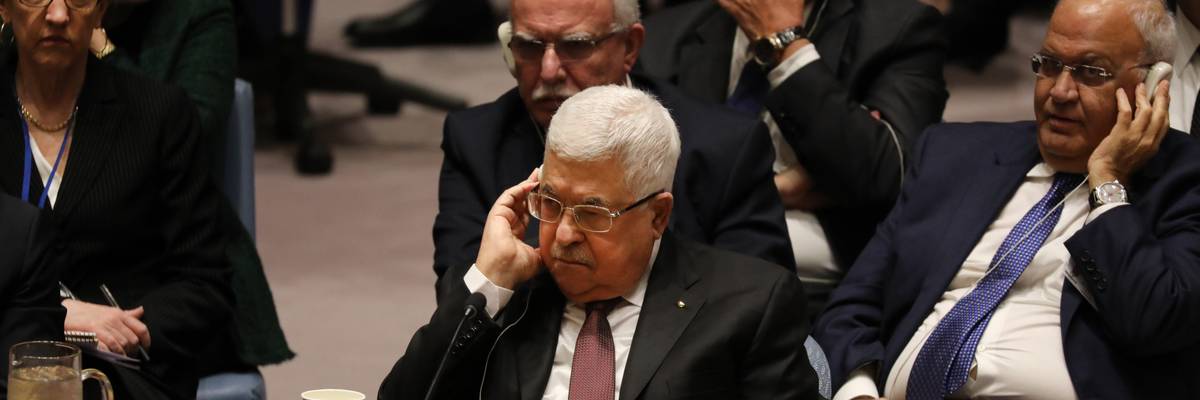
Palestinian President Mahmoud Abbas listens at the United Nations (UN) Security Council in New York on February 11, 2020 in New York City. Abbas used the world body to denounce the US peace plan between Israel and Palestine. Donald Trump's proposal for Israeli-Palestinian peace, which was released on January 28, has been met with universal Palestinian opposition.
"Resorting to international institutions and international law is a legitimate right of the State of Palestine and a peaceful, legal means to protect the Palestinian people and their rights," said the PA Foreign Ministry.
For the second year in a row, the US government under President Donald Trump has denied diplomatic visas for Palestinian Authority leader Mahmoud Abbas and other Palestinian officials—a move condemned by the PA and outside critics as counter to international peace efforts.
Abbas, who leads both the PA and the Palestine Liberation Organization (PLO), was to attend meetings at the United Nations in New York City next week, but the move by the US State Department means he will have to deliver remarks and participate in meetings via video link.
In a statement, the foreign ministry of the PA called the refusal of visas “an unjustified measure that runs counter to efforts to rebuild trust, develop Palestinian-US relations, and create the necessary political climate for implementing the two-state solution and achieving peace and stability.”
The US State Department said the refusal of visas was justified, in part, because of the efforts by Palestinian leaders to seek redress for crimes against their people carried out by the Israeli government by pursuing actions through both the International Criminal Court (ICC) and International Court of Justice (ICJ) as well as for efforts toward "unilateral recognition" with UN members states.
Palestinian pursuits at the ICC and ICJ, the State Department charged in a statement, constitute "taking actions to internationalize the Israeli-Palestinian Conflict." While the US has steadfastly backed Israel politically and armed its military during recent years while it has carried out what experts, including those backed by the UN itself, have characterized as "genocide" in Gaza and grave crimes in the Occupied West Bank, the US accused Palestinian leaders of "glorifying terrorism" to justify the visa bans.
Critics of the US move called it a betrayal of its obligations as host nation of the United Nations General Assembly (UNGA), headquartered in New York City.
Mohammed Maree, head of media and public opinion studies at the Egyptian Center for Strategic Studies, an independent research institution, said that denying Abbas entry to attend the UNGA "confirms that Washington has effectively abandoned its supposed role in the Middle East peace process and fully embraced Israel’s agenda."
The move, added Maree, "once again exposes the stark contradiction between Washington’s rhetoric about peace and its actual policies. In the medium term, it will become clear that attempting to eliminate the two-state solution in line with Israel’s wishes will bring neither stability nor the peace the region desperately needs. Instead, it will only fuel further escalation and uncertainty."
In its statement, the PA Foreign Ministry rejected the US stance.
"Resorting to international institutions and international law is a legitimate right of the State of Palestine and a peaceful, legal means to protect the Palestinian people and their rights," it stated. "This cannot be equated with the policies of occupation, settlement expansion, annexation, displacement, and settler violence [by Israelis]—actions that pose the real threat to the two-state solution and prospects for peace."
The ministry further called for the Trump administration to reconsider its decision and "halt the policy of sanctions and restrictions, and engage in a direct, serious Palestinian-US dialogue to address any points of contention."
"The State of Palestine," the statement concluded, "will continue to fulfill its national and international obligations, pursue its reform program, and utilize peaceful political, diplomatic, and legal means to defend its people's rights, stressing that it will not relinquish their right to self-determination, freedom, and stability."
Dear Common Dreams reader, It’s been nearly 30 years since I co-founded Common Dreams with my late wife, Lina Newhouser. We had the radical notion that journalism should serve the public good, not corporate profits. It was clear to us from the outset what it would take to build such a project. No paid advertisements. No corporate sponsors. No millionaire publisher telling us what to think or do. Many people said we wouldn't last a year, but we proved those doubters wrong. Together with a tremendous team of journalists and dedicated staff, we built an independent media outlet free from the constraints of profits and corporate control. Our mission has always been simple: To inform. To inspire. To ignite change for the common good. Building Common Dreams was not easy. Our survival was never guaranteed. When you take on the most powerful forces—Wall Street greed, fossil fuel industry destruction, Big Tech lobbyists, and uber-rich oligarchs who have spent billions upon billions rigging the economy and democracy in their favor—the only bulwark you have is supporters who believe in your work. But here’s the urgent message from me today. It's never been this bad out there. And it's never been this hard to keep us going. At the very moment Common Dreams is most needed, the threats we face are intensifying. We need your support now more than ever. We don't accept corporate advertising and never will. We don't have a paywall because we don't think people should be blocked from critical news based on their ability to pay. Everything we do is funded by the donations of readers like you. When everyone does the little they can afford, we are strong. But if that support retreats or dries up, so do we. Will you donate now to make sure Common Dreams not only survives but thrives? —Craig Brown, Co-founder |
For the second year in a row, the US government under President Donald Trump has denied diplomatic visas for Palestinian Authority leader Mahmoud Abbas and other Palestinian officials—a move condemned by the PA and outside critics as counter to international peace efforts.
Abbas, who leads both the PA and the Palestine Liberation Organization (PLO), was to attend meetings at the United Nations in New York City next week, but the move by the US State Department means he will have to deliver remarks and participate in meetings via video link.
In a statement, the foreign ministry of the PA called the refusal of visas “an unjustified measure that runs counter to efforts to rebuild trust, develop Palestinian-US relations, and create the necessary political climate for implementing the two-state solution and achieving peace and stability.”
The US State Department said the refusal of visas was justified, in part, because of the efforts by Palestinian leaders to seek redress for crimes against their people carried out by the Israeli government by pursuing actions through both the International Criminal Court (ICC) and International Court of Justice (ICJ) as well as for efforts toward "unilateral recognition" with UN members states.
Palestinian pursuits at the ICC and ICJ, the State Department charged in a statement, constitute "taking actions to internationalize the Israeli-Palestinian Conflict." While the US has steadfastly backed Israel politically and armed its military during recent years while it has carried out what experts, including those backed by the UN itself, have characterized as "genocide" in Gaza and grave crimes in the Occupied West Bank, the US accused Palestinian leaders of "glorifying terrorism" to justify the visa bans.
Critics of the US move called it a betrayal of its obligations as host nation of the United Nations General Assembly (UNGA), headquartered in New York City.
Mohammed Maree, head of media and public opinion studies at the Egyptian Center for Strategic Studies, an independent research institution, said that denying Abbas entry to attend the UNGA "confirms that Washington has effectively abandoned its supposed role in the Middle East peace process and fully embraced Israel’s agenda."
The move, added Maree, "once again exposes the stark contradiction between Washington’s rhetoric about peace and its actual policies. In the medium term, it will become clear that attempting to eliminate the two-state solution in line with Israel’s wishes will bring neither stability nor the peace the region desperately needs. Instead, it will only fuel further escalation and uncertainty."
In its statement, the PA Foreign Ministry rejected the US stance.
"Resorting to international institutions and international law is a legitimate right of the State of Palestine and a peaceful, legal means to protect the Palestinian people and their rights," it stated. "This cannot be equated with the policies of occupation, settlement expansion, annexation, displacement, and settler violence [by Israelis]—actions that pose the real threat to the two-state solution and prospects for peace."
The ministry further called for the Trump administration to reconsider its decision and "halt the policy of sanctions and restrictions, and engage in a direct, serious Palestinian-US dialogue to address any points of contention."
"The State of Palestine," the statement concluded, "will continue to fulfill its national and international obligations, pursue its reform program, and utilize peaceful political, diplomatic, and legal means to defend its people's rights, stressing that it will not relinquish their right to self-determination, freedom, and stability."
For the second year in a row, the US government under President Donald Trump has denied diplomatic visas for Palestinian Authority leader Mahmoud Abbas and other Palestinian officials—a move condemned by the PA and outside critics as counter to international peace efforts.
Abbas, who leads both the PA and the Palestine Liberation Organization (PLO), was to attend meetings at the United Nations in New York City next week, but the move by the US State Department means he will have to deliver remarks and participate in meetings via video link.
In a statement, the foreign ministry of the PA called the refusal of visas “an unjustified measure that runs counter to efforts to rebuild trust, develop Palestinian-US relations, and create the necessary political climate for implementing the two-state solution and achieving peace and stability.”
The US State Department said the refusal of visas was justified, in part, because of the efforts by Palestinian leaders to seek redress for crimes against their people carried out by the Israeli government by pursuing actions through both the International Criminal Court (ICC) and International Court of Justice (ICJ) as well as for efforts toward "unilateral recognition" with UN members states.
Palestinian pursuits at the ICC and ICJ, the State Department charged in a statement, constitute "taking actions to internationalize the Israeli-Palestinian Conflict." While the US has steadfastly backed Israel politically and armed its military during recent years while it has carried out what experts, including those backed by the UN itself, have characterized as "genocide" in Gaza and grave crimes in the Occupied West Bank, the US accused Palestinian leaders of "glorifying terrorism" to justify the visa bans.
Critics of the US move called it a betrayal of its obligations as host nation of the United Nations General Assembly (UNGA), headquartered in New York City.
Mohammed Maree, head of media and public opinion studies at the Egyptian Center for Strategic Studies, an independent research institution, said that denying Abbas entry to attend the UNGA "confirms that Washington has effectively abandoned its supposed role in the Middle East peace process and fully embraced Israel’s agenda."
The move, added Maree, "once again exposes the stark contradiction between Washington’s rhetoric about peace and its actual policies. In the medium term, it will become clear that attempting to eliminate the two-state solution in line with Israel’s wishes will bring neither stability nor the peace the region desperately needs. Instead, it will only fuel further escalation and uncertainty."
In its statement, the PA Foreign Ministry rejected the US stance.
"Resorting to international institutions and international law is a legitimate right of the State of Palestine and a peaceful, legal means to protect the Palestinian people and their rights," it stated. "This cannot be equated with the policies of occupation, settlement expansion, annexation, displacement, and settler violence [by Israelis]—actions that pose the real threat to the two-state solution and prospects for peace."
The ministry further called for the Trump administration to reconsider its decision and "halt the policy of sanctions and restrictions, and engage in a direct, serious Palestinian-US dialogue to address any points of contention."
"The State of Palestine," the statement concluded, "will continue to fulfill its national and international obligations, pursue its reform program, and utilize peaceful political, diplomatic, and legal means to defend its people's rights, stressing that it will not relinquish their right to self-determination, freedom, and stability."