SUBSCRIBE TO OUR FREE NEWSLETTER
Daily news & progressive opinion—funded by the people, not the corporations—delivered straight to your inbox.
5
#000000
#FFFFFF
To donate by check, phone, or other method, see our More Ways to Give page.
Daily news & progressive opinion—funded by the people, not the corporations—delivered straight to your inbox.
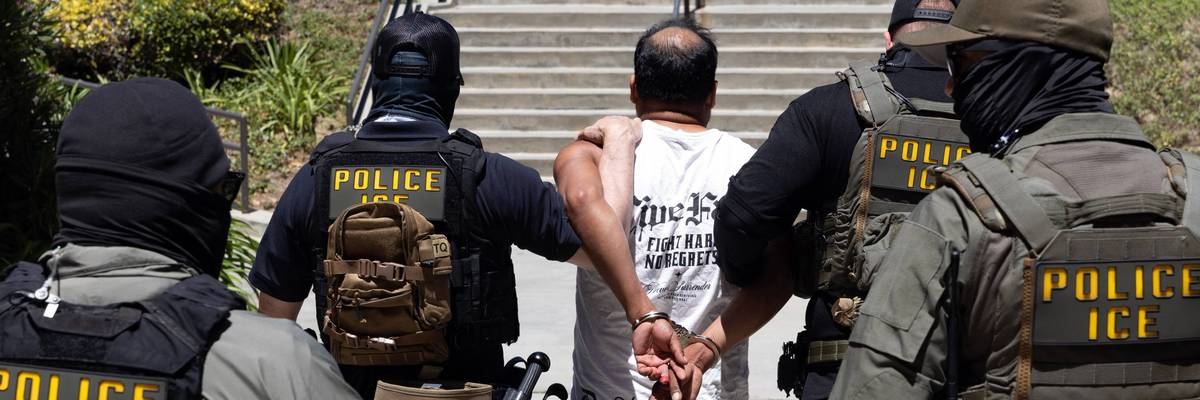
Immigration and Customs Enforcement (ICE) agents walk a detainee out of the Ventura County Government Center in Ventura, California, on July 27, 2026.
"If our government can close off channels of exchange and the free flow of ideas, it is no more than a dictatorship."
A coalition of 15 press freedom advocacy organizations on Friday demanded the release of Nicaraguan journalist Luis Galeano, who was arrested by federal immigration enforcement officials earlier this week.
The groups—which include Free Press, the Committee to Protect Journalists, the Freedom of the Press Foundation, the National Association of Hispanic Journalists, and Reporters Without Borders (RSF)—released a letter decrying Galeano's detention at the hands of US Immigration and Customs Enforcement (ICE) agents on Monday.
The organizations expressed concern about Galeano being potentially deported back to Nicaragua, where he could face imprisonment for his past work exposing that government's human rights abuses. According to a Wednesday report in The Guardian, Galeano fled his home country eight years ago shortly after police raided the news outlet where he worked.
The groups also said Galeano's detention marked "a troubling escalation of attacks on journalists and media workers, particularly immigrant journalists, who consistently provide much-needed journalism and civic information for their communities."
Galeano was taken into custody despite entering the US legally in 2018 and having a pending asylum case. The Nicaraguan journalist also has a work permit and a Social Security number.
Nora Benavidez, senior counsel at Free Press, called Galeano's arrest "horrifying," while noting that the Nicaraguan is "the latest in a long line of journalists who came to the United States to report on issues of the day and instead face deportation."
"These cases aren’t just about cracking down on immigration," said Benavidez. "They are about cutting off community access to vital coverage and scaring reporters from holding those in power accountable. If our government can close off channels of exchange and the free flow of ideas, it is no more than a dictatorship."
Edith Rodríguez Cachera, vice president of RSF Spain, pointed out that Galeano was also a citizen of Spain, and urged the Spanish government to secure his freedom.
"Spain cannot stand by while one of its citizens, a journalist persecuted for doing his job, is detained in the United States and faces the risk of being sent back to a country he fled because of severe repression," said Rodríguez Cachera, "where his safety could be seriously endangered if he is deported. Spain must use every diplomatic and consular instrument at its disposal to safeguard his security and prevent his return to a country where he will likely be targeted due to his journalistic work."
Galeano's wife, Deykell Santamaría, said in an interview with El País published Thursday that she has been able to contact her husband during his detention, but she still fears "for his safety, his freedom, and his integrity if he were to be sent to Nicaragua."
Javier Melendez, a longtime friend of the detained journalist, was even blunter about what would happen to Galeano were he to be deported, describing it as nothing less than a "death sentence" in an interview with The Guardian.
The El País report noted that US Reps. María Elvira Salazar (R-Fla.) and Mario Díaz-Balart (R-Fla.) have expressed concerns about Galeano's detention, with Salazar saying that the US government should "always know how to distinguish between a criminal and a political exile."
Dear Common Dreams reader, It’s been nearly 30 years since I co-founded Common Dreams with my late wife, Lina Newhouser. We had the radical notion that journalism should serve the public good, not corporate profits. It was clear to us from the outset what it would take to build such a project. No paid advertisements. No corporate sponsors. No millionaire publisher telling us what to think or do. Many people said we wouldn't last a year, but we proved those doubters wrong. Together with a tremendous team of journalists and dedicated staff, we built an independent media outlet free from the constraints of profits and corporate control. Our mission has always been simple: To inform. To inspire. To ignite change for the common good. Building Common Dreams was not easy. Our survival was never guaranteed. When you take on the most powerful forces—Wall Street greed, fossil fuel industry destruction, Big Tech lobbyists, and uber-rich oligarchs who have spent billions upon billions rigging the economy and democracy in their favor—the only bulwark you have is supporters who believe in your work. But here’s the urgent message from me today. It's never been this bad out there. And it's never been this hard to keep us going. At the very moment Common Dreams is most needed, the threats we face are intensifying. We need your support now more than ever. We don't accept corporate advertising and never will. We don't have a paywall because we don't think people should be blocked from critical news based on their ability to pay. Everything we do is funded by the donations of readers like you. When everyone does the little they can afford, we are strong. But if that support retreats or dries up, so do we. Will you donate now to make sure Common Dreams not only survives but thrives? —Craig Brown, Co-founder |
A coalition of 15 press freedom advocacy organizations on Friday demanded the release of Nicaraguan journalist Luis Galeano, who was arrested by federal immigration enforcement officials earlier this week.
The groups—which include Free Press, the Committee to Protect Journalists, the Freedom of the Press Foundation, the National Association of Hispanic Journalists, and Reporters Without Borders (RSF)—released a letter decrying Galeano's detention at the hands of US Immigration and Customs Enforcement (ICE) agents on Monday.
The organizations expressed concern about Galeano being potentially deported back to Nicaragua, where he could face imprisonment for his past work exposing that government's human rights abuses. According to a Wednesday report in The Guardian, Galeano fled his home country eight years ago shortly after police raided the news outlet where he worked.
The groups also said Galeano's detention marked "a troubling escalation of attacks on journalists and media workers, particularly immigrant journalists, who consistently provide much-needed journalism and civic information for their communities."
Galeano was taken into custody despite entering the US legally in 2018 and having a pending asylum case. The Nicaraguan journalist also has a work permit and a Social Security number.
Nora Benavidez, senior counsel at Free Press, called Galeano's arrest "horrifying," while noting that the Nicaraguan is "the latest in a long line of journalists who came to the United States to report on issues of the day and instead face deportation."
"These cases aren’t just about cracking down on immigration," said Benavidez. "They are about cutting off community access to vital coverage and scaring reporters from holding those in power accountable. If our government can close off channels of exchange and the free flow of ideas, it is no more than a dictatorship."
Edith Rodríguez Cachera, vice president of RSF Spain, pointed out that Galeano was also a citizen of Spain, and urged the Spanish government to secure his freedom.
"Spain cannot stand by while one of its citizens, a journalist persecuted for doing his job, is detained in the United States and faces the risk of being sent back to a country he fled because of severe repression," said Rodríguez Cachera, "where his safety could be seriously endangered if he is deported. Spain must use every diplomatic and consular instrument at its disposal to safeguard his security and prevent his return to a country where he will likely be targeted due to his journalistic work."
Galeano's wife, Deykell Santamaría, said in an interview with El País published Thursday that she has been able to contact her husband during his detention, but she still fears "for his safety, his freedom, and his integrity if he were to be sent to Nicaragua."
Javier Melendez, a longtime friend of the detained journalist, was even blunter about what would happen to Galeano were he to be deported, describing it as nothing less than a "death sentence" in an interview with The Guardian.
The El País report noted that US Reps. María Elvira Salazar (R-Fla.) and Mario Díaz-Balart (R-Fla.) have expressed concerns about Galeano's detention, with Salazar saying that the US government should "always know how to distinguish between a criminal and a political exile."
A coalition of 15 press freedom advocacy organizations on Friday demanded the release of Nicaraguan journalist Luis Galeano, who was arrested by federal immigration enforcement officials earlier this week.
The groups—which include Free Press, the Committee to Protect Journalists, the Freedom of the Press Foundation, the National Association of Hispanic Journalists, and Reporters Without Borders (RSF)—released a letter decrying Galeano's detention at the hands of US Immigration and Customs Enforcement (ICE) agents on Monday.
The organizations expressed concern about Galeano being potentially deported back to Nicaragua, where he could face imprisonment for his past work exposing that government's human rights abuses. According to a Wednesday report in The Guardian, Galeano fled his home country eight years ago shortly after police raided the news outlet where he worked.
The groups also said Galeano's detention marked "a troubling escalation of attacks on journalists and media workers, particularly immigrant journalists, who consistently provide much-needed journalism and civic information for their communities."
Galeano was taken into custody despite entering the US legally in 2018 and having a pending asylum case. The Nicaraguan journalist also has a work permit and a Social Security number.
Nora Benavidez, senior counsel at Free Press, called Galeano's arrest "horrifying," while noting that the Nicaraguan is "the latest in a long line of journalists who came to the United States to report on issues of the day and instead face deportation."
"These cases aren’t just about cracking down on immigration," said Benavidez. "They are about cutting off community access to vital coverage and scaring reporters from holding those in power accountable. If our government can close off channels of exchange and the free flow of ideas, it is no more than a dictatorship."
Edith Rodríguez Cachera, vice president of RSF Spain, pointed out that Galeano was also a citizen of Spain, and urged the Spanish government to secure his freedom.
"Spain cannot stand by while one of its citizens, a journalist persecuted for doing his job, is detained in the United States and faces the risk of being sent back to a country he fled because of severe repression," said Rodríguez Cachera, "where his safety could be seriously endangered if he is deported. Spain must use every diplomatic and consular instrument at its disposal to safeguard his security and prevent his return to a country where he will likely be targeted due to his journalistic work."
Galeano's wife, Deykell Santamaría, said in an interview with El País published Thursday that she has been able to contact her husband during his detention, but she still fears "for his safety, his freedom, and his integrity if he were to be sent to Nicaragua."
Javier Melendez, a longtime friend of the detained journalist, was even blunter about what would happen to Galeano were he to be deported, describing it as nothing less than a "death sentence" in an interview with The Guardian.
The El País report noted that US Reps. María Elvira Salazar (R-Fla.) and Mario Díaz-Balart (R-Fla.) have expressed concerns about Galeano's detention, with Salazar saying that the US government should "always know how to distinguish between a criminal and a political exile."