
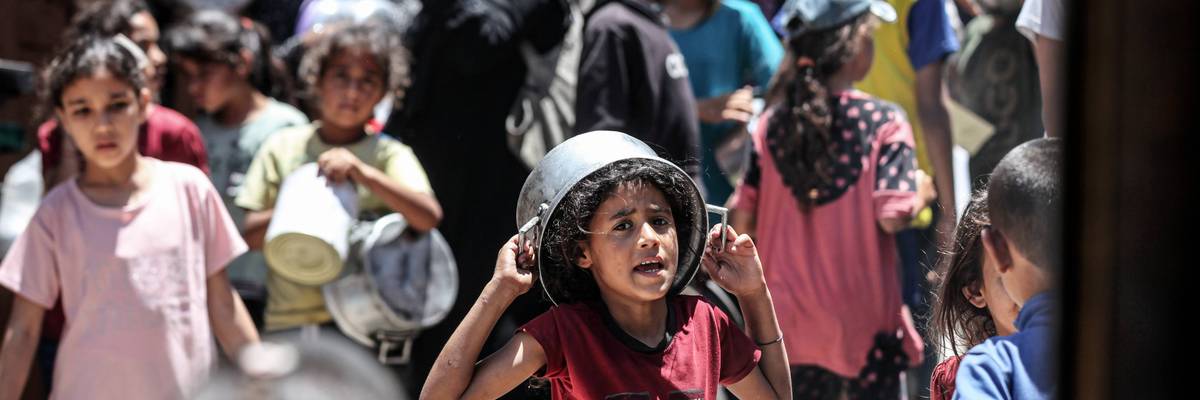
Displaced Palestinians, including many children, wait in long queues to receive hot meals distributed by a charitable organization in Gaza City, Gaza, Palestine on June 7, 2026.
‘Collective Punishment’: Israel Halts All Humanitarian Aid to Gaza in Retaliation for Iran Strikes
"Aid is not a political tool and should not be weaponized in this way," said an advocate at Save the Children. "The survival and needs of children in Gaza should not have to answer to airstrikes elsewhere."
In an act described as "collective punishment" against two million Palestinians, Israel announced that it would close off the main entry points for humanitarian aid into Gaza indefinitely in retaliation for strikes launched this weekend by Iran.
Iran launched missiles at Israel on Sunday in response to Israel's bombing of a densely populated Beirut suburb, which killed civilians and violated a June 1 agreement not to bomb Lebanon's capital.
In addition to retaliating with new strikes on Iran, Israel’s Coordinator of Government Activities in the Territories (COGAT) said on Sunday that “a number of necessary security measures have been implemented” following the missile fire, “including the closure of the crossings into the Gaza Strip, among them the Kerem Shalom Crossing and the Rafah Crossing, until further notice.”
COGAT claimed that closing the crossings "will not affect the humanitarian situation in the Gaza Strip" because "the substantial quantities of food that have entered the strip since the beginning of the ceasefire significantly exceed the nutritional needs of the population, according to [United Nations] methodologies."
That is not what actual UN reports say. The World Food Program (WFP) estimated in June that about 1.6 million people living in Gaza, more than three-quarters of the population, were "facing high levels of acute food insecurity" despite the entry of food parcels and other aid since the October 2025 "ceasefire" between Israel and Hamas.
In the first half of May, UN workers identified more than 2,000 cases of acute malnutrition among young children, according to a June report from the UN Office for the Coordination of Humanitarian Affairs (OCHA).
That same OCHA report said about 678,000 hot meals were delivered in May, down from 1.5 million per day in mid-March as a result of underfunding and due to Israel's closures and restrictions at certain entry points. The number of people receiving food parcels in May also dropped to about 820,000, down from 1.1 million in March. The rations that were distributed in May covered only about 75% of the average person's minimum daily caloric needs, while those distributed in March covered about 50%.
While the amount of aid entering the strip has increased since the ceasefire went into effect, UN data has never suggested that the amount entering "exceeds" the needs of Palestinians. Since the truce began, reports have consistently said the amount of aid entering the strip was only reaching part of the population, and that aid packages only contained part of the needed nutritional value, which did not meet the terms of the agreement.
Israel, which has been accused of using starvation as a "weapon of war" against Gaza by UN bodies and major human rights groups, previously closed all crossings into the strip at the start of its military assault against Iran in late February.
This not only halted the entry of food and medical aid but also blocked medical evacuations for sick and injured Palestinians, which were desperately needed due to Israel’s destruction of Gaza’s medical system. Even as entry points reopened in the following weeks, aid entry never returned to previous levels.
COGAT said on Monday that "the crossings will be reopened gradually, subject to an ongoing operational assessment and under security restrictions designed to ensure the safety of all personnel present at the crossings on both sides," though it provided no clear timeframe or indication of how much aid would be allowed in.
“Aid is not a political tool and should not be weaponized in this way. The survival and needs of children in Gaza should not have to answer to airstrikes elsewhere,” said Ahmad Alhendawi, Save the Children’s regional director for the Middle East, North Africa, and Eastern Europe in a statement on Monday.
“For nearly three years, Gaza has been pummelled so hard by Israeli airstrikes that nothing can grow there and people have been reliant on the already small amount of aid crossing the border—aid that was never enough and is now totally out of reach,” he added. “Children in Gaza have already been starved by design. They should not now be denied water, medicine, shelter, and the other essentials needed to survive. The Israeli authorities must re-open these crossings immediately, lift the siege, and facilitate the safe delivery of humanitarian aid at scale.”
With Israeli leaders openly stating their goal in recent weeks to expand the nation's occupation of Gaza despite the ceasefire, international observers have suggested that Israel was using the escalation of hostilities with Iran as an excuse to ramp up its brutal treatment of Palestinians, nearly 1,000 of whom have been killed in the strip since the ceasefire went into effect.
The US-brokered ceasefire agreement signed by Israel and Hamas in October required the “full entry of humanitarian aid and relief” into the strip.
"The guarantors of the ceasefire must step in and force Israel to reopen the crossings, resume and triple the aid amounts, and totally stop any attacks on Gaza now," said Palestinian journalist Abubaker Abed. "This is their job. And they must uphold the ceasefire agreement."
We are at a crossroads
This country and this world are at a monumental crossroads. In a few short weeks, US voters will have an opportunity to beat back the forces of fascism and confront the billionaires who are rigging the economy, our media system, and our democracy, making it increasingly impossible for ordinary people to get by. We’re not just talking about the election. We’re talking about what must be done once these fascist elements are vanquished from power. We need a bolder set of solutions than what either major party has so far been willing to offer and a working-class movement ready to fight like hell for it. Trump didn't emerge from nowhere. The conditions that fueled MAGA authoritarianism were created by decades of radical neoliberal economic policies and a corrupt political system dominated by corporate interests. They slashed taxes on the super-rich, promising that the benefits would trickle down. They said giveaways to the corporate titans would make life more affordable for the rest of us. It was all bullshit. And when a bitter, betrayed populace searches for someone to blame, right-wing demagogues have little trouble finding scapegoats. People know when they're being lied to, but you won't hear any of this from the corporate media. Only independent journalism—powered and funded by people who believe in building a better world—can deliver truly trustworthy daily news. Our Fall Campaign is underway, and we need your help. To power our newsroom through the rest of the year, we need to raise $125,000 by midnight on October 31. So if you share our vision, please contribute whatever you can to sustain our work. |
In an act described as "collective punishment" against two million Palestinians, Israel announced that it would close off the main entry points for humanitarian aid into Gaza indefinitely in retaliation for strikes launched this weekend by Iran.
Iran launched missiles at Israel on Sunday in response to Israel's bombing of a densely populated Beirut suburb, which killed civilians and violated a June 1 agreement not to bomb Lebanon's capital.
In addition to retaliating with new strikes on Iran, Israel’s Coordinator of Government Activities in the Territories (COGAT) said on Sunday that “a number of necessary security measures have been implemented” following the missile fire, “including the closure of the crossings into the Gaza Strip, among them the Kerem Shalom Crossing and the Rafah Crossing, until further notice.”
COGAT claimed that closing the crossings "will not affect the humanitarian situation in the Gaza Strip" because "the substantial quantities of food that have entered the strip since the beginning of the ceasefire significantly exceed the nutritional needs of the population, according to [United Nations] methodologies."
That is not what actual UN reports say. The World Food Program (WFP) estimated in June that about 1.6 million people living in Gaza, more than three-quarters of the population, were "facing high levels of acute food insecurity" despite the entry of food parcels and other aid since the October 2025 "ceasefire" between Israel and Hamas.
In the first half of May, UN workers identified more than 2,000 cases of acute malnutrition among young children, according to a June report from the UN Office for the Coordination of Humanitarian Affairs (OCHA).
That same OCHA report said about 678,000 hot meals were delivered in May, down from 1.5 million per day in mid-March as a result of underfunding and due to Israel's closures and restrictions at certain entry points. The number of people receiving food parcels in May also dropped to about 820,000, down from 1.1 million in March. The rations that were distributed in May covered only about 75% of the average person's minimum daily caloric needs, while those distributed in March covered about 50%.
While the amount of aid entering the strip has increased since the ceasefire went into effect, UN data has never suggested that the amount entering "exceeds" the needs of Palestinians. Since the truce began, reports have consistently said the amount of aid entering the strip was only reaching part of the population, and that aid packages only contained part of the needed nutritional value, which did not meet the terms of the agreement.
Israel, which has been accused of using starvation as a "weapon of war" against Gaza by UN bodies and major human rights groups, previously closed all crossings into the strip at the start of its military assault against Iran in late February.
This not only halted the entry of food and medical aid but also blocked medical evacuations for sick and injured Palestinians, which were desperately needed due to Israel’s destruction of Gaza’s medical system. Even as entry points reopened in the following weeks, aid entry never returned to previous levels.
COGAT said on Monday that "the crossings will be reopened gradually, subject to an ongoing operational assessment and under security restrictions designed to ensure the safety of all personnel present at the crossings on both sides," though it provided no clear timeframe or indication of how much aid would be allowed in.
“Aid is not a political tool and should not be weaponized in this way. The survival and needs of children in Gaza should not have to answer to airstrikes elsewhere,” said Ahmad Alhendawi, Save the Children’s regional director for the Middle East, North Africa, and Eastern Europe in a statement on Monday.
“For nearly three years, Gaza has been pummelled so hard by Israeli airstrikes that nothing can grow there and people have been reliant on the already small amount of aid crossing the border—aid that was never enough and is now totally out of reach,” he added. “Children in Gaza have already been starved by design. They should not now be denied water, medicine, shelter, and the other essentials needed to survive. The Israeli authorities must re-open these crossings immediately, lift the siege, and facilitate the safe delivery of humanitarian aid at scale.”
With Israeli leaders openly stating their goal in recent weeks to expand the nation's occupation of Gaza despite the ceasefire, international observers have suggested that Israel was using the escalation of hostilities with Iran as an excuse to ramp up its brutal treatment of Palestinians, nearly 1,000 of whom have been killed in the strip since the ceasefire went into effect.
The US-brokered ceasefire agreement signed by Israel and Hamas in October required the “full entry of humanitarian aid and relief” into the strip.
"The guarantors of the ceasefire must step in and force Israel to reopen the crossings, resume and triple the aid amounts, and totally stop any attacks on Gaza now," said Palestinian journalist Abubaker Abed. "This is their job. And they must uphold the ceasefire agreement."
In an act described as "collective punishment" against two million Palestinians, Israel announced that it would close off the main entry points for humanitarian aid into Gaza indefinitely in retaliation for strikes launched this weekend by Iran.
Iran launched missiles at Israel on Sunday in response to Israel's bombing of a densely populated Beirut suburb, which killed civilians and violated a June 1 agreement not to bomb Lebanon's capital.
In addition to retaliating with new strikes on Iran, Israel’s Coordinator of Government Activities in the Territories (COGAT) said on Sunday that “a number of necessary security measures have been implemented” following the missile fire, “including the closure of the crossings into the Gaza Strip, among them the Kerem Shalom Crossing and the Rafah Crossing, until further notice.”
COGAT claimed that closing the crossings "will not affect the humanitarian situation in the Gaza Strip" because "the substantial quantities of food that have entered the strip since the beginning of the ceasefire significantly exceed the nutritional needs of the population, according to [United Nations] methodologies."
That is not what actual UN reports say. The World Food Program (WFP) estimated in June that about 1.6 million people living in Gaza, more than three-quarters of the population, were "facing high levels of acute food insecurity" despite the entry of food parcels and other aid since the October 2025 "ceasefire" between Israel and Hamas.
In the first half of May, UN workers identified more than 2,000 cases of acute malnutrition among young children, according to a June report from the UN Office for the Coordination of Humanitarian Affairs (OCHA).
That same OCHA report said about 678,000 hot meals were delivered in May, down from 1.5 million per day in mid-March as a result of underfunding and due to Israel's closures and restrictions at certain entry points. The number of people receiving food parcels in May also dropped to about 820,000, down from 1.1 million in March. The rations that were distributed in May covered only about 75% of the average person's minimum daily caloric needs, while those distributed in March covered about 50%.
While the amount of aid entering the strip has increased since the ceasefire went into effect, UN data has never suggested that the amount entering "exceeds" the needs of Palestinians. Since the truce began, reports have consistently said the amount of aid entering the strip was only reaching part of the population, and that aid packages only contained part of the needed nutritional value, which did not meet the terms of the agreement.
Israel, which has been accused of using starvation as a "weapon of war" against Gaza by UN bodies and major human rights groups, previously closed all crossings into the strip at the start of its military assault against Iran in late February.
This not only halted the entry of food and medical aid but also blocked medical evacuations for sick and injured Palestinians, which were desperately needed due to Israel’s destruction of Gaza’s medical system. Even as entry points reopened in the following weeks, aid entry never returned to previous levels.
COGAT said on Monday that "the crossings will be reopened gradually, subject to an ongoing operational assessment and under security restrictions designed to ensure the safety of all personnel present at the crossings on both sides," though it provided no clear timeframe or indication of how much aid would be allowed in.
“Aid is not a political tool and should not be weaponized in this way. The survival and needs of children in Gaza should not have to answer to airstrikes elsewhere,” said Ahmad Alhendawi, Save the Children’s regional director for the Middle East, North Africa, and Eastern Europe in a statement on Monday.
“For nearly three years, Gaza has been pummelled so hard by Israeli airstrikes that nothing can grow there and people have been reliant on the already small amount of aid crossing the border—aid that was never enough and is now totally out of reach,” he added. “Children in Gaza have already been starved by design. They should not now be denied water, medicine, shelter, and the other essentials needed to survive. The Israeli authorities must re-open these crossings immediately, lift the siege, and facilitate the safe delivery of humanitarian aid at scale.”
With Israeli leaders openly stating their goal in recent weeks to expand the nation's occupation of Gaza despite the ceasefire, international observers have suggested that Israel was using the escalation of hostilities with Iran as an excuse to ramp up its brutal treatment of Palestinians, nearly 1,000 of whom have been killed in the strip since the ceasefire went into effect.
The US-brokered ceasefire agreement signed by Israel and Hamas in October required the “full entry of humanitarian aid and relief” into the strip.
"The guarantors of the ceasefire must step in and force Israel to reopen the crossings, resume and triple the aid amounts, and totally stop any attacks on Gaza now," said Palestinian journalist Abubaker Abed. "This is their job. And they must uphold the ceasefire agreement."