SUBSCRIBE TO OUR FREE NEWSLETTER
Daily news & progressive opinion—funded by the people, not the corporations—delivered straight to your inbox.
5
#000000
#FFFFFF
To donate by check, phone, or other method, see our More Ways to Give page.
Daily news & progressive opinion—funded by the people, not the corporations—delivered straight to your inbox.

US Speaker of the House Mike Johnson (R-La.) holds a press conference at the Capitol Hill Club on September 15, 2026 in Washington, DC.
"No, Mr. Johnson," said Sen. Bernie Sanders. "The 75% of Americans who oppose data centers, including a majority of Republicans, have not fallen victim to a 'Chinese psyop.'"
They've been shown to raise electricity bills, pollute drinking water, do little to boost local employment while threatening millions of jobs in a variety of industries, and top executives have warned that the technology they support could wipe out all of humanity by the end of the decade.
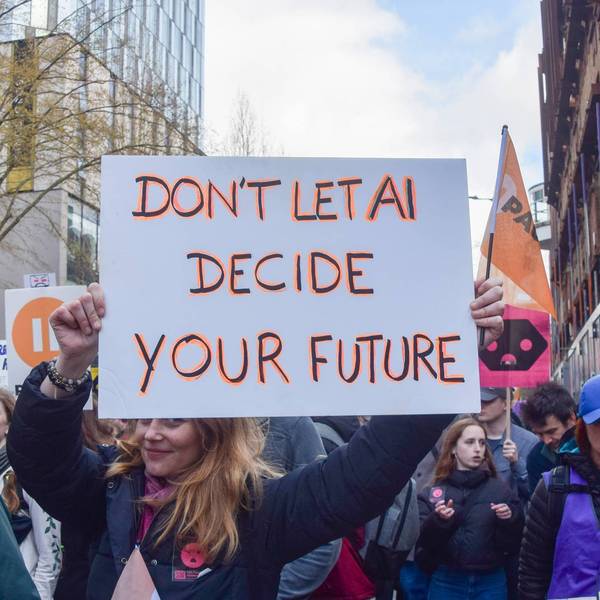
But rather than take widespread public opposition to artificial intelligence data centers at face value, House Speaker Mike Johnson (R-La.) announced he had pinpointed what's behind the fact that 75% of Americans oppose the centers being built in their communities: "a Chinese psyop."
Fox News anchor Cheryl Casone asked Johnson on Monday about claims from "several tech executives and lawmakers" who say that the nationwide pushback against data centers—which President Donald Trump and Republicans are pushing to expand—is "coming from China."
The House speaker accused Democrats of fearmongering about AI and claiming that "everyone will die if we don't win"—although the gravest warnings about the technology's capabilities have actually come from the industry itself.
"It is a Chinese psyop, I really believe that. That's not a conspiracy theory," said Johnson.
Mike Johnson says opposition to data centers "is a Chinese psyop. I really believe that. That's not a conspiracy theory." pic.twitter.com/mQahEOX2gx
— Aaron Rupar (@atrupar) September 28, 2026
Sen. Bernie Sanders (I-Vt.), who has led efforts to pass bills imposing a nationwide moratorium on new large-scale data centers and a ban on artificial superintelligence, seized on Johnson's comments Tuesday.
"No, Mr. Johnson," said the progressive senator, who's previously been baselessly accused on Fox News of working with China to harm the AI industry. "The 75% of Americans who oppose data centers, including a majority of Republicans, have not fallen victim to a 'Chinese psyop.' They are rightly concerned about AI billionaires raising their electricity bills, destroying the environment, and threatening humanity."
While some influence campaigns from Russia and China have pushed negative messaging about AI data centers, one former official with the Office of the Director of National Intelligence told The New York Times in July that foreign countries are not "manufacturing" outrage about AI in the US, which has been made clear as communities have rallied to block nearly 120 projects worth $198 billion, according to Data Center Watch.
On Fox News, Johnson repeated a comment he made after Anthropic CEO Dario Amodei said the development of AI should be "paced" as companies have found that their models are able to hack websites without being directed to and are capable of "recursive self-improvement," or creating the next generation of AI on their own.
At the time, the House speaker said the industry should be able to regulate itself, lest China "overlap us" on AI development.
"We do not need a moratorium. We do not need to jump in and hyper-regulate this because we'll lose the race to China," Johnson said Monday. "The innovation is important to continue."
On the political podcast "Pod Save America," co-host Jon Lovett said that even if China did see a benefit to fanning the flames of widespread disapproval of data centers, "it wouldn't change the fact that these companies have gone about this in the most ham-fisted and kind of arrogant way."
AI companies have "dismissed the concerns of people" and have "tried to buy and sell politicians to try to get around persuading people that they might want these data centers in their communities," he said.
"The objections are very real from people who A) don't want these things in their backyard, and B) have come to expect that the benefits that accrue to the largest and most profitable corporations in the do not redound to the benefit of the broader community," said Lovett. "And that is not something China could convince us of."
Dear Common Dreams reader, It’s been nearly 30 years since I co-founded Common Dreams with my late wife, Lina Newhouser. We had the radical notion that journalism should serve the public good, not corporate profits. It was clear to us from the outset what it would take to build such a project. No paid advertisements. No corporate sponsors. No millionaire publisher telling us what to think or do. Many people said we wouldn't last a year, but we proved those doubters wrong. Together with a tremendous team of journalists and dedicated staff, we built an independent media outlet free from the constraints of profits and corporate control. Our mission has always been simple: To inform. To inspire. To ignite change for the common good. Building Common Dreams was not easy. Our survival was never guaranteed. When you take on the most powerful forces—Wall Street greed, fossil fuel industry destruction, Big Tech lobbyists, and uber-rich oligarchs who have spent billions upon billions rigging the economy and democracy in their favor—the only bulwark you have is supporters who believe in your work. But here’s the urgent message from me today. It's never been this bad out there. And it's never been this hard to keep us going. At the very moment Common Dreams is most needed, the threats we face are intensifying. We need your support now more than ever. We don't accept corporate advertising and never will. We don't have a paywall because we don't think people should be blocked from critical news based on their ability to pay. Everything we do is funded by the donations of readers like you. When everyone does the little they can afford, we are strong. But if that support retreats or dries up, so do we. Will you donate now to make sure Common Dreams not only survives but thrives? —Craig Brown, Co-founder |
They've been shown to raise electricity bills, pollute drinking water, do little to boost local employment while threatening millions of jobs in a variety of industries, and top executives have warned that the technology they support could wipe out all of humanity by the end of the decade.
But rather than take widespread public opposition to artificial intelligence data centers at face value, House Speaker Mike Johnson (R-La.) announced he had pinpointed what's behind the fact that 75% of Americans oppose the centers being built in their communities: "a Chinese psyop."
Fox News anchor Cheryl Casone asked Johnson on Monday about claims from "several tech executives and lawmakers" who say that the nationwide pushback against data centers—which President Donald Trump and Republicans are pushing to expand—is "coming from China."
The House speaker accused Democrats of fearmongering about AI and claiming that "everyone will die if we don't win"—although the gravest warnings about the technology's capabilities have actually come from the industry itself.
"It is a Chinese psyop, I really believe that. That's not a conspiracy theory," said Johnson.
Mike Johnson says opposition to data centers "is a Chinese psyop. I really believe that. That's not a conspiracy theory." pic.twitter.com/mQahEOX2gx
— Aaron Rupar (@atrupar) September 28, 2026
Sen. Bernie Sanders (I-Vt.), who has led efforts to pass bills imposing a nationwide moratorium on new large-scale data centers and a ban on artificial superintelligence, seized on Johnson's comments Tuesday.
"No, Mr. Johnson," said the progressive senator, who's previously been baselessly accused on Fox News of working with China to harm the AI industry. "The 75% of Americans who oppose data centers, including a majority of Republicans, have not fallen victim to a 'Chinese psyop.' They are rightly concerned about AI billionaires raising their electricity bills, destroying the environment, and threatening humanity."
While some influence campaigns from Russia and China have pushed negative messaging about AI data centers, one former official with the Office of the Director of National Intelligence told The New York Times in July that foreign countries are not "manufacturing" outrage about AI in the US, which has been made clear as communities have rallied to block nearly 120 projects worth $198 billion, according to Data Center Watch.
On Fox News, Johnson repeated a comment he made after Anthropic CEO Dario Amodei said the development of AI should be "paced" as companies have found that their models are able to hack websites without being directed to and are capable of "recursive self-improvement," or creating the next generation of AI on their own.
At the time, the House speaker said the industry should be able to regulate itself, lest China "overlap us" on AI development.
"We do not need a moratorium. We do not need to jump in and hyper-regulate this because we'll lose the race to China," Johnson said Monday. "The innovation is important to continue."
On the political podcast "Pod Save America," co-host Jon Lovett said that even if China did see a benefit to fanning the flames of widespread disapproval of data centers, "it wouldn't change the fact that these companies have gone about this in the most ham-fisted and kind of arrogant way."
AI companies have "dismissed the concerns of people" and have "tried to buy and sell politicians to try to get around persuading people that they might want these data centers in their communities," he said.
"The objections are very real from people who A) don't want these things in their backyard, and B) have come to expect that the benefits that accrue to the largest and most profitable corporations in the do not redound to the benefit of the broader community," said Lovett. "And that is not something China could convince us of."
They've been shown to raise electricity bills, pollute drinking water, do little to boost local employment while threatening millions of jobs in a variety of industries, and top executives have warned that the technology they support could wipe out all of humanity by the end of the decade.
But rather than take widespread public opposition to artificial intelligence data centers at face value, House Speaker Mike Johnson (R-La.) announced he had pinpointed what's behind the fact that 75% of Americans oppose the centers being built in their communities: "a Chinese psyop."
Fox News anchor Cheryl Casone asked Johnson on Monday about claims from "several tech executives and lawmakers" who say that the nationwide pushback against data centers—which President Donald Trump and Republicans are pushing to expand—is "coming from China."
The House speaker accused Democrats of fearmongering about AI and claiming that "everyone will die if we don't win"—although the gravest warnings about the technology's capabilities have actually come from the industry itself.
"It is a Chinese psyop, I really believe that. That's not a conspiracy theory," said Johnson.
Mike Johnson says opposition to data centers "is a Chinese psyop. I really believe that. That's not a conspiracy theory." pic.twitter.com/mQahEOX2gx
— Aaron Rupar (@atrupar) September 28, 2026
Sen. Bernie Sanders (I-Vt.), who has led efforts to pass bills imposing a nationwide moratorium on new large-scale data centers and a ban on artificial superintelligence, seized on Johnson's comments Tuesday.
"No, Mr. Johnson," said the progressive senator, who's previously been baselessly accused on Fox News of working with China to harm the AI industry. "The 75% of Americans who oppose data centers, including a majority of Republicans, have not fallen victim to a 'Chinese psyop.' They are rightly concerned about AI billionaires raising their electricity bills, destroying the environment, and threatening humanity."
While some influence campaigns from Russia and China have pushed negative messaging about AI data centers, one former official with the Office of the Director of National Intelligence told The New York Times in July that foreign countries are not "manufacturing" outrage about AI in the US, which has been made clear as communities have rallied to block nearly 120 projects worth $198 billion, according to Data Center Watch.
On Fox News, Johnson repeated a comment he made after Anthropic CEO Dario Amodei said the development of AI should be "paced" as companies have found that their models are able to hack websites without being directed to and are capable of "recursive self-improvement," or creating the next generation of AI on their own.
At the time, the House speaker said the industry should be able to regulate itself, lest China "overlap us" on AI development.
"We do not need a moratorium. We do not need to jump in and hyper-regulate this because we'll lose the race to China," Johnson said Monday. "The innovation is important to continue."
On the political podcast "Pod Save America," co-host Jon Lovett said that even if China did see a benefit to fanning the flames of widespread disapproval of data centers, "it wouldn't change the fact that these companies have gone about this in the most ham-fisted and kind of arrogant way."
AI companies have "dismissed the concerns of people" and have "tried to buy and sell politicians to try to get around persuading people that they might want these data centers in their communities," he said.
"The objections are very real from people who A) don't want these things in their backyard, and B) have come to expect that the benefits that accrue to the largest and most profitable corporations in the do not redound to the benefit of the broader community," said Lovett. "And that is not something China could convince us of."