

SUBSCRIBE TO OUR FREE NEWSLETTER
Daily news & progressive opinion—funded by the people, not the corporations—delivered straight to your inbox.
5
#000000
#FFFFFF
To donate by check, phone, or other method, see our More Ways to Give page.
Daily news & progressive opinion—funded by the people, not the corporations—delivered straight to your inbox.
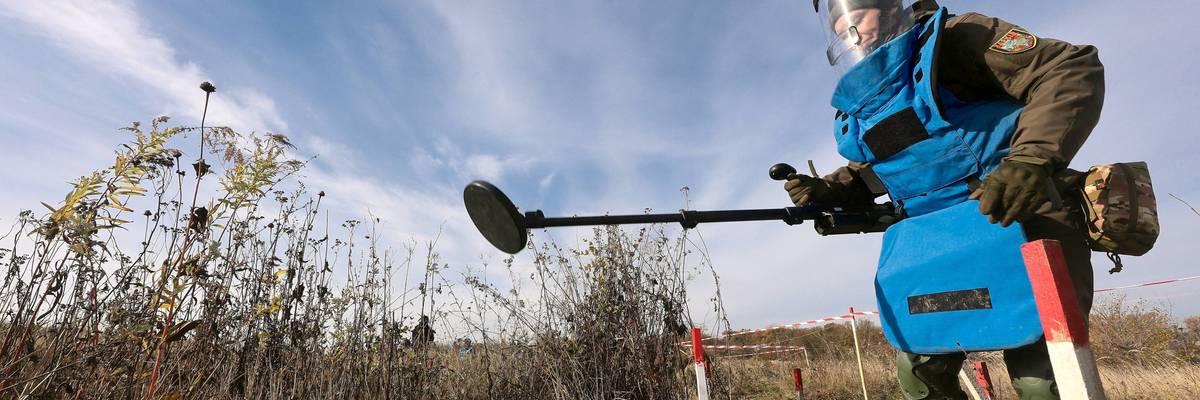
A sapper wearing protective gear uses a metal detector at a training ground near Kharkiv, Ukraine on October 29, 2026.
“It is civilians, especially children, who continue to suffer terrible harm from landmines. This harm is avoidable, but only if all countries commit to preventing any further use."
An advocacy coalition working to eradicate the production and use of antipersonnel landmines worldwide said Tuesday that such weapons killed or injured at least 6,929 people last year, the highest toll since 2020 and a sign of growing cracks in the 1997 treaty banning the mines.
Civilians made up at least 84% of those killed or injured by landmines in 2025, according to the International Campaign to Ban Landmines (ICBL). The campaign's latest "Landmine Monitor" report estimates that, in cases where the age group of victims was known, children made up 50% of the casualties. Afghanistan was the most-impacted state party to the 1997 ban, with nearly 500 casualties last year. Myanmar, whose government was found guilty of genocide earlier this month, recorded the most landmine casualties for 2025 overall, with 1,891.
"It is civilians, especially children, who continue to suffer terrible harm from landmines," said Loren Persi Vicentic, an editor of the new report. "This harm is avoidable, but only if all countries commit to preventing any further use."
ICBL said that the Mine Ban Treaty faces its "greatest test" in nearly three decades, noting that five countries—Estonia, Finland, Latvia, Lithuania, and Poland—ditched the convention over the last year, "the first withdrawals in its history."
"Poland and Finland are preparing to bring antipersonnel mines back into their arsenals," the report says. "Poland is moving to acquire almost 15 million antipersonnel mines from domestic manufacturers, with production poised to begin as early as the end of 2026."
Ukraine, a state party to the 1997 agreement, used landmines against invading Russian forces, in violation of its treaty obligations, the new report observes. The report also found that countries not party to the treaty—Iran, Myanmar, North Korea, Russia, and "possibly" the US—have recently used landmines.
"Open-source researchers reviewed and geolocated visual evidence that indicates US forces may have used antivehicle mines from the air-delivered GATOR Mine Scattering System in or near populated areas of Iran in March 2026," the report states, noting that the Trump administration last year reversed earlier US limits on landmine use.
Tamar Gabelnick, ICBL's director, said that while the "withdrawals, new use, and new production" of landmines "are dangerous steps backward" for the 1997 ban, "they do not define the treaty."
“We urge all states to reject the production and use of antipersonnel mines, by any actor, under any circumstances," said Gabelnick.
This country and this world are at a monumental crossroads. US voters have an opportunity to beat back the forces of fascism and confront the billionaires who are rigging the economy, our media system, and our democracy, making it increasingly impossible for ordinary people to get by. We’re not just talking about the election. We’re talking about what must be done once these fascist elements are vanquished from power. We need a bolder set of solutions than what either major party has so far been willing to offer and a working-class movement ready to fight like hell for it. Trump didn't emerge from nowhere. The conditions that fueled MAGA authoritarianism were created by decades of radical neoliberal economic policies and a corrupt political system dominated by corporate interests. They slashed taxes on the super-rich, promising that the benefits would trickle down. They said giveaways to the corporate titans would make life more affordable for the rest of us. It was all bullshit. And when a bitter, betrayed populace searches for someone to blame, right-wing demagogues have little trouble finding scapegoats. People know when they're being lied to, but you won't hear any of this from the corporate media. Only independent journalism—powered and funded by people who believe in building a better world—can deliver truly trustworthy daily news. If you share our vision, please contribute whatever you can to sustain our work. |
An advocacy coalition working to eradicate the production and use of antipersonnel landmines worldwide said Tuesday that such weapons killed or injured at least 6,929 people last year, the highest toll since 2020 and a sign of growing cracks in the 1997 treaty banning the mines.
Civilians made up at least 84% of those killed or injured by landmines in 2025, according to the International Campaign to Ban Landmines (ICBL). The campaign's latest "Landmine Monitor" report estimates that, in cases where the age group of victims was known, children made up 50% of the casualties. Afghanistan was the most-impacted state party to the 1997 ban, with nearly 500 casualties last year. Myanmar, whose government was found guilty of genocide earlier this month, recorded the most landmine casualties for 2025 overall, with 1,891.
"It is civilians, especially children, who continue to suffer terrible harm from landmines," said Loren Persi Vicentic, an editor of the new report. "This harm is avoidable, but only if all countries commit to preventing any further use."
ICBL said that the Mine Ban Treaty faces its "greatest test" in nearly three decades, noting that five countries—Estonia, Finland, Latvia, Lithuania, and Poland—ditched the convention over the last year, "the first withdrawals in its history."
"Poland and Finland are preparing to bring antipersonnel mines back into their arsenals," the report says. "Poland is moving to acquire almost 15 million antipersonnel mines from domestic manufacturers, with production poised to begin as early as the end of 2026."
Ukraine, a state party to the 1997 agreement, used landmines against invading Russian forces, in violation of its treaty obligations, the new report observes. The report also found that countries not party to the treaty—Iran, Myanmar, North Korea, Russia, and "possibly" the US—have recently used landmines.
"Open-source researchers reviewed and geolocated visual evidence that indicates US forces may have used antivehicle mines from the air-delivered GATOR Mine Scattering System in or near populated areas of Iran in March 2026," the report states, noting that the Trump administration last year reversed earlier US limits on landmine use.
Tamar Gabelnick, ICBL's director, said that while the "withdrawals, new use, and new production" of landmines "are dangerous steps backward" for the 1997 ban, "they do not define the treaty."
“We urge all states to reject the production and use of antipersonnel mines, by any actor, under any circumstances," said Gabelnick.

