
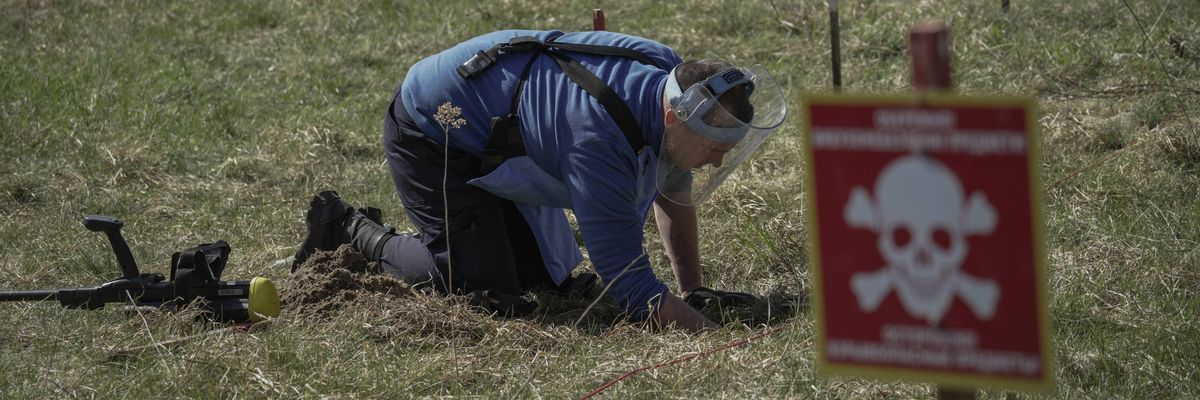
Ukrainian deminers from the HALO Trust, worldwide humanitarian nongovernment organization, clear territories on April 17, 2025 in Chernihiv Oblast, Ukraine. Due to the ongoing Russian-Ukrainian war, Ukraine is now one of the most mined countries in the world.
'Devastating': Amnesty Rips Hegseth Memo Reversing Limits on Landmines
“Antipersonnel landmines are inherently indiscriminate weapons that take a disproportionate toll on civilian lives, oftentimes long after conflicts end," said the group's director for Europe and Central Asia.
In a move decried by human rights organizations, the Trump administration has scrapped a Biden-era prohibition on the use of antipersonnel landmines, which killed thousands of noncombatants last year.
The Washington Post reported on Friday that US Secretary of Defense Pete Hegseth sent a memo on December 2 reversing the policy, saying the use of such mines would provide the US military with a “force multiplier” against enemies during “one of the most dangerous security environments in its history.”
“Antipersonnel landmines are inherently indiscriminate weapons that take a disproportionate toll on civilian lives, oftentimes long after conflicts end," explained Ben Linden, Amnesty International USA's advocacy director for Europe and Central Asia, in a statement on Tuesday.
According to a report published earlier this month by the Nobel Peace Prize-winning International Committee to Ban Landmines (ICBL), antipersonnel landmines and other explosive remnants of war killed at least 1,945 people and injured another 4,325 in 2024—the highest yearly casualty figure since 2020 and a 9% increase from the previous year.
Ninety percent of those casualties were civilians, and 46% of those civilians were children.
More than 160 countries have signed an international treaty, written in 1997, banning the use of antipersonnel landmines, defined as mines “designed to be exploded by the presence, proximity or contact of a person and that will incapacitate, injure or kill one or more persons” in war.
The US military has not used antipersonnel mines widely since the Persian Gulf War over three decades ago. However, it is one of the few countries that has not signed the treaty, known as the Ottawa Convention, and until earlier this year was the only NATO member not to participate.
In June 2022—just months after Russia launched its invasion of Ukraine—then-President Joe Biden announced the US would begin to follow many provisions of the convention, outlawing the use of antipersonnel mines in war zones with the exception of the Korean Peninsula. It was a return to a policy instituted under former President Barack Obama, before it was rolled back during the first Trump administration.
The Biden White House cited the mines' "disproportionate impact on civilians, including children," and drew a contrast with Russia, which it said was using the mines "irresponsibly" in civilian areas.
But Biden would reverse the policy just two years later, opting in 2024 to greenlight their provision to Ukraine, which was forbidden from acquiring or using the mines under the treaty.
The ICBL, a leading donor to global mine clearance, condemned the move, noting that "Ukraine already faces years of demining due to Russian landmine use."
In his memo, Hegseth has delivered another blow to global demining efforts. According to the Post:
He outlines five objectives for the new policy—including lifting geographic limits on the use of landmines, which would allow for their use globally, and giving combatant commanders the authority to use the explosives. It would also limit the destruction of landmines in the US inventory only to those that are “inoperable or unsafe."
The decision comes as other state actors are rapidly abandoning their obligations under the landmine treaty. Last week, Poland announced that after withdrawing from the convention, it plans to start producing antipersonnel mines again, deploying them to the eastern border, and possibly exporting them to Ukraine.
According to the ICBL report, Cambodia, Iran, Myanmar, and North Korea have all been alleged to have used mines within the last year. Meanwhile, Estonia, Finland, Latvia, and Lithuania are also in the process of withdrawing from the Ottawa Treaty, while Ukraine is trying to “suspend the operation” of the convention during its war with Russia.
Hegseth's memo also states that President Donald Trump has rescinded the US Humanitarian Mine Program, a long-running government initiative that helps partner nations find and destroy unexploded landmines.
According to the Landmine and Cluster Munition Monitor, the research arm of the Campaign to Ban Landmines, the US was the largest global donor to mine-clearing actions around the world in 2024. According to the State Department, it has provided more than $5 billion in assistance to more than 125 countries and areas since 1993.
Some of the money for the program has already been revoked through the Trump administration's slashing of funds for the US Agency for International Development (USAID) at the beginning of his term. The administration ordered mine-clearing nonprofits funded by the agency to cease operations "effective immediately."
According to a report earlier this month from the Century Foundation, the State Department "terminated or let expire" nearly 100 security assistance programs, which included demining programs, as part of its "foreign aid review" in January.
Hegseth's memo states that despite the end of the program, the US will remain "a global leader in unexploded ordnance clearing assistance and in conventional weapons destruction." It provides no details on how the new policy would allow for this.
Linden at Amnesty International called Hegseth's reversal of the landmine policy a "devastating decision."
"Not only will this policy change put more civilians at increased risk of harm, but it will undermine global efforts to eliminate the use of these dangerous weapons," Linden said. “This landmine policy reversal would make the United States and its partners less safe by eroding the prohibition against the use of these indiscriminate weapons on the battlefield."
We are at a crossroads
This country and this world are at a monumental crossroads. In a few short weeks, US voters will have an opportunity to beat back the forces of fascism and confront the billionaires who are rigging the economy, our media system, and our democracy, making it increasingly impossible for ordinary people to get by. We’re not just talking about the election. We’re talking about what must be done once these fascist elements are vanquished from power. We need a bolder set of solutions than what either major party has so far been willing to offer and a working-class movement ready to fight like hell for it. Trump didn't emerge from nowhere. The conditions that fueled MAGA authoritarianism were created by decades of radical neoliberal economic policies and a corrupt political system dominated by corporate interests. They slashed taxes on the super-rich, promising that the benefits would trickle down. They said giveaways to the corporate titans would make life more affordable for the rest of us. It was all bullshit. And when a bitter, betrayed populace searches for someone to blame, right-wing demagogues have little trouble finding scapegoats. People know when they're being lied to, but you won't hear any of this from the corporate media. Only independent journalism—powered and funded by people who believe in building a better world—can deliver truly trustworthy daily news. Our Fall Campaign is underway, and we need your help. To power our newsroom through the rest of the year, we need to raise $125,000 by midnight on October 31. So if you share our vision, please contribute whatever you can to sustain our work. |
In a move decried by human rights organizations, the Trump administration has scrapped a Biden-era prohibition on the use of antipersonnel landmines, which killed thousands of noncombatants last year.
The Washington Post reported on Friday that US Secretary of Defense Pete Hegseth sent a memo on December 2 reversing the policy, saying the use of such mines would provide the US military with a “force multiplier” against enemies during “one of the most dangerous security environments in its history.”
“Antipersonnel landmines are inherently indiscriminate weapons that take a disproportionate toll on civilian lives, oftentimes long after conflicts end," explained Ben Linden, Amnesty International USA's advocacy director for Europe and Central Asia, in a statement on Tuesday.
According to a report published earlier this month by the Nobel Peace Prize-winning International Committee to Ban Landmines (ICBL), antipersonnel landmines and other explosive remnants of war killed at least 1,945 people and injured another 4,325 in 2024—the highest yearly casualty figure since 2020 and a 9% increase from the previous year.
Ninety percent of those casualties were civilians, and 46% of those civilians were children.
More than 160 countries have signed an international treaty, written in 1997, banning the use of antipersonnel landmines, defined as mines “designed to be exploded by the presence, proximity or contact of a person and that will incapacitate, injure or kill one or more persons” in war.
The US military has not used antipersonnel mines widely since the Persian Gulf War over three decades ago. However, it is one of the few countries that has not signed the treaty, known as the Ottawa Convention, and until earlier this year was the only NATO member not to participate.
In June 2022—just months after Russia launched its invasion of Ukraine—then-President Joe Biden announced the US would begin to follow many provisions of the convention, outlawing the use of antipersonnel mines in war zones with the exception of the Korean Peninsula. It was a return to a policy instituted under former President Barack Obama, before it was rolled back during the first Trump administration.
The Biden White House cited the mines' "disproportionate impact on civilians, including children," and drew a contrast with Russia, which it said was using the mines "irresponsibly" in civilian areas.
But Biden would reverse the policy just two years later, opting in 2024 to greenlight their provision to Ukraine, which was forbidden from acquiring or using the mines under the treaty.
The ICBL, a leading donor to global mine clearance, condemned the move, noting that "Ukraine already faces years of demining due to Russian landmine use."
In his memo, Hegseth has delivered another blow to global demining efforts. According to the Post:
He outlines five objectives for the new policy—including lifting geographic limits on the use of landmines, which would allow for their use globally, and giving combatant commanders the authority to use the explosives. It would also limit the destruction of landmines in the US inventory only to those that are “inoperable or unsafe."
The decision comes as other state actors are rapidly abandoning their obligations under the landmine treaty. Last week, Poland announced that after withdrawing from the convention, it plans to start producing antipersonnel mines again, deploying them to the eastern border, and possibly exporting them to Ukraine.
According to the ICBL report, Cambodia, Iran, Myanmar, and North Korea have all been alleged to have used mines within the last year. Meanwhile, Estonia, Finland, Latvia, and Lithuania are also in the process of withdrawing from the Ottawa Treaty, while Ukraine is trying to “suspend the operation” of the convention during its war with Russia.
Hegseth's memo also states that President Donald Trump has rescinded the US Humanitarian Mine Program, a long-running government initiative that helps partner nations find and destroy unexploded landmines.
According to the Landmine and Cluster Munition Monitor, the research arm of the Campaign to Ban Landmines, the US was the largest global donor to mine-clearing actions around the world in 2024. According to the State Department, it has provided more than $5 billion in assistance to more than 125 countries and areas since 1993.
Some of the money for the program has already been revoked through the Trump administration's slashing of funds for the US Agency for International Development (USAID) at the beginning of his term. The administration ordered mine-clearing nonprofits funded by the agency to cease operations "effective immediately."
According to a report earlier this month from the Century Foundation, the State Department "terminated or let expire" nearly 100 security assistance programs, which included demining programs, as part of its "foreign aid review" in January.
Hegseth's memo states that despite the end of the program, the US will remain "a global leader in unexploded ordnance clearing assistance and in conventional weapons destruction." It provides no details on how the new policy would allow for this.
Linden at Amnesty International called Hegseth's reversal of the landmine policy a "devastating decision."
"Not only will this policy change put more civilians at increased risk of harm, but it will undermine global efforts to eliminate the use of these dangerous weapons," Linden said. “This landmine policy reversal would make the United States and its partners less safe by eroding the prohibition against the use of these indiscriminate weapons on the battlefield."
In a move decried by human rights organizations, the Trump administration has scrapped a Biden-era prohibition on the use of antipersonnel landmines, which killed thousands of noncombatants last year.
The Washington Post reported on Friday that US Secretary of Defense Pete Hegseth sent a memo on December 2 reversing the policy, saying the use of such mines would provide the US military with a “force multiplier” against enemies during “one of the most dangerous security environments in its history.”
“Antipersonnel landmines are inherently indiscriminate weapons that take a disproportionate toll on civilian lives, oftentimes long after conflicts end," explained Ben Linden, Amnesty International USA's advocacy director for Europe and Central Asia, in a statement on Tuesday.
According to a report published earlier this month by the Nobel Peace Prize-winning International Committee to Ban Landmines (ICBL), antipersonnel landmines and other explosive remnants of war killed at least 1,945 people and injured another 4,325 in 2024—the highest yearly casualty figure since 2020 and a 9% increase from the previous year.
Ninety percent of those casualties were civilians, and 46% of those civilians were children.
More than 160 countries have signed an international treaty, written in 1997, banning the use of antipersonnel landmines, defined as mines “designed to be exploded by the presence, proximity or contact of a person and that will incapacitate, injure or kill one or more persons” in war.
The US military has not used antipersonnel mines widely since the Persian Gulf War over three decades ago. However, it is one of the few countries that has not signed the treaty, known as the Ottawa Convention, and until earlier this year was the only NATO member not to participate.
In June 2022—just months after Russia launched its invasion of Ukraine—then-President Joe Biden announced the US would begin to follow many provisions of the convention, outlawing the use of antipersonnel mines in war zones with the exception of the Korean Peninsula. It was a return to a policy instituted under former President Barack Obama, before it was rolled back during the first Trump administration.
The Biden White House cited the mines' "disproportionate impact on civilians, including children," and drew a contrast with Russia, which it said was using the mines "irresponsibly" in civilian areas.
But Biden would reverse the policy just two years later, opting in 2024 to greenlight their provision to Ukraine, which was forbidden from acquiring or using the mines under the treaty.
The ICBL, a leading donor to global mine clearance, condemned the move, noting that "Ukraine already faces years of demining due to Russian landmine use."
In his memo, Hegseth has delivered another blow to global demining efforts. According to the Post:
He outlines five objectives for the new policy—including lifting geographic limits on the use of landmines, which would allow for their use globally, and giving combatant commanders the authority to use the explosives. It would also limit the destruction of landmines in the US inventory only to those that are “inoperable or unsafe."
The decision comes as other state actors are rapidly abandoning their obligations under the landmine treaty. Last week, Poland announced that after withdrawing from the convention, it plans to start producing antipersonnel mines again, deploying them to the eastern border, and possibly exporting them to Ukraine.
According to the ICBL report, Cambodia, Iran, Myanmar, and North Korea have all been alleged to have used mines within the last year. Meanwhile, Estonia, Finland, Latvia, and Lithuania are also in the process of withdrawing from the Ottawa Treaty, while Ukraine is trying to “suspend the operation” of the convention during its war with Russia.
Hegseth's memo also states that President Donald Trump has rescinded the US Humanitarian Mine Program, a long-running government initiative that helps partner nations find and destroy unexploded landmines.
According to the Landmine and Cluster Munition Monitor, the research arm of the Campaign to Ban Landmines, the US was the largest global donor to mine-clearing actions around the world in 2024. According to the State Department, it has provided more than $5 billion in assistance to more than 125 countries and areas since 1993.
Some of the money for the program has already been revoked through the Trump administration's slashing of funds for the US Agency for International Development (USAID) at the beginning of his term. The administration ordered mine-clearing nonprofits funded by the agency to cease operations "effective immediately."
According to a report earlier this month from the Century Foundation, the State Department "terminated or let expire" nearly 100 security assistance programs, which included demining programs, as part of its "foreign aid review" in January.
Hegseth's memo states that despite the end of the program, the US will remain "a global leader in unexploded ordnance clearing assistance and in conventional weapons destruction." It provides no details on how the new policy would allow for this.
Linden at Amnesty International called Hegseth's reversal of the landmine policy a "devastating decision."
"Not only will this policy change put more civilians at increased risk of harm, but it will undermine global efforts to eliminate the use of these dangerous weapons," Linden said. “This landmine policy reversal would make the United States and its partners less safe by eroding the prohibition against the use of these indiscriminate weapons on the battlefield."