SUBSCRIBE TO OUR FREE NEWSLETTER
Daily news & progressive opinion—funded by the people, not the corporations—delivered straight to your inbox.
5
#000000
#FFFFFF
To donate by check, phone, or other method, see our More Ways to Give page.
Daily news & progressive opinion—funded by the people, not the corporations—delivered straight to your inbox.
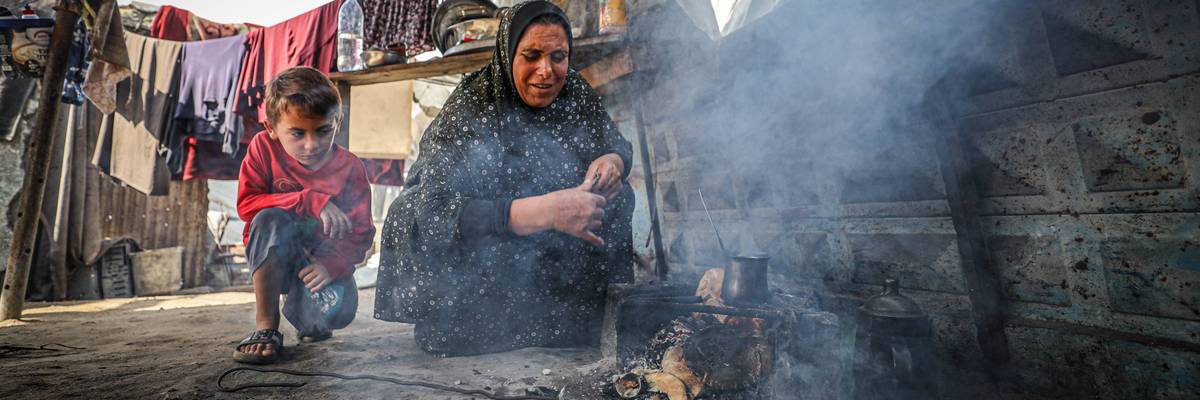
Palestinian mother Ismet Subh cooks food on a makeshift stove as her family struggles to survive in difficult conditions, living in a makeshift tent in Gaza City, Gaza, Palestine, on September 22, 2026.
"We have moved from development blocked to development reversed," said the UN official behind a new report.
Israel’s US-backed military assault on Gaza has not only caused mass death and destruction; it has also created “the world’s most severe economic crisis on record,” according to Pedro Manuel Moreno, the acting secretary-general of the United Nations Conference on Trade and Development.
Moreno presented a recent report at a press conference on Thursday showing that 92% of economic establishments in Gaza—including shops, factories, restaurants, and farms—have been damaged or destroyed since Israel launched its assault on the territory in October 2023 and reduced most of its infrastructure to rubble.
Less than 1.5% of cropland across the strip remained accessible and undamaged, while more than half of its hospitals and primary health clinics have been rendered nonfunctional.
Compared with 2022, Gaza’s main productive sectors have been almost entirely wiped out: Agricultural and industrial output were each down 94%, while construction was down 99% in 2025. With most of its economic capacity destroyed, unemployment in the exclave skyrocketed to 78% in 2025, while tremendous scarcity led prices to soar to 274% above 2022 levels.
Dropping to just 17% of its 2022 level, Gaza’s gross domestic product (GDP) per capita cratered to $212 in 2025, equivalent to about 58 cents per person per day.
"Productive capacity is wiped out while the entire population is displaced and condemned to multidimensional poverty," said UNCTAD's coordinator for assistance to the Palestinians, Mutasim Elagraa, who led work on the report. "By multidimensional poverty I mean not just income poverty; it's also a lack of proper shelter, a lack of access to basic services like health and education and sanitation."
"Before the onset of this crisis in October 2023, two out of three residents were poor," Elagraa continued. "Today, everyone in Gaza is multidimensionally poor."
These conditions have increased the territory's reliance on outside aid, which Israel has often blocked, leading UN experts and human rights organizations to accuse its leaders of using starvation and deprivation as "weapons of war."
The International Criminal Court has found reasonable grounds to believe that Israeli Prime Minister Benjamin Netanyahu—who gave a defiant speech denying Israel's responsibility for genocide at the UN General Assembly Thursday—bears criminal responsibility for the war crime of starvation as a method of warfare.
The report estimates that $71.5 billion will be needed for recovery and reconstruction, as well as $35.2 billion in physical infrastructure damage and $22.7 billion in economic and social losses.
"Restoring the collapsed health system, rebuilding destroyed education infrastructure and other public infrastructure will need to go together while restoring productive capacity, employment, functioning markets and the ability for businesses to operate," Moreno said. "Peace cannot be built on a collapsed economy."
Though the report emphasizes how Israel's bombardment has brought near-apocalyptic conditions upon the strip, it notes that Gaza's economic deprivation dates back decades before the Hamas-led attack in October 2023, which was the catalyst for the unprecedented assault.
It noted that 59 years of Israeli occupation of Palestine had severely stunted its economic growth, particularly as it tightened its blockade of Gaza in the last two decades.
Previous UNCTAD analyses have shown that between 2006, a year before Israel began its land, air, and sea blockade of Gaza, and 2022, Gaza's real GDP per capita fell by 37% while its productive economy, including agriculture and manufacturing, was hollowed out by Israel's restrictions on movement and imports. Even before 2023, nearly half of Gaza's workforce was unemployed, roughly two-thirds lived in poverty, and 80% depended on international aid.
“The central message of this report we are talking about today is that about six decades of occupation have hollowed out the Palestinian economy and de-developed it,” Elagraa said. “We have moved from development blocked to development reversed, and now decades of human development that has been achieved in Gaza has been wiped out."
"Although the intensity of destruction is far more in Gaza" than in the West Bank, he said, the report showed the "destruction" to be "a dramatic escalation of a pattern that dates back to 1967 with the onset of occupation."
"The report," he said, "maintains that history did not start in October 2023."
Dear Common Dreams reader, It’s been nearly 30 years since I co-founded Common Dreams with my late wife, Lina Newhouser. We had the radical notion that journalism should serve the public good, not corporate profits. It was clear to us from the outset what it would take to build such a project. No paid advertisements. No corporate sponsors. No millionaire publisher telling us what to think or do. Many people said we wouldn't last a year, but we proved those doubters wrong. Together with a tremendous team of journalists and dedicated staff, we built an independent media outlet free from the constraints of profits and corporate control. Our mission has always been simple: To inform. To inspire. To ignite change for the common good. Building Common Dreams was not easy. Our survival was never guaranteed. When you take on the most powerful forces—Wall Street greed, fossil fuel industry destruction, Big Tech lobbyists, and uber-rich oligarchs who have spent billions upon billions rigging the economy and democracy in their favor—the only bulwark you have is supporters who believe in your work. But here’s the urgent message from me today. It's never been this bad out there. And it's never been this hard to keep us going. At the very moment Common Dreams is most needed, the threats we face are intensifying. We need your support now more than ever. We don't accept corporate advertising and never will. We don't have a paywall because we don't think people should be blocked from critical news based on their ability to pay. Everything we do is funded by the donations of readers like you. When everyone does the little they can afford, we are strong. But if that support retreats or dries up, so do we. Will you donate now to make sure Common Dreams not only survives but thrives? —Craig Brown, Co-founder |
Israel’s US-backed military assault on Gaza has not only caused mass death and destruction; it has also created “the world’s most severe economic crisis on record,” according to Pedro Manuel Moreno, the acting secretary-general of the United Nations Conference on Trade and Development.
Moreno presented a recent report at a press conference on Thursday showing that 92% of economic establishments in Gaza—including shops, factories, restaurants, and farms—have been damaged or destroyed since Israel launched its assault on the territory in October 2023 and reduced most of its infrastructure to rubble.
Less than 1.5% of cropland across the strip remained accessible and undamaged, while more than half of its hospitals and primary health clinics have been rendered nonfunctional.
Compared with 2022, Gaza’s main productive sectors have been almost entirely wiped out: Agricultural and industrial output were each down 94%, while construction was down 99% in 2025. With most of its economic capacity destroyed, unemployment in the exclave skyrocketed to 78% in 2025, while tremendous scarcity led prices to soar to 274% above 2022 levels.
Dropping to just 17% of its 2022 level, Gaza’s gross domestic product (GDP) per capita cratered to $212 in 2025, equivalent to about 58 cents per person per day.
"Productive capacity is wiped out while the entire population is displaced and condemned to multidimensional poverty," said UNCTAD's coordinator for assistance to the Palestinians, Mutasim Elagraa, who led work on the report. "By multidimensional poverty I mean not just income poverty; it's also a lack of proper shelter, a lack of access to basic services like health and education and sanitation."
"Before the onset of this crisis in October 2023, two out of three residents were poor," Elagraa continued. "Today, everyone in Gaza is multidimensionally poor."
These conditions have increased the territory's reliance on outside aid, which Israel has often blocked, leading UN experts and human rights organizations to accuse its leaders of using starvation and deprivation as "weapons of war."
The International Criminal Court has found reasonable grounds to believe that Israeli Prime Minister Benjamin Netanyahu—who gave a defiant speech denying Israel's responsibility for genocide at the UN General Assembly Thursday—bears criminal responsibility for the war crime of starvation as a method of warfare.
The report estimates that $71.5 billion will be needed for recovery and reconstruction, as well as $35.2 billion in physical infrastructure damage and $22.7 billion in economic and social losses.
"Restoring the collapsed health system, rebuilding destroyed education infrastructure and other public infrastructure will need to go together while restoring productive capacity, employment, functioning markets and the ability for businesses to operate," Moreno said. "Peace cannot be built on a collapsed economy."
Though the report emphasizes how Israel's bombardment has brought near-apocalyptic conditions upon the strip, it notes that Gaza's economic deprivation dates back decades before the Hamas-led attack in October 2023, which was the catalyst for the unprecedented assault.
It noted that 59 years of Israeli occupation of Palestine had severely stunted its economic growth, particularly as it tightened its blockade of Gaza in the last two decades.
Previous UNCTAD analyses have shown that between 2006, a year before Israel began its land, air, and sea blockade of Gaza, and 2022, Gaza's real GDP per capita fell by 37% while its productive economy, including agriculture and manufacturing, was hollowed out by Israel's restrictions on movement and imports. Even before 2023, nearly half of Gaza's workforce was unemployed, roughly two-thirds lived in poverty, and 80% depended on international aid.
“The central message of this report we are talking about today is that about six decades of occupation have hollowed out the Palestinian economy and de-developed it,” Elagraa said. “We have moved from development blocked to development reversed, and now decades of human development that has been achieved in Gaza has been wiped out."
"Although the intensity of destruction is far more in Gaza" than in the West Bank, he said, the report showed the "destruction" to be "a dramatic escalation of a pattern that dates back to 1967 with the onset of occupation."
"The report," he said, "maintains that history did not start in October 2023."
Israel’s US-backed military assault on Gaza has not only caused mass death and destruction; it has also created “the world’s most severe economic crisis on record,” according to Pedro Manuel Moreno, the acting secretary-general of the United Nations Conference on Trade and Development.
Moreno presented a recent report at a press conference on Thursday showing that 92% of economic establishments in Gaza—including shops, factories, restaurants, and farms—have been damaged or destroyed since Israel launched its assault on the territory in October 2023 and reduced most of its infrastructure to rubble.
Less than 1.5% of cropland across the strip remained accessible and undamaged, while more than half of its hospitals and primary health clinics have been rendered nonfunctional.
Compared with 2022, Gaza’s main productive sectors have been almost entirely wiped out: Agricultural and industrial output were each down 94%, while construction was down 99% in 2025. With most of its economic capacity destroyed, unemployment in the exclave skyrocketed to 78% in 2025, while tremendous scarcity led prices to soar to 274% above 2022 levels.
Dropping to just 17% of its 2022 level, Gaza’s gross domestic product (GDP) per capita cratered to $212 in 2025, equivalent to about 58 cents per person per day.
"Productive capacity is wiped out while the entire population is displaced and condemned to multidimensional poverty," said UNCTAD's coordinator for assistance to the Palestinians, Mutasim Elagraa, who led work on the report. "By multidimensional poverty I mean not just income poverty; it's also a lack of proper shelter, a lack of access to basic services like health and education and sanitation."
"Before the onset of this crisis in October 2023, two out of three residents were poor," Elagraa continued. "Today, everyone in Gaza is multidimensionally poor."
These conditions have increased the territory's reliance on outside aid, which Israel has often blocked, leading UN experts and human rights organizations to accuse its leaders of using starvation and deprivation as "weapons of war."
The International Criminal Court has found reasonable grounds to believe that Israeli Prime Minister Benjamin Netanyahu—who gave a defiant speech denying Israel's responsibility for genocide at the UN General Assembly Thursday—bears criminal responsibility for the war crime of starvation as a method of warfare.
The report estimates that $71.5 billion will be needed for recovery and reconstruction, as well as $35.2 billion in physical infrastructure damage and $22.7 billion in economic and social losses.
"Restoring the collapsed health system, rebuilding destroyed education infrastructure and other public infrastructure will need to go together while restoring productive capacity, employment, functioning markets and the ability for businesses to operate," Moreno said. "Peace cannot be built on a collapsed economy."
Though the report emphasizes how Israel's bombardment has brought near-apocalyptic conditions upon the strip, it notes that Gaza's economic deprivation dates back decades before the Hamas-led attack in October 2023, which was the catalyst for the unprecedented assault.
It noted that 59 years of Israeli occupation of Palestine had severely stunted its economic growth, particularly as it tightened its blockade of Gaza in the last two decades.
Previous UNCTAD analyses have shown that between 2006, a year before Israel began its land, air, and sea blockade of Gaza, and 2022, Gaza's real GDP per capita fell by 37% while its productive economy, including agriculture and manufacturing, was hollowed out by Israel's restrictions on movement and imports. Even before 2023, nearly half of Gaza's workforce was unemployed, roughly two-thirds lived in poverty, and 80% depended on international aid.
“The central message of this report we are talking about today is that about six decades of occupation have hollowed out the Palestinian economy and de-developed it,” Elagraa said. “We have moved from development blocked to development reversed, and now decades of human development that has been achieved in Gaza has been wiped out."
"Although the intensity of destruction is far more in Gaza" than in the West Bank, he said, the report showed the "destruction" to be "a dramatic escalation of a pattern that dates back to 1967 with the onset of occupation."
"The report," he said, "maintains that history did not start in October 2023."