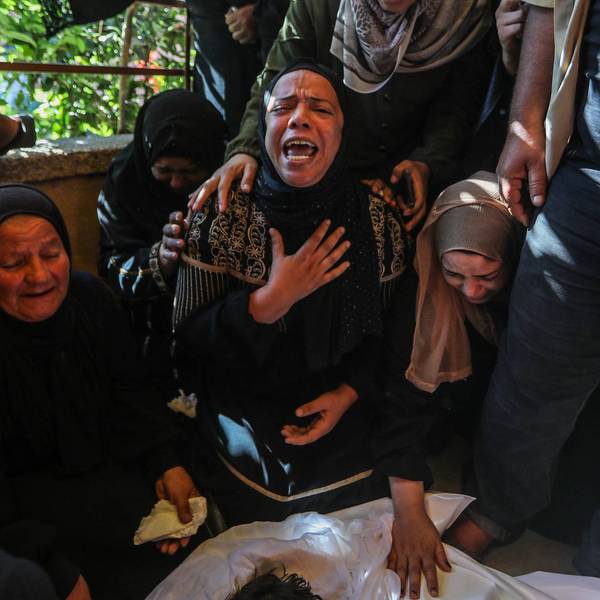
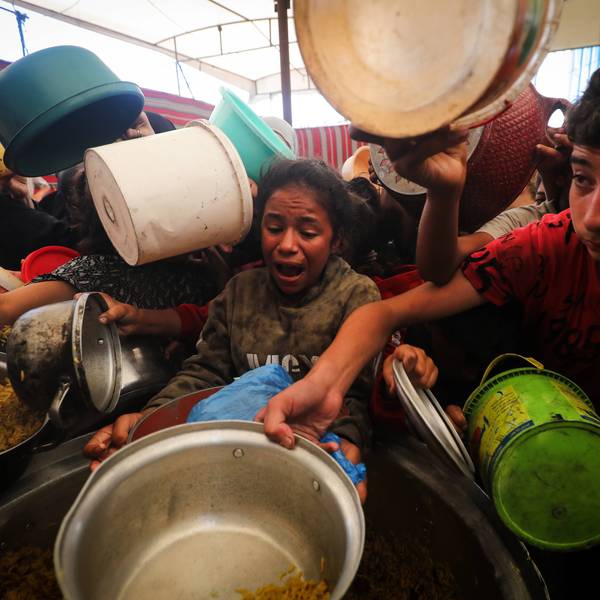
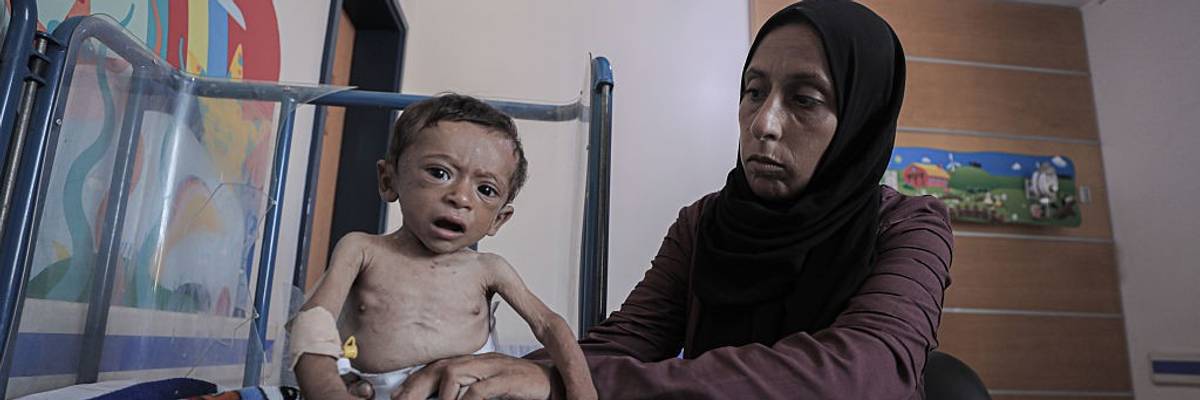
Seven-month-old Hasan Ahmed Felfel, whose condition is worsening by the day due to severe malnutrition, putting his life at serious risk, receives treatment under limited conditions at Abdel Aziz al-Rantisi Hospital in the Nasser neighborhood of Gaza City, Gaza, on August 3, 2025.
Man-Made Famine Is Starving Gaza’s Children
This is the real front line in this conflict; a child clinging to life through a sachet of RUTF, now forced to flee. But none of this is inevitable. It is a choice.
Gaza is in the midst of a manufactured famine. I have witnessed far too many humanitarian catastrophes, but Gaza is unique. Gazans are 100% dependent on the flow of food into their territory, and there is only one actor controlling the tap: Israel. What is occurring in Gaza right now is the systematic starvation of an entire population, and children are bearing the cruelest brunt.
My MedGlobal colleagues have ample medical expertise to treat all manner of injury and illness in Gaza. But right now they face an overwhelming wave of malnutrition, and without medicines and sachets of Ready-to-Use Therapeutic Food (RUTF) to give to their patients, there is only so much they care they can offer. Within a 72-hour window in July, my colleagues watched devastated and helpless as five children between the ages of 3 months and 4 years died due to complications directly linked to malnutrition.
At MedGlobal’s primary health clinics across Gaza, we are treating children who weigh merely 4 pounds (1.8 kilograms) at birth. Gazan mothers are so malnourished that they cannot breastfeed their infants, leaving newborns with no source of nutrition in a place where baby formula and clean water are scarce. Among pregnant and lactating women, 22% are acutely malnourished, and for teenage girls aged 15-19, that figure is a devastating 39%, condemning a generation to irreversible harm during their most critical developmental years.
This was an entirely predictable consequence of the near total blockade imposed on Gaza in March of this year. Starvation does not occur immediately, but deny food to an entire population over time and that is the only possible outcome. MedGlobal's recent report, Starved by Siege, reveals a skyrocketing of acute malnutrition among children under 5 to 16.8%, surpassing the famine threshold in just a few months. Our data show that more children died from malnutrition in July alone than in the previous six months combined.
Like this, the war has entered every Gazan household. As acute malnutrition rates have soared by 2,000% since the escalation of hostilities in 2023, health facilities are overrun with the casualties. As a MedGlobal doctor put it, “I looked at her feeding him the RUTF sachet and I realized… this is the front line. Not the rubble. Not the noise. This: a mother trying to keep her child alive with one packet of lifesaving food.”
As a neutral humanitarian organization, MedGlobal does not pick sides in a war, nor is our objective to end wars; we simply aim to preserve a measure of humanity in the midst of war. The Geneva Conventions lay out the rules for doing so, the most fundamental of which is that noncombatants are protected. As signatory to the Geneva Conventions, Israel has written these rules into its own law.
There is only one humane path forward: Respect the first rule of the Geneva Conventions and stop targeting noncombatants in this war.
Protected persons may not be targeted, and warring parties must allow and facilitate access to the basic means of survival. This includes food. While families starve inside Gaza, humanitarian aid sits in warehouses just outside, waiting for Israeli approval. The World Food Programme (WFP) has enough food ready to feed all of Gaza for three months. MedGlobal has medicine and nutrition supplies to treat over 10,000 children. This willful denial of an entire population’s access to food is a war crime.
What happened on October 7, 2023 was a horrendous and brutal crime too. How many more children will have to pay for that crime with their lives? There is only one humane path forward: Respect the first rule of the Geneva Conventions and stop targeting noncombatants in this war. More specifically, Gaza needs an immediate ceasefire, an end to the blockade, unimpeded access for humanitarian organizations, and the protection of healthcare facilities, health workers, and patients.
Yet, as I write this my colleagues are evacuating Gaza City in the midst of a full-scale invasion. Just two weeks ago, one of my colleagues was killed in the initial stages of this offensive. Our medical activities, including care for the malnourished, are being transplanted to areas further south, but many of our patients are in critical condition and will not survive the move.
This is the real front line in this conflict; a child clinging to life through a sachet of RUTF, now forced to flee. But none of this is inevitable. It is a choice.
Seventy-seven years ago, member states of the United Nations united in a shared commitment captured in the words “Never Again.” A genocide had occurred and the world said it would never again tolerate another. Are we tolerating one now?
We are at a crossroads
This country and this world are at a monumental crossroads. In a few short weeks, US voters will have an opportunity to beat back the forces of fascism and confront the billionaires who are rigging the economy, our media system, and our democracy, making it increasingly impossible for ordinary people to get by. We’re not just talking about the election. We’re talking about what must be done once these fascist elements are vanquished from power. We need a bolder set of solutions than what either major party has so far been willing to offer and a working-class movement ready to fight like hell for it. Trump didn't emerge from nowhere. The conditions that fueled MAGA authoritarianism were created by decades of radical neoliberal economic policies and a corrupt political system dominated by corporate interests. They slashed taxes on the super-rich, promising that the benefits would trickle down. They said giveaways to the corporate titans would make life more affordable for the rest of us. It was all bullshit. And when a bitter, betrayed populace searches for someone to blame, right-wing demagogues have little trouble finding scapegoats. People know when they're being lied to, but you won't hear any of this from the corporate media. Only independent journalism—powered and funded by people who believe in building a better world—can deliver truly trustworthy daily news. Our Fall Campaign is underway, and we need your help. To power our newsroom through the rest of the year, we need to raise $125,000 by midnight on October 31. So if you share our vision, please contribute whatever you can to sustain our work. |
Gaza is in the midst of a manufactured famine. I have witnessed far too many humanitarian catastrophes, but Gaza is unique. Gazans are 100% dependent on the flow of food into their territory, and there is only one actor controlling the tap: Israel. What is occurring in Gaza right now is the systematic starvation of an entire population, and children are bearing the cruelest brunt.
My MedGlobal colleagues have ample medical expertise to treat all manner of injury and illness in Gaza. But right now they face an overwhelming wave of malnutrition, and without medicines and sachets of Ready-to-Use Therapeutic Food (RUTF) to give to their patients, there is only so much they care they can offer. Within a 72-hour window in July, my colleagues watched devastated and helpless as five children between the ages of 3 months and 4 years died due to complications directly linked to malnutrition.
At MedGlobal’s primary health clinics across Gaza, we are treating children who weigh merely 4 pounds (1.8 kilograms) at birth. Gazan mothers are so malnourished that they cannot breastfeed their infants, leaving newborns with no source of nutrition in a place where baby formula and clean water are scarce. Among pregnant and lactating women, 22% are acutely malnourished, and for teenage girls aged 15-19, that figure is a devastating 39%, condemning a generation to irreversible harm during their most critical developmental years.
This was an entirely predictable consequence of the near total blockade imposed on Gaza in March of this year. Starvation does not occur immediately, but deny food to an entire population over time and that is the only possible outcome. MedGlobal's recent report, Starved by Siege, reveals a skyrocketing of acute malnutrition among children under 5 to 16.8%, surpassing the famine threshold in just a few months. Our data show that more children died from malnutrition in July alone than in the previous six months combined.
Like this, the war has entered every Gazan household. As acute malnutrition rates have soared by 2,000% since the escalation of hostilities in 2023, health facilities are overrun with the casualties. As a MedGlobal doctor put it, “I looked at her feeding him the RUTF sachet and I realized… this is the front line. Not the rubble. Not the noise. This: a mother trying to keep her child alive with one packet of lifesaving food.”
As a neutral humanitarian organization, MedGlobal does not pick sides in a war, nor is our objective to end wars; we simply aim to preserve a measure of humanity in the midst of war. The Geneva Conventions lay out the rules for doing so, the most fundamental of which is that noncombatants are protected. As signatory to the Geneva Conventions, Israel has written these rules into its own law.
There is only one humane path forward: Respect the first rule of the Geneva Conventions and stop targeting noncombatants in this war.
Protected persons may not be targeted, and warring parties must allow and facilitate access to the basic means of survival. This includes food. While families starve inside Gaza, humanitarian aid sits in warehouses just outside, waiting for Israeli approval. The World Food Programme (WFP) has enough food ready to feed all of Gaza for three months. MedGlobal has medicine and nutrition supplies to treat over 10,000 children. This willful denial of an entire population’s access to food is a war crime.
What happened on October 7, 2023 was a horrendous and brutal crime too. How many more children will have to pay for that crime with their lives? There is only one humane path forward: Respect the first rule of the Geneva Conventions and stop targeting noncombatants in this war. More specifically, Gaza needs an immediate ceasefire, an end to the blockade, unimpeded access for humanitarian organizations, and the protection of healthcare facilities, health workers, and patients.
Yet, as I write this my colleagues are evacuating Gaza City in the midst of a full-scale invasion. Just two weeks ago, one of my colleagues was killed in the initial stages of this offensive. Our medical activities, including care for the malnourished, are being transplanted to areas further south, but many of our patients are in critical condition and will not survive the move.
This is the real front line in this conflict; a child clinging to life through a sachet of RUTF, now forced to flee. But none of this is inevitable. It is a choice.
Seventy-seven years ago, member states of the United Nations united in a shared commitment captured in the words “Never Again.” A genocide had occurred and the world said it would never again tolerate another. Are we tolerating one now?
- UN Human Rights Chief Says 'Famine' in Gaza May Constitute 'War Crime' by Israel ›
- Top Senate Dem Says Gaza Famine is a 'Shameful Black Mark on Humanity,' Admits Party Failed to Act ›
- 'New Levels of Desperation' in Gaza as Israeli Blockade Starves 19 People to Death in One Day ›
- Famine Expert: Israel's Starvation of Gaza Most 'Minutely Designed and Controlled' Since WWII ›
- 'Worst-Case Scenario of Famine' Unfolding in Gaza: IPC Report ›
- Entire UN Security Council Except US Says Gaza Famine 'Man-Made' as 10 More People Starve to Death ›
- Gaza No Longer Officially Facing Famine—But 1.6 Million Palestinians Still in 'Man-Made Hunger Crisis' | Common Dreams ›
- Israel Exploits Attack on Iran to Reinstate Gaza 'Starvation Policy' | Common Dreams ›
- World Famine Authorities Warn Most Gazans Still Suffering 'Crisis'-Level Hunger | Common Dreams ›
Gaza is in the midst of a manufactured famine. I have witnessed far too many humanitarian catastrophes, but Gaza is unique. Gazans are 100% dependent on the flow of food into their territory, and there is only one actor controlling the tap: Israel. What is occurring in Gaza right now is the systematic starvation of an entire population, and children are bearing the cruelest brunt.
My MedGlobal colleagues have ample medical expertise to treat all manner of injury and illness in Gaza. But right now they face an overwhelming wave of malnutrition, and without medicines and sachets of Ready-to-Use Therapeutic Food (RUTF) to give to their patients, there is only so much they care they can offer. Within a 72-hour window in July, my colleagues watched devastated and helpless as five children between the ages of 3 months and 4 years died due to complications directly linked to malnutrition.
At MedGlobal’s primary health clinics across Gaza, we are treating children who weigh merely 4 pounds (1.8 kilograms) at birth. Gazan mothers are so malnourished that they cannot breastfeed their infants, leaving newborns with no source of nutrition in a place where baby formula and clean water are scarce. Among pregnant and lactating women, 22% are acutely malnourished, and for teenage girls aged 15-19, that figure is a devastating 39%, condemning a generation to irreversible harm during their most critical developmental years.
This was an entirely predictable consequence of the near total blockade imposed on Gaza in March of this year. Starvation does not occur immediately, but deny food to an entire population over time and that is the only possible outcome. MedGlobal's recent report, Starved by Siege, reveals a skyrocketing of acute malnutrition among children under 5 to 16.8%, surpassing the famine threshold in just a few months. Our data show that more children died from malnutrition in July alone than in the previous six months combined.
Like this, the war has entered every Gazan household. As acute malnutrition rates have soared by 2,000% since the escalation of hostilities in 2023, health facilities are overrun with the casualties. As a MedGlobal doctor put it, “I looked at her feeding him the RUTF sachet and I realized… this is the front line. Not the rubble. Not the noise. This: a mother trying to keep her child alive with one packet of lifesaving food.”
As a neutral humanitarian organization, MedGlobal does not pick sides in a war, nor is our objective to end wars; we simply aim to preserve a measure of humanity in the midst of war. The Geneva Conventions lay out the rules for doing so, the most fundamental of which is that noncombatants are protected. As signatory to the Geneva Conventions, Israel has written these rules into its own law.
There is only one humane path forward: Respect the first rule of the Geneva Conventions and stop targeting noncombatants in this war.
Protected persons may not be targeted, and warring parties must allow and facilitate access to the basic means of survival. This includes food. While families starve inside Gaza, humanitarian aid sits in warehouses just outside, waiting for Israeli approval. The World Food Programme (WFP) has enough food ready to feed all of Gaza for three months. MedGlobal has medicine and nutrition supplies to treat over 10,000 children. This willful denial of an entire population’s access to food is a war crime.
What happened on October 7, 2023 was a horrendous and brutal crime too. How many more children will have to pay for that crime with their lives? There is only one humane path forward: Respect the first rule of the Geneva Conventions and stop targeting noncombatants in this war. More specifically, Gaza needs an immediate ceasefire, an end to the blockade, unimpeded access for humanitarian organizations, and the protection of healthcare facilities, health workers, and patients.
Yet, as I write this my colleagues are evacuating Gaza City in the midst of a full-scale invasion. Just two weeks ago, one of my colleagues was killed in the initial stages of this offensive. Our medical activities, including care for the malnourished, are being transplanted to areas further south, but many of our patients are in critical condition and will not survive the move.
This is the real front line in this conflict; a child clinging to life through a sachet of RUTF, now forced to flee. But none of this is inevitable. It is a choice.
Seventy-seven years ago, member states of the United Nations united in a shared commitment captured in the words “Never Again.” A genocide had occurred and the world said it would never again tolerate another. Are we tolerating one now?
- UN Human Rights Chief Says 'Famine' in Gaza May Constitute 'War Crime' by Israel ›
- Top Senate Dem Says Gaza Famine is a 'Shameful Black Mark on Humanity,' Admits Party Failed to Act ›
- 'New Levels of Desperation' in Gaza as Israeli Blockade Starves 19 People to Death in One Day ›
- Famine Expert: Israel's Starvation of Gaza Most 'Minutely Designed and Controlled' Since WWII ›
- 'Worst-Case Scenario of Famine' Unfolding in Gaza: IPC Report ›
- Entire UN Security Council Except US Says Gaza Famine 'Man-Made' as 10 More People Starve to Death ›
- Gaza No Longer Officially Facing Famine—But 1.6 Million Palestinians Still in 'Man-Made Hunger Crisis' | Common Dreams ›
- Israel Exploits Attack on Iran to Reinstate Gaza 'Starvation Policy' | Common Dreams ›
- World Famine Authorities Warn Most Gazans Still Suffering 'Crisis'-Level Hunger | Common Dreams ›