
SUBSCRIBE TO OUR FREE NEWSLETTER
Daily news & progressive opinion—funded by the people, not the corporations—delivered straight to your inbox.
5
#000000
#FFFFFF
To donate by check, phone, or other method, see our More Ways to Give page.


Daily news & progressive opinion—funded by the people, not the corporations—delivered straight to your inbox.
A Gaza trucker's association leader called it "a deliberate killing of a civilian driver who had complied with all instructions."
A soldier with the Israel Defense Forces reportedly shot and killed a Palestinian driver delivering aid to Gaza on Wednesday in what witnesses described as a "field execution."
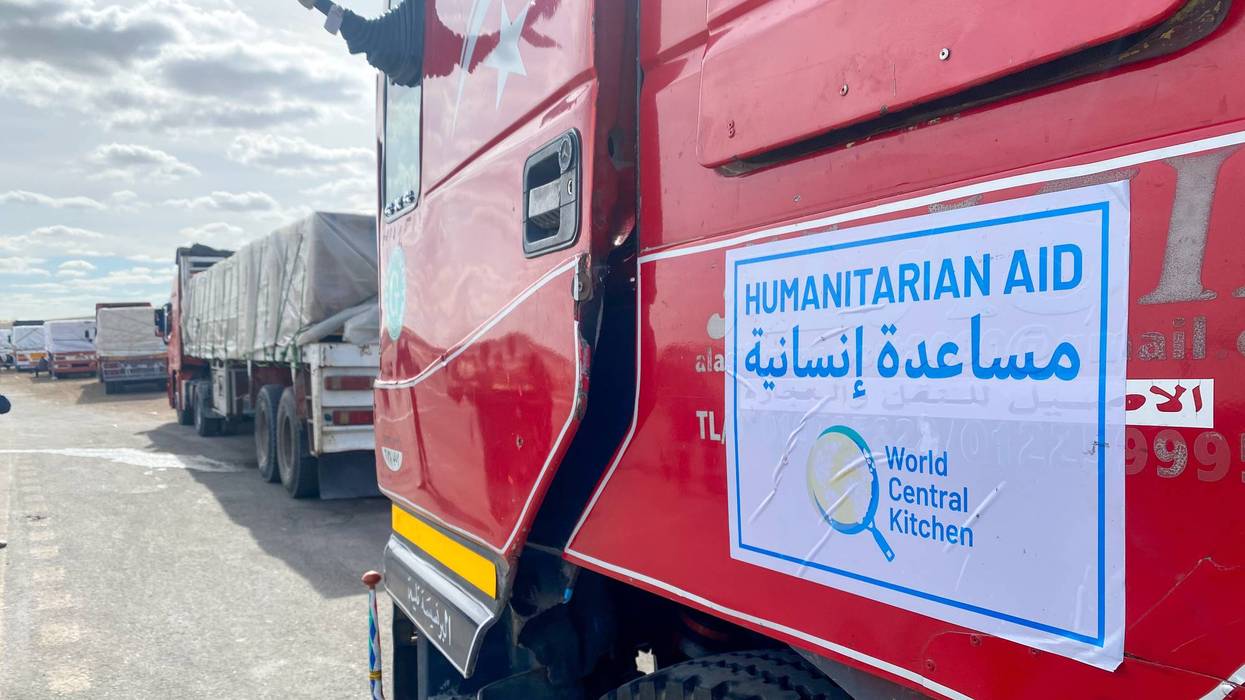
Based on accounts from three witnesses, The Guardian reported that the driver, Ahmad Nasser Saleem, was shot in the head at close range shortly after his convoy entered Gaza to deliver food supplies from the World Central Kitchen.
They said the four-truck convoy had stopped along the Philadelphi Corridor on the edge of Gaza after one of the vehicles broke down. Israeli soldiers then ordered the drivers to dismount before one of them shot Saleem in the head when his hands were raised.
The other drivers in the convoy stressed that every movement made by the World Central Kitchen is coordinated with the Israeli government.
“After the truck broke down, we waited for authorization to get out and inspect it, because every movement we make has to be coordinated in advance,” said one of the other drivers, Diaa Mansour.
He said that while they were awaiting authorization, an Israeli military vehicle arrived and soldiers ordered him, Saleem, and another driver, Alaa Shaat, to get out of their trucks.
“They made us stand by the side of the road. They ordered me to take off my clothes and forced me to sit under the sun,” Mansour said. “Then they brought Ahmad out of his truck. One of the soldiers began talking to Ahmad while he stood with his hands raised. Ahmad did not speak Hebrew, and it seemed the soldiers did not understand his Arabic."
"Suddenly, they shot him. He was hit in the head and died at the scene," Mansour said. "It appeared they were trying to find out why we had stopped, but they did not understand the situation and opened fire immediately, without any discussion or attempt to communicate.”
Jihad Saleem, the deputy head of the Association of Transport Companies in Gaza, identified as a distant relative of the aid worker who was killed, said that the transportation of aid was "100%" coordinated with Israel through the UN World Food Program and WCK.
"The moment Ahmad raised his hands in surrender, one of the soldiers drew his M16 rifle and shot him directly in the head,” he said. “It was a field execution and a deliberate killing of a civilian driver who had complied with all instructions. He was wearing his orange safety vest and carried all the required permits, security clearances, and coordination that had been approved by the IDF."
The IDF confirmed the shooting, but disputed the series of events. A military spokesperson said the convoy "had stopped along the Philadelphi Corridor and exited their trucks contrary to established procedures" and that one of the drivers "ran toward the troops" who "initiated the suspect apprehension protocol and, after perceiving an immediate threat, opened fire toward him."
Jihad Saleem said that “drivers are subjected to daily violations, including beatings, abuse, humiliation, and being forced to stand for long hours under the sun."
“Even more disturbing," Saleem said, "the soldier who shot Ahmad talked to the three surviving drivers afterward and threatened them, saying they would meet the same fate as Ahmad. This clearly indicates that the attack was deliberate.”
Israel's genocidal assault on Gaza, which began in October 2023, has included the systematic restriction of humanitarian aid entering the strip, which has caused widespread starvation, which humanitarian groups have said Israel is using as a "weapon of war" against the Palestinian population.
The United Nations Office for the Coordination of Humanitarian Affairs said as of April 29, 2026, that it had recorded the killing of 593 aid workers in the territory, including eight since a ceasefire agreement between Israel and Hamas in October 2025.
The shooting of Ahmad Saleem follows the shooting of two other Palestinian aid drivers in May under similar circumstances. According to The Guardian, the two men had been detained by the IDF for days before being released near a roundabout in Rafah where they were each shot.
The month before, two drivers working for the UN Children's Fund (UNICEF) were killed by Israeli fire as they were filling their water trucks at an established distribution point.
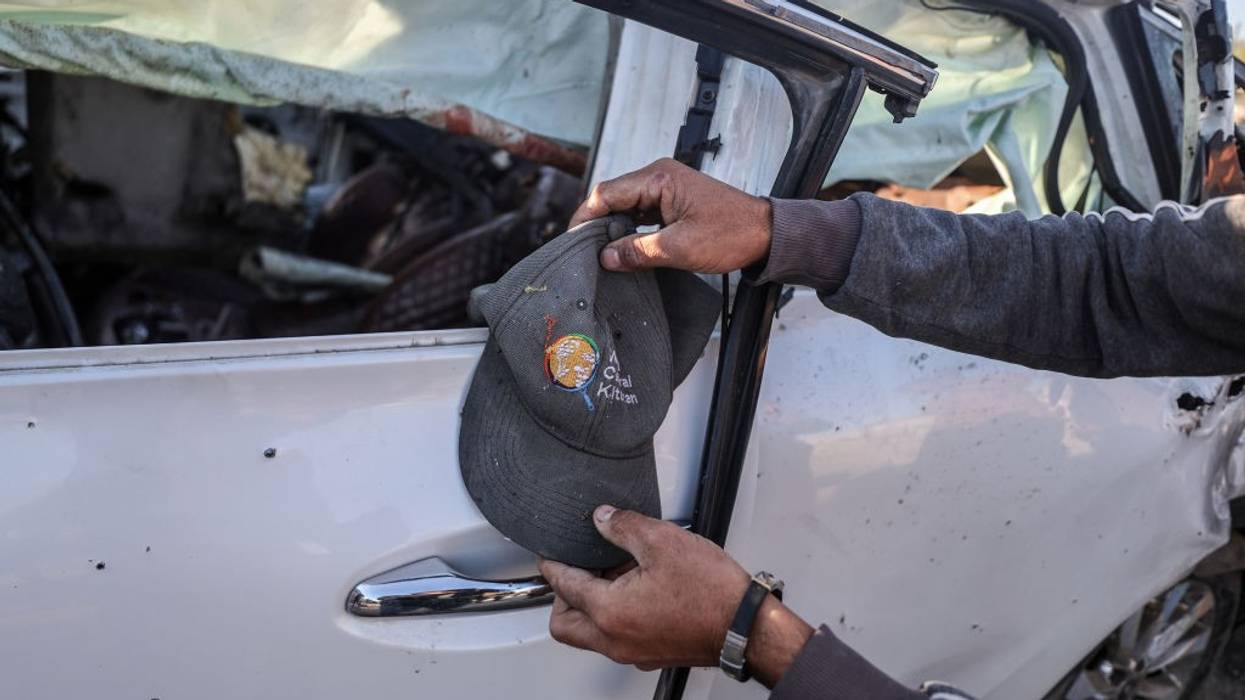
Saleem is at least the 11th documented worker with WCK to have been killed by Israeli forces during the conflict. In April 2024, an Israeli strike hit a convoy clearly marked with the WCK logo and killed seven workers after the drivers had similarly coordinated their movements with the IDF.
That November, Israel bombed another vehicle, killing three WCK workers and two others, claiming that one of them had been involved in Hamas' October 7, 2023 attack against Israel, which was not independently confirmed and which the WCK said it had no knowledge of.
WCK said in a statement that it was "devastated" to learn of Saleem's killing on Wednesday.
"Ahmad Nasser Saleem was doing what so many of our partners do every day in Gaza—working to get food to hungry people," the group said. "We are in contact with his family, and our deepest grief is with them. WCK expects a full accounting of what happened. Humanitarian aid deliveries should never be a target."
"All the NGOs in Gaza need more food, medicine, medical equipment, fuel, tents, personal care every day. We cannot wait," said chef José Andrés, founder of World Central Kitchen.
After Israeli and US forces launched an illegal war aimed at forcing regime change in Iran this past weekend, Israel also announced "the closure of the crossings into the Gaza Strip," which it has bombed and starved for nearly 29 months, killing at least tens of thousands of Palestinians.
Israel's Coordinator of Government Activities in the Territories (COGAT)—which oversees civilian policy in Gaza and the West Bank—announced on social media Saturday that "several necessary security adjustments have been implemented" because of the operation against Iran, including the closure of Gaza crossings "until further notice."
COGAT also claimed that "the closure of the crossings will have no impact on the humanitarian situation" in Gaza, adding that "the substantial quantities of food that have entered since the beginning of the ceasefire amount to four times the nutritional needs of the population," so "the existing stock is expected to suffice for an extended period."
However, reports from human rights groups, journalists, and the United Nations have highlighted how Israel's restrictions have continued to impede evacuations of the sick and severely wounded, and nongovernmental groups' deliveries of humanitarian aid, despite the October ceasefire deal. Palestinians in Gaza also remain at risk of Israeli forces' airstrikes, gunfire, and shelling.
"A new chokehold on Gaza," Philippe Lazzarini, commissioner-general of the United Nations Relief and Works Agency for Palestine Refugees in the Near East, said Monday. "Once again, Israel is renewing its ban on supplies entering Gaza. After more than two years of unspeakable suffering and a spreading man-made famine, people still lack the most basic supplies, despite increases in aid since the ceasefire. UNRWA personnel in Gaza keep providing healthcare, learning, and clean water—but we must be allowed to do much more and certainly not less."
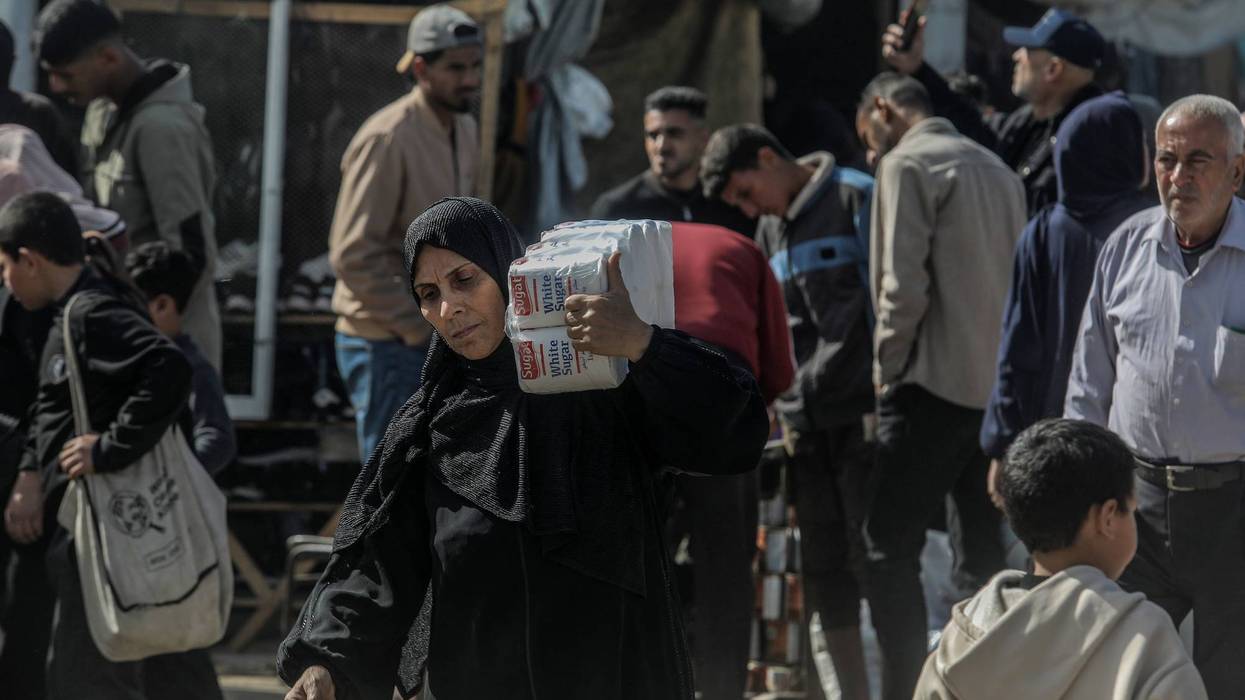
Even before Israel closed the borders on Saturday, the US-Israel attack on Iran led to Palestinians in Gaza "buying whatever food supplies and goods they could manage," Al Jazeera reported Monday. "People everywhere rushed to the market to buy sugar, flour, cooking oil, and yeast. Shelves began to empty, and the price of essential goods increased."
Things got even worse after COGAT's announcement. Asmaa Abu Al-Khair, a 38-year-old mother of eight, told Al Jazeera at a Gaza City market on Sunday that "I feel great anxiety. Everyone is talking about it—about Iran's strike and the closure of the crossings—and I cannot afford to buy what I need, while at the same time, I am afraid of famine returning. I have young children."
Many displaced families living in nearby tents also "do not have the money to buy supplies, nor the space to store them inside the tents," she said. "We endured so much hardship during the war, and it barely ended with the announcement of a ceasefire. So why close the crossing now? What do we have to do with what is happening? Is what we witnessed not enough? Why play with people’s nerves?"
Since Saturday, critics around the world have also warned about the impacts of Israel shutting off the Palestinian exclave indefinitely, again. Arab Center Washington DC fellow Assal Rad declared on social media that "under the cover of its illegal war on Iran, Israel is continuing genocide in Gaza."
Mass shooting survivor and former congressional candidate Cameron Kasky similarly said that "the siege on Gaza returns in its fullest force. Illegal wars to advance Israel's goals are being used for expanding the genocide plans."
Israel faces a South Africa-led genocide case at the International Court of Justice (ICJ) over the US-backed war on Gaza that it launched after Hamas' October 7, 2023 attack. The International Criminal Court (ICC) has also issued related arrest warrants for Israeli Prime Minister Benjamin Netanyahu and former Defense Minister Yoav Gallant.
Chef José Andrés said on social media Sunday that World Central Kitchen—which he founded—is cooking 1 million hot meals every day, and if Gaza's borders stay closed, the group "will run out of food this week."
"We need food deliveries every single day to feed hungry families who are not part of this war," he said. "All the NGOs in Gaza need more food, medicine, medical equipment, fuel, tents, personal care every day. We cannot wait... let the humanitarian trucks go through today!"
Responding to Andrés, US Congressman Mark Pocan (D-Wis.) said that "Israel must reopen access to aid groups. If not, Netanyahu must be arrested immediately. He continues war crimes."
The Hague Group—a coalition of countries that came together last year, led by Colombia and South Africa, with the goal of upholding the ICC and ICJ rulings on Israel and Palestine—responded to COGAT by scheduling an emergency meeting that at least 30 nations are set to attend in the Dutch city for which the organization is named.
The focus of Wednesday's meeting "is simple," Varsha Gandikota-Nellutla, the group's executive secretary, said in a Monday statement. "How do we give international law teeth? Several states have begun enforcing their legal obligations, turning rhetoric into concrete action through The Hague Group's measures: cutting arms flows, closing ports, and pursuing accountability."
Ronald Lamola, South Africa's minister of international relations and cooperation, said that "the application of international law can no longer be selective: punitive for some and totally disregarded by others. The Hague Group exists to translate obligations that arise out of international law into coordinated state action. We invite governments of conscience—those prepared to uphold law in deed as well as word—to join us."
Francesca Albanese, the UN special rapporteur focused on the occupied Palestinian territories and a target of Trump administration sanctions, said that "I am honored to attend the upcoming emergency meeting of the The Hague Group."
"Time has come for decolonized multilateralism, grounded in universal rights and obligations, applied with integrity and free from double standards," Albanese added. "May European and Arab states join this necessary effort."
The people of Gaza are not only being starved, bombed, and murdered. They are being erased from global consciousness by a wall of deception.
Throughout its long history of ethnic cleansing and occupation, Israel has remained consistent in its tactics: lie, deny, and distort the truth—often with the backing, or at least the indulgence, of Western powers. Lying has become an Israeli art form, refined over decades, practiced with impunity, and amplified by a complicit global media that not only tolerates but actively legitimizes these falsehoods.
The latest massacre at the food distribution in Gaza offers yet another stark and sickening reminder of this pattern. At dawn on Sunday, June 1st, more than 30 Palestinians were murdered while waiting for food aid in Rafah. As usual, Israel swiftly denied responsibility, claiming its army was unaware of any shooting near the American-led distribution center. But eyewitnesses, survivors, humanitarian organizations, and hospitals told a contradictory story.
Israel is not only getting away with war crimes—it’s getting away with lying about them.
Israel’s denial was immediately echoed—and defended by American officials. The U.S. ambassador—better described as Israel’s emissary within the State Department—dismissed reports of the massacre as “fake news.” This grotesque inversion of truth is a familiar maneuver, reminiscent of the Flour Massacre on February 29, 2024, when Israeli forces opened fire on civilians collecting flour, killing 112 and injuring over 760.
Again, Israel denied responsibility, claiming the deaths resulted from “stampedes” and civilians being run over by aid trucks. Yet even after the United Nations and media outlets like Al Jazeera challenged the Israeli disinformation and presented video footage clearly showing Israeli forces firing on unarmed civilians, no accountability followed.
In Gaza, it is not just food aid sites have become death traps. Ambulances are targets. First responders, doctors, and even their children have become “legitimate” military objectives.
Last week, Israel targeted the home of Dr. Alaa al-Najjar, killing nine of her ten children—Yahya (12), Eve (9), Rival (5), Sadeen (3), Rakan (10), Ruslan (7), Jibran (8), Luqman (2), and Sedar, not yet one year old. Her husband, Dr. Hamdi al-Najjar, succumbed to his injuries days later. Their tenth child, 11-year-old Adma, sustained a critical head injury and is unlikely to survive due to Gaza’s medical blockade.
Israel’s standard, callous response followed, explaining that its aircraft had struck “a number of suspects” in Khan Younis.
In March, the Israeli army murdered eight medics, six civil defense workers, and a United Nations employee—then buried them in the sand. The military later blamed the “suspicious behavior” of an ambulance for the attack. When confronted with video evidence disproving the claim, the army reverted to its usual script: “a mistake,” “a wrong decision,” “disciplinary action taken.” Fifteen lives erased with a bureaucratic shrug.
When Israel murdered seven humanitarian workers from the World Central Kitchen in April 2024, the Biden administration initially expressed outrage. Twenty-four hours later, that outrage was mollified by Israeli firsters in Washington. White House spokesperson John Kirby reversed course, claiming there was no evidence of deliberate targeting—absolving Israel in the same breath that had condemned it. A mass killing became a footnote.
This is nothing new.
In October 2023, nearly 500 civilians were killed in a blast at the Al-Ahli Arab Hospital in Gaza. Israel immediately blamed a misfired Palestinian rocket. Just hours after landing in Tel Aviv, President Joe Biden publicly parroted the Israeli narrative—despite overwhelming eyewitness accounts, growing evidence, and skepticism from independent observers.
And then there is the case of Shireen Abu Akleh, the Palestinian-American journalist gunned down in 2022. Israel initially claimed she was killed by Palestinian crossfire and released a video that was quickly discredited. Yet Western media gave more airtime to Israeli claims than to eyewitness testimony. Months later, under the weight of irrefutable evidence, Israel admitted responsibility—calling it, once again, a “mistake.”
The soldier who murdered a “lesser” U.S. citizen, like other killers of journalists, never faced justice. In fact he was promoted to Captain and went on killing with impunity—until reports emerged of his death during a battle in Jenin.
Just like the murdered children of Gaza, truth itself has become another collateral damage in Israel's war of disinformation. And those tasked with defending it—the media and democratic institutions—have too often served instead as marketers and conveyors of Israeli lies and propaganda.
The people of Gaza are not only being starved, bombed, and murdered. They are being erased from global consciousness by a wall of deception. And until the world begins to value Palestinian lives as much as it values Israeli (proven false) narratives, the Israeli theater of blood and deceit will continue.
Israel is not only getting away with war crimes—it’s getting away with lying about them. The impunity is not only military; it is moral, political, and informational. Israel has long mastered the art of the lie, dating back to the creation of political Zionism. The West, and its managed media, has normalized these falsehoods—just as it has normalized the starvation and siege of Gaza.
Israel lies with impunity because the world—especially the United States and much of the West—not only permits it, but promotes it. Western governments and media have built an echo chamber where Israeli narratives always take precedence—not due to credibility, but to avoid the reckoning that truth would demand. In choosing falsehood over fact, they evade moral accountability and sidestep the need to reconcile their professed values with the genocide they enable.
This is no longer just about Israeli lies. It’s about a global system complicit in sustaining Israel’s habitual lies and systematic deceit to cover up a starvation and a livestreamed genocide.